Like many other students in this course, I aimed to reduce the amount of time I spent mindlessly scrolling through social media. Too often, I would find myself having just spent 20 minutes on Twitter without even realizing it. If my roommate briefly left the room, I got stuck on a PSET problem, or I had to wait a lengthy 60 seconds for my food to heat up in the microwave, I instinctually picked up my phone and started scrolling.
To help remedy this behavior, I made a simple change: I changed my phone’s lock and home screen to a black background with white text that read, “Don’t scroll”. Having had the same lock screen on my phone for multiple years, this change caught my attention each time I picked up my phone. The background image also served as an automatic reminder to log a phone pickup whenever I subconsciously picked up my phone with no intention in mind. Ironically, I logged these pickups in the Notes app of my phone, which required me to unlock and use my phone each time I unintentionally picked it up.
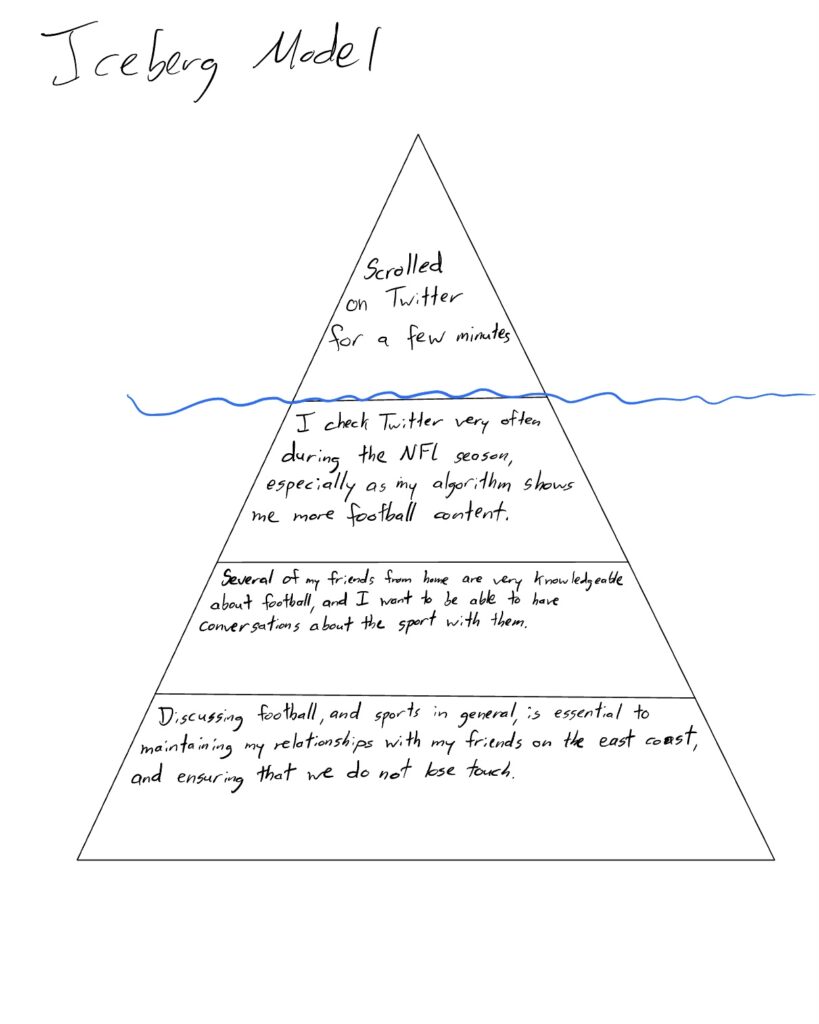
I measured myself on Sunday and Monday, and saw that I picked up my phone 24 times on Sunday and 10 on Monday. I was initially shocked by how many times I picked up my phone on Sunday to mindlessly scroll. After doing some reflection, I realized that many of these pickups were influenced by my environment, which included a TV in the background that played NFL playoff games for a large portion of the day. I provided some additional insights on this phenomenon in my iceberg model.
If I were to repeat this experience, I would consider physically moving my phone to a different location. While I was able to reduce the amount of time that I actually spent scrolling, my strategy did not address my tendency to grab and look at my phone. I also could feel myself beginning to adapt to my phone’s new background, finding it less surprising each time I saw it. I suspect that if I continued using this background, I would eventually grow even more used to it and ignore its message.
Another strategy that has worked for me in the past is relying on social accountability. I have previously set up time limits for certain social media apps using Apple’s settings, and required a passcode entry to “ignore” the limits. In the past, I have given my passcode to one of my friends, instructing them to not reveal it to me under any circumstances. While I had considered using this strategy again, Dr. Wendy Wood’s analysis made me reconsider, as this approach is most effective only in the short term.