
Spotify
Spotify has quite a simple goal for their MVP—allow users to listen to unlimited music for free from a large majority of artists. The basic version of Spotify accomplishes exactly this. However, along with the basic version of Spotify comes the common user frustration of needing to hear advertisements every few songs, which introduces friction to the user experience. Additionally, the basic mode lacks features that many “general music enthusiasts”–their primary user–prefers—customizing the order of songs to play, downloading music, etc. So, while the basic version is enough to keep a proportion of customers from paying the premium fee (such as my dad, who claims the ads are worth saving the $11.99 monthly fee), roughly 42% of Spotify accounts are premium subscribers. (Source: https://www.bankmycell.com/blog/number-of-spotify-users/#:~:text=There%20are%20approximately%20254%20million,Are%20There%20(2015%2D2025)). This is significantly higher than the industry standard of a 10-15% free-to-paid conversion, which indicates that Spotify has introduced enough friction yet significant demand for the product to entice users to make this conversion.
Figma
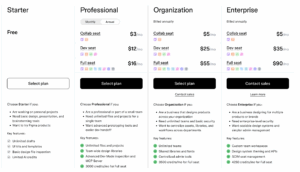
As depicted in the screenshot below, Figma differentiates its packages by the size of the team/company using the platform, as well as the persona of those teams. Figma realizes that folks will likely use the platform for collaborative projects, and in turn, as teams grow, subscriptions increase. So while folks can work on independent projects on low-scale POCs independently, perhaps to initially verify that Figma will be helpful for their use case, Figma approximates that a majority of their customers will utilize it for collaborative work. This conversion is less so about avoiding friction, and more so about being able to use Figma for the most crucial, substantial, and ever-scaling use cases.
New York Times
Unlike the other platforms, the NYT does not add “shiny” features that differentiate the subscribed and regular accounts. Rather, NYT introduces a limitation of number of articles a basic account can read—quite a point of friction for most users. NYT hopes that the basic subscription users will like the preliminary articles they read so much that they are enticed to purchase a subscription to continue the experience. Ironically, while I was trying to read more about the relevant statistics, I reached my limit for NYT articles.



