Intro
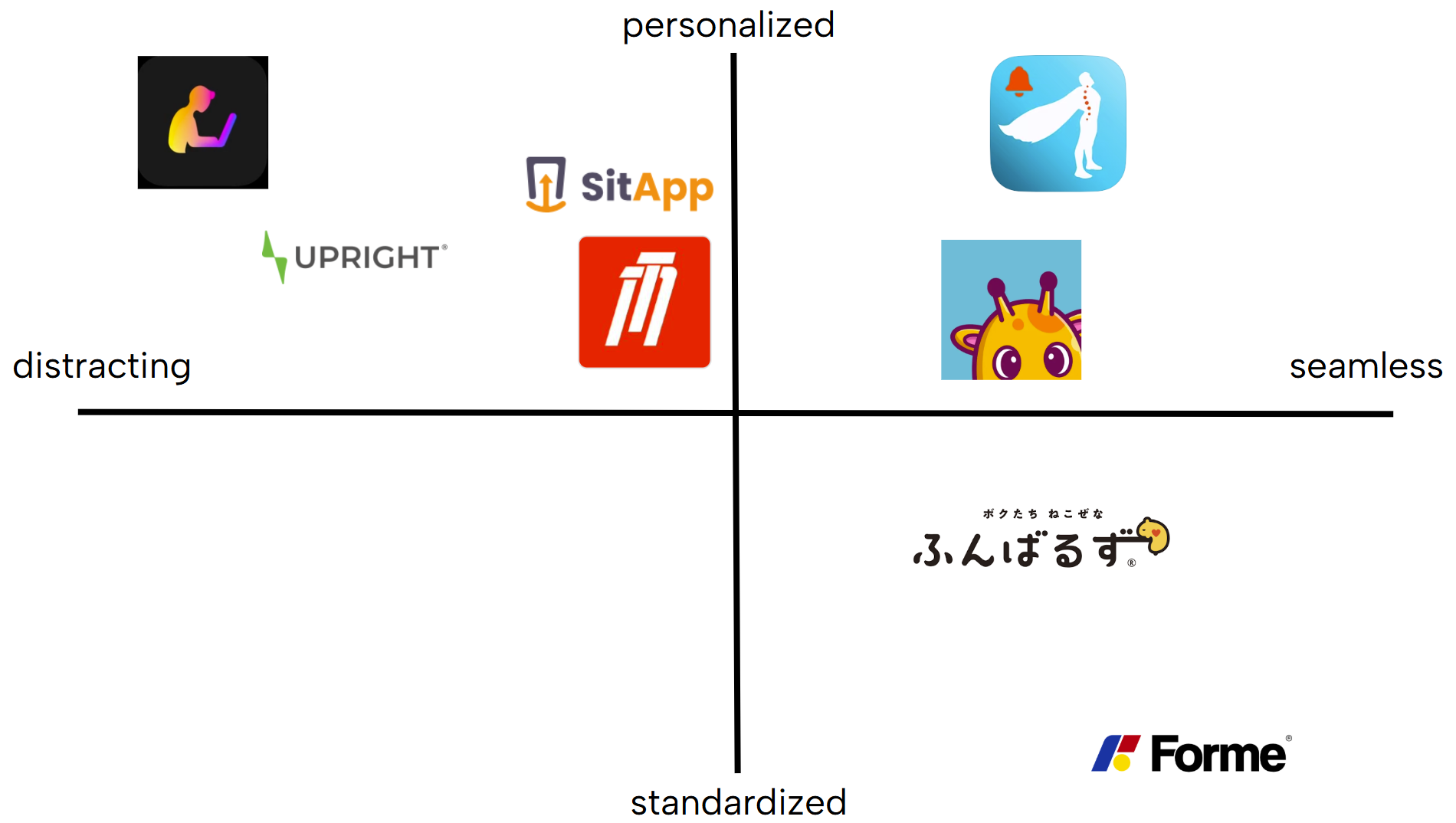
When it comes to posture, existing solutions are everywhere on the digital and analog spectrum. This means the competitors we chose for our research all take different approaches; their effectiveness is a function based on how intrusive and distracting, as well as how much it caters to the user’s relationship with posture. Our 2×2 chart is at the bottom of this post!
(Also I don’t know why the images are so big…. I thought I made them smaller)
Competitors
Heather
Upright
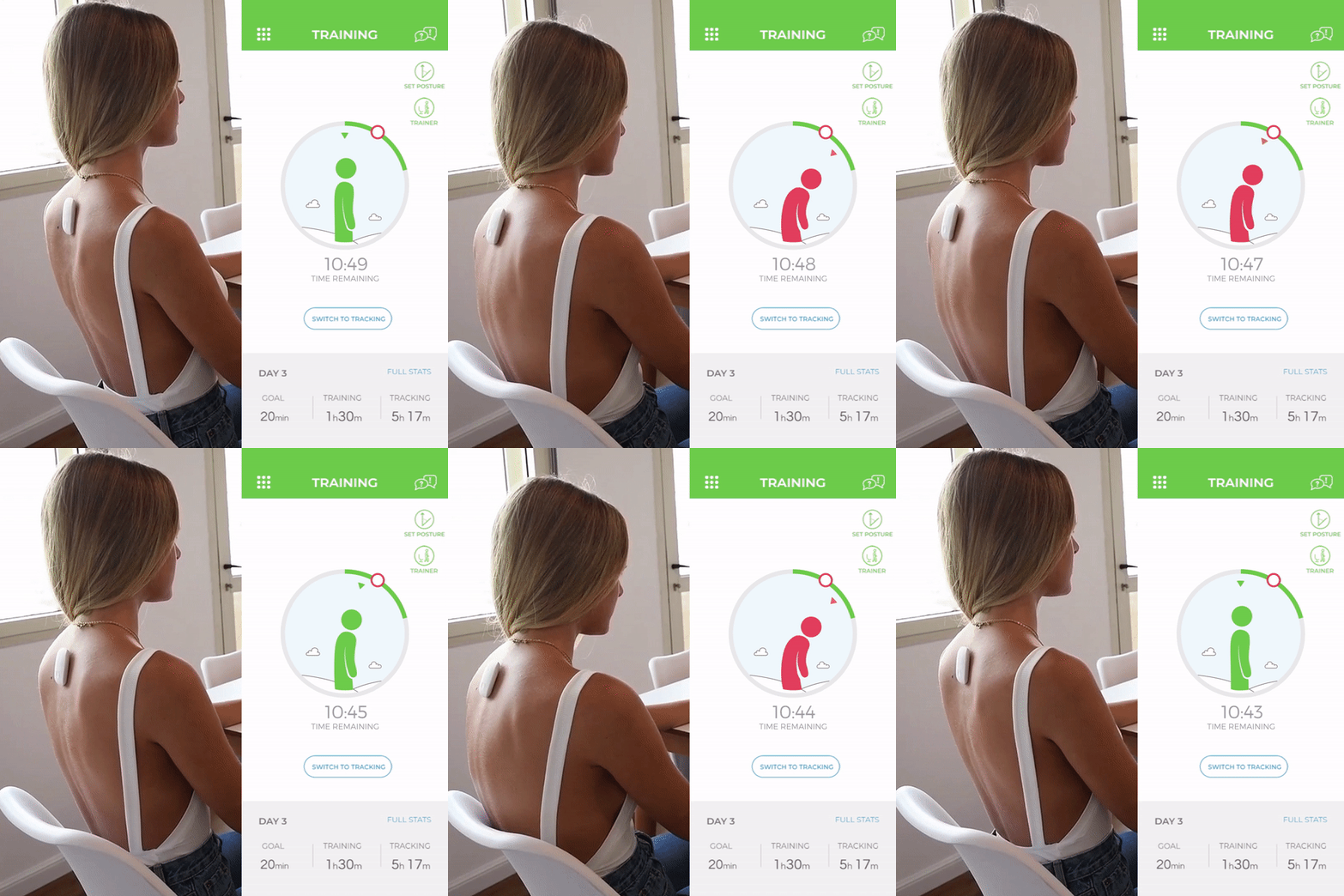
Upright is a small device that you attach on your back either using its adhesive or by wearing a special necklace. The target audience for this device is anyone who struggles with posture and has access to a phone. The device connects to your phone and tracks your posture in real-time, providing a gentle vibration when you begin to slouch. The app also keeps stats for you so you can see your progress towards better posture. They fulfill the market need by combining real-time feedback with long-term progress tracking, making posture improvement both actionable and measurable.
Strengths: effective reminder; only buzzes when posture is bad; personalizations available and trained on your body
Weaknesses: worry about it falling off of back; issues with calibration or simply poor posture can lead to frequent and intrusive buzzing
Upright is more towards distracting than seamless because it buzzes to notify you (sometimes very frequently) throughout the day and users sometimes are distracted by worrying if it is staying on their back. Upright is more personalized than standardized because they calibrate to your body and allow you to personalize when you receive buzzes.
Forme Posture Bra

The Forme Posture Bra is a sports bra engineered to immediately help improve the user’s posture. Its target audience is women who want to improve their posture, and more specifically athletes. It is supposed to engage spinal and shoulder muscle groups to naturally improve posture and improve muscle memory for long-term improvements. The market need they fulfill is a non-digital, wearable solution that passively supports proper posture without requiring technology.
Strengths: No effort throughout the day; may not be a permanent fix that lasts past wearing the bra; works immediately
Weaknesses: Very expensive; some say its tight and uncomfortable; uniform sizes miss many body types
The Forme Posture Bra is almost completely seamless rather than distracting as you only need to put it on in the morning and then can forget about it throughout the day (other than for the users who say it is uncomfortable). The Forme Posture Bra is almost completely standardized rather than personalized as there are a few uniform sizes that don’t fit many body types and no other personalizations available.
Lucy
Posture Reminder

- An app that provides smart, customized notifications to maintain good posture
- Target audience: people who spend the day sitting (e.g., office workers, drivers)
- Unique features: set custom recurring reminders; track progress; provides posture exercises
- Market fulfilment: Lack of real-time awareness of posture
- Analysis: This app addresses the non-invasive desire for posture reminders. It’s also customizable so it can be upped or decreased and doesn’t feel obligatory or overwhelming. It also provides some interventions too with posture correction breaks or exercises, adding a rehabilitatory, educational element
Posture Monitor with Media Pipe

- This is a real-time posture monitoring system that uses a webcam or video. The application assesses the alignment of the shoulders and the inclination of the neck and torso to determine whether the user is maintaining a good or bad posture. It also tracks the time of the posture and sends relevant alerts.
- Target Audience: People working at a desk
- Unique features: notifications about bad posture for extended periods; dynamic feedback on posture status; calculation of time spent in each posture.
- Market fulfillment: real-time posture feedback
- Analysis: This provides real-time monitoring based on your specific posture at any given time. It is a less private solution and more invasive to set up. It also may not be super accurate if there are multiple people in the frame.
Ginelle
SitApp

SitApp is a desktop application that monitors posture via webcam. When activated, the app tracks the user’s posture in real-time and sends a pop-up icon whenever the user begins to slouch, which is detected with your personalized posture and AI. It is targeted to desktop and laptop users, with access to a working webcam, who want to work on their sitting posture. The app includes a streak feature that allows users to track consistency over daily usage, and a progress dashboard for a condensed view of the user’s posture quality throughout the week.
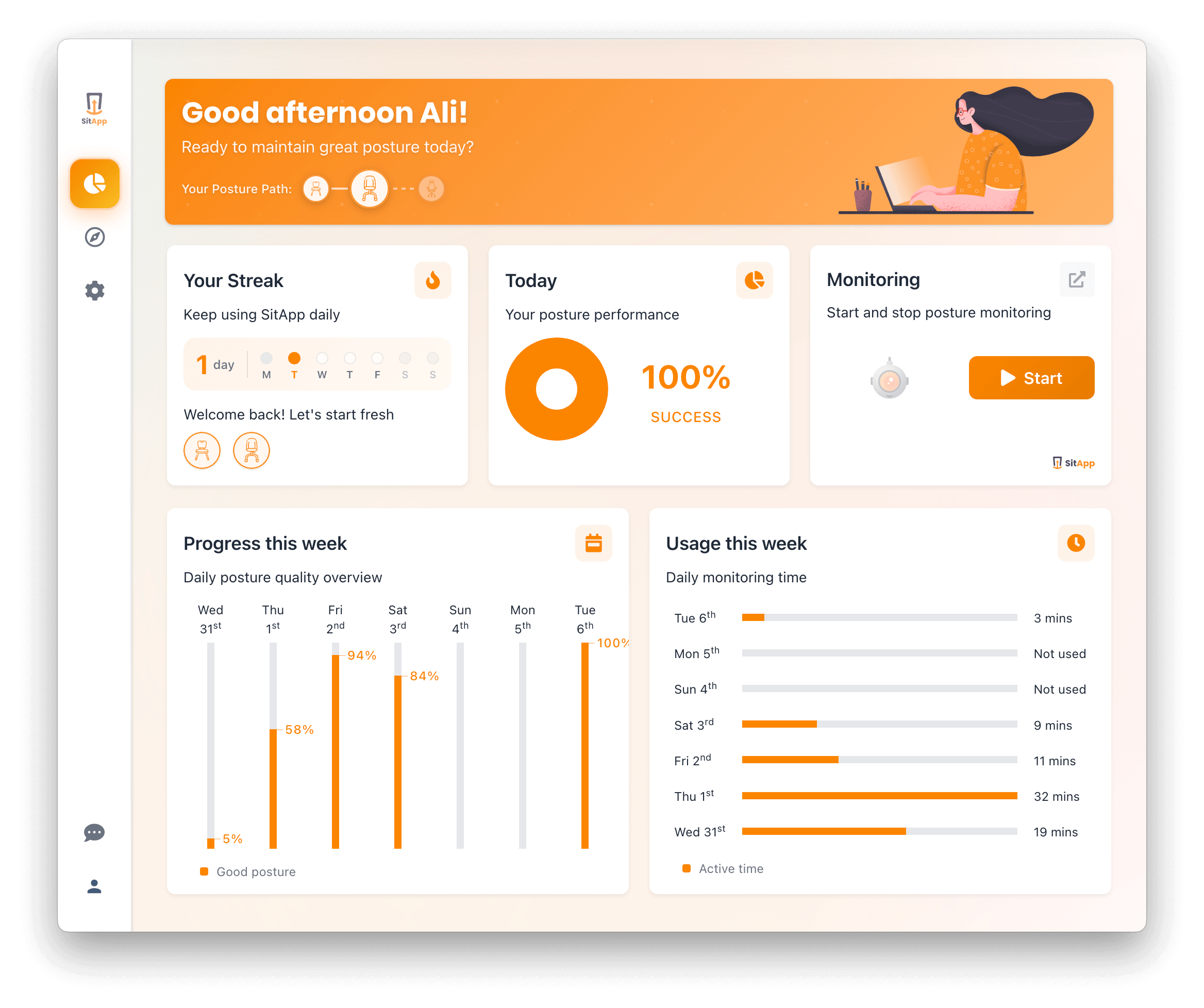
SitApp provides both real-time and retrospective feedback, which many posture improvement applications already do. However, many apps in this genre also track user posture non-stop and feel invasive. SitApp fulfills a market need by giving users control over timing posture monitoring sessions. The dashboard image above showcases this feature (note how monitoring times are less than an hour per day; the important thing is that it is up to the user how much gets monitored).
Strengths: user-controlled posture sessions ensures posture practice is intentional; free application; streak encourages long-term consistency.
Weaknesses: pop-up icon, user may benefit from having more sessions than self-directed if goal is so improve posture when unaware.
Analysis and insight on 2×2: SitApp sits on the more distracting side due to its pop-up icon nature, but it is less distracting than other products because the sessions are user-controlled. This also gives more personalization; apart from this, calibration is personalized during setup for each user so it doesn’t use a standard model to judge your slouch, only uses your own slouch data to improve yours.
Funbaruzu Posture Pal


The Funbaruzu Posture Pal is a plush toy that is placed in between the user’s abdomen and a flat surface (like a desk or table). Inside of the plush’s core is a firm, heart-shaped cushion for keeping its shape and remaining aligned to the desk. It is aimed at people who spend long periods of time at a desk, table, or surface; in particular, it attempts to disrupt the habit of slouching over a desk (the kind of slouching where you press yourself against the table).
In terms of innovation, Funbaruzu manages to incorporate a cute and endearing quality to their product, as there are many critter designs to choose from + a version that is microwave-heatable. Apart from being a non-digital product, it fulfills a market gap by reaching categories of users who aren’t typically concerned with sitting posture, thereby encouraging better posture among people who may unknowingly be practicing poor sitting posture, including younger audiences, plush, toy, and hipper collectors (it’s on the Sonny Angel official online store!) and those not necessarily working at a desk job.
Strengths: Constant physical presence serves as a cue; many critter designs to choose from; doubles as a unique portable accessory, collectible, or toy.
Weaknesses: The product itself doesn’t remind user, rather it forms the conditioned response by user pressure against the plush; could slouch the neck and upper back while using; only works in one position (against table).
Analysis and insight on 2×2: It is one of the more seamless products in the lineup: its function is not outright visible to a non-user and is masked by the design. However, Posture Pal is not entirely seamless as it requires conscious, constant physical pressure for it work. As for personalization, having at least 20 distinct animal designs and heatable versions, gives it some points; still, it doesn’t cross the halfway mark because it comes with approximately the same core shape and dimensions, assuming universal fit for all ages and sizes.
Nikki
Posture Pal
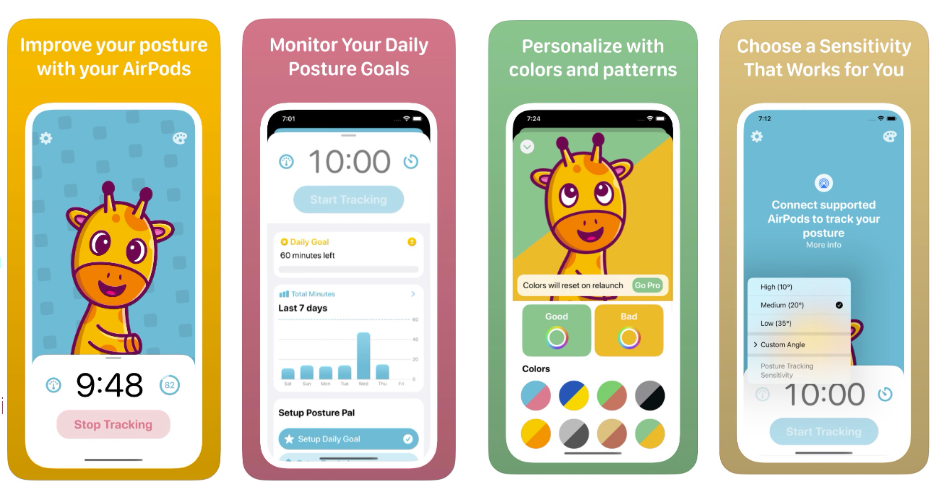
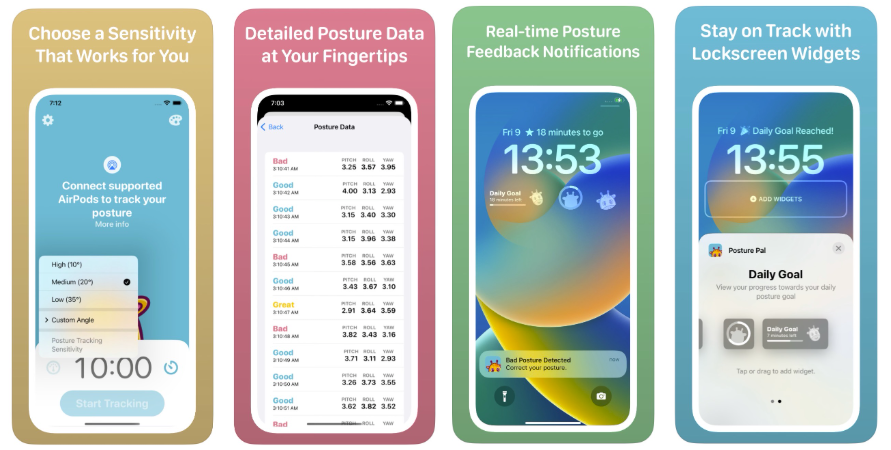
Introduction: Posture Pal is a mobile app that uses motion sensors in the user’s headphones or AirPods to track neck and shoulder tilt and provide alerts and feedback on bad posture.
Features and Design: The platform utilizes a cute, clean, and engaging interface that makes it appealing and user-friendly to younger audiences (school-age children). The giraffe mascot also stands out among the more serious, utilitarian apps on the market. Its unique features include:
- Setting daily posture goals and reviewing historical posture data
- A lockscreen widget feature, sound, and vibration alerts when bad posture is detected
- Customizable posture tilt sensitivity and personalized “Pal” companion.
Value Proposition: Posture Pal allows users to set a time limit to track their posture and sends gentle reminders when it detects slacking. Users can receive feedback on their posture in real-time and track their progress across sessions. heir posture is lacking.
Strengths: It is engaging and easy to use. Users can review their posture without delving into complex scientific diagnostics. It also does not require purchase of an external device.
Weaknesses: Some users mentioned connectivity issues with Airpods Pro 2 and inaccurate detection of neck angles. In addition, the requires a subscription for unlimited posture sessions.
Chart Analysis: Posture Pal allows the users to set customized sessions but the feedback is fairly stable and standard. Most of its interventions come in the form of reminders, which can lose effectiveness on more resistant users.
Hyud
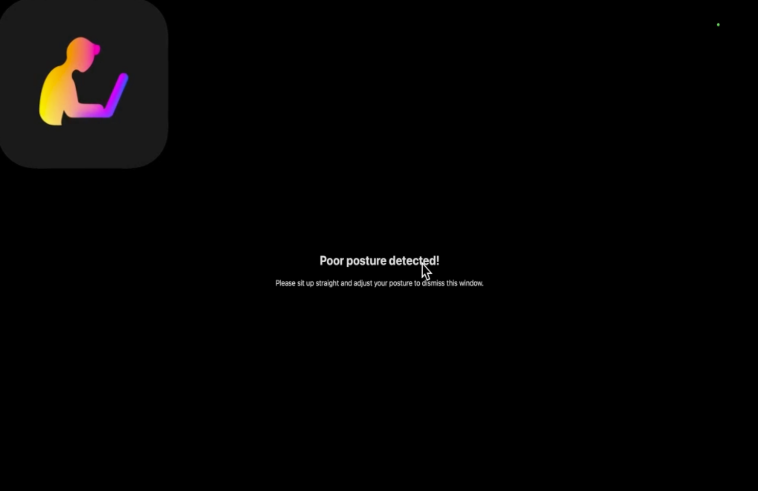
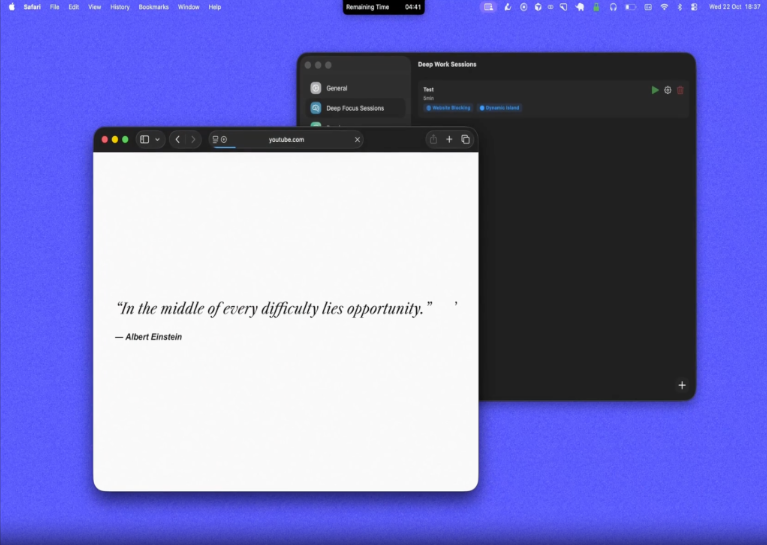
Introduction: Hyud offers customizable work sessions where the user can set configure block settings for websites and entertainment apps. It monitors the user’s sitting position through their webcam and either send alerts or blocks the user’s screen when they exhibit bad posture. Finally, it enforces breaks within the sessions such as prompting the user to stand up and exercise or close and rest their eyes.
Features and Design:
- Depending on the strictness level of your posture settings, the app may block your screen when they find you slouching or require you complete an exercise round during your breaks
- It allows you schedule sessions throughout the week and customize the session name, beaks, and duration. It also enables you to block specific websites and apps. This is extremely helpful for users who have a fixed work schedule they wish to automate. When the user tries to access a blocked website, they are shown an inspirational quote instead.
- It provides an option to shut down your Mac when the session is complete, limiting decision fatigue and cutting off the psychological triggers of entertainment and distraction that lead to prolonged sitting time.
Value Proposition: Hyud is unique because it takes direct control over the user’s monitor, including their screen and power options. It exceeds other applications in the market by creating a wrap-around that combines the features of screen time, app blocking, posture monitoring, and break reminders into a single app.
Strengths:
- It does not require external products.
- The inspirational quotes provide users positive cognitive restructuring.
- It not only identifies the problem (bad posture), but also provides effective solutions in the form of productive breaks (exercise)
Weaknesses:
- Rigidness: Sessions can’t be stopped once began.. This may deter users who seek a gentler approach.
- The complete blocking and control of the user’s screen may be too strong an intervention for some. The users may miss out on important messages during the ‘restricted’ time.
Chart Analysis: Hyud definitely offers a lot of customization options for websites and session scheduling, but its interventions are enforced strongly. Users need to be cautious when configuring their settings beforehand to prevent the app from feeling invasive.
2×2 Chart
Here is our chart:
We decided to make our axes be:
- Personalized–Standardized: we noticed the majority of our competitors made a huge emphasis on narrowing and personalizing the user experience to the user themselves, with many utilizing AI or calibration methods to measure goals and progress.
- Distracting–Seamless: we brought up privacy concerns when discussing competitors, and noted that intrusiveness comes in two ways (data privacy and distraction from user experience), so we decided that the seamlessness and hassle of using the product is a bit more relevant to habit and behavior change.
(Full link to Google Slides version: here)