As AI tools become more common in students’ academic workflows, the key question is no longer whether students use AI, but how that use affects learning and decision-making. Many existing products optimize for speed and convenience, but fewer help users reflect on when AI support is actually beneficial. To explore this space, we conducted comparative research on a set of apps and platforms that students already use for learning and information-seeking, looking for patterns that could inform healthier, more intentional AI use.
Description
ChatGPT is a chat-based tool that people use to ask questions, draft writing, get explanations, and help with tasks like coding or studying, etc. In school settings, students often use it to get unstuck, summarize material, or generate a first draft they can edit.
Target Audience
ChatGPT is used by a wide range of people, but it’s especially popular among high school and college students because it’s fast, flexible, and easy to use.
Unique Features
Its biggest differentiator is how general purpose it is. One interface can help with almost anything from brainstorming to rewriting to debugging to drawing. The conversational format makes it feel approachable, and the tool adapts quickly to whatever the user asks.
Market Need
It meets the need for quick help when users are overwhelmed, confused, or short on time. It also reduces the friction of starting a task, especially when someone doesn’t know where to begin.
Brand Analysis

The branding is clean and neutral, which signals credibility and seriousness. The interface is minimal, which makes the product feel like a “blank slate” you can use for any task.
Strengths
ChatGPT is strong because it’s fast and adaptable. It can turn vague questions into workable answers and help users move forward quickly.
Weaknesses
Because it makes things so easy, users can slip into letting it do the thinking for them. The tool rarely asks users to reflect, verify, or slow down, so it’s easy to accept outputs without really engaging with the material.
How Our Product Addresses Gaps / Improves the UX
Our product isn’t replacing ChatGPT: it’s a layer that helps users approach chat tools more intentionally. We want to guide users to clarify what they’re trying to accomplish, how much effort they want to put in, and when AI support is actually appropriate.
Description
Khan Academy is a learning platform with lessons and practice problems across common school subjects. Khanmigo is their AI tutor, designed to help students learn by guiding them through problems rather than giving them the final answer.
Target Audience
Khan Academy is mainly built for K–12 students and teachers, but it’s also used by anyone who wants structured learning. Khanmigo is for students who want help while still doing the work themselves.
Unique Features
Khanmigo is intentionally “tutor-like.” Instead of handing users an answer, it asks questions, gives hints, and encourages step-by-step reasoning. That design choice directly reduces the chance of students using AI as a shortcut.
Market Need
It addresses the need for extra learning support—especially tutoring—without making students fully dependent. It’s trying to give students help while keeping the learning process intact.
Brand Analysis

Khan Academy’s brand feels trustworthy and mission-driven. The style is straightforward and educational, which makes it feel more like a classroom tool than a flashy tech product.
Strengths
Its biggest strength is that it’s designed around learning. It supports deeper understanding by nudging students to explain reasoning and stay engaged rather than copying outputs.
Weaknesses
Because it’s structured, it can feel slower than general chat tools. It’s also mainly useful for traditional academic subjects, so it doesn’t translate as well to broader “life tasks” students might use AI for (emails, brainstorming, planning, etc.).
How Our Product Addresses Gaps / Improves the UX
Khanmigo shows what responsible AI support can look like in education. Our product takes that same philosophy, guided use and calibrated help, and applies it across any context where students might turn to AI, not just subject tutoring.
Description
Duolingo is a language-learning app built around short lessons that users can do daily. It focuses on building habits through repetition, practice, and small wins over time.
Target Audience
Duolingo is for anyone trying to learn a language, especially beginners and casual learners. It’s common among students because it’s simple to start and easy to keep up with.
Unique Features
Duolingo’s biggest differentiator is its gamified structure: streaks, levels, rewards, reminders, and quick exercises. The app is designed to keep users coming back regularly, even if they only spend a few minutes per day.
Market Need
It meets the need for consistent, low-pressure learning. Instead of requiring long study sessions, it helps users build progress through small, repeatable practice.
Brand Analysis
The brand is playful and memorable. The mascot, bright colors, and casual tone make learning feel less intimidating and more approachable.
Strengths
Duolingo is extremely good at behavior design. It makes it easy for users to build a routine, stay motivated, and feel progress quickly.
Weaknesses
Because lessons are short and structured, users can sometimes move forward without fully understanding deeper concepts. It can also encourage “completion behavior” (keeping a streak) instead of meaningful learning.
How Our Product Addresses Gaps / Improves the UX
We want to borrow Duolingo’s strength—habit-building—and apply it to healthier AI use. Instead of optimizing for quick answers, we want to encourage consistent patterns of reflection, verification, and intentional reliance when students use AI tools.
Description
Quizlet is an incumbent player in the education space. Their primary offering are digital flashcards as well as practice exams and study guides to help learners memorize and master concepts.
Target Audience
Their target audience is primarily K-12, looking to study and review educational concepts.
Unique Features
Their main unique feature in the AI space is called Magic Notes which is a tool that allows you to upload study materials into one place and Quizlet will generate flashcards and study materials to help the student study. They also have a feature that allows you to gamify matching flashcards turning it into a race with other students.
Market Need
Their product meets a need in the educational space to help students with active recall and spaced repetition which are well-researched educational methods that help students maximize their learning.
Brand analysis

Their logo is blue which as a marketing color conveys stability and professionalism. The Q is stand alone, bold, and memorable.
Strengths
One of their biggest strengths is how much user-generated content they have. Millions of students have used Quizlet to study and most of those resources are available to the masses. They also have a mobile interface which allows you to study on the go.
Weaknesses
Their product sort of only lives at the end of the educational journey. Quizlet itself is limited in how much it can teach you conceptually beyond what is captured in the flashcard itself.
How Our Product Addresses Gaps / Improves the UX
Our product is seeking to help users for any task they want to use AI for and also help them across the whole learning journey not just when it comes to memory recall over concepts after they’ve been learned. We want to design a companion for a student as they actively engage with a chat-based interface.
Description
A conversational AI chat-based “answer engine” that uses large language models to deliver direct, up-to-date answers with citations pulled from the internet.
Target Audience
Their target audience is any individual looking for instant insights with reliable references to real-time data.
Unique Features
One of the most unique features Perplexity has is its “Deep Research” tool which is an advanced research tool that takes multiple steps of analysis in order to provide detailed, citable reports.
Market Need
Perplexity exists in the middle between a Google Search and ChatGPT by providing concise, consolidated immediate information that is backed by credible real-life sources.
Brand analysis


Their logo is reminiscent of an open book with its pages splayed open which conveys an open-ended, boundless learning experience. The colors are turquoise and white which convey a moodier, more modern tone than Quizlet for example.
Strengths
Their strengths lie in the fact that they access the web in real time when responding to a users’ queries and all results are clearly cited.
Weaknesses
They shared a weakness with most other chat-based AI interfaces in which the user is at risk of becoming cognitively disengaged with the material provided because of how rapid and immediate the response is without much work needed on the user’s end. So as an educational tool, it is weak in how effectively it can truly maximize a user’s learnings.
How Our Product Addresses Gaps / Improves the UX
In terms of UX, the product is not a chat-based AI interface itself. It is rather a layer between the user and the chat. So instead of the user typing directly into Perplexity, we take the prompt and redirect with the goal of maximizing their learning experience within the time constraint they provide.
2×2 Map
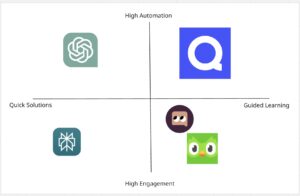
This 2×2 maps tools along two dimensions that strongly shape how students interact with AI and learning technologies: Automation vs. Engagement and Quick Solutions vs. Guided Learning.
The vertical axis represents the level of automation versus user engagement. Tools placed higher on this axis automate more of the cognitive work for the user, often generating answers or outputs directly. Tools lower on the axis require more active participation, asking users to think, respond, or practice in order to make progress.
The horizontal axis captures whether a tool is oriented toward quick solutions or guided learning. Products on the left prioritize speed and immediacy, helping users get unstuck or obtain answers quickly. Products on the right emphasize structured support, prompting users through steps, hints, or practice rather than delivering final answers outright.
Plotted together, this framework reveals meaningful differences in design intent. ChatGPT and Perplexity lean toward fast, automated solutions, while Duolingo and Khanmigo intentionally slow users down to promote engagement and learning. Quizlet occupies a middle space: it automates study material creation but is primarily used during review, after learning has already occurred. This visualization highlights a gap for tools that preserve AI’s efficiency while still encouraging thoughtful engagement—an opportunity our product aims to address.