
Comparative Research Map
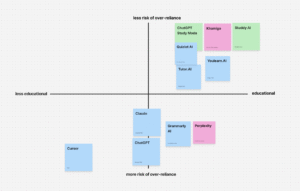
Youlearn.ai (found by Angela)


Summary
Youlearn is an AI tutor that personalizes your learning to your taste – you can upload your own content, test your own knowledge, and talk with an AI tutor. They also have pre-existing content you can browse to learn things in your own time.
Strengths
- Interactive and personalized: everything is personalized because you upload your own materials, and you choose what modes you want to study with
- Efficiently processes and digests content for you: can summarize lectures, PDFs, etc. into key points and save time
- Verifies its sources
Weaknesses
- No support for complex diagrams (although this is like other AI tools)
- Not free: paywall restricts usage
- People can still rely on it too much because the AI provides you answers
Value proposition
“An AI tutor made for you – turns your learning materials into notes, interactive chats, quizzes, and more”
Interesting features
- Voice chat + podcast: multimodal! Not just the traditional “chat” format for people who are interested
- Flashcard and quiz generation – which helps a lot with retention
- Dashboard (ChatGPT-style) UI, which allows you to create spaces to your taste
- Pre-made materials to browse
We are different from it because
- It is a tool that specifically helps you study, and encourages creating your own materials for your own benefit – helping people use AI more effectively – but I think still has a high potential for misuse
- Not a cross-platform tool
Tutor AI
Summary
Tutor AI is – you guessed it – an AI tutor that creates customizable courses and learning paths. You can upload your own content or you can generate courses from scratch. It is meant to replace online (hand-made) courses with AI generated courses.
Strengths
- Interactive and personalized: everything is personalized because you upload your own materials and you customize the course for yourself
- Makes learning more “chunked,” and gives you a clearer sense on how to learn if you have no structure
Weaknesses
- The content is pretty generic because … well… it’s AI generated
- Not meant to be a school supplement for students, but more of a school replacement for busy professionals (facilitates self-study)
- Doesn’t seem like it verifies its sources – high probability it hallucinates and you don’t know
Value proposition
“Next level AI tutoring for life-long learners – create a custom learning pathway to help you achieve more in school, work, and life”
Interesting features
- Tracks progress: there are analytics for progress tracking
- AI homework helper: you can get answers, step-by-step solutions
We are different from it because
- It’s not meant for active students who already have a course structure planned by actual teachers – more for pre-professionals, like Duolingo
____________________________________________________________________________
Studdy AI (Found by Natalia)


Summary
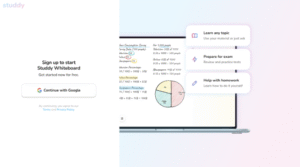
Studdyai is an AI chatbot tool that tries to mimic the experience of a teacher giving a lesson on a whiteboard. You can learn a new topic, prepare for an exam, or ask for help on a homework problem.
Strengths
- Generates visuals (drawings) along with text to teach content
- Default is conversational – you get the answer step by step
- Questions are timed to be asked at critical learning moments
- Can generate more practice questions
- Supportive and encouraging language
Weaknesses
- Still offers the option of an immediate full answer
- Can be a little slow to load the next response
- Drawings are a little slow to load
- Default is mic on
- It doesn’t save the transcript
Value proposition
- Provides a tutor to help with learning including visuals and interactive audio to simulate the real life experience of having a teacher.
Interesting features
- Download the whiteboard any time to save the graphics
- Ask questions to personalize the lesson
- Asks you questions to check for understanding
- Ability to speak or type to the bot
- Able to change the voice speed
Introducing study mode | OpenAI (Found by Natalia)


Summary
- ChatGPT’s study mode feature teaches you step-by-step instead of giving immediate complete answers, like regular ChatGPT defaults do.
Strengths
- Breaks down the problem into strategies to approach the concept
- Makes sure you’ve got all the facts down before starting
- Asks guiding questions
- Fast response times
Weaknesses
- Can still be used to shortcut learning if asked directly
- Could overwhelm students with too much information
- Requires self-discipline to use this over the default search engine
Value proposition
- Turns AI into a learning partner rather than an answer generator
- Helps students learn concepts and apply their knowledge rather than copy and memorize
Interesting features
- Socratic style learning approach
- Ability to explain concepts in different ways
- Works for diverse concepts and topics
____________________________________________________________________________
Khanmigo (Found by Varsha)
Khanmigo
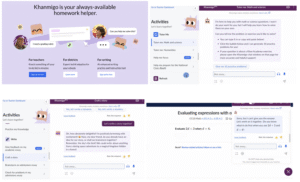
- Summary: Khanmigo is an AI powered tutoring chatbot developed by Khan Academy that provides personalized, conversational learning support. Khanmigo guides students step by step through concepts, while adapting explanations to their interests and replicating a teacher like tutoring experience to scaffold understanding rather than simply giving answers.
Strengths
- Step by step scaffolding: Khanmigo guides students through problems instead of revealing the full solution, which helps them build conceptual understanding.
- Personalized Explanations: Khanmigo adapts examples based on student interests, such as relating polynomials to cooking, making the content more engaging and relevant.
- Conversational and Encouraging tone: Khanmigo mimics a tutor by nudging students to try again and offering them hints. This increases student engagement and persistence, both of which are crucial to the learning process.
- Interactive learning: Khamingo encourages students to practice additional topics and explore deeper concepts.
Weaknesses
- Occasional inaccuracies: Khanmigo sometimes accepts incorrect answers as correct, which could mislead learners if they are not corrected.
- Limited performance tracking: Unlike some platforms, Khanmigo does not track long term student progress or mastery across topics.
- Reliance on conversational format: Students who prefer structured quizzes and summaries may find it less effective than traditional assessment tools.
Value proposition
Khanmigo offers a personalized, tutor-like experience that provides scaffolding for students’ understanding through back and forth dialogue, personalized explanations, and practice. The product’s conversation approach helps students reach their ‘Zone of Proximal Development’ by providing just in time guidance and adaptive support.
Interesting features
- Teacher-like prompting: Khanmigo encourages students to solve problems in an iterative, step by step manner and refrains from providing direct answers.
- Personalization based on Interest: Khnmigo adjusts examples based on student interests like programming and real world analogies.
- Conversational quizzes: Students are able to practice iteratively and ask clarifying questions in real time.
- Encouraging prompting: Khanmigo actively invites students to explore more topics and practice further.
____________________________________________________________________________
GRAMMARLY (found by Eva)

- Summary
Grammarly AI is an AI-powered writing assistant that helps students improve their writing through real-time grammar, style, tone, and clarity suggestions across multiple platforms such as web, desktop, mobile, and as a browser extension.
- Strengths
Grammarly provides contextual, real-time feedback exactly where students are writing be it Google Docs, email, or Microsoft Word, eliminating friction and fitting naturally into existing workflows. Its tone detection and formality adjustments directly solve the use cases of polishing emails and making writing to be more formal, and it offers explanations for suggestions that promote learning rather than just correction. The platform has strong brand recognition and educator acceptance since it positions itself as a learning tool rather than a cheating enabler, with educational pricing and plagiarism detection features. - Weaknesses
Grammarly has features like “rewrite” and “compose” which may confuse users and make them outsource work when all they needed was assistance.
The tool doesn’t address non-writing tasks like code debugging, understanding STEM concepts, and assignment spec clarification, which limits its relevance to students’ actual AI use patterns. Premium features require expensive subscriptions, and the platform lacks built-in academic integrity controls to prevent students from over-relying on generative features for original assignments.
- Value proposition
It was originally focused on grammar correction, but has evolved to include generative AI features for brainstorming, rewriting, and composition assistance while maintaining a focus on helping users develop their own voice and writing skills. - Interesting features
Grammarly offers cross-platform consistency with a unified writing profile that learns individual writing styles and maintains preferences across all devices and applications. Its “Goals” feature allows students to set audience, formality, and intent before writing, providing tailored suggestions. The platform includes plagiarism detection integrated with writing assistance, citation suggestions for academic work, and a personal dictionary that learns discipline-specific terminology, which helps students in specialized fields like biochemistry.
QUIZLET AI TUTOR (found by Eva)
- Summary
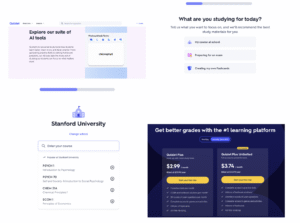
Quizlet’s AI tutor (Q-Chat) is an adaptive learning companion integrated into Quizlet’s study platform that helps students understand course material through Socratic-style conversations. It uses students’ existing study sets to provide personalized tutoring, asking guiding questions rather than simply providing answers, and adapts to individual learning paces while tracking progress across study sessions. - Strengths
Q-Chat encourages active learning by refusing to give direct answers and instead guiding students through problem-solving with scaffolded questions, which aligns with pedagogical best practices. It also seamlessly integrates with students’ existing study materials and flashcard sets, creating a familiar and low-friction experience. The platform has built-in academic integrity safeguards since it’s designed explicitly for learning rather than assignment completion, and benefits from Quizlet’s established trust with educators and 60+ million student user base. - Weaknesses
Q-Chat is limited to content that students have already created study sets for, making it less useful for understanding new or complex material not yet in their Quizlet library. Its Socratic method can frustrate students seeking quick answers under time pressure. The platform requires a subscription for full AI features, creating a paywall that may drive students to free alternatives like ChatGPT, and it lacks the versatility students need for diverse tasks like code debugging, assignment spec clarification, or emotional support. - Value proposition
Q-Chat’s value proposition is that they will make learning rewarding, delightful, and fun. They promise to use AI to deliver more effective learning tools at scale so that all students from different geographical locations have an opportunity to benefit. They have multiple safeguards to focus the AI’s responses to relevant study content and also to encourage conversation between the AI and the student instead of just the AI providing answers. - Interesting features
Q-Chat’s unique “tutor mode” refuses to provide direct answers and instead models expert teaching strategies by breaking down concepts into smaller steps. It offers memory across study sessions so the AI remembers what concepts a student has struggled with previously. The platform provides subject-specific tutoring optimized for memorization-heavy courses and integrates with Quizlet’s spaced repetition system to reinforce long-term retention.
____________________________________________________________________________
Cursor (Found by Siddhartha Javvaji)
Summary
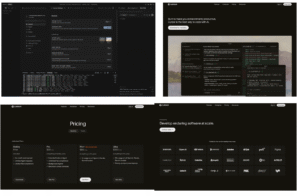
Cursor is an AI code editor that basically brings LLMs into VSCode. It targets developers and students learning to code, and most importantly, it provides the users with faster coding performance through AI autocompletes, chat-based debugging, and also codebase suggestions.
Strengths
- Many integrations: Works within existing development environment so that minimal context switching is needed if at all
- Codebase understanding: Indexes through entire projects for relevant suggestions thoroughly
- Multi-model support: Can use Claude, GPT-4, Composer 1, or other models
Weaknesses
-
- High dependency: Makes it difficult to code without AI assistance once hooked in
- Little learning: Doesn’t encourage users to understand why code works
- Blackbox Functionality: Users don’t understand why the code is being built the way the AI is coding (strategies, etc.)
Value Proposition
“Code faster with AI that understands your entire codebase”
Interesting Features
- Hallucination ‘rewards’: Sometimes suggestions are perfect, sometimes not – creates reinforcement for user to read code themselves
- Social proof: Shows “accept” percentage to show how often users are using suggestions
- Friction removal: Tab completes make it extremely easy for users to not read through the AI-generated code
Claude (Found by: Siddhartha Javvaji)

Summary
LLM AI assistant by Anthropic that resembles a general knowledge worker. It targets the everyday person for various tasks like research help, writing support, coding help, or creative ideation.
Strengths
- Long context windows: Claude now can process ~1M tokens, which gives it context over long documents, codebases, etc.
- Multi-modal: Claude can handle text, images, spreadsheets, voice messages, etc.
- Projects feature and integrations: Maintains context across conversations and can pull information via integrated accounts if needed
Weaknesses
- Basically replaces critical thinking: Students outsource tasks that they would be forced to do otherwise – decreases cognitive ability and patience over the long-run
- No plagiarism detection or awareness: It’s really easy to submit AI-generated work as original, which leads to more ethical issues
Value Proposition
“An incredibly intelligent AI for thinking through complex problems”
Interesting Features
- Quick gratification or dopamine hit: Immediate answers (whether or not they’re correct is a separate discussion) to any questions asked
- Memory context: User basically forced to feel like the AI knows them at a personal level, which keeps them highly engaged
Mobile app?: Increases daily interactions since its extremely easy to access



