Baseline Study
Overview
When discussing everyday behaviors that feel small but are still hard to complete, we became interested in how undergraduate students delay social micro-responsibilities. We defined social-microresponsibilities as tasks that may take less than 5 minutes to complete, like responding to texts, emails, or confirming plans. Considering busy schedules, long to-do tasks, and social expectations, we wanted to understand why students avoid and postpone these tasks. Although the tasks are minor, delaying them often creates stressful and lingering emotions, so we hope to understand what emotions are tied to avoidance, how social expectations shape behavior, and the reasons for the delay of simple, everyday tasks.
Methodology
For our baseline study, we conducted a five-day diary study with a pre- and post-interview for 8 undergraduate participants. Participants completed an initial 30-minute interview to discuss their existing habits, emotions, and perceptions around delaying social-microresponsibilities. After understanding their relationship with these tasks, we asked participants at the end of each day to record five social micro-responsibilities they delayed each day and two they completed without delay, asking for what the task was, when in the day, and the reasons for the delay or non-delay. After the study, we completed a post 30-minute interview reflecting on patterns they noticed, emotional experiences with their impact on others, and whether tracking influenced their behaviors and actions. This study focused on qualitative data to capture daily precision-making and emotional context.
Participant Recruitment
We recruited undergraduate students who regularly engage in digital communications and identified that they are occasional or frequent at delating social micro-responsibilities or social follow-ups. Participants all complete a screener to ensure qualifications and availability. It focused on undergraduates due to their high number of daily social interactions and communication.
Key Research Questions
With this study, we aimed to understand: why do students delay small tasks despite how low the effort they are? What emotions, thoughts, and social pressures contribute to avoidance? How do students organize their thoughts and emotions when being alerted to a passage and choosing to respond immediately or later, and whether or not self-tracking changes how they perceive or manage these behaviors?
Raw Data –> Grounded Theory Report
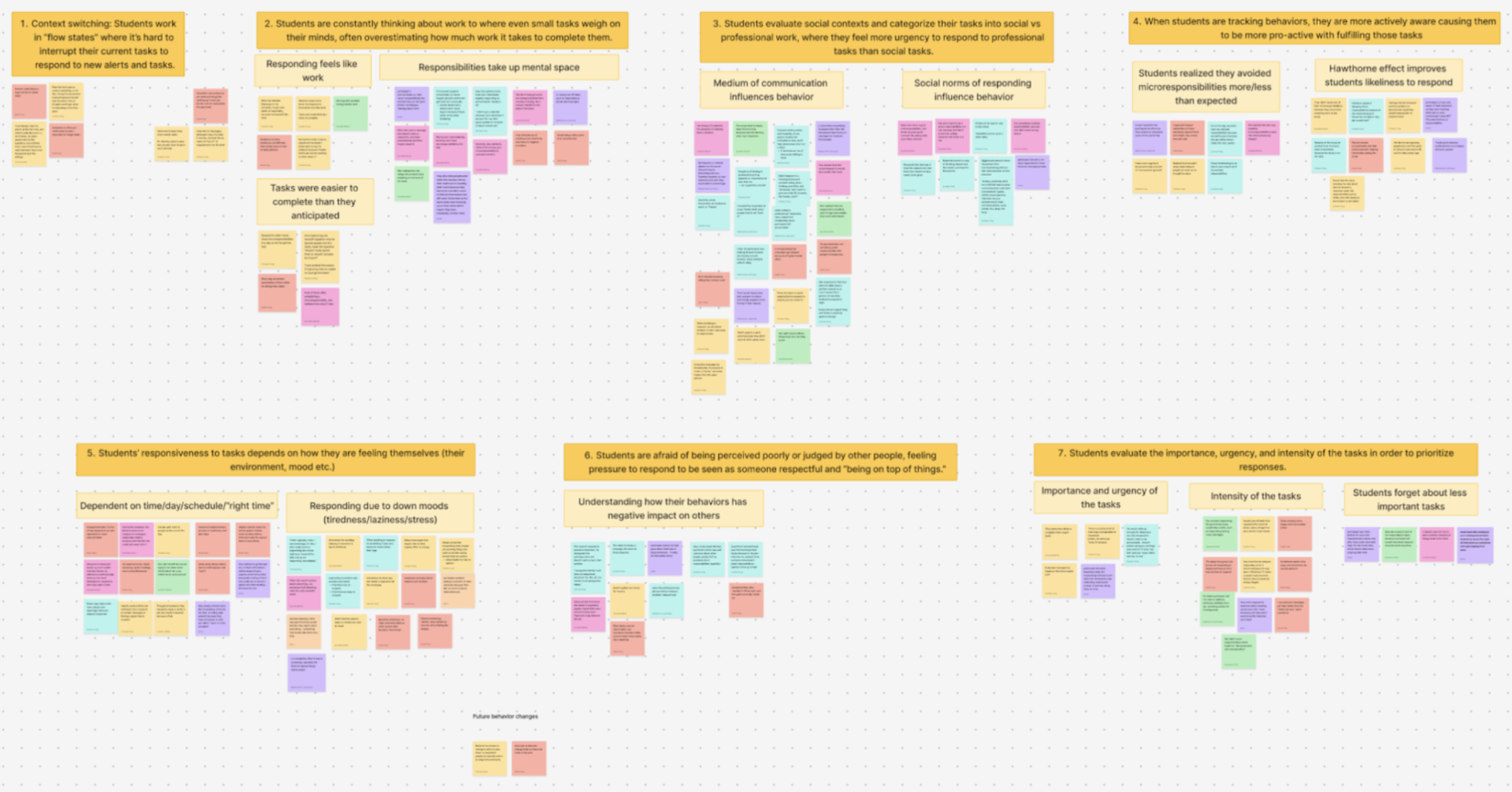
After conducting our baseline study, we synthesized all of our data into affinity maps. From our mappings, we began with categorizing through similarity. Then, we dove deeper into subgroups, adding in more details, and developed these grounded theories. The diagrams can be seen in more detail here.

Clustering Main Ideas
Insights Development
Grounded Theory 1: Context switching makes short social micro-responsibilities feel disruptive.
Difficulty with context switching discourages starting the task.
-
- WZ said he is bad at context switching, so for him, it’s hard to do random 5 minute tasks because he will lose his entire train of thought and forget what he was doing in the first place if he tends to the alert.
- SP recognizes it may only take a few moments to respond, but they describe the task as something they need to “lock in” to respond to.
- Some micro-tasks have even smaller tasks to complete that take them out of their current mental state.
The transition into the task, rather the actual task itself, is a significant barrier
- SP noted that “getting up” is the real barrier and not necessarily the task itself, so transition costs matter.
- WZ described moments of treating their phone time as “chill time” so he doesn’t respond because he focuses more on relaxing.
Grounded Theory 2: Students are constantly thinking about work to where even small tasks weigh on their minds, often making tasks feel heavier than they actually are.
Responding is framed as work rather than a casual action.
- WZ installed iMessage on his computer and it improved his response behavior because he treated messages like a work task, where he would allocate a block of time to respond to all of them all at once.
- CF regularly avoids texting friends back, framing responses as a task than casual conversation.
Delayed social micro-responsibilities continue to take up mental space.
- LJ procrastinates on micro-tasks but it will always stay in the back of her mind.
- AS described the delays are mentally draining, and it feels like a checklist she always thinks about.
- CF realized that the tasks she avoided continue to weigh on her mentally.
Completing micro-responsibilities were often easier than anticipated.
- WZ reflected that the study prompted him to question why he ignored people and led him to respond when he realized the reason was “stupid.”
- AS noted that after completing tasks, she realized how easy they were.
Grounded Theory 3: Students categorize their tasks into social or professional work, responding with greater urgency to professional responsibilities than social ones.
The medium of communication influences response urgency.
- CF, BL, WZ distinguished between work-related and social interactions, responding more urgently in professional contexts than in social ones.
- AS described feeling more pressure to respond to emails to students due to her role as a TA.
Relationship strength affects prioritization of responses.
- BL consistently responded to close friends and avoided people he was less fond of, expressing levels of respect for someone affected his response time.
- LJ prioritized people older than him and adjusted social expectations based on the network he was interacting with (ex. Stanford students vs students at other universities).
Social norms shape expectations around response timing
- BL adheres to different response times norms, where emails are up to 2 days and text can be delayed to around a week.
- AS described social micro-responsibilities as an “implicit social contract,” such as expectations around sitting with friends or maintaining contact.
Grounded Theory 4: When students are tracking behaviors, they are more actively aware causing them to be more pro-active with fulfilling those tasks
Students realized they avoided microresponsibilities more/less than they expected
- WZ reflected that the study helped him realise that he didn’t delay responding to people as much as he thought he did.
- AS learned that she was avoiding and delaying micro-responsibilities more than she was aware of.
Hawthorne effect improves students’ likeliness to respond, boosting their productivity
- SP, BL and WZ noted that the diary study helped them become more conscious about why they delayed micro-responsibilities which made them respond better.
- WZ mentioned he fears after the study he might return to old habits.
- SP and LJ also talked about how the diary study record created accountability where they were more pro-active with fulfilling their micro-responsibilities.
Grounded Theory 5: Students’ responsiveness to tasks depends on how they are feeling themselves (their environment, mood etc.)
Students responsiveness was often dependent on their schedules or waiting for the “right time”
- WZ and CF put off replying until they find a “good time” which is usually after they’re done with all their work or at night.
- BL and LJ don’t prioritise responding and micro-responsibilities on busier days.
One’s mood affects prioritization of responses.
- BL and SP remarked avoidance is often based on emotions rather than logic or lack of time.
- BL, SP, AS and WZ described avoiding responding due to laziness or tiredness.
Grounded Theory 6: Students are afraid of being perceived poorly or judged by other people, feeling pressure to respond to be seen as someone respectful and “being on top of things.”
Participants are aware of how their behaviors may negatively impact others.
- LJ noted feeling bad about not responding to their friends.
- BL and AS confided they worry that when they don’t respond to people, they’ll think they’re not prioritizing them, especially long-distance friends.
Grounded Theory 7: Students evaluate the importance, urgency, and intensity of the tasks in order to prioritize responses.
The importance and urgency of tasks influences response urgency.
- WZ and BL mentioned responding to tasks based on their urgency (e.g. they would respond to important emails within 24 hours but ignore their friends)
Intensity of tasks influences response urgency.
- CF and WZ noted usually putting off tasks that required time and effort.
- WZ mentioned putting off tasks that were for things too far in the future.
- SP responds faster to low-pressure messages (memes, “where are you,” quick reactions).
Less important tasks are often forgotten/missed.
- AZ repeatedly forgot to send their family member a document they had asked for because it wasn’t as important of a task for AZ.
- LJ and CF would prefer to do lesser important tasks after all their important tasks which would often lead to those tasks getting missed.
System Models
From our baseline study and raw data, we noticed that a possible area for intervention is the moment a student receives a social micro-responsibility (such as a text, email, or social follow-up) and decides whether to respond now or delay. Participants tended to feel the most guilt and mental burden around tasks they knew were simple yet still put off. Conversely, they felt most relieved and accomplished when they responded promptly, especially when the task turned out to be easier than anticipated. This gap between perceived effort and actual effort is particularly significant in students’ daily routines and contributes to their stress in a meaningful way.
The connection circle below explores more of the daily thoughts, emotions, and actions that occur when a student receives a social micro-responsibility.
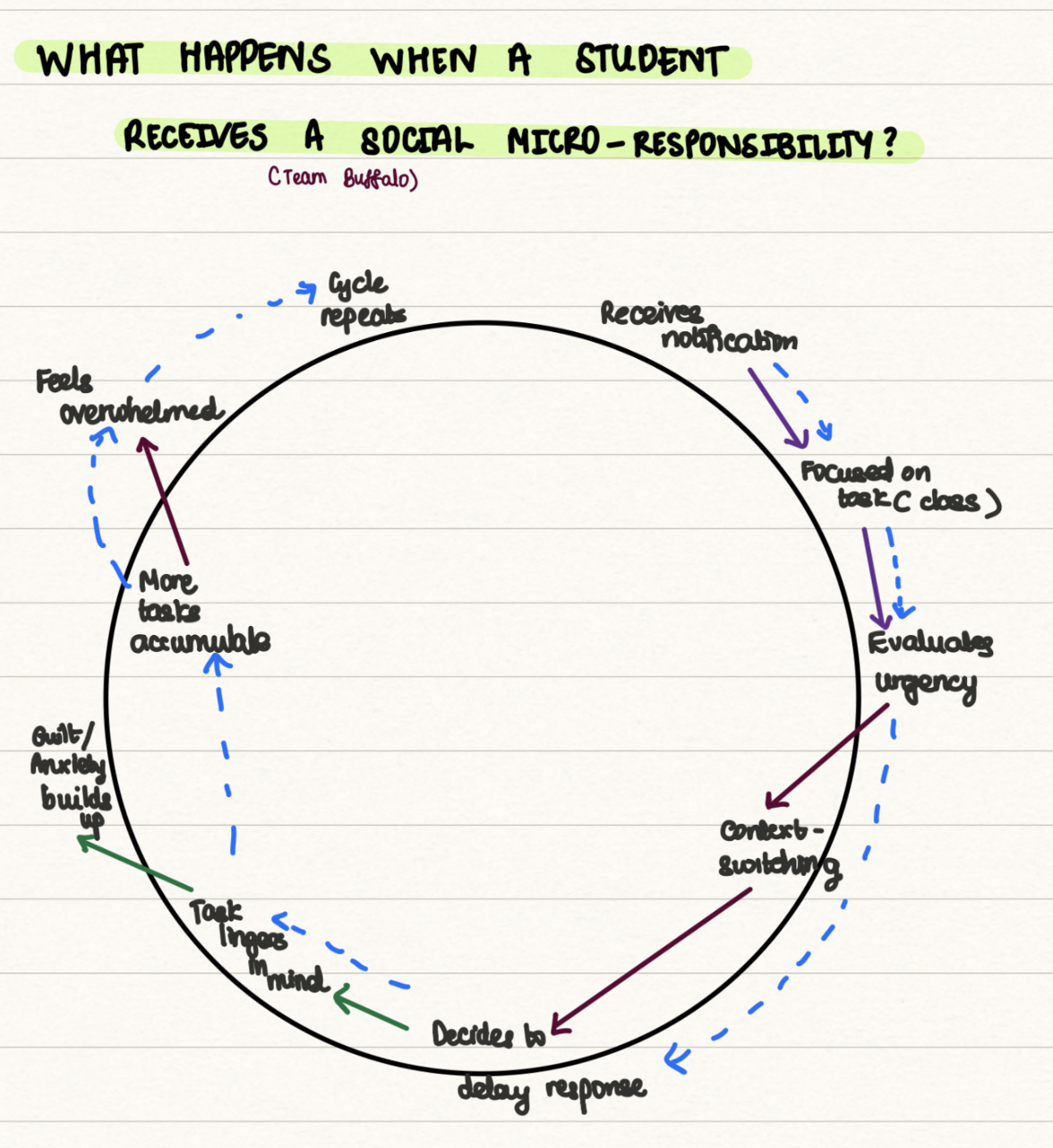
From this circle, we see that someone receives a notification, perceives context switching as disruptive, decides to delay, and then the unfinished task lingers in their mind, generating guilt. As more tasks accumulate throughout the day, the pile feels increasingly overwhelming which makes them less likely to respond. This continues the cycle even though each individual task would take under five minutes.
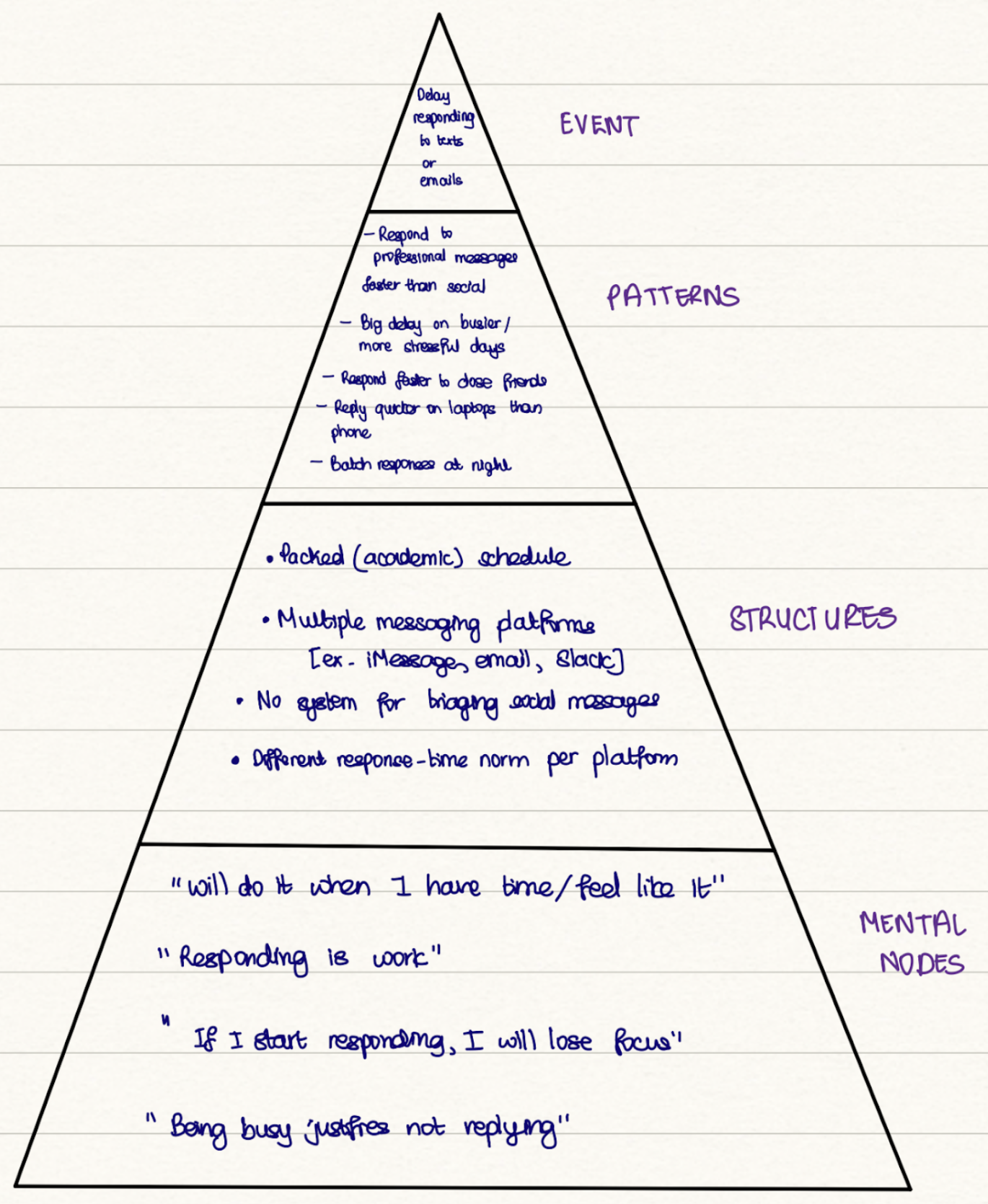
This second model is a bit more general and focuses on why students consistently delay social micro-responsibilities despite recognizing how quick they are, a very common theme among our interviews. This model highlights that professional and social communications are treated fundamentally differently. Students feel significantly more urgency around emails to professors or work-related messages than texts from friends. Like the connection model, this model also highlights how unique aspects of university life encourage avoidance and the constant competition between academic demands and social obligations. Finally, it demonstrates that although context switching was the most cited barrier in our baseline study, deeper mental models also play a major role. Students frame responding as “work” rather than a casual social moment, and they believe they need to be in the “right mood” or have the “right energy” to reply. Since these ideal conditions rarely align during a busy day, the delay becomes the default behavior, and students rationalize it by telling themselves that social tasks can always wait.
Insights from these models give a few interesting opportunities for intervention:
- Reduce the perceived weight of context switching by designing micro-moments for response rather than treating each message as a separate task. If responding could feel as effortless as reacting to an Instagram story, students might be less resistant to interrupting their flow. But if students genuinely lose focus when they switch contexts, will a lighter-weight format actually solve the problem?
- Bridge the gap between perceived effort and actual effort so students recognize in the moment that most micro-responsibilities take less than a minute. Real-time awareness nudges could surface how long a response actually took versus how long the task sat unfinished, helping students recalibrate their mental models around effort.
- Instead of eliminating delays entirely, leverage the Hawthorne effect through sustained, lightweight tracking. Our study showed that simply logging delayed tasks made students more proactive. A gentle daily summary, rather than a rigid productivity system, could maintain this effect and make managing micro-responsibilities feel like self-awareness rather than another obligation.
Secondary Research
One key insight that was found during literature review was that many times, avoidance of tasks is more emotional than logistical. For instance, people tend to delay tasks that they find unpleasant, which some researchers call ‘emotional resistance’. This is often a larger barrier to completing tasks than poor time management, busy schedules, or other logistical reasons that are commonly blamed for incomplete tasks.
Another finding is that starting a task is oftentimes the hardest part. This is partially because of the emotional barrier to starting, caused by overestimation of how long the task will take, or emotional resistance. In order to combat this, researchers propose the ‘5-minute rule’, recommending that you start the task for just 5 minutes. Interestingly, after starting the task, people often find themselves completing it because they’ve overcome the initial barrier.
A third insight is that ‘digital tool fatigue’, the impact of the increasing number of workplace technologies, is undermining employee productivity and collaboration, despite the goal to improve these aspects. This can be attributed to the overwhelming number of notifications and redundant platforms which creates invisible labor for employees. In order to address this, companies should aim to require fewer tools with clearer priorities.
Finally, avoidance can result in long-term costs, as the mental load takes a toll on people’s mental and physical health. However, 20% of adults are called ‘chronic procrastinators’, which means they’ve built procrastination into their lives. Additionally, while there’s a common misconception that people work faster under impending deadlines, the study revealed that procrastinators. make more mistakes and work slower than non-procrastinators.
Market Research
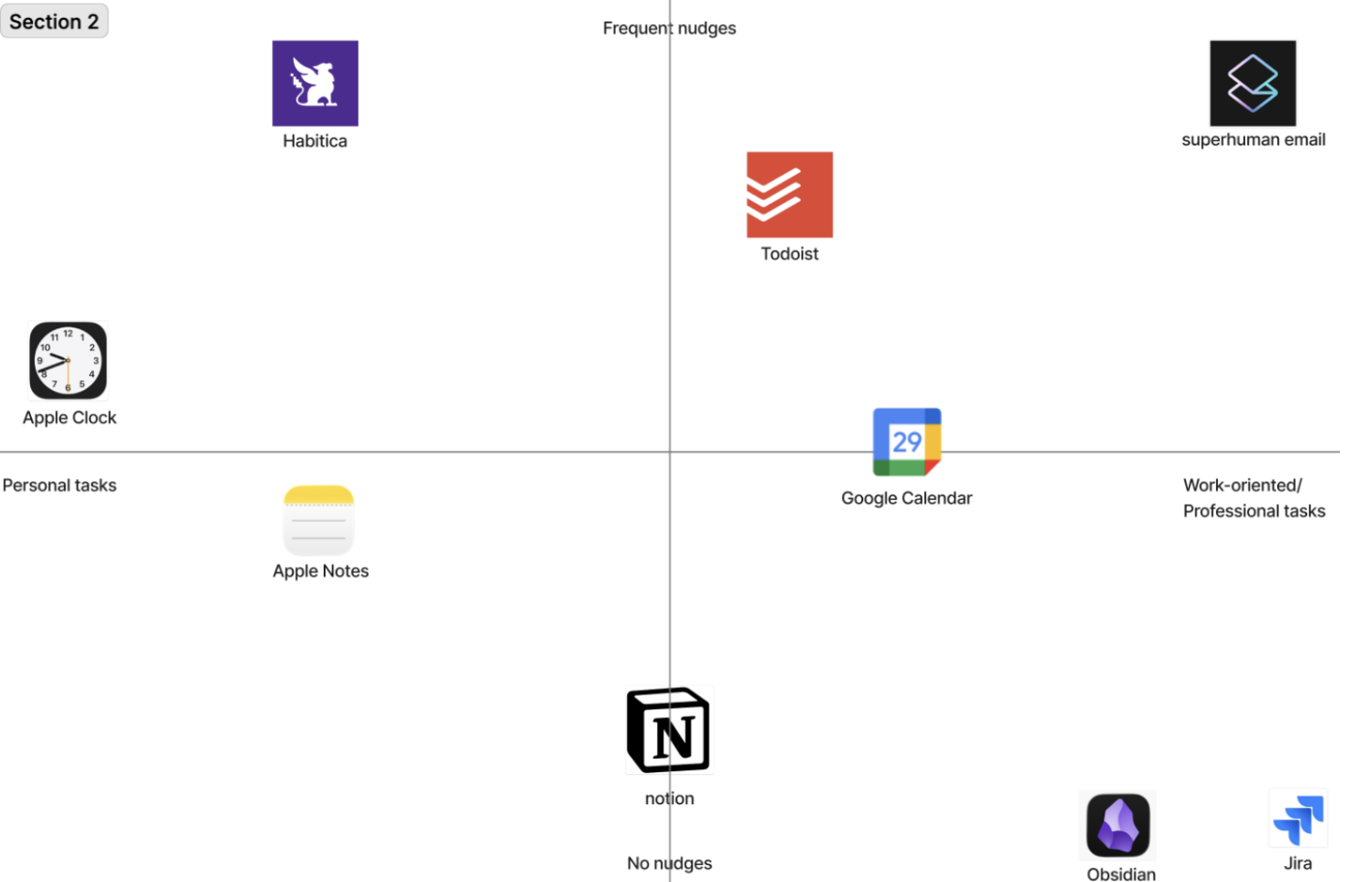
One of the main trends we saw in market research was that the market for professional tasks was oversaturated, with well-loved products such as Jira and Superhuman. However, there aren’t too many products that address personal or social tasks, perhaps because taking care of one’s personal life has only recently started becoming a priority in society. This motivates our group to focus on addressing personal rather than professional task completion.
Another insight we had was that the most well-loved tools for personal task completion were the incredibly barebones apps that come with the iPhone: Clock and Notes. This could point to two things. First, users aren’t as willing to adopt a new technology for personal tasks that they see as minimal and trivial. They want a quick and easy way to manage their tasks. Second, users may not feel the need to overcomplicate or overstructure their personal lives. Rather than force-fitting their personal goals into a complex tracker, they want an unstructured platform that doesn’t require personalization.
Behavorial-Personas
1) Context Switcher
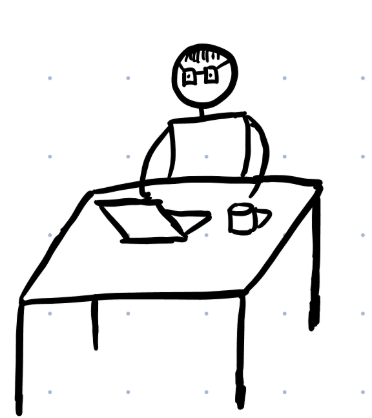
Activated role: Stanford student, current CS + MechE double-major, who lives in long, fragile deep-work blocks of coding, CAD, lab writeups and grueling psets.
Goal: His goal is to stay reliable to friends/teammates while protecting momentum and finishing work on time.
Conflict: a message arriving mid-flow feels like stepping off a moving treadmill; even “low-effort” replies trigger context loss, decision fatigue, and follow-up loops. They want to respond, but the interruption cost is disproportionate to the message.
Attempts to solve: they silence notifications during work, plan to “reply after I finish this section,” and sometimes send an ultra-short acknowledgement like “saw this, replying later,” but they often forget, or the later window gets eaten by the next task.
Setting/environment: late nights in Green Library, headphones on in Huang Engineering Basement, group lab meetings where Slack is constantly pinging
Tools: Focus mode/DND, calendar time blocks, laptop and phone, pinned message threads, occasional to-do capture on notes app
Skills: intense concentration, high output under uninterrupted time, strong problem solving.
Backstory: They’re not unresponsive by personality but they’re probably optimizing for sustained cognition. The moment they start replying, their brain keeps re-opening the conversation loop until it’s complete, which is exactly what they can’t afford.
2) Student Constantly Thinking About Work
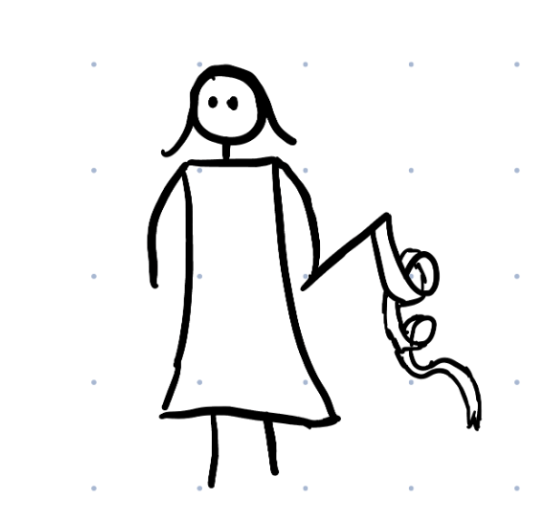
Activated role: Stanford student leader, a residential staff, student org VP, and currently on the pre-med track who’s always carrying an invisible checklist.
Goal: feels caught up and in control with clear obligations, avoids letting anyone down, and stops the constant background stress.
Conflict: small tasks don’t feel small. Because they’re already saturated, every new request lands as another big thing, and their brain overestimates effort, snowballing a 30-second reply into a looming chore.
Attempts to solve: they write everything down obsessively, make detailed lists, start replies but don’t send them, and try “quick batching,” yet the backlog itself becomes a stressor they avoid every time they look at it.
Setting/environment: walking across campus with their head constantly running, during meals, between meetings, or in bed at night when they finally have quiet
Tools: notes app, reminders, task managers, sticky notes, email flags, calendar color-coding; sometimes mindfulness apps, but inconsistently.
Skills: conscientiousness, high empathy, strong organization when not overloaded, great at proactive planning
Backstory: After years of being the responsible one, their mind never fully shuts off. They don’t ignore messages because they don’t care but rather they ignore them because each one feels like a new commitment they can’t sustain.
3) Selective Responder
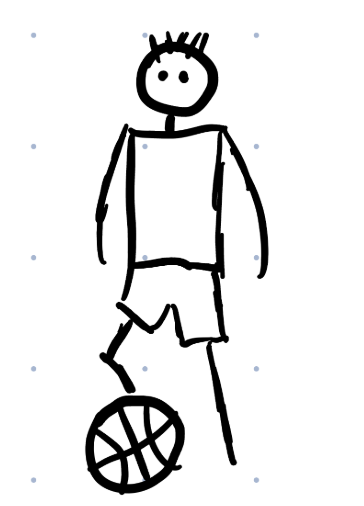
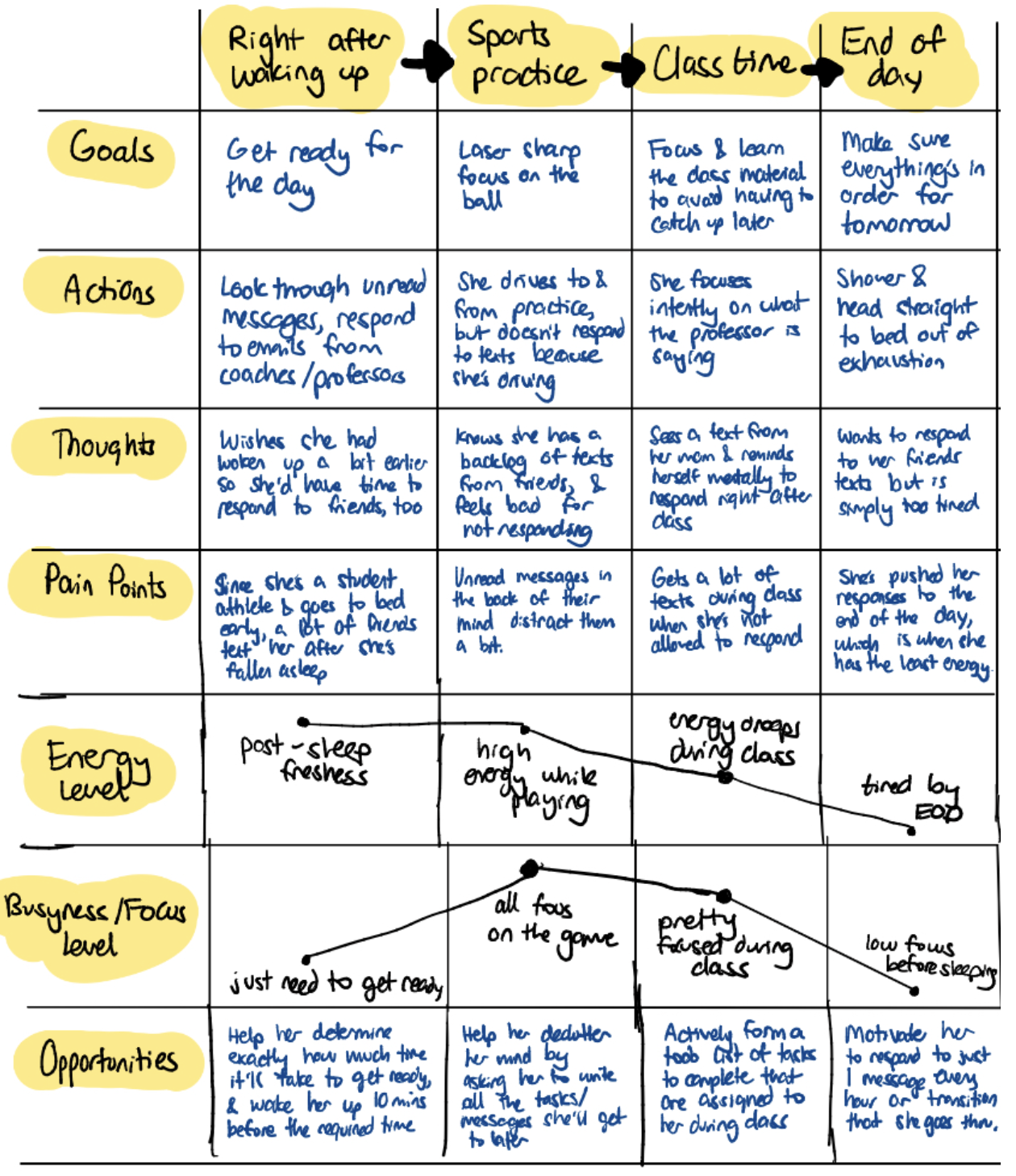
Activated role: Stanford student-athlete on the men’s basketball team balancing practice, travel, academic deadlines, and recruiting/networking.
Goal: protect energy and performance while maintaining critical relationships and meeting expectations in high-stakes areas
Conflict: they can’t respond to everything, so they run a fast internal ranking. They rank based on who sent, what’s the consequence, what’s the ask, how long will it take, and will it spawn follow ups. Social messages lose to anything with obvious deadlines or status implications.
Attempts to solve: they create “VIP” notification lists, respond immediately to coaches/TAs/team leads, and leave social threads unread until they have a long break
Setting/environment: training facilities, study hall with the team, airports, group chats exploding during away games
Tools: priority notifications, pinned contacts, calendar constraints, quick-reply templates
Skills: ruthless prioritization, timeboxing, clear professional communication, resilience under pressure
Backstory: When your day is scheduled to the minute, responsiveness becomes a strategic nightmare. He’s not cold, just calibrated.
Journey Maps
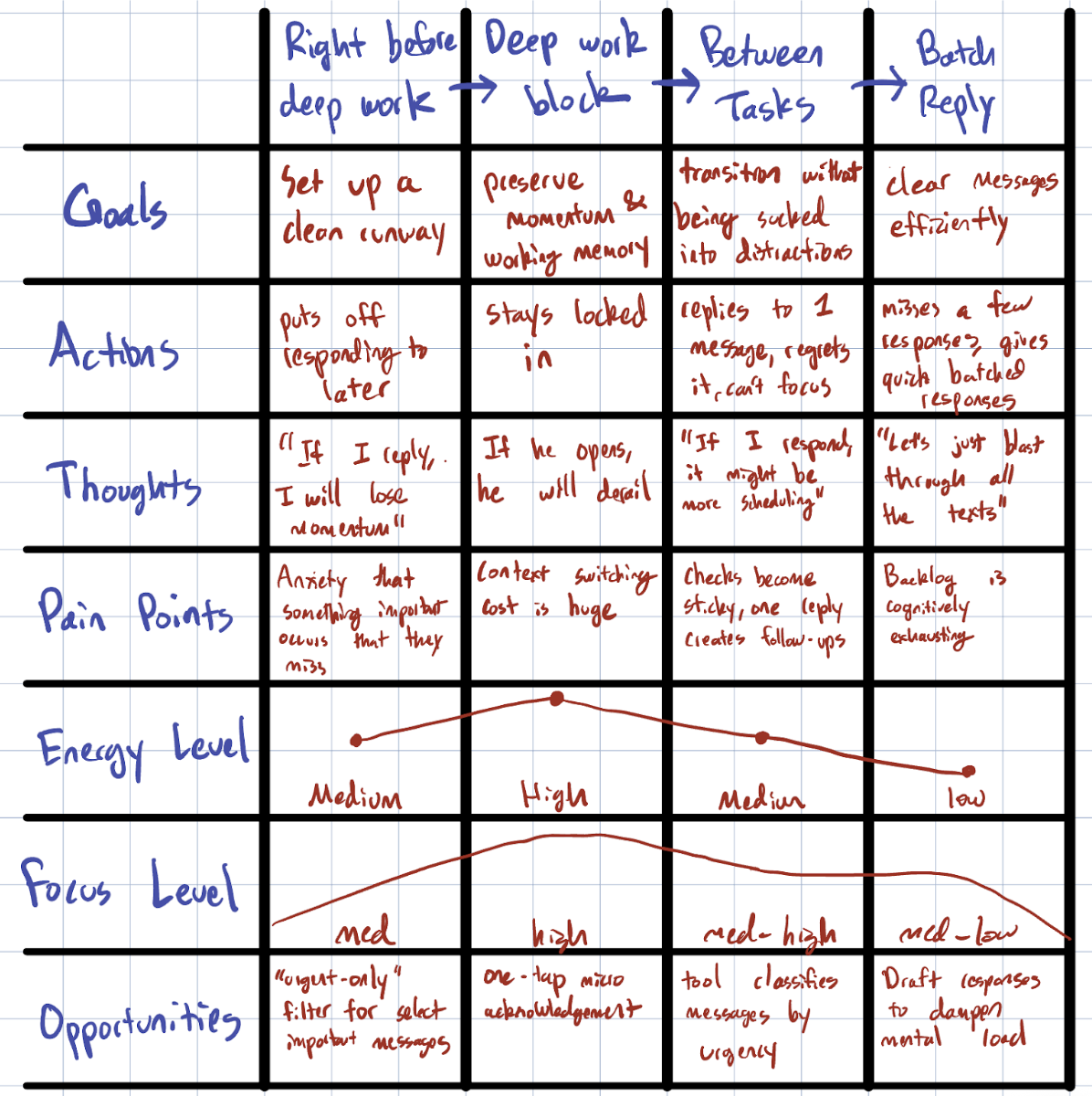
- Context Switcher
- Selective Responder