
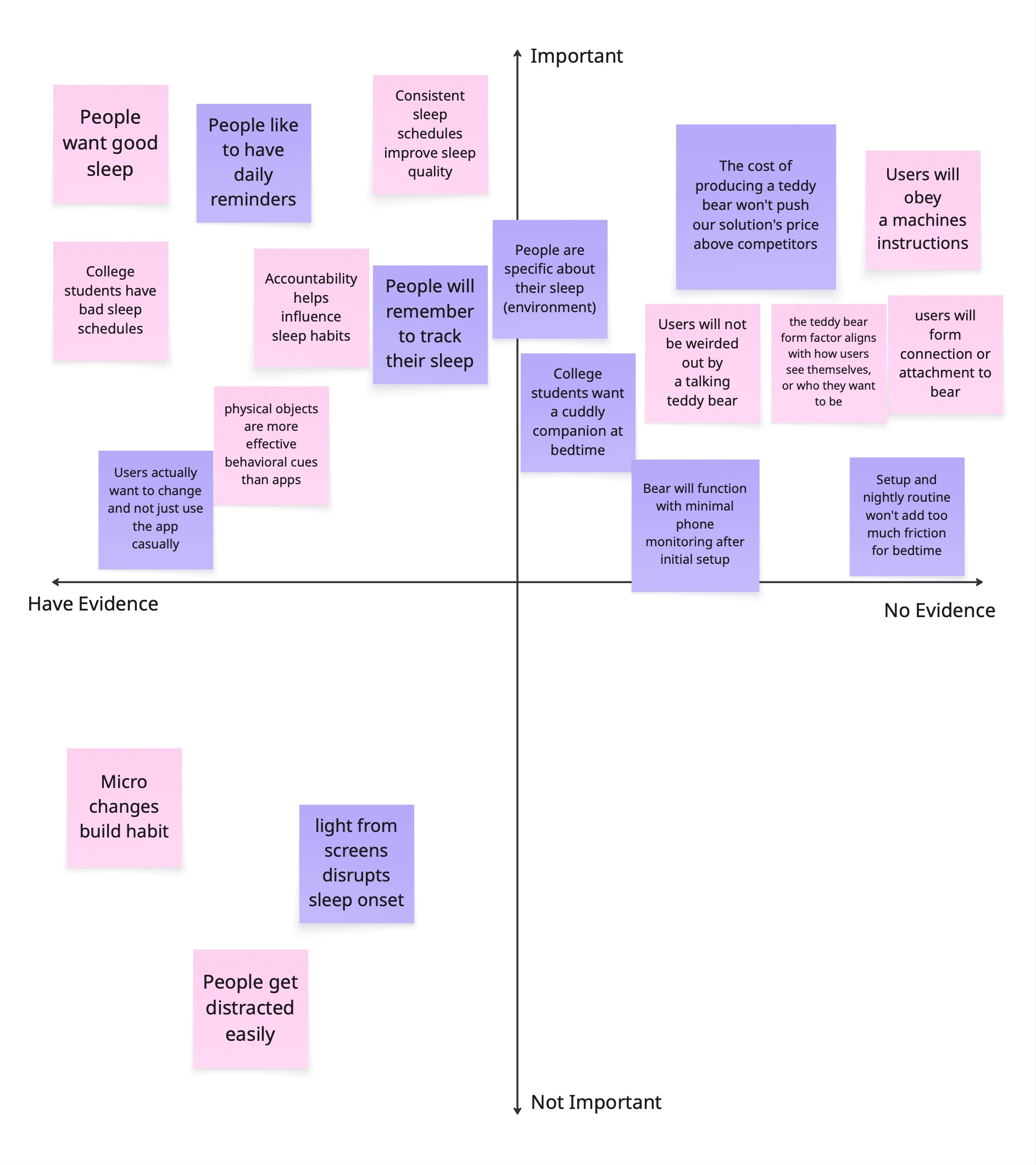
Key Insights
The three most critical unvalidated assumptions in our intervention are identity fit, emotional attachment, and user compliance. These three assumptions form a single chain of dependency.
For the intervention to work, users first need to genuinely connect with the bear as an object. Our hypothesis is that a warm, personalized companion with its own personality is inherently more inviting than a sterile app or device, and that this distinction is what makes someone want to bring it into their most private space. From there, sustained physical proximity needs to develop into real emotional attachment, because attachment is the mechanism that makes the final link possible: a user who has bonded with the bear is far more likely to actually follow its guidance than one who sees it as just another piece of technology or an expensive bedside decoration.
This chain is what distinguishes our solution from a standard sleep app. The physical, characterful form factor is our core design hypothesis. If we can validate that a personalized, friendly companion builds the kind of relationship that a phone simply cannot, we have evidence for something genuinely novel in the behavioral intervention space.
To do so, we designed the following assumptions tests:
Assumption Test 1: People Will Accept and Feel Comfortable with a Talking Sleep Companion
WE BELIEVE THAT
We believe that college students and individuals with inconsistent sleep schedules will feel comfortable having a talking teddy bear in their bedroom and will not perceive it as childish, intrusive, or socially embarrassing.
TO VERIFY THAT, WE WILL
Conduct surveys and short concept-testing interviews with potential users, presenting them with visuals and a clear description of the talking teddy bear prototype.
AND MEASURE
Measure comfort level on a Likert scale, willingness to place the device in their bedroom, likelihood of long-term use, and qualitative concerns about privacy, embarrassment, or dependency.
WE ARE RIGHT IF
A majority (e.g., >70%) report moderate to high comfort (4 or 5 out of 5), and major concerns raised are minor or solvable through simple design adjustments.
Assumption Test 2: Users Will Respond to and Follow Guidance from a Humanized Agent
WE BELIEVE THAT
We believe that people are more likely to listen to and follow bedtime guidance when it is delivered by a humanized, emotionally supportive agent rather than a neutral, app-style reminder.
TO VERIFY THAT, WE WILL
Run a controlled comparison where participants receive bedtime prompts framed either as generic reminders or as messages from a personalized “sleep companion,” and observe differences in response and behavior.
AND MEASURE
Measure immediate compliance (did they go to bed within 30 minutes of the prompt), changes in self-reported belief or motivation after interaction, perceived trust, and perceived emotional support.
WE ARE RIGHT IF
Participants show higher compliance rates, higher trust scores, and stronger motivation ratings when prompts are framed as coming from a humanized companion.
Assumption Test 3: Users Will Form Emotional Attachment to the Companion
WE BELIEVE THAT
We believe that college students and individuals with inconsistent sleep will form a meaningful emotional connection or sense of attachment to a humanized sleep companion, and that this attachment will increase their willingness to follow its guidance.
TO VERIFY THAT, WE WILL
Conduct short-term prototype testing using a low-fidelity physical teddy bear paired with scripted or Wizard-of-Oz interactions that simulate personalized, emotionally supportive dialogue over several consecutive nights.
AND MEASURE
Measure perceived emotional connection (using attachment and companionship scales), frequency of voluntary interaction with the bear, likelihood of naming or personalizing it, perceived accountability, and willingness to continue using it after the study.
WE ARE RIGHT IF
Participants report moderate to high emotional connection (4/5 or above), demonstrate repeated voluntary engagement, and indicate that the sense of companionship influences their bedtime decisions.
Assumption Test 4: The app and Bear will not compel users to access their phone more before bed
WE BELIEVE THAT
We believe that college students will not be more likely to use their phones for an extended period before bed while interacting with the bear and any setup in the app required before bed.
TO VERIFY THAT, WE WILL
We will run a short study to measure self-reported phone time with a low-fidelity prototype of our app to gather data on phone usage before bed time both related and unrelated to usage of the prototype.
AND MEASURE
Measure baseline phone usage before bed and track both total phone usage during the night period as well as total phone usage required to interact with the app prototype before bed.
WE ARE RIGHT IF
If users report that little phone setup or usage of the app was required during their nightly routines and that their baseline phone usage did not increase while interacting with the prototype.



