
Before This Class:
I walked into CS247B thinking I had design mostly figured out. I’d taken CS210A and CS210B, so I thought I knew the process. Prototyping, market research, and building products. Find a problem, build a solution, ship it, iterate. Clean. Logical. My CS brain loved it.
Behavior change? I figured that was just a matter of building smarter tools. If people know staying up late destroys them, they just need a better app to stop. Better reminders. Better notifications. Maybe some AI personalization. The problem was technical, and I was trained to solve technical problems. What I completely underestimated was that humans are not rational. Like, at all. Knowing something is bad for you and actually stopping are two completely different things. The gap between them has almost nothing to do with information or features. It’s emotion. It’s context. It’s the fact that at 11:47 PM, your brain doesn’t care about tomorrow.
The Work and the Experience:
Our project, SleepPea, tackled bedtime procrastination among Gen Z. The core insight we discovered through our research was that people already know they should sleep earlier. The problem isn’t information, it’s that scrolling at midnight provides immediate dopamine while the benefits of sleep feel abstract and distant. Our solution centered on Sleep Pods: small groups of friends who commit to bedtimes together and watch a shared digital garden grow or wither based on how well the pod hits its goals.
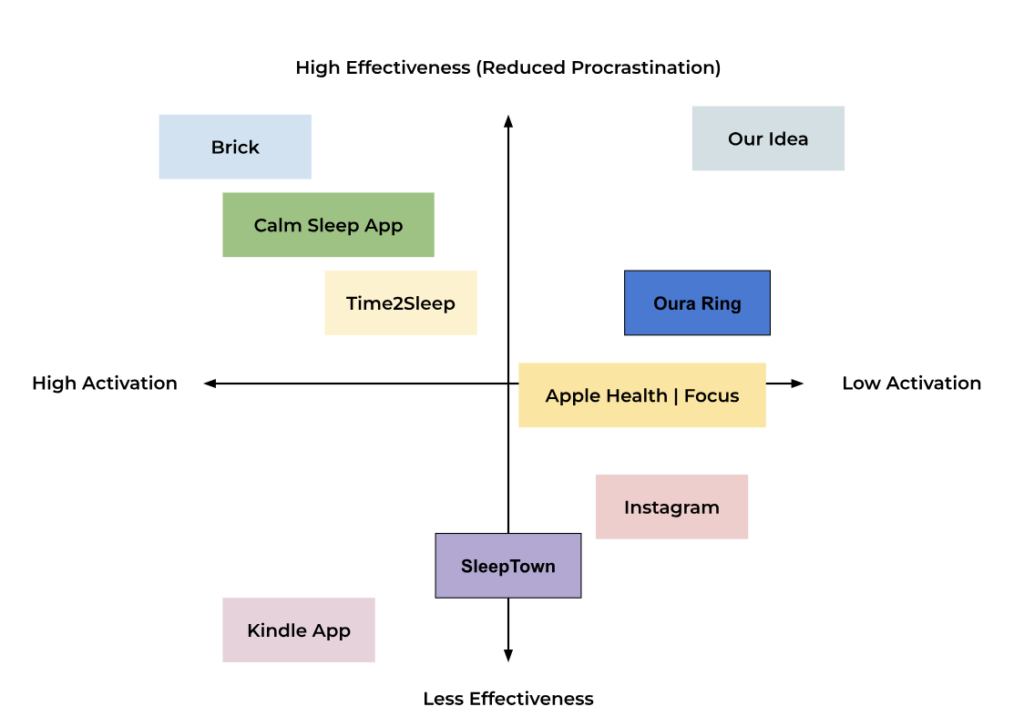
I was responsible for building out the Sleep Pods feature and setting up the backend infrastructure to host our app. This was the technical heart of the app, and it felt meaningful because our research showed that social accountability was the most underexplored approach in the entire market. During our comparative analysis, we mapped 19 competitors and found that almost everything fell into blocking apps, meditation content, or passive tracking. Nobody was leveraging the social pressure that actually motivates our generation.
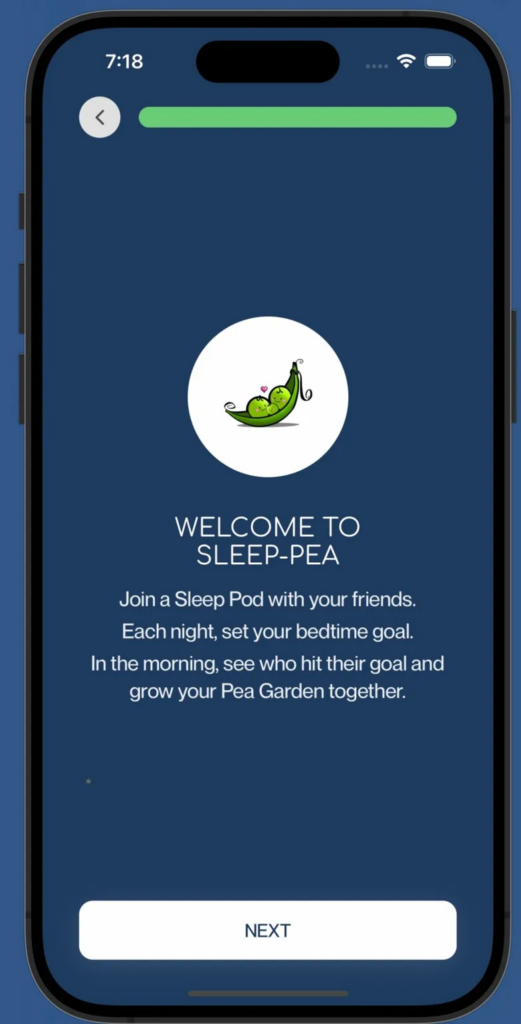
Working with Cannon, Sujin, and Osose was genuinely one of the best team experiences I’ve had at Stanford. We did almost everything together: brainstorming, interviews, synthesis, prototyping. One of my favorite memories was when we were trying to name the app and Cannon just said “I’m sleepy” out of exhaustion. I immediately heard “Sleep Pea” and it stuck. That became our whole brand identity: the peas in a pod, the garden metaphor, the cozy aesthetic. Sometimes the best ideas come from the most random moments.
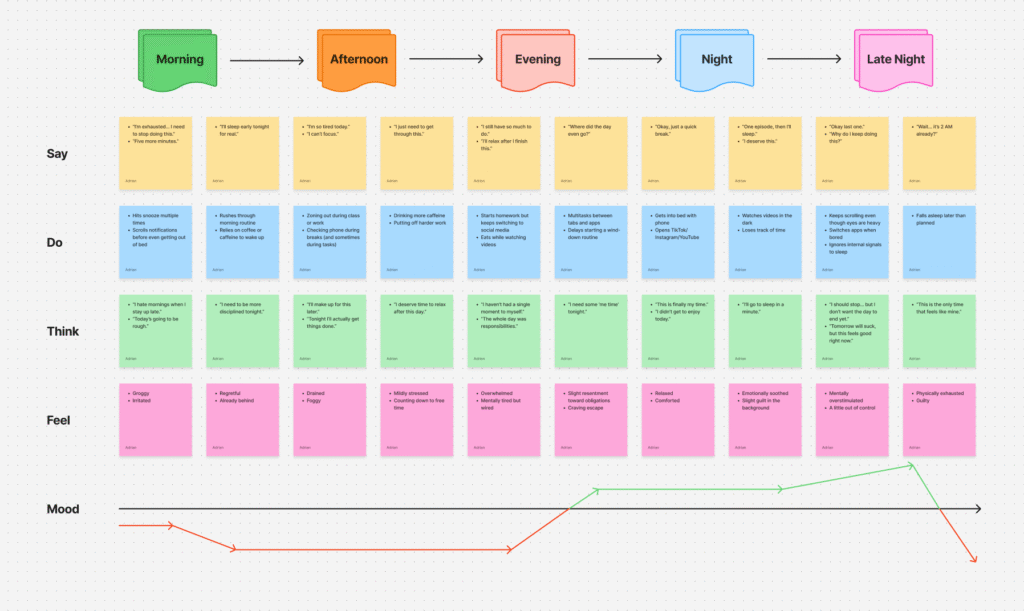
The hardest parts of the project were getting participants to actually keep up with our diary studies and narrowing down our intervention idea. During our baseline study, we had people logging their activities every 30 minutes from 10 PM until they fell asleep for five days straight. Some participants gave us rich, detailed reflections; others gave us one-word answers. You learn quickly that the quality of your research depends entirely on participant engagement, and that’s something you can influence but never fully control.
Usability testing was also challenging because we had to kill features we liked. Our initial prototype had a “Visualize Tomorrow” feature that showed users how tired they’d feel and look like the next day if they stayed up. It tested well conceptually, but our intervention study revealed that reminders alone don’t shift how people prioritize sleep against competing tasks like homework or socializing. That was humbling. We had to accept that a feature we’d invested time in wasn’t the core value driver.
What I Loved, What Worked, What I’ll Use Again:
I loved the tools. Figma became second nature for prototyping, and I actually used Cursor for development work on the backend. Being able to iterate quickly between design and code felt powerful. The methods that clicked most for me were behavioral personas and assumption testing. Creating the “Chronically Online Student” persona (someone who has a youtube video open while scrolling on TikTok) gave us a concrete user to design for instead of abstract “Gen Z students.” And assumption mapping forced us to be honest about what we actually knew versus what we were guessing. We ran four tests on our riskiest assumption (whether users would feel motivated rather than judged by social accountability) and validated it before building out the full feature.
The ethics discussions were unexpectedly impactful. The weeks on nudging versus manipulation and unintended consequences stuck with me because they directly applied to our project. We constantly asked ourselves: how much gamification is too much? At what point does social accountability become social pressure that harms people during stressful periods like finals? We built in forgiveness mechanisms. Streaks reward consistency over perfection (building a garden), and the tone is encouraging rather than punishing. But those tensions were never fully resolved. They’re inherent to any behavior change product.
Now I Think:
I now understand that behavior change isn’t about giving people information or even building elegant features. It’s about reshaping the environment in which decisions happen. The “Chronically Online” user doesn’t stay up late because they forgot sleep matters. They stay up because at 1:47 AM, nothing is holding them accountable, and the immediate reward of one more video beats the distant reward of feeling rested tomorrow. Design for behavior change means designing for that specific moment of weakness, not for the rational self who sets goals in the morning.
I also have a much deeper appreciation for the ethical weight of this work. When you build something intended to change how people act, you carry responsibility for both intended and unintended consequences. Our app could help someone fix their sleep schedule, or it could make them feel guilty and ashamed when they’re already struggling. The difference often comes down to tone, framing, and whether you designed with empathy or just with metrics.
Next Time:
Next time I face a similar design challenge, I’ll test my riskiest assumptions earlier and more aggressively. We validated the social accountability hypothesis well, but we didn’t fully test whether users would actually recruit friends onto a new app. That friction point came up in every interview, but we never ran a dedicated test for it. I’d also pay more attention to edge cases: what happens during finals week? What about users who don’t have close friends willing to join? Designing for the happy path is easy; designing for the messy, stressful, lonely paths is where the real work happens.
This class won’t change my career trajectory (I’m starting a job in AI research in the summer), but it gave me a framework for thinking about how technology shapes human behavior. That feels relevant no matter what I end up building.
Thank you to Christina, Angela, and the entire teaching team. And to Team Armadillo (Cannon, Sujin, Osose), it was a genuine pleasure building SleepPea with you.



