After incorporating feedback from our sanity check pitch, we chose fragmented meeting information and the lack of a single source of truth for decisions and tasks as our core problems. This week we worked on developing our value proposition, built an opportunity solution tree (OST) and story map, and refined our direction based on what we learned.
Value prop
Turn scattered conversations into actionable tasks, without losing the context behind them.
For PMs at medium-to-large startups and big tech companies, tada connects discussions, decisions, and updates across Zoom, Slack, and email, turning them into actionable tasks in Jira and Linear while preserving the reasoning behind them.
Today, meeting tools capture conversations and project-management tools track tasks but the context connecting often gets lost. PMs are left manually piecing together decisions, updating tickets, and keeping everyone aligned.
Tada bridges that gap, keeping project context and tasks connected, up to date, and accessible where teams already work.
Opportunity Solution Tree
Our outcome is better team alignment and less time spent coordinating. Our interviews revealed three main opportunities: meetings are time-consuming and difficult to keep track of, project decisions and tasks are scattered across tools, and visual alignment is challenging, especially for remote teams. We brainstormed solutions across these areas and developed cheap tests for each. Our lead concept, Tada, combines AI-powered meeting summaries, centralized project context, and automatic updates to existing tools like Jira and Linear, so teams can stay aligned without manually piecing information together.
Smoke Test Design
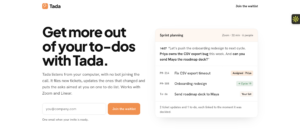
https://tada-landing.vercel.app/
We’ve posted in reddit groups and also sent it out and pubbed it in whatsapp group chats, so far we have 1 signup, but we will keep monitoring and updating the blog post as we get more.
Reddit post is here: https://www.reddit.com/r/PMCareers/comments/1xgcrtk/pms_are_you_also_tired_of_manually_updating/
Story Map & User Stories
Our story map follows PMs and engineers as they keep track of project changes, manage their to-do lists, and catch up on meetings they missed. For our MVP, we’re focusing on a simple log of Linear ticket updates, like to the original tickets, one place to access meeting conversations, a chat tool that can answer questions using meeting transcripts, and a personal to-do list.
- As a PM, I want to see a history of changes made to Linear tickets, so I can keep track of project updates without checking every ticket individually.
- As an engineer, I want to click on an update and go directly to its Linear ticket, so I can quickly see what changed.
- As a PM, I want to have meeting transcripts in one place, so I can easily go back and find important discussions or decisions
- As a PM or engineer, I want to ask a chatbot questions about meetings I missed, so I can catch up without having to ask someone to explain everything again.
- As a team member, I want to add tasks to my personal to-do list, so I can keep track of what I need to work on.
- As a PM, I want to understand the context behind project changes and decisions, so I can make sure everyone on the team is on the same page.
Readings & Learnings
One thing we learned from our interviews is that alignment is not just about communication, but also about making sure decisions are actually followed through. PMs spend a lot of time in meetings, coordinating with different teams, and keeping track of what needs to be done. Even when everyone agrees during a meeting, keeping track of changes and responsibilities can still be difficult.
Initially, we were looking at alignment as a broader problem, but we decided to focus on something more specific that we could realistically solve. Our product now focuses on turning meeting discussions into actionable tasks and connecting them to tools PMs already use, like Linear. We also want to avoid creating another tool that PMs have to constantly update manually, since that would just add to their workload.
One idea we used from Teresa Torres’s Continuous Discovery Habits was separating the opportunities we identified from the solutions we came up with. This helped us explore different approaches before deciding which features to prioritize.