Quibi was a short-form streaming service that generated content just for mobile phones. The riskiest assumption they were betting on is that people were willing to pay for short-form content. In my research, I found it extremely interesting that this service was launched right before Covid, which is when TikTok really took off as people were watching (less professional) short-form content from home.
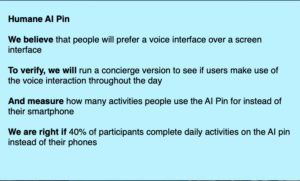
The Humane AI Pin was a wearable AI assistant that worked through voice control and was supposed to serve as a screenless alternative to smartphones. The riskiest assumption they were betting on was that people would prefer a voice interface over a touchable, screen interface. I found it particularly interesting that even though the product was built by two ex-Apple employees, they did not recognize the need to have the AI pin integrate with smartphones and push to market the pin as an additional technology add-on.
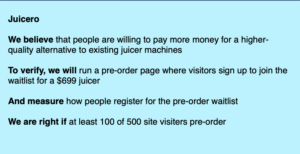
Juicero was an internet-connected juicer that pressed fruit and vegetable packets also sold by the company. The riskiest assumption they were betting on was that people were willing to pay more money for a higher-quality alternative to existing juicer machines. I was most shocked by the fact that this juicer could not juice anything other than the packets sold by the company.
This was an interesting exercise to learn just how important it is to identify and test assumptions and also to learn about some of the obviously doomed ideas that managed to raise large amounts of money.