
1. Synthesis
Raw Data on Sticky Notes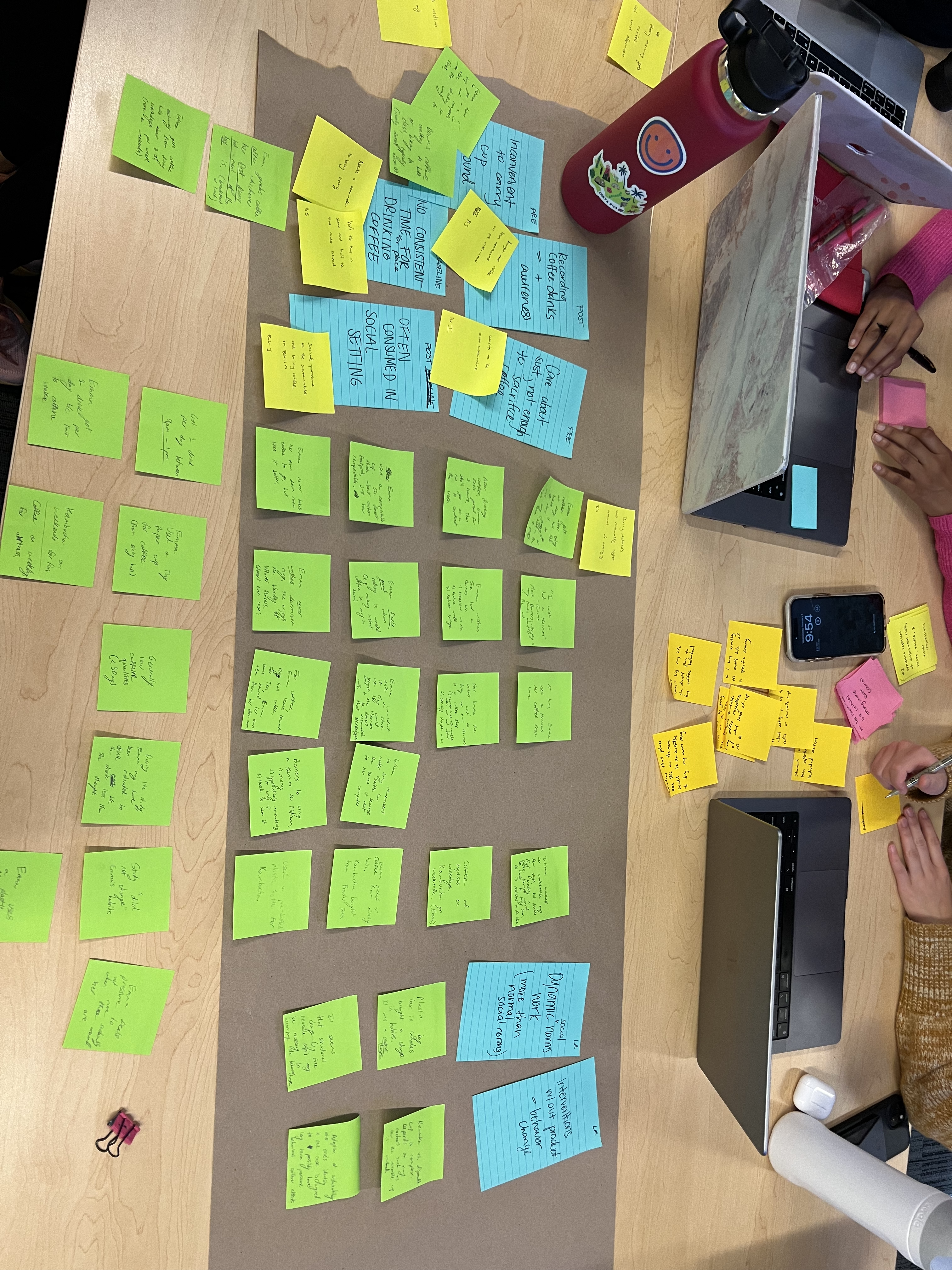
Affinity Grouping
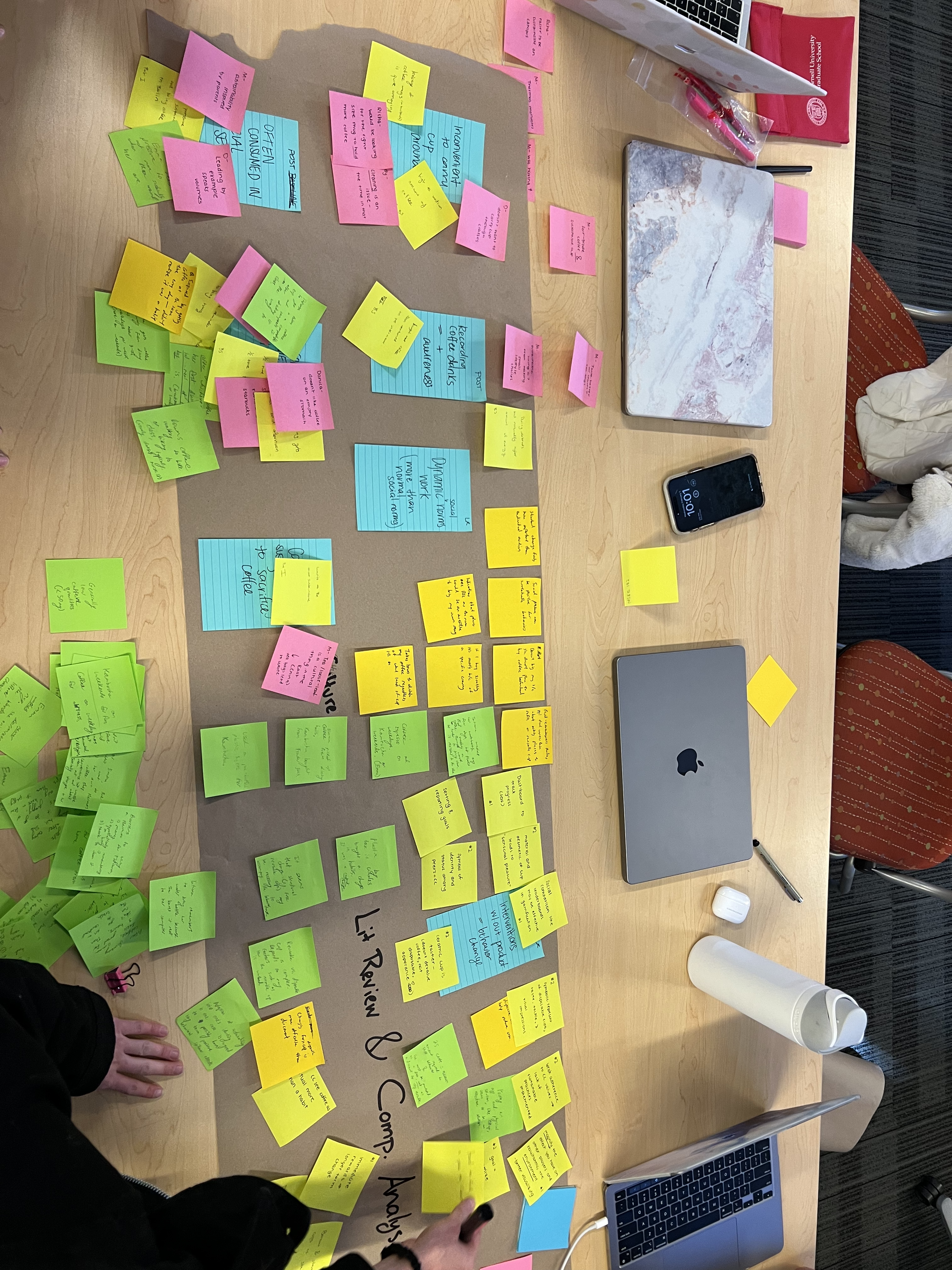
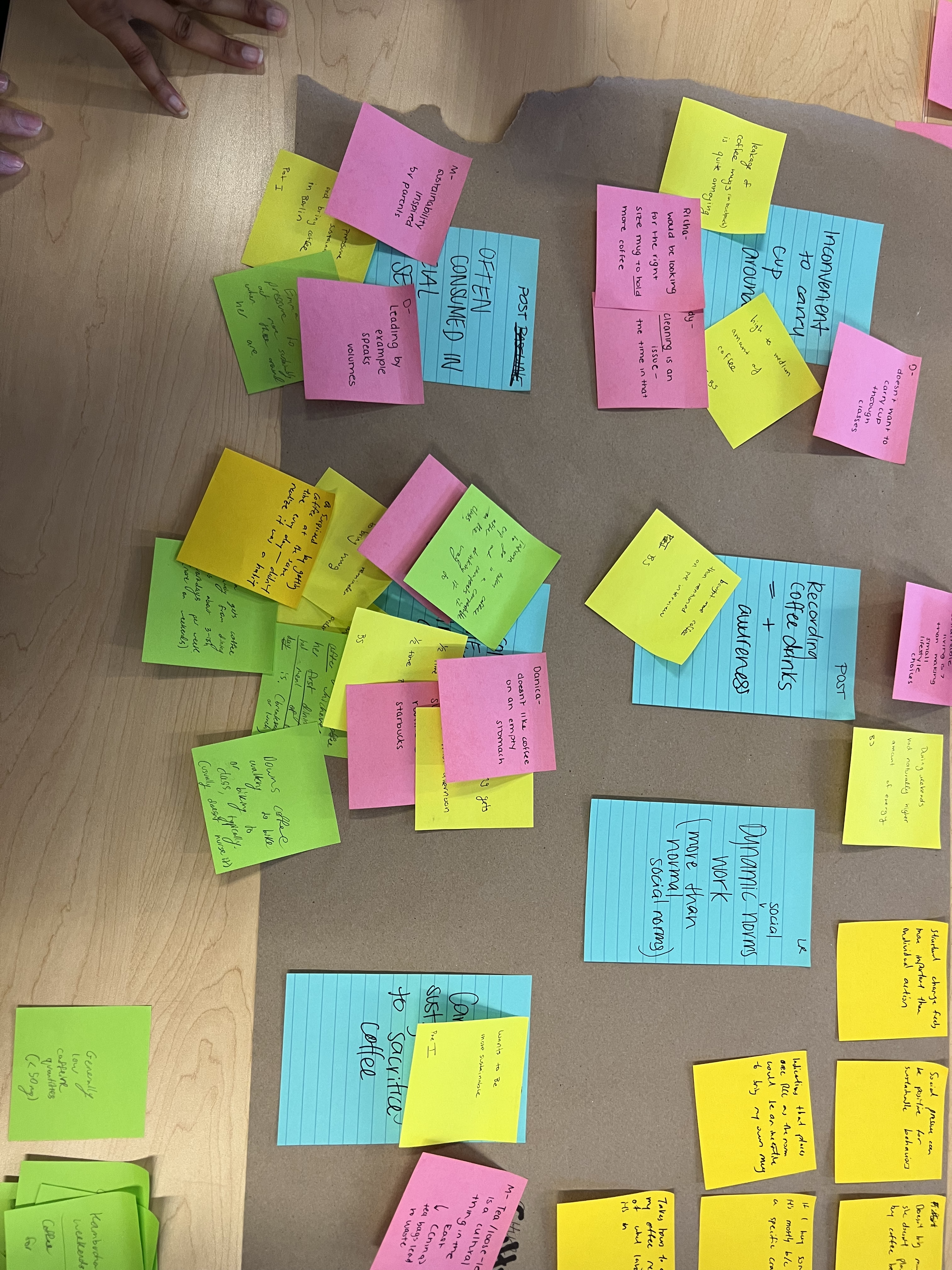
📖 After transferring our raw data of our literature review, competitor analysis, and 5-day baseline study from their various forms onto sticky-notes, we employed three techniques to better understand what we had collected. First, we sorted through the mess by using Affinity Grouping to quickly sort our data of similar themes into piles. Our piles ended up being, listed in order of frequency from most to least dense:
- Routines around coffee drinking.
- Social pressures as they relate to both coffee consumption and sustainability
- Problems people experience that prevent them from using a reusable mug. Highlights included washing it, bringing it, and buying it.
- Surprises participants found about themselves in doing the study.
- Desire to be sustainable.
We also had off to the side a collection of lit review and comparative literature datapoints that we mostly omitted from this initial process of understanding the baseline study data, though related content to these themes we included.
From the Affinity Grouping process we were able to glean the following key insights:
- Confirms relevancy of social pressure in drinking coffee
- It is a recurring issue that people don’t like to carry a coffee cup around (take it to class, etc.)
- Routines around coffee are incredibly strong.
The third point around routines sparked out interest especially because routines provide opportunities for us to use triggers and nudges to incorporate habits of sustainability. It also revealed a point of tension: If interviewees don’t plan to have coffee beforehand, it is hard for them to remember to bring a cup. This is why we incorporated lack of routine into the anti-persona. In addition to a lack of interest in sustainability, lack of routine and infrequent coffee drinking makes any solution difficult, even those which transfer responsibility from the individual to the coffee shop or third party because who knows when they will be back to return a borrowed cup.
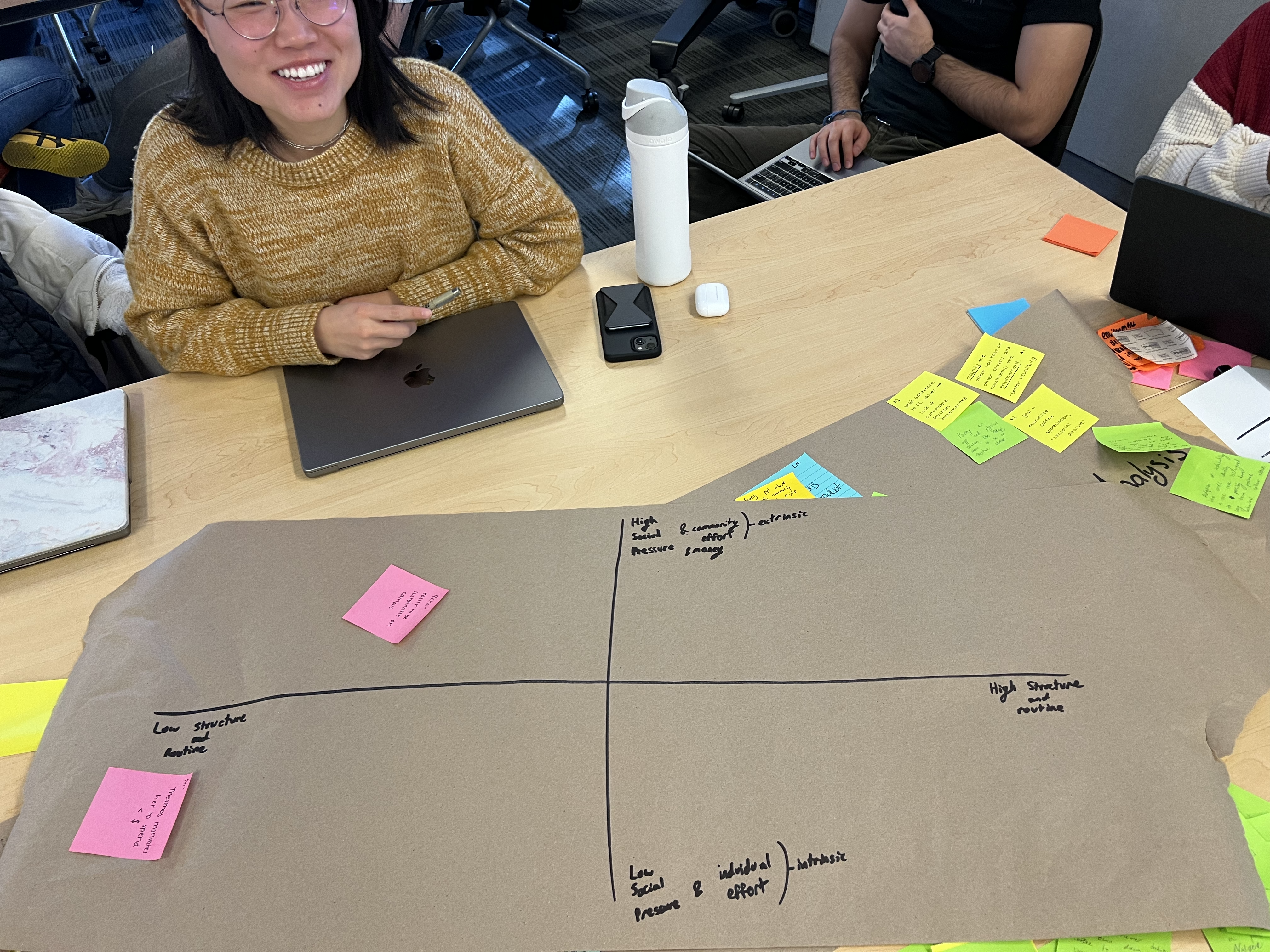
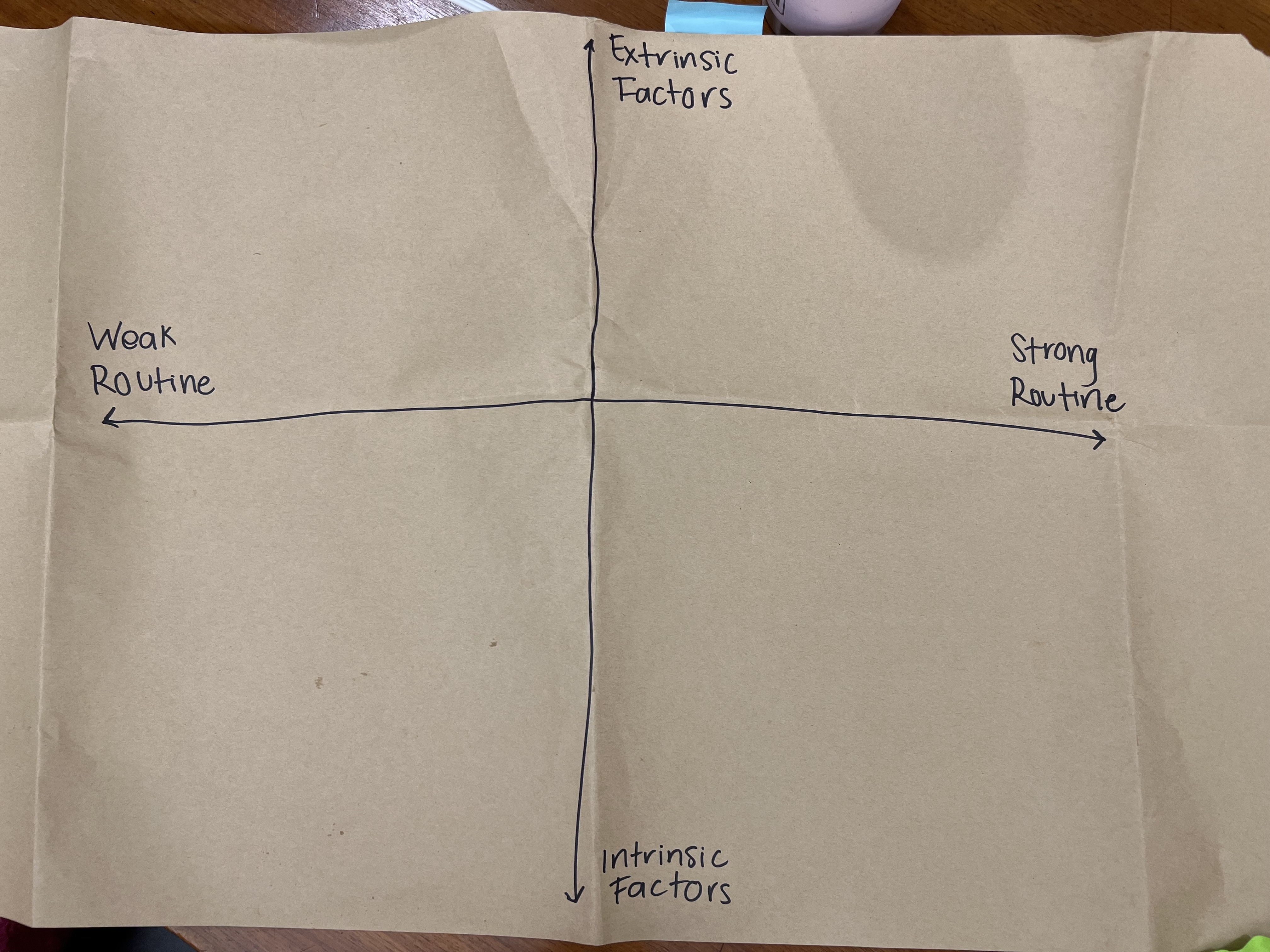
2×2: (Intrinsic factors -› extrinsic factors), (lack of routine -› strong routine)
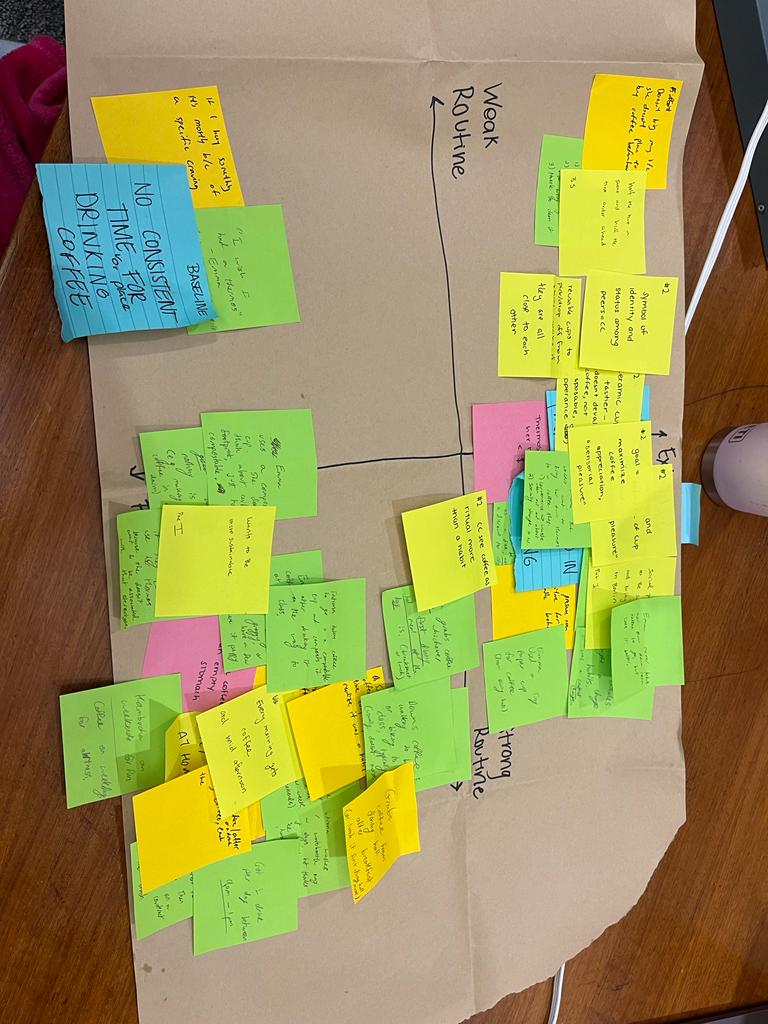
📖 The second mapping we explored was a 2×2 mapping. We used the following axis to re-group our data: (Intrinsic factors -› extrinsic factors), (lack of routine -› strong routine). We found through our Affinity Grouping process as well as taking into account our literature review and comparative analysis information that these axis explored two key aspects of our data that could greatly improve our understanding.
We gleaned the following insights from the process of distributing data across our 2-dimensional plane:
- There are two types of coffee drinkers:
- Those who drink it quickly on the way to a destination (typically class in our target audience) for a specific purpose such as habit / ritual, morning energy, or to prevent a headache. More over this is the profile that usually incorporates coffee-drinking into a routine, sometimes without even realizing they’ve created a habit of coffee drinking.
- Those who have coffee over a long time while participating in activities like work or chatting with a friend. This profile typically drinks coffee more irregularly and spontaneously.
- We also found an intriguing paradoxical cognitive frameworks / rationalization: One participant expressed that they didn’t want to spend money on buying a thermos while the other expressed that their thermos encourages them to spend less money. This provides an intriguing angle for us to consider, should we decide to encourage folks to buy their own thermoses, as the concerns of the initial cost concerns may be lessened with a greater understanding of the psychological effects of owning a thermos when it comes to spending.
- This analysis revealed that the mass of our combined data revealed that there are often strong routines around coffee drinking, as the center of mass of the sticky notes was right of center.
- This heat map revealed that while routine is not highly correlated with extrinsic factors (due to a spread distribution of stickies across quadrants I and II), a strong routine and intrinsic factors with respect to using a reusable mug seem to be more highly correlated, as stickies below center skewed rightward. This is a relationship we explore later in our models.
Journey Map
📖 We then used our understanding gained from Affinity Grouping and 2×2 to create a composite Journey Map incorporating all of our data. We decided to employ this approach because how the critical routine surrounding coffee turned out to be. As a result, we thought this would be an effective way of visualizing said critical routine and exploring what additional insights we could squeeze out of our data. Additionally, from this data, we were able to determine what the most crucial aspects to consider along the axis were to include in our personas’ individual journey maps as well as which personas best a and worst encapsulate our target audience, which we discuss in depth below.
From this composite journey map with sticky-notes we were able glean the following insights:
- Our data shows that people don’t usually carry their coffee around all day, and instead consume it at finite and distinct points throughout the day. This insight came from the data at the location (Actions, Drinking Coffee).
- We learned a crucial insight about the “strong routines” of our target audience. In particular, our target audience often gets coffee around breakfast/lunch time, and for those who get it at dining halls, it is often their first dining hall meal of the day. This insight came from the data at the location (Location, Journey To Coffee)
- We reinforced our understanding again that a major barrier for individuals in using a personal reusable mug is that cleaning coffee mugs is a pain. This insight came from data at the location (Pains, Post-coffee-activity).
- We were able to compile various research findings, coming to the conclusion that research shows that social pressure can be positive for sustainable behaviors & symbol of identity and status among peers. This insight came from data at the location (Motivation, Drinking Coffee).
- This grouping of data revealed a key contradiction in the behavior of our target audience and the behavior described in our research. Our interviews and data show that our target audience tends to drink coffee as a means to an end. For instance, unless they are drinking coffee socially (much less common), they will often down coffee on bike going to class without nursing it. However, research shows that sensorial pleasure from material and aesthetic of cup is important in people’s choices of what to drink coffee out of — revealing more detailed insight about the two groupings of people initially discovered in the 2×2 process, explained above. This insight came from data at the location (Motivation, Drinking Coffee). Often, reusable mugs are touted as being touted as better coffee drinking experiences as compared to disposable mugs, which our research verified. However, among out target audience, the coffee-drinking experience was not incredibly important which crucially reveals to us that solutions involving boosting the coffee drinking experience at the expense of practicality may be highly ineffective among our target audience.
Models
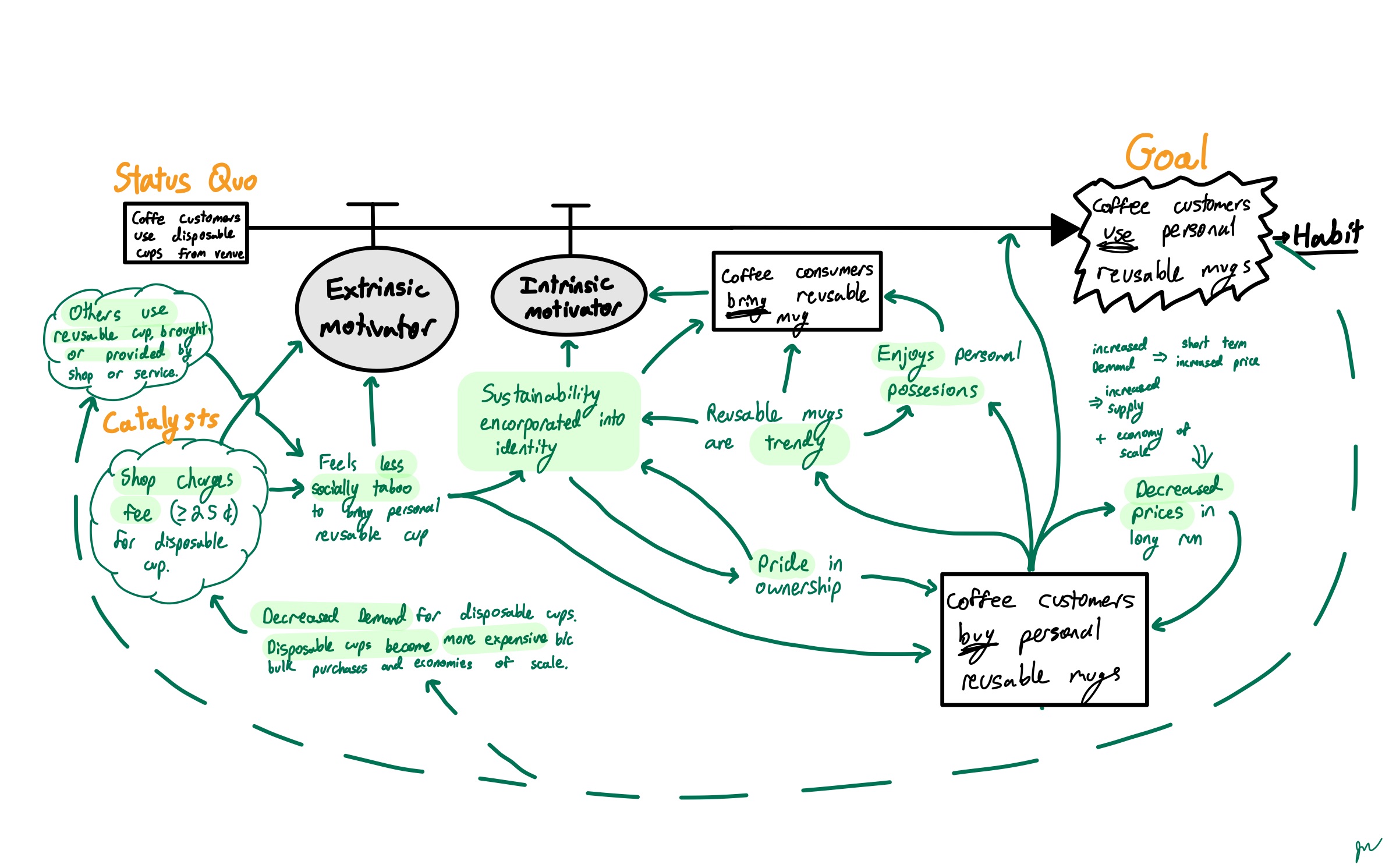
📖 This diagram, similar to a causal diagram with structure inspired by stock and flow to capture directionality, explores the positive relationships between datapoints, diving into the motivations (extrinsic and intrinsic) that fuel use of reusable coffee cups, the directional central axis. We decided to focus on this destination between extrinsic and intrinsic motivation because they reveal different points where we can nudge users and increase that motivation. We also discovered in our 2×2 mapping that this distinction was quite effecting in understanding our data. The diagram uses the data from our diary study to understand the effects of catalysts on user behavior. The two catalysts were the key environmental factors we discovered in our diary study, literature review, and comparative analysis: the social effects of others using reusable cups as well as techniques employed to increase usage of reusables, such as providing reusables or charging for disposables. We used the process of creating this diagram as a way to explore the implicit and explicit loops within user behavior. These catalysts additionally encapsulate all strategies we discovered in competitors, allowing us to examine which points in this intertwined model offer an opportunity for us to create a new catalyst or strengthen existing relationships between our data.
Through this model, we learned that there are three key points of high traffic in this web of causality loops: two actions, and one feeling. Users bringing and buying a reusable cup sensibly were the two actions with greatest impact on usage, as they are the primary key barriers. We discovered, though, that the extent to which sustainability was incorporated into identity also had a crucial role in the self-perpetuating loop of motivation required to form a habit of bringing a reusable mug. This reveals a key point at which we can consider focusing our efforts. Another set of key points we can examine are the social acceptance and trendiness of reusable cup use. We found in our data, which this model reinforced, that a significant barrier to bringing personal reusable mugs to a coffee shop was the social foreignness of doing such a thing.
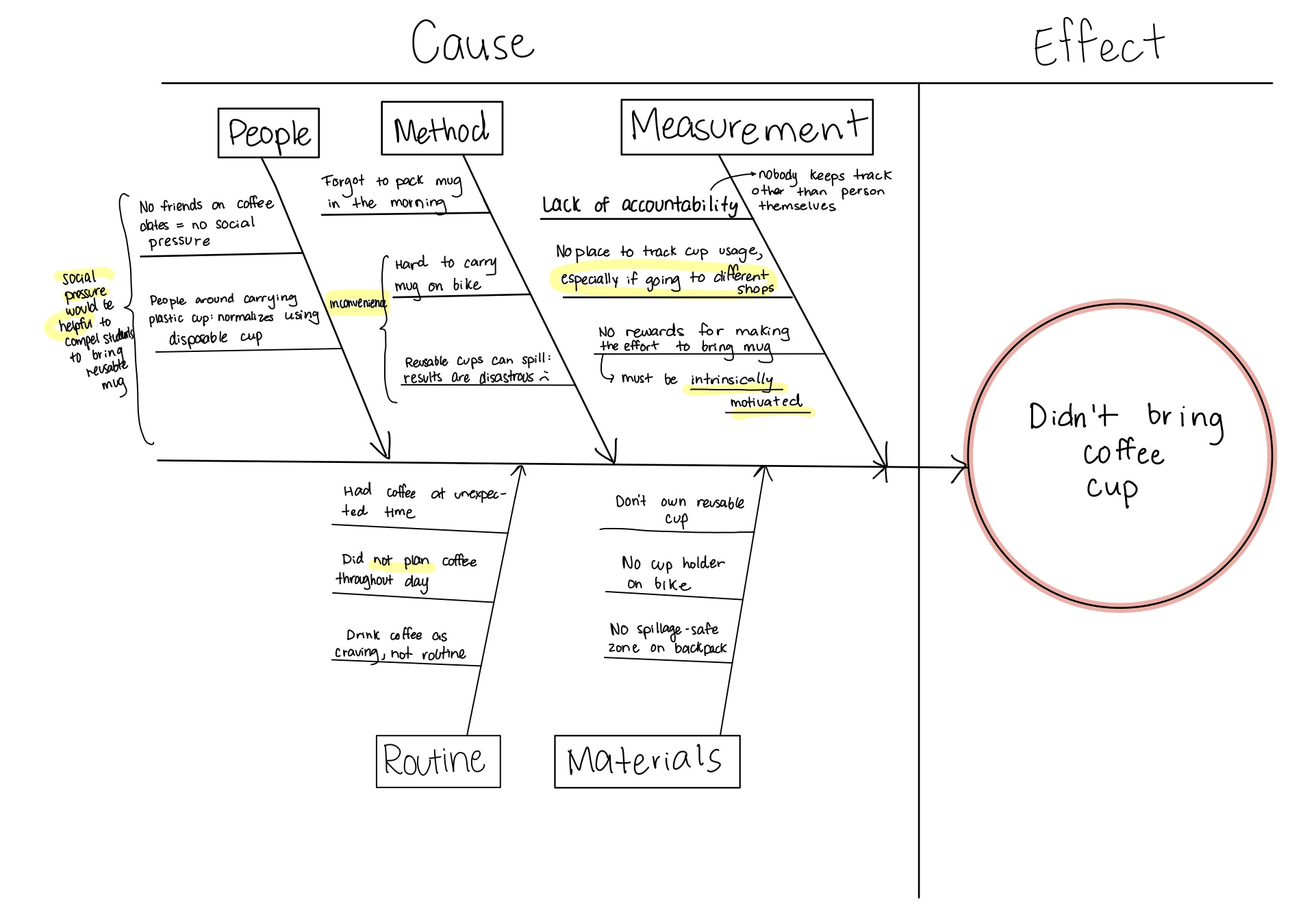
This model was used to encapsulate all the reasons our interviewees and our studies (comparative, lit review) suggested for not using a reusable coffee cup. This model was helpful as an aggregator for 1) the inconveniences that using a coffee cup may bring, 2) the conveniences that disposable cups afford, and 3) the habits that dis-enable users to remember their cup. This model was particularly helpful in finding solutions to the problems we listed; by having all the factors that lead to an undesirable outcome, we were able to brainstorm exhaustive solutions to them. In addition, this model highlights the most influential factors in not bringing a coffee cup, namely: methods, routines, people and measurement.
2. Proto-Personas and Journey Maps
Persona 1: Coffee Shop Clara
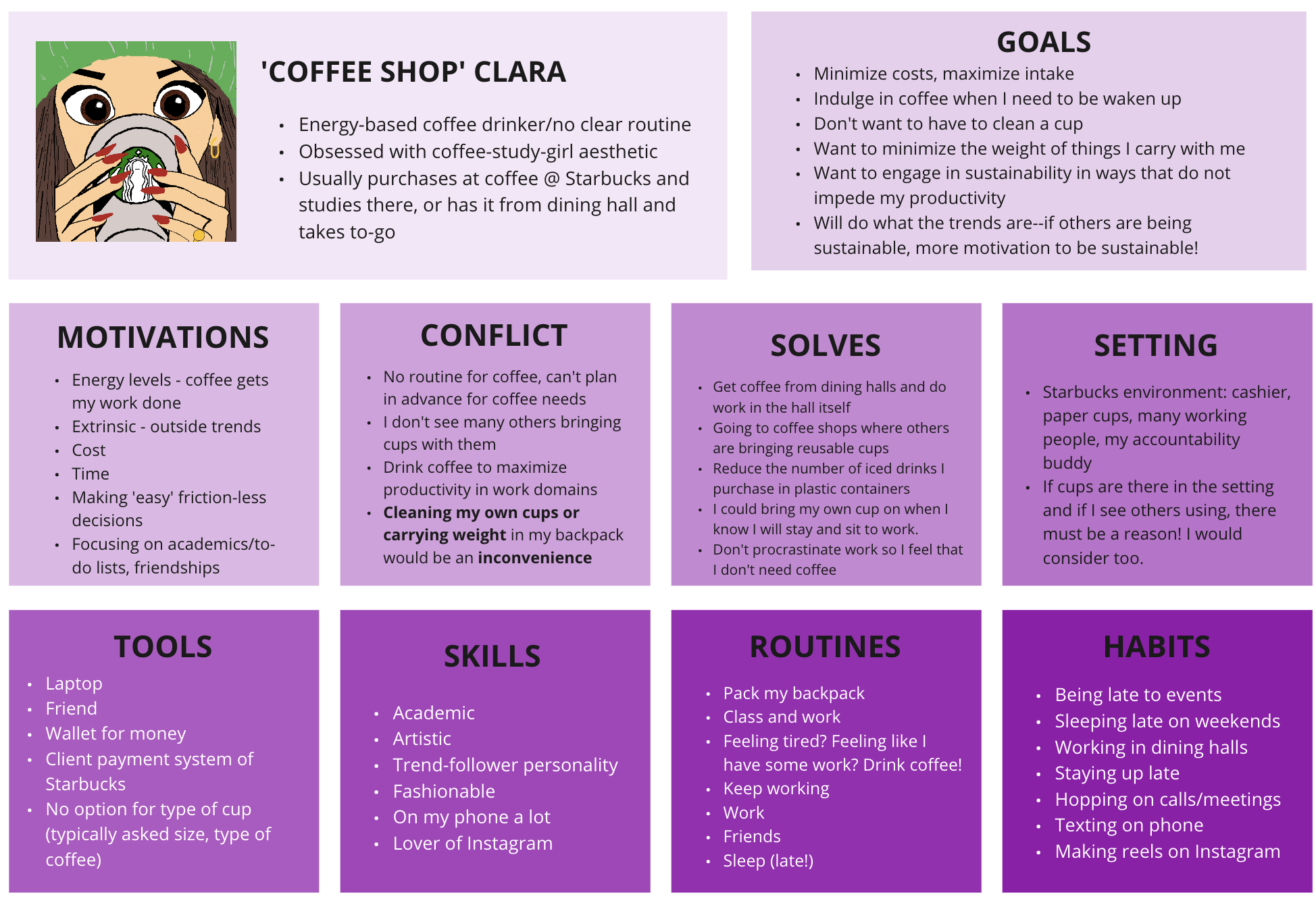
We first wanted to explore a common persona we saw of some coffee drinkers that we interviewed and studied. These coffee drinkers drink coffee almost every day, but does not have routine in terms of when. When they do get coffee, they get coffee at Starbucks or CoHo on campus, or if they are feeling stingy, they grab coffee to-go at the dining hall. They are typically motivated by extrinsic factor and are a trend-follower, active on social media and wanting to actively become more trendy. Mapping out this persona from our interviews and preliminary study, it might look something like this:
As a result, we can map out this persona’s irregular journey map step-by-step, and the pains/gains we see along the way as they decide to get coffee out of the blue and pursue their busy schedules:
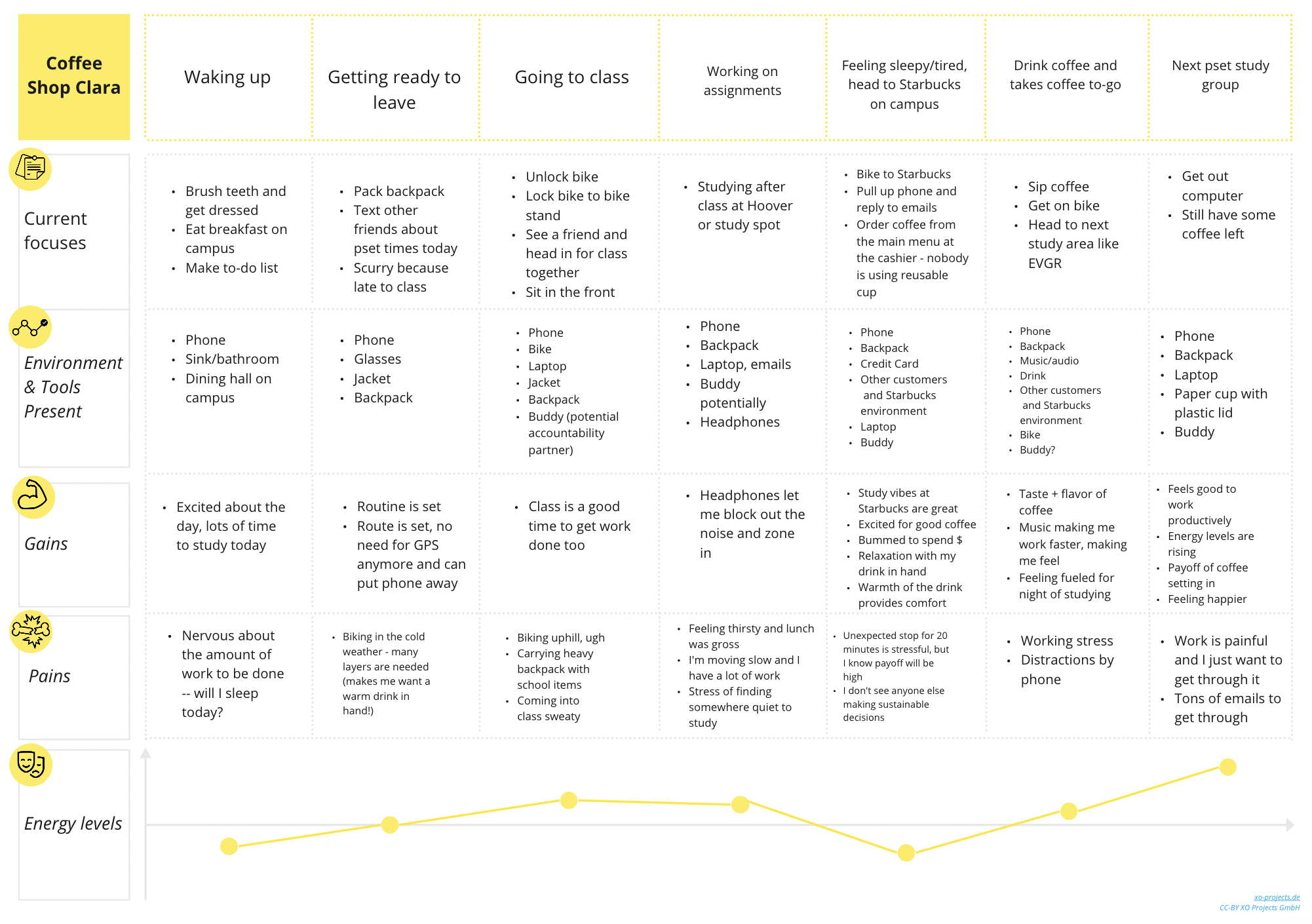
From this, some key insights we can derive are:
- Energy levels dropping can be detected before coffee purchase and can correlate with the decision to purchase coffee and go through the pain of temporary “un-productivity” in return for prolonged productivity late at night.
- When the purchase occurs, extrinsically-motivated individuals rely on their environment more to decide whether or not to be sustainable. For instance, without presented a choice at the counter to make a sustainable decision/without seeing others make a similar choice, this is a difficult tradeoff.
- Items Clara would carry all-day (since this habit is irregular), include her phone, backpack, and she is typically around others like an accountability buddy who could help her make more sustainable decisions. We could explore modular solutions through these vectors to insert a behavior modifier.
Persona 2: Ritual-driven Riley
The second persona that we identified is the habitual coffee drinker who sees the coffee-getting process as a ritual that is part of their daily routine. Usually, people falling into this persona are also very organized when it comes to scheduling out their day and planning out where they’re going to get coffee and when. Usually, they drink coffee in the morning, either by making it themselves or by going to a coffee shop that has a calming aesthetic (think Backyard brew, Coffee bar). They see coffee as a calming, grounding experience that not only puts them in a productive, alert mindset, but also provides a sensory experience. Coffee just tastes so good!
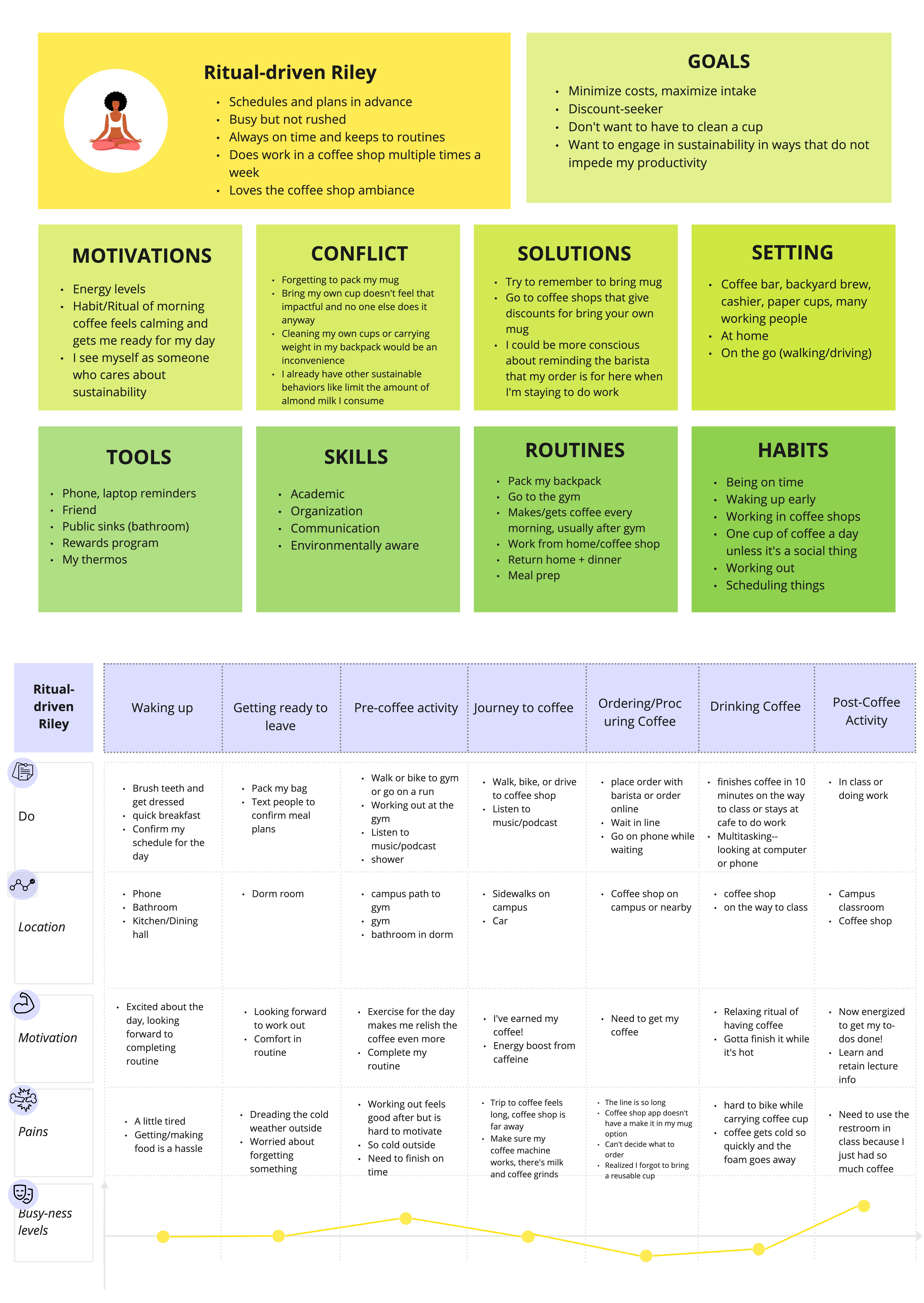
After creating the ritual-driven persona for Riley, we took sticky notes with insights from participants who fell into the ritual-driven Riley persona and mapped them to the morning stages of their day, from waking up to getting coffee.
From this, some key insights we can derive are:
- Points with lower busy-ness levels might be good times for an intervention like getting them to pick up or drop off a reusable cup, especially when they’re waiting in line or on their way to get coffee
- People drink their coffee immediately and finish within 5 minutes might see even less of a point to having to carry around a mug all day since they don’t need the portability aspect of grabbing coffee to go.
- Ordering ahead doesn’t have an option to make the coffee in your own reusable cup
Person 3 – Carefree Clara
In the end we wanted to explore our anti persona. Someone who would not be the easiest of targets for our intervention, however, if our intervention works on this type of persona it would work on all other types of persona. This type of persona would be one of the the last personas we would want to target at the beginning of the study nor focus our attention to, but it is good to take into consideration when brainstorming interventions that could even break the habits of the “anti-persona”.
Carefree Clara is a student st Stanford University majoring in History, she spends her time at the library writing her papers and only goes to coffee shops to socialize, especially Coupa outside of Green. Clara would perhaps be an anti persona for us as she does not have a regular routine for drinking coffee because she only drinks coffee when she socializes or when she extremely needs coffee as she has a late night ahead. Clara does not really think about her environmental impact as where she grew up in latin America, it is not something spoken about, nor made conscious about. She never really thinks about her carbon footprint hence never thinks about how her habits are affecting the environment and how they should or why they should even change.
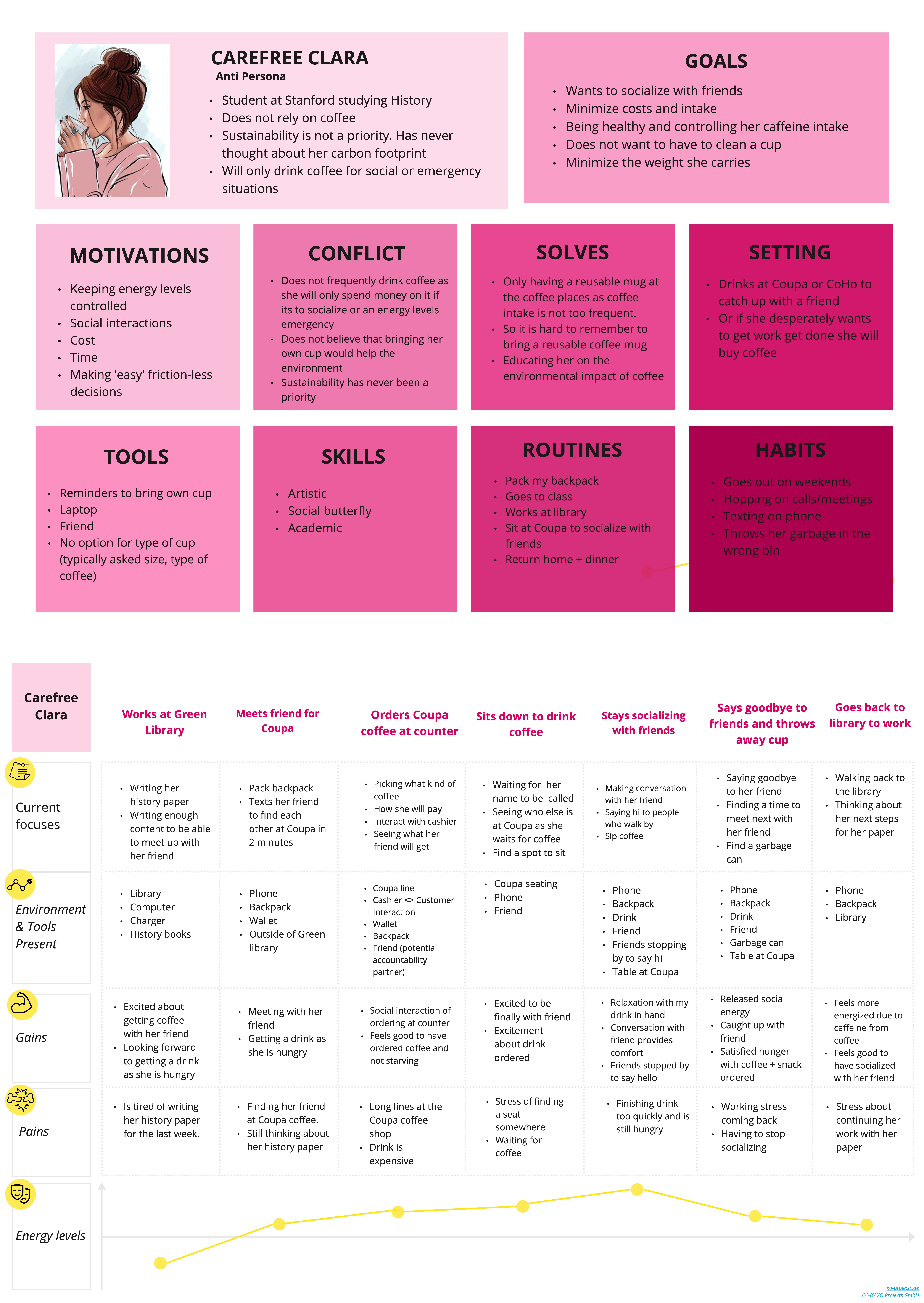
Clara is not our most obvious customer nor would be the easiest target, however, if we could make Clara make the slightest changes to her behavior and consume the coffee in a reusable mug, then we can create this change for many other people. This persona and journey map are useful in order to understand the person’s perspective, what goes through their mind, their emotions throughout the process of getting coffee, what are their motivations and goals, etc. Clara is a fictional character that represents the characteristics and motivations of a user group, allowing me as the product designer to empathize with their users and make design decisions that better meet their needs. Journey maps, on the other hand, illustrate the steps a user like Clara takes in achieving a goal or completing a task, giving designers insight into pain points and opportunities to improve the user experience. By combining all of our different personas and journey, as designers and coders, we will be able to create more effective, user-centered designs that meet the needs and expectations of our target audience, but ultimately changes their habits.
4. Ideation (Top 3 Ideas)
Intervention Idea: Smart Thermos
Smart Thermos Experience Prototypes
- Personal Numeric Tracker: that tracks how many drinks it fills up with. App that helps sustainability feel part of identity.
- Intervention: personal, numeric tracking (ie coffee journal) —> sends you an update with a visual # after each entry
- Social-Comparison: Compete with leader boards
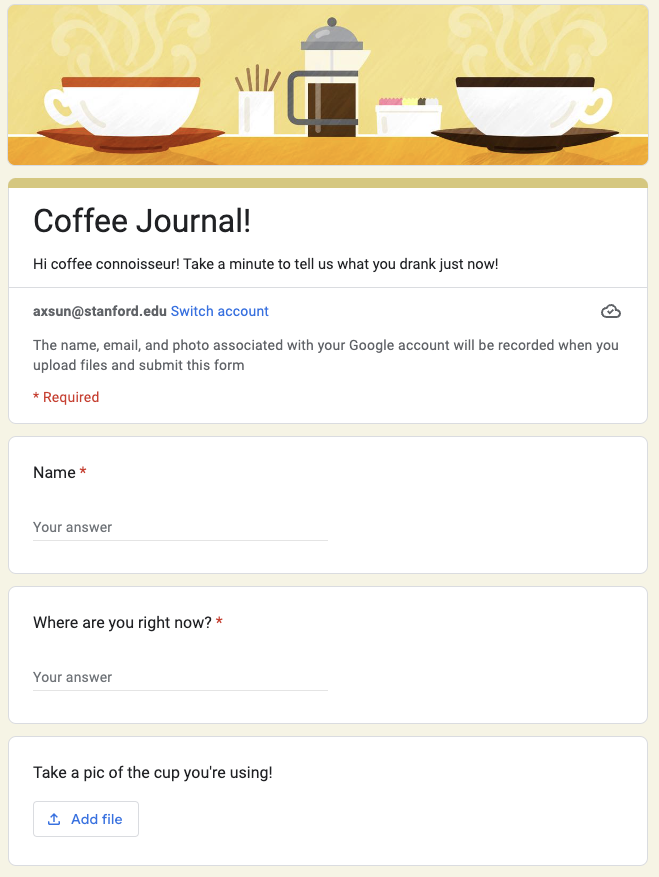
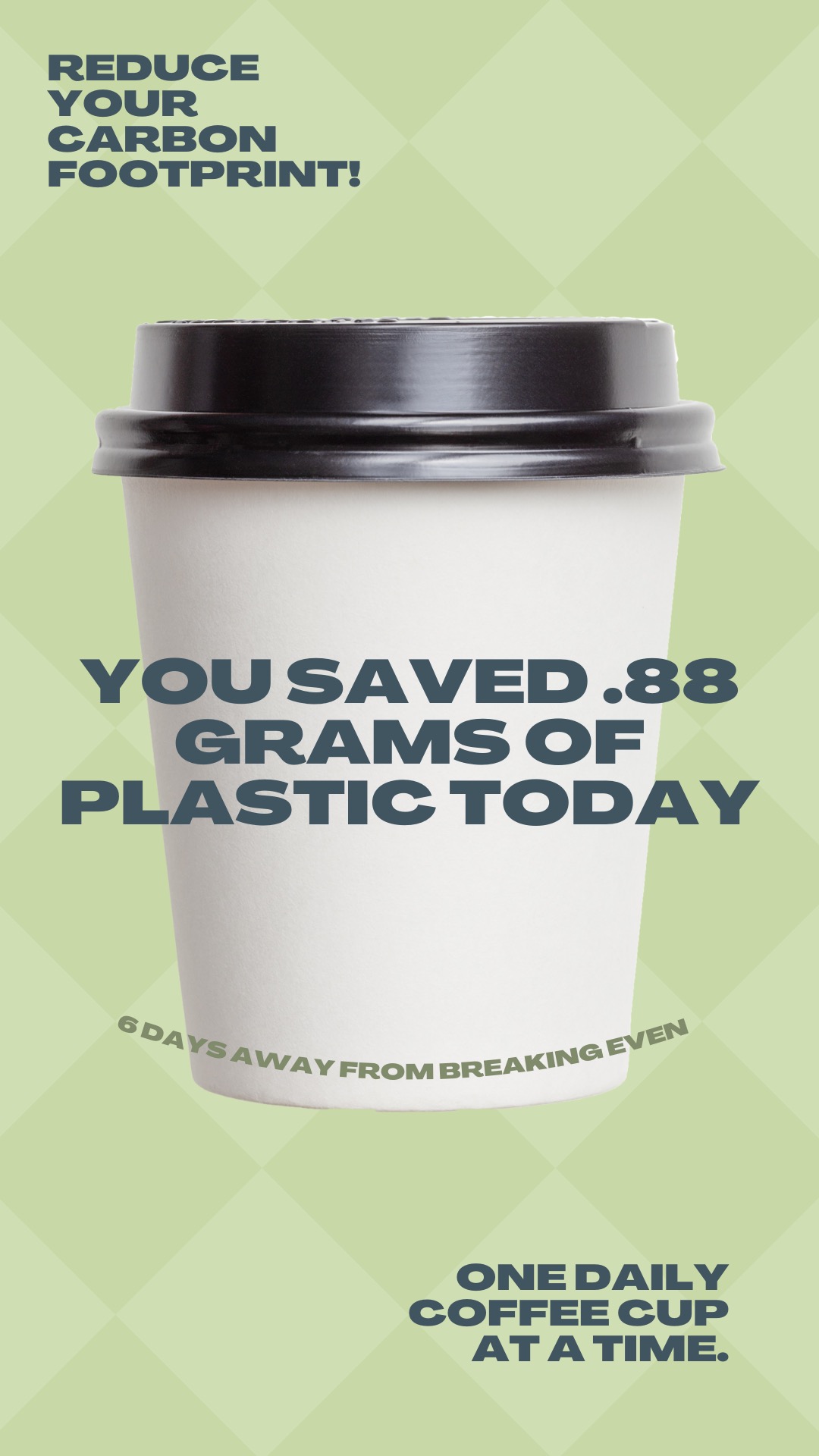
- Intervention: competing/leaderboard character for reusable mug usage —> user fills out Google form, we send them an immediate visual via email based on what level they are, and then they get dashboard at the end of the day showing who is #1, #2, #3
- Story-Based “Build Your Own Adventure”: You have a little character (build narrative) that is traveling through different settings, moves forward as you go through your day and when you use a reusable cup, gets some special prize in the app.
Pros:
- According to lit. review studies, gamification has had significant impact on sustainability practices
- Many of our studies found that social pressure can drive the use of reusable cups. Adding the social aspect to the leaderboard might be helpful to see change.
- Competition increases motivation!
- The intervention can be carried out with little to no financial investment
- We get to test instant gratification, and whether that makes a difference
Cons:
- It may be hard to do a “low-fidelity” version of this, since the solution in the app is kind of unique in the technology involved
- A purely extrinsic motivation (coming from social pressure) to save cups could be unsustainable in the long term
- The Google form may not be a particularly good representation of how the smart Thermos would work — the experience would be more fun.
Intervention Idea: Coffee Fountain
Coffee Fountain Experience Prototypes
- Simulate Coffee Fountain: Set up a booth on White Plaza where our participants can come to get coffee (provide no cups, only serve when people have their own containers)
- Put coffee in water gun to simulate coffee fountain
- Coffee dispenser: We fill a large gatorade-style dispenser with coffee. We set it up in white plaza and then we let our participants stop by and dispense coffee from it in their reusable cups (personal or we provide for the week – they are responsible for cleaning).
Pros:
- Experience in the intervention is very similar to high-fidelity coffee fountain experience
- Researchers (aka us) get to experience participants thoughts and experience first-hand (rather than through a report)
Cons:
- We need $$, which we don’t have, to get dispenser and coffee
- Hard to track people who come and go / conduct post and pre-interviews, etc.
- May need more than five days with the booth for people to start building the habit of bringing their coffee mug.
Intervention Idea: Campus-Wide Reusable Cup Program
Campus-Wide Reusable Cup Program Experience Prototypes
- We play the role of campus-wide program or third-party service: Give participants reusable cups, text us when they have a used cup and are heading to a coffee shop to get a new drink. We’ll come meet them at the coffee shop, give them a new cup, and then go wash their old one to put it back into “circulation”.
- Coffee-shop-centric program: We give the coffee shops a set of 10 cups, participants go and get coffee in these cups, take it to-go, and give them back to coffee shop whenever. Coffee shops gather the returned cups and we wash them and give them back to the coffee shop. Participants can start the cycle over again when they come to order coffee at the coffee shop.
Pros:
- This intervention solves the problem from the root; that people forget their coffee cup
- Coffee cups can be used more times, offsetting the carbon emissions, as they are a part of a rotating program
Cons:
- Complicated logistics for a week-long study and students balancing a full-time school schedule as well
- Really hard to coordinate the times in the day to deliver the coffee cup
- The complex procedure may change the natural behavior of the participants (i.e. they may not want to get coffee) or drive them away from the study
- This solution is popular and present in a couple of our competing companies
5. Intervention Study
Intervention study description: We decided to go with the social comparison intervention, where we would create a leaderboard for reusable mug usage and allow users to compete for the top spot by becoming the #1 reusable mug user. We also provided a little extra incentive by offering a mystery prize.
Rationale: We felt that because our target user’s motivation to develop more sustainable habits is intrinsic, gamifying their use of a reusable mug wouldn’t be a forced venture of generating motivation but rather a framework that would allow users to channel their motivation more tangibly. The social comparison intervention allows us to create a community of people who are engaging in reducing disposable cup waste and set community norms of asking to take their coffee in a reusable cup. We heard from a lot of interviews that people either weren’t sure about or didn’t feel comfortable with asking coffee shops to make a drink in their own mug. So we figured that by creating a greater presence of a community of people who are all trying to use reusable cups, we could counter this anxiety and give our participants more confidence in using their own mug.
Conducting the study: Over the course of 5 days, our participants will receive a reminder text in the morning and in the afternoon about filling out a google form whenever they get a coffee and choose to use a reusable cup instead of a disposable cup. At the end of the day they’ll receive via text a recap of their reusable cup use for the day, as pictured below, as well as an update on their current standing in the leaderboard. At the end of the 5 days, the winner will be announced and a weekly digest of where they got coffee, what drink they hand, how much total waste they saved will be sent out to all participants. Unbeknownst to our participants, the winner will be treated to a cup of coffee (in their reusable container, of course).
Recruitment: To keep a balance of new and old participants, we kept 3 participants from our diary study and introduced 5 new participants, some of whom we had already screened for our previous study. For the wholly new participants, we did a short round of pre-interviews where we made sure they drank coffee consistently, were at least somewhat interested in sustainable behaviors, and usually obtained coffee from places that only offer disposable to-go containers.
Key questions: The core assumption that we wanted to test is whether increasing positive social pressure around avoiding disposable cups via gamification would increase user motivation in building the habit of using a reusable cup for coffee. Another assumption that we are hoping to test by sending out the daily summary and end-of-week digest is whether people will enjoy having a coffee journal, where they can keep track of their preferred coffee shops and the drinks that they’ve tried. Furthermore, the locations that they frequent for coffee might tell us which coffee shops on campus feel more eco-friendly and make participants more likely to engage in reusable cup use.



