
For Measuring Me Take 2 I tried to change a behavior that I struggle with in school, but not really when I am back home with my family. The behavior I sought to change is snacking constantly throughout the day. This behavior has a very negative impact on my day because I snack even though I am not hungry in an anxious manner and then when it’s time for a meal, I am no longer hungry. This imbalances my meals, which at home are very nutritious and balanced in terms of the nutrients I am getting, and in school become less so as the snacks I eat are not particularly healthy or varied.
I measured my behavior for 6 days – 3 of which I was on campus, and 3 of which I was in Tahoe in the ski team cabin.
Data Collection
Day 1 – Thursday 1/11 – Stanford
- Woke up, went to hike the dish, and had a coffee before heading to the class I’m TAing
- After class, I bought a pack of chips and ate it while I did some homework
- I hadn’t made plans for lunch, and I had just had chips so I didn’t go eat during lunchtime
- I went to Verve at 1:30 pm and had coffee and a croissant
- Came back to campus and sat down to do work – at some point made popcorn and ate it while doing work. I also ate a pack of baby carrots.
- Ordered a poke bowl for dinner. Ate half of my poke bowl cause I was kind of full
- Went to watch Anyone but you at the movies with friends, had some popcorn and a soda
Day 2 – Friday 1/12 – Stanford → Tahoe
- Woke up, went to hike the dish, and had a coffee and some oatmeal
- At 10:30, I got in my car to drive to Tahoe
- Stopped for lunch at a Taco place in Davis. I had a burrito bowl and finished it since I had been driving, not snacking that morning
- Arrived at the ski team cabin, left my things, and went to practice from 4 – 7pm at Boreal. Had a granola bar and a coffee at 4pm before practice
- Cooked dinner with the team at 8pm in the cabin. We had pasta with bolognese sauce
Day 3 – Saturday 1/12 – Tahoe
- Woke up, had oatmeal for breakfast, went to Palisades to ski
- Skied till 2 pm, went to grab lunch with the team at an italian restaurant. I had a risotto
- Went to visit some friends. Spent the afternoon in their cabin. We cooked chicken and salad together and ate that for dinner. Again I ate all my meal as I hadn’t been snacking in between
Day 4 – Sunday 1/12 – Tahoe
- Woke up, had avocado toast for breakfast, went to Boreal to ski
- Went to lunch after practice with the team to Burger Me
- Grabbed coffee at 4 pm with a friend and went to visit my other friends at their cabin
- Went back to the ski team cabin and we cooked salmon and grilled vegetables as a team and ate together
Day 5 – Monday 1/15 – Tahoe → Stanford
- Woke up, skipped breakfast, went to Palisades to ski
- Ate a croissant and coffee at 10 ish
- Headed back to campus at noon
- Stopped at Trader Joe’s and bought a bunch of snacks for the road (including the trader joes curly fries, chocolate almonds, Harvest Snaps, kettle corn, and pita chips)
- I drove from noon to 7 pm because there was a lot of traffic, snacking throughout the way
- I got to campus and started doing work. Around 9 I had a pack of cheese its
- Later that night I had yogurt with granola
Day 6 – Tuesday 1/16 – Stanford
- Woke up, skipped breakfast, went to the dish
- Went to the class I TA
- Had a croissant at coupa around 11
- Went back to 680 for lunch and had a salad from the salad bar and a yogurt
- Went to class at 1:30, ate a bag of chips in class
- Went to do some work, I was quite stressed about how much work I had. I ate a lot of popcorn (a large bag) while I worked.
- Went to a club board meeting at 6pm. I had some, chocolate pretzels, doritos, and cookies.
- Ate avocado toast and yogurt with granola around 9 pm
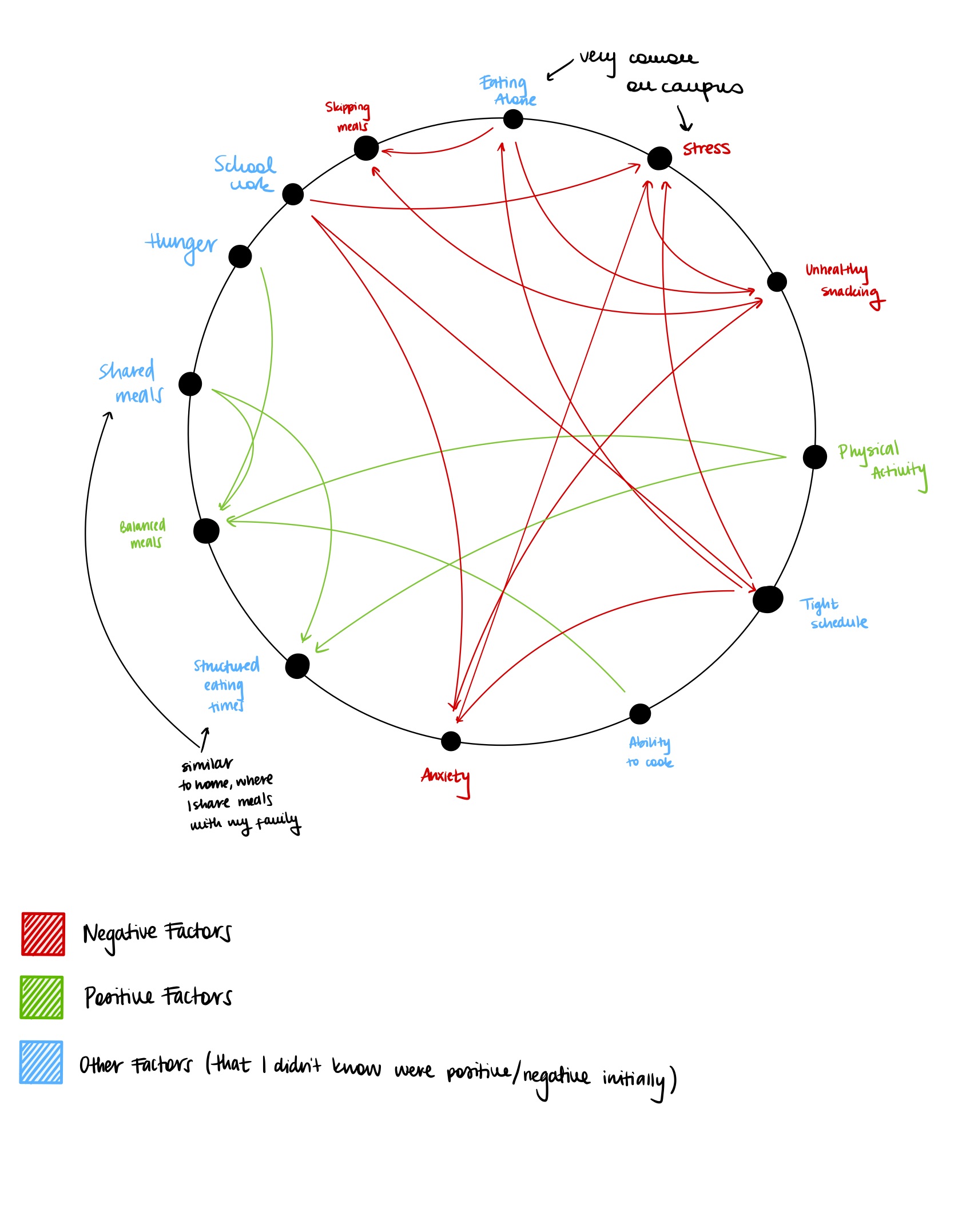
In the diagram, red text marks the negative factors affecting my eating habits. ‘Stress’ and ‘Anxiety’ are identified with this color, indicating their harmful influence that often leads to my unhealthy snacking and disrupted meal patterns. Positive factors are in green text, which includes factors such as ‘Physical Activity,’ and ‘Balanced meals’, which are commonly known to promote healthy eating and I had identified as having a positive effect before this exercise.
Other factors such as ‘Eating Alone’, ‘Ability to cook’, and ’Structured eating times’ are highlighted in blue text, which I’ve used to label factors that I initially didn’t categorize as strictly negative or positive. These are neutral factors whose impact was less clear before completing this exercise and creating this diagram.
The diagram shows that stress and eating alone are central nodes for negative impacts, suggesting these are key areas to address to change the behavior. The positive factors, on the other hand, are all interconnected, indicating that reinforcing one positive habit, such as shared meals, could have a beneficial impact on others, like balanced meals.
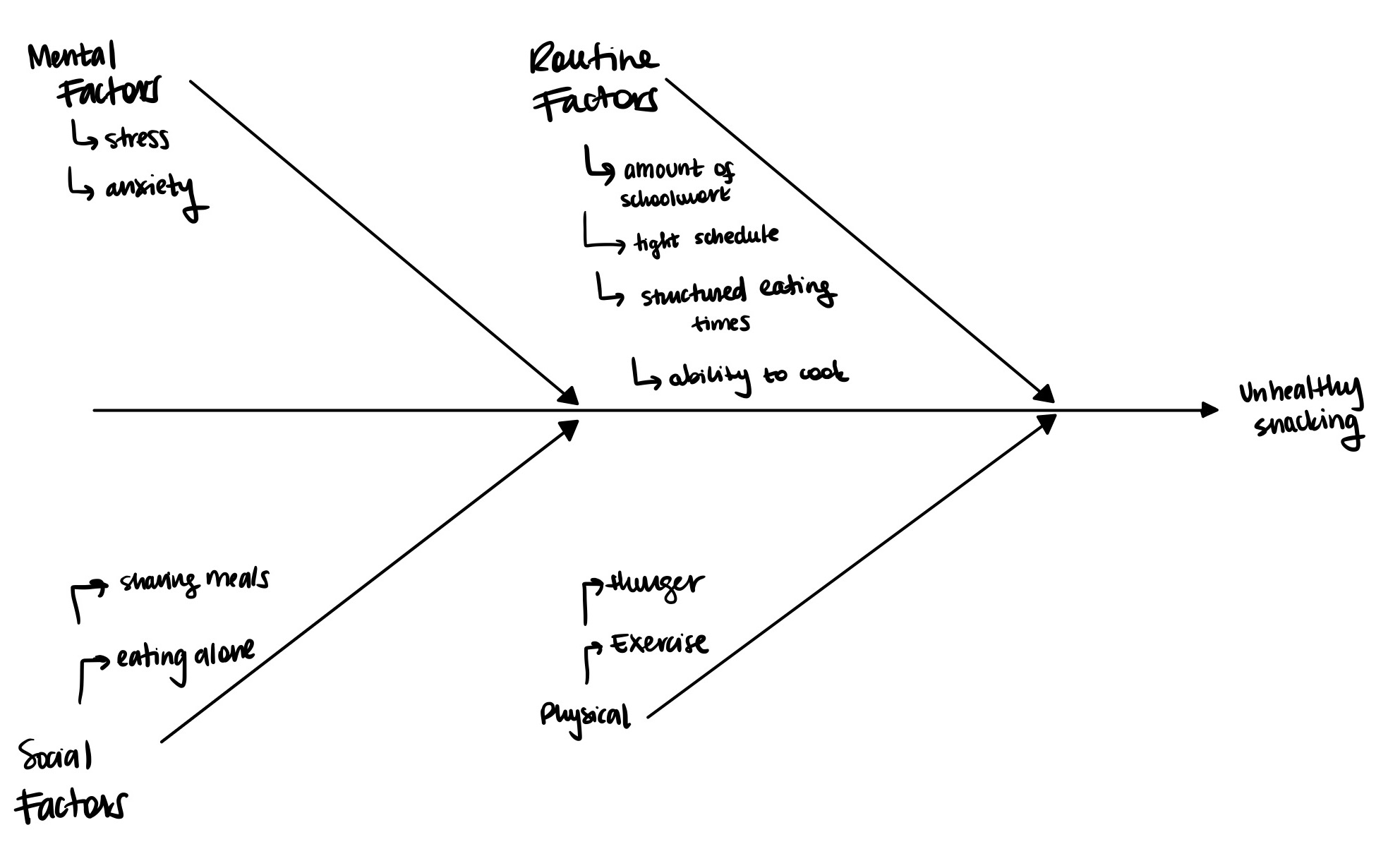
Observing my data and creating the Connection Circle and Fish diagram, I noticed a clear pattern in my snacking habits that differs between my time at Stanford and my stay at the ski team cabin in Tahoe. At Stanford, my snacking is frequent and often replaces proper meals. For instance, on Day 1, I snacked on chips, popcorn, baby carrots, and later, only ate half of my poke bowl for dinner. This pattern is consistent throughout my days on campus, where I often find myself reaching for snacks, like chips or popcorn, instead of having structured meals. This behavior seems to be influenced by my busy schedule and perhaps stress, as evidenced on Day 6 where I indulged in a large bag of popcorn and various snacks during a stressful work session.
In contrast, my time in Tahoe shows a marked difference. There, my meals are more structured and wholesome. For example, on Day 3, I had oatmeal for breakfast, risotto for lunch, and a balanced dinner of chicken and salad without snacking in between. This pattern is consistent across all days in Tahoe, where my meals are more substantial and I’m less inclined to snack. This could be due to a combination of factors like a change in environment, being more physically active, and having communal meals with my team which might offer a more regulated eating schedule.
The stark contrast in my eating habits between the two locations is intriguing. It suggests that my snacking behavior at Stanford might be more linked to environmental and emotional factors, like stress or the convenience of snacking, rather than actual hunger. This insight can be crucial for me to develop strategies to change this behavior, like planning meals with friends ahead of time or finding healthier snack alternatives, especially when I’m on campus.
Additionally, the influence of sharing meals appears to be a significant factor in my eating habits. In Tahoe, the communal aspect of meal preparation and dining with my ski team seems to encourage more regular and nutritious meals. This social setting might contribute to a more disciplined approach to eating. For example, on Day 2, we cooked dinner together, which was a well-balanced meal of pasta with bolognese sauce. Similarly, on Day 4, the team prepared salmon and grilled vegetables together. These shared meals not only provided a variety of nutrients but also established a structured eating schedule.
This contrast is quite evident when compared to my experience at Stanford, where I mostly ate alone as I have a different schedule from most of my friends. Eating alone seems to correlate with more frequent snacking and less structured meal times. The social aspect of dining, which is present in Tahoe but lacking at Stanford, appears to play a crucial role in my dietary habits. It seems that the communal experience of sharing meals contributes positively to my eating behavior, leading to more balanced and regular meals. This is also true when I am home, where I always share meals with my family and eat at regular times. Recognizing this could be key in altering my snacking habits at Stanford, perhaps by seeking more opportunities to share meals with others or by creating a more structured meal plan that mimics the communal dining experience.
Overall this was a very useful exercise that allowed me to notice multiple patterns that influence my behavior and have given me hope to be able to change it by changing these other factors.



