
Synthesis
In our first round of synthesis, our unit of analysis was “morning activities” broadly. We started by clustering findings, quotes, and interesting notes from our interviews into categories with a special focus of understanding the morning tasks that participants either mentioned in interviews or in their baseline studies. Many of these had to do with various tasks during your morning routine, what participants wish they could do if they had more time, and how they feel about their phone usage.

A day later, we did a second pass at this clustering to see the types of activities that are top of mind for our users in morning routines.

Next, we created a frequency map and discovered that the category that had the most sticky notes was phone usage and getting out of bed.

Finally, we took our first stab at a 2×2, clustering the various morning tasks on two axes: how instant is the reward and how much discipline the task requires.

This synthesis was a bit scattered and didn’t lead to any groundbreaking insights. However, it served an important purpose: to familiarize ourselves with the broader context of the morning routine in which our intervention takes place. This process of synthesis not only allowed us to understand the tasks that comprise a morning routine, but also helped us engage with user thoughts and feelings about these tasks.
After that, we zeroed in on phone usage as our primary zone of analysis. This led us to a series of insights.
Insight #1: Phone usage can be plotted on a spectrum of low to high engagement
Our team set out to broadly “reduce morning phone usage”. However, as we processed the data from our interviews and baseline study, we found that there is a lot of nuance in this habit. The most important distinction had to do with how cognitively engaging a phone task is. Below is a plot of this spectrum:

Insight #2: Although our study participants want to reduce their phone usage in the mornings, certain tasks are extremely valuable to them.
Going into our baseline study, we sought participants who were frustrated with their morning phone usage. They didn’t like how much time they spent in front of screens in the morning, as it led them to feel rushed when they ran out the door.
As we got to understand the drivers of phone usage, we found something surprising: our participants get an immense amount of value out of certain phone tasks. Although our participants wanted to reduce scrolling and social media usage, they highly valued being able to catch up on messages and email first thing in the morning. It allowed them to start the day with a sense of calm, knowing that they hadn’t missed anything important overnight. This means that any intervention cannot interfere with positive phone usage such as putting on music or quickly catching up with friends.
Therein lies the crux of our problem. Our users turn to their phones for the many positive uses, but get sucked in due to the addictive design of phones.

Insight #3: We should not seek to reduce phone usage; we should seek to increase intentional phone usage and reduce unintentional phone usage.
What differentiates the positive and negative phone usage? The feeling of regret. Our participants might say that they regret scrolling on social media for so long or spending so much time finding memes to send to their friends. But they never regretted calling their mom or checking through their notifications to ensure that they hadn’t missed an important text or email overnight.
No matter what, we’ll know our intervention succeeded if participants report less regret around the time spent on their phones in the morning.
Insight #4: We have a large “market” to work with.
After drawing out the journey maps, we found that our persona spends nearly as much time scrolling in bed as they do completing all other tasks in their morning routine! This is good news, as it means we have a lot of time to work with. Shaving off a few minutes of unintentional phone time will have an outsize impact on the rest of their morning routine. Moreover, we frequently heard participants say that their morning routine sets the tone for the rest of the day. This means that our intervention has the potential for knock-on effects that persist for the entire day.


The above images show a journey map of a generalized user with high phone usage from our different personas. The map reveals that the first thing they do is check notifications and messages from work or social commitments. This then triggers scrolling through other applications in order to feel stimulated and more awake. However, tension arises when phone usage takes time away from doing other activities, like getting up and having breakfast.
We noted that a main turning point in the journey was getting out of bed after laying in bed and continuing to the rest of the routine. Laying in bed was then connected to phone use, offering a potential point of intervention.

In this feedback loop model, people wake up feeling tired, which leads to them not wanting to get out of bed. Staying in bed is connected to checking notifications, which can trigger longer term scrolling on apps and perpetuate the feeling of not wanting to get up. The end result is that people feel rushed throughout the rest of their routine because they spent so much time laying in bed. The arrow from checking notifications to starting scrolling might offer a possible point of intervention, as we consider intentional versus unintentional phone use.

In this connection circle model, we see many factors that increase and decrease the time it takes to get out of bed, which is strongly connected to phone use. The main path of interest is the connection between these two factors, as well as waking up feeling tired, checking notifications, and starting scrolling on apps. We see an opportunity to break this cycle by stopping “scrolling” and unintentional phone use so that the time to get out of bed might decrease.
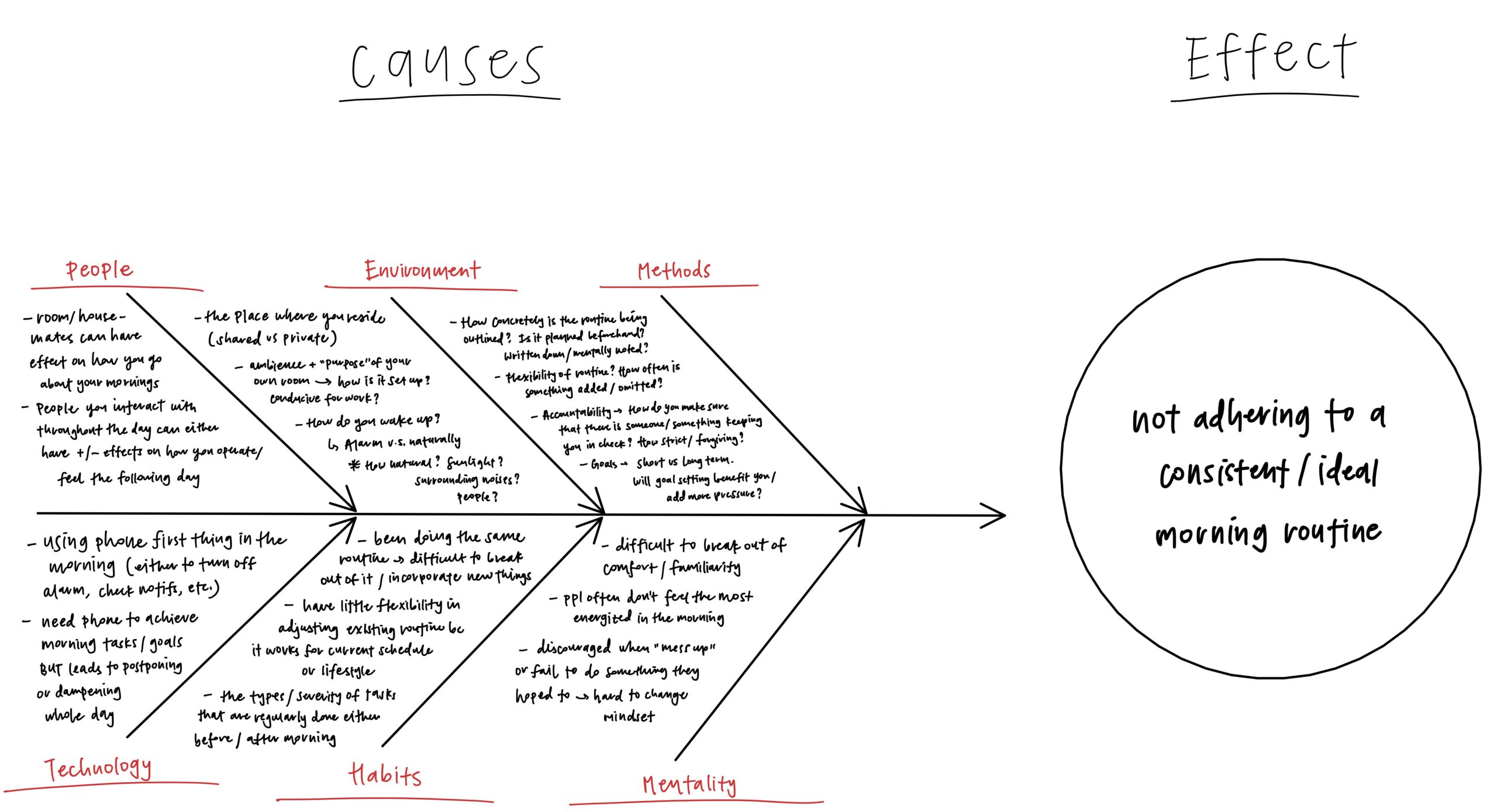
In this fishbone diagram, we consider the varying types of reasons attributing to the lack of adherence to an ideal morning routine. As mentioned above, our main area of interest surrounds the technological causes of this behavior, as it is almost inevitable to not use some device (whether directly or indirectly) in the morning. It may be interesting to explore how we can leverage technology use to help reduce the magnitude of the other behavioral causes!
Proto-Personas
|
Our Selected Proto-Personas |
||
|
|
|
|
|
Name |
Sleepy Sam |
Conflicted Cameron |
|
Role |
College student living alone |
College student living in the dorms, has morning classes |
|
Goal and Motivation |
Want more sleep but also want to feel awake quicker to have more time to get ready and get to class |
Wants to find a way to spend less time on phone in the morning while getting rest and staying connected to others for productivity and personal well being |
|
Conflict |
Sleepiness, fatigue from busy schedule, and notification checking makes morning rushed and stressful; want to have a more relaxing morning to prepare herself for a hectic day |
Staying in bed is good for personal well being and rest but bad for productivity (being on phone); being on the phone is good for social interaction but bad for focus |
|
Why haven’t they been able to solve this problem yet? |
Sleeping earlier, hitting the snooze button more so there’s less time to use phone (and more time to sleep); using phone to make herself feel more awake |
Always feels conflicted by all the different factors they are trying to balance |
|
Setting/Environment |
Studio room, quiet and cozy space |
Warm bed, dorm room with roommates |
|
Tools and Skills |
Mobile, alarm clock, laptop and monitor |
iPhone, laptop, iPad Knows how to use apps, plan ahead, play games, and communicate with others |
|
Routines |
Wakes up to alarm clock, snoozes 3 times, checks notifications and scrolls through Youtube, puts on Spotify while getting out of bed & changing; an hour passes before finally heading out the door |
morning routine; sets alarm for 1hr before class, stays in bed for 20+ min after waking up on phone, then rest of routine |
|
Habits |
Puts phone on airplane mode throughout the night, so notifications all come in in the morning; Watches Youtube and read Webtoon in the morning to feel more awake and stimulated |
habit of going on phone immediately after waking up in the morning |


We created these two personas because we noticed many of our participants having trouble with getting up due to tiredness, so we wanted to focus on the sleepy aspect of the morning routine. We also noticed that participants felt tension between different priorities, which was a bit different from being sleepy, and instead connected to how they wanted to spend/prioritize their time in bed and on their phones. Hence, we created two separate identities that help encapsulate the opposing feelings and thoughts tied with phone usage and its effects on morning behaviors.
Sleepy Sam:

Sleepy Sam’s journey map shows us that the most stimulated time of their morning is actually looking at messages and scrolling. However, it is also the most stressful because Sam is aware of the amount of time they are wasting by scrolling, but thinks that screen time is necessary in order to feel awake. That dopamine rush can both hurt and benefit the user. In our solution, we will think up ways to make screen time more effective in a shorter period of time.
Conflicted Cameron:

Conflicted Cameron’s journey map shows that there are multiple tensions between wanting to get up and wanting to stay in bed, as well as wanting to use their phone while wanting to stay focused and away from their phone. These tensions rise primarily when they are laying in bed, the point at which there is most opportunity to intervene, although they might use their phone at other times in the routine.
Our Intervention:
The Idea:
Since the majority of scrolling time spent occurs when our users are in bed, our study hinges on getting people out of bed as soon as possible using pre-commitment and social competition.
Every evening, our participants will send us a text with the time they want to wake up in the morning and a screenshot of said alarm (if they use an alarm clock; if no alarm clock, then it’s on the honor system). The following morning, they will send us a photo once they get out of bed. The photo can depict any part of their morning routine – a selfie, a photo of their feet on the floor, their morning coffee, etc. They are encouraged to get as creative as they want, BeReal style. The only rule is that they must get out of bed for the photo. These photos will not be shared with anyone. At the same time, we will ask participants to fill out a routine tracker to capture their morning routine.
We will note when the photo was sent and calculate the time between their alarm and wake up. In the afternoon, we will tally all of the time periods and send out a scoreboard to all participants in the study, anonymously showing who is in what place. Participants will be ranked by the time between when they said they would wake up and when they sent us the photo.
Data Collection
We will collect data on the time span between intended wake up and participants starting their day. We will also have access to the photos they take, which will provide an interesting inside view into what participants think of when we say “morning routine.” Finally, we will have their routine logs to see how they capture their morning routine.
Hypotheses
Pre-commitment and social pressure are both well-known tactics for behavior change, so we expect that participants will indeed spend less time in bed in the morning, as well as less time on their phones, as compared to baseline.
For our study, we recruited a combination of participants from our baseline study and new people. They are all students or young adults from the ages of 18 to 30, who have trouble getting up in the morning.
How We Arrived Here:
Looking at the competitive landscape, we found a lot of alarm apps that attempt to jolt their users awake through “unpleasant” experiences such as solving math problems (Alarmy) or rolling away from the user to force them out of bed (Clocky). We decided to avoid this type of approach because it makes the first moments of the day unpleasant for users. We felt this would severely decrease retention and would only be attractive to people who feel their habits are a serious issue.
Next, we noticed that some of our participants benefited from social pressure when going through their morning routines. Some participants had a partner who encouraged them to get out of bed early or held them accountable to their wake-up goals. Others had roommates that provided small bursts of social interaction, making them less tempted to get this interaction from their phones.
This led us to consider a few highly social interventions to encourage this habit change.
The first idea we had was to assign participants to follow a celebrity’s morning routine, as many are widely available on the internet. We saw this as a fun way to get people to break out of familiar patterns for the better. While this intervention holds weight, we felt it would be difficult to standardize celebrity routines among our participants as some are more simple/complex than others. Also, it takes extra work for the participants to follow completely new routines, so this would put undue strain on their willpower.
Next, we considered placing participants in a group chat and asking them to send one interesting learning from their morning scrolling. The idea here was to increase cognitive engagement during scrolling such that participants browse the internet intentionally. We noticed many positive benefits to morning phone use, so we hoped to capitalize on some of these in this intervention. We ultimately did not choose this approach because the connection between reading interesting information and reducing morning, in-bed phone use is tenuous.
Finally, we explored the idea of utilizing social pressure to influence behavior. One approach discussed was to send a photo proving a participant is out of bed by the time they set on their alarm the previous night (which we would ask them to send via text beforehand) to the study facilitators. For extra motivation, we considered using a leaderboard to exhibit to a participant how well they are sticking with their wake-up time (calculated by subtracting alarm time from actual time out of bed) and instill a sense of friendly competition against others. This approach really taps into healthy social pressure where one naturally feels encouraged to change their behaviors, especially when they see the positive impacts/outcomes on others. A potential con of this idea is that people may start drastically changing the way they typically go about their mornings just for the sake of appearing “better” to others, so the behavior change would not be sustainable.
Some other ideas we want to credit are: asking participants to set a goal for their morning screen usage, then send screenshot of screen time usage throughout the study; sending a text/reminder after X minutes (set by participant) of using their phones as a minor shame; promoting habit association where if a participant goes on a certain app, they have to do something that gets them out of bed; and sending them an embarrassing social media post if they do not get out of bed on time.



