
Before this class…
I mainly played the “engineer” role, implementing features and requirements outlined by various designers and product managers. I never had much of an opportunity to make design decisions, to consider the ethics behind interfaces, or to deeply think about or develop the “user.” Instead I tended to focus on how to make my code more efficient, what the technical architecture would look like, and how to fix existing bugs. Being a CS major with an AI concentration didn’t help, as the concentration is highly technical in nature and none of the CS core classes consist of HCI or even design-related classes! (which is absurd given that systems, theory, algorithms classes are all requirements). Ultimately, my lack of design background and visual art skills, coupled with a general sense of Imposter Syndrome, made me feel as though design just wasn’t for me.
However, in this class…
I realized that design skills are something that one can learn and grow, which seems obvious, now as I write this. I also learned that intuition is very important in design and something that can be strengthened through practice.
Over the past 10 weeks, I had the opportunity to work with my team and build studybuddies. Being a group of 3 was difficult, with us often feeling short-handed, but it made me realize how much my ideas matter and how important it was to recognize and rely on each other’s strengths. Most of this class consisted of new material for both my teammates and I, so sometimes I felt that the work we submitted was a reflection of our learning process more than anything that was necessarily polished, so sometimes I wasn’t sure exactly how or what exactly I would be graded on. Nevertheless, all of the hands-on work and iterative nature of the class helped solidify a lot of my learnings. I particularly enjoyed making system maps and journey maps (see the journey map I made below!). Both of these helped me consolidate a lot of the smaller tasks and ideas I had about the user and our app/product.
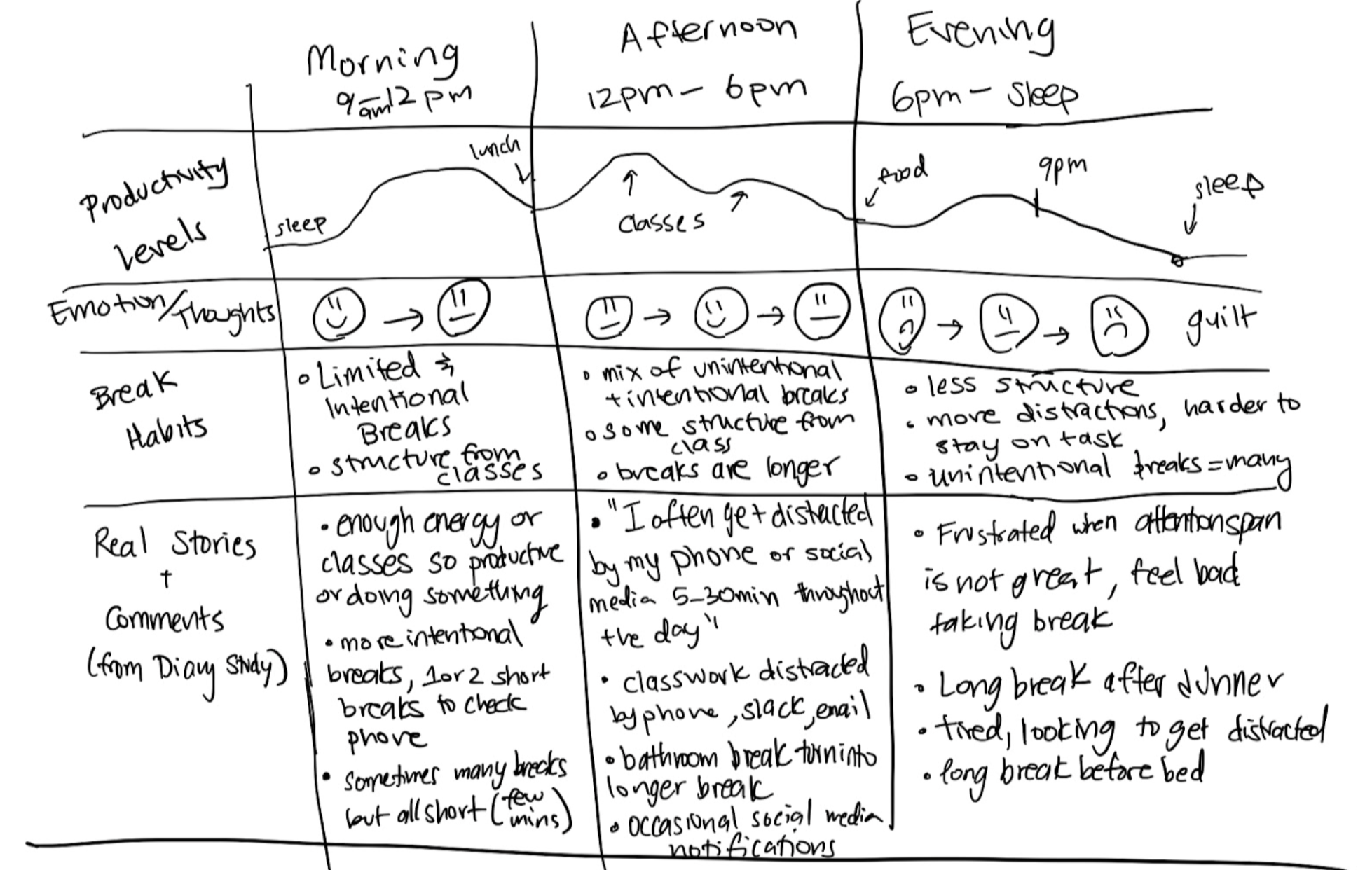
The system maps helped me take a step back and think about how different, important parts of the app fit together and how different personas experience the app. Meanwhile the journey maps helped me understand the user as a whole more – how do their thoughts and feelings vary throughout the day? How does the customer experience develop over time, and what are possible problems or areas where we can improve the experience? I hope to take these tools and methods with me, and to always remind myself to understand my user deeply no matter what role I’m playing.
But perhaps the most important tool/method I will take with me is to raise ethical questions and think about ethical concerns – not at the end of the process or development but throughout. It’s never too early to think about ethics! Through our ethical discussions, I learned that the act of trying to change a behaviour (the topic of this class!) is itself an ethical consideration. When is nudging justified? How does the party designing for behavioural change (ex. a corporation or government or individual) impact the ethics of that change? What are some consequences of gamification? Who is responsible for thinking about ethics and raising ethical concerns (the product manager? The designer? The engineer?)? I have so many unanswered questions, but it’s a wonderful feeling to know that my mind has expanded to think more deeply and widely, if that makes any sense.
One thing I think could have been better done in the class is to continue to emphasize and remind ourselves of the personas, the users, the user experience. Particularly, as we moved towards the latter half of the class and got closer to thinking about designing our app, it was very easy to get overwhelmed by how much needed to get done. It was also very easy to get carried away by all the buttons and features of our app, what our prototypes needed to contain, etc! I felt myself slipping away from this user-centric view that was so emphasized towards the beginning of class.
For our project, I wish we had more time to dig more deeply and to keep making new discoveries. I feel like my team finally has gotten a grasp of where we want to take this idea and how to make our product fit within the wider productivity space and products BUT… we’re unfortunately out of time. Nevertheless, I’m so proud of my team for continuing to learn, being flexible, and staying motivated and positive through it all! 🙂 Even though our project was not exactly a success, the people and journey were so exciting, informative, and full of adventure! I’ve grown a lot through the quarter and I hope I’ve been able to help my teammates grow in their respective ways too.
When it comes to ethical considerations…
Our project uses the concept of accountability, specifically accountability buddies, to change behaviour. From our intervention study, and various surveys/interviews throughout our project, we realized how effective external factors and people around you are in sticking with a behaviour change. We believe that having people you care about keeping you accountable and you doing so for them was acceptable since it benefitted both parties to accomplishing the goal they sought out for. Also, we felt these nudges were acceptable since the original behaviour was something oour users wanted to change themselves and just needed extra nudges and motivations from friends and those they trust.
In using accountability buddies, we considered ethical concerns relating to people you can schedule work sessions with. One concern we had was how to deal with the case when Person A used to work with Person B but are longer comfortable doing so. Would person B still be able to send Person A an invitation to work? Could this become manipulative and almost stalkerish? We thought that this could make Person A even more uncomfortable and not want to use our app anymore. Worst case the situation could be quite dangerous or triggering for Person A depending on the original circumstance for no longer wanting to work with Person B. As such, we thought of designing the app such that invitations would only be sent if everyone in the proposed work session is mutual friends with one another.
When it comes to privacy, we thought deeply about what information we actually need from the user. Factors like age, race, gender, etc which many apps ask for were not necessary for our app. We even made it optional for users to sync the calendar from our app to external calendars like Google Calendar, Outlook Calendar, etc. In terms of privacy and freedom of choice of who each user wants to work with, we also set the contacts to be editable. This means that users can add and remove potential people to work with at any point, and if person A and person B are then no longer mutual in each other’s contacts, then they can’t work together (as the above section mentions)
For interface design, we take an approach somewhere between inclusive and universal design, though we put more weight on universal design. Our users are only Stanford students at the moment, who come from a wide range of backgrounds whether it be nationality, gender, socio-economic status (SES), ability, etc. We felt like aspects such as gender and SES status are aspects that would not impact the experience of the app since there is nothing inherently related to those identities. We wanted to make our app as accessible as possible. We tried to pick accent colors and our style tiles using colors that would accommodate color-blind folks (ex. protanopia, deuteranopia, or tritanopia). The colors we ended up picking are those we felt gave enough contrast for the 3 types of colorblindness as well as normal or nearly normal color vision folks while also aligning with the mood boards we had in mind. Our color palette can be seen here. We also tried to vary the font size when emphasizing content. One thing we noticed is that we only have support for English at the moment, but we felt that Stanford students have enough English proficiency to use our app based on English requirements by the University itself.
For well-being, we pivoted from simply scheduling breaks to finding a way to incorporate breaks and taking breaks to those sessions. Particularly, this decision was motivated by how we should encourage healthy habits and discourage students from overworking and getting burnt out, which Stanford students like myself are unfortunately prone to do. However, due to the fast nature of the course we did not have as much time to ideate other solutions which may better promote the well-being of students. As such, whether there is a better alternative is still something somewhat unresolved for our project. If I were to redo this project again, I would try to incorporate ethical concerns like these from much early on as pivoting later in the quarter proved quite difficult. Part of me wishes we completely changed our topic to finding ways for friends and family to spend more time with each other since something everyone in our group values and is passionate about is bringing people together and staying connected.
Now I think…
And realize how valuable it is for engineers to learn about design principles. I have so much more appreciation for designers and for the spec sheets and mock-ups I’ve seen. I never understood how much thought goes into the placement of certain buttons, features, fonts, colors, etc. I also never realized how messy (and non-linear or straightforward) of a process designing something can be. Also, I realize how difficult navigating productivity is as well as designing for productivity. The space is just SO big and there are also many ethical considerations to keep in mind (though this latter part is always true).

Next time when faced with a similar situation…
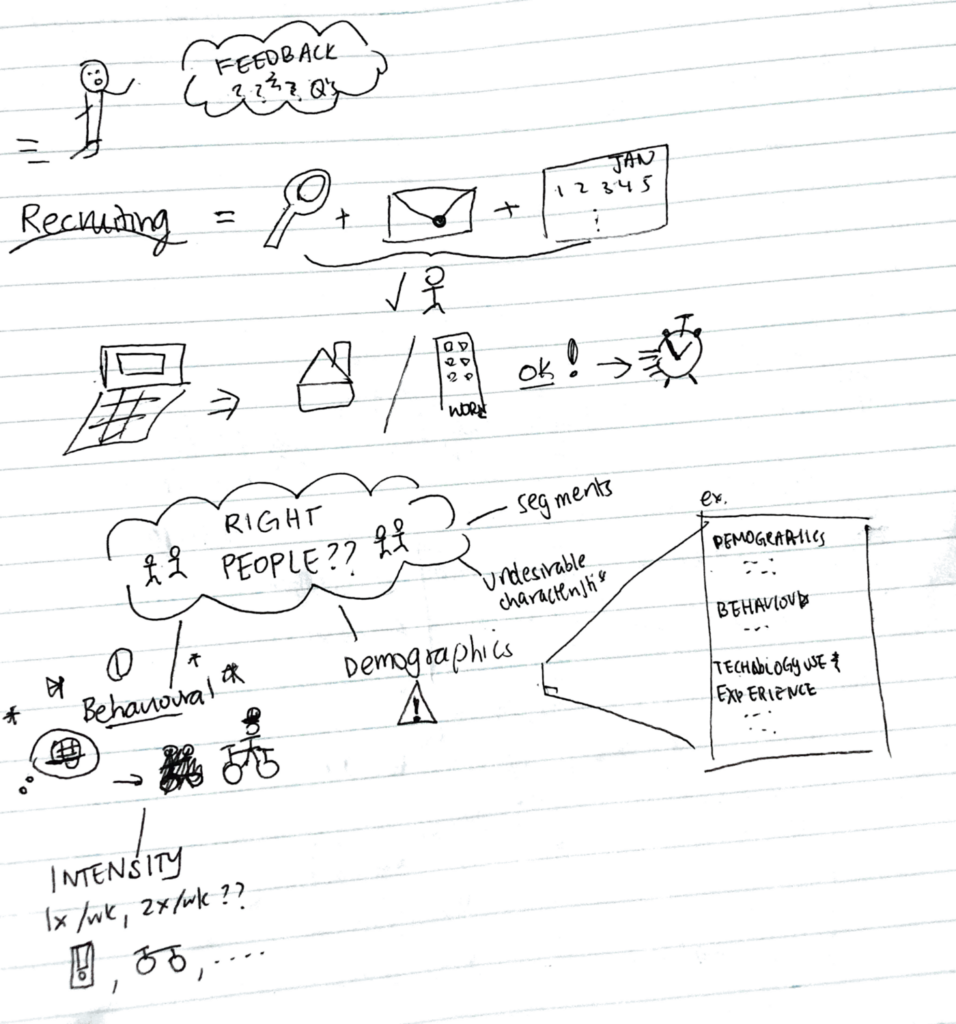
I will try to have a better understanding of any project I’m working on, instead of immediately diving into a project and somewhat-randomly figuring it out as I go. Methods and frameworks like system maps will be really helpful in collecting my knowledge and furthering my understanding (as I mentioned earlier!). I will also be thinking more critically while building a product. Lastly, I plan on using more visual tools in the future (look at the image above to see how much my sketchnotes improved) and to remind myself that things that I do don’t need to be clean or polished!
Stay sketchy, friends! 😉



