
Team Reflections:
We conducted three types of tests on a total of 9 participants one explored whether events and classes could foster romantic connections, another examined whether social proof features increased user trust and safety, and a third evaluated whether people would be willing to pay to make friends compared to using free alternatives.We selected these tests because they targeted core assumptions underlying our proposed feature additions to Classy.
Overall our assumption testing revealed a few key findings for us a group across UX elements and overall product strategy:
Across the experiments, we found notable demand and enthusiasm for paid Classy subscriptions, along with a clear preference for social proof elements in the interface. Regarding dating, participants reported feeling more comfortable on a blind date when engaged in a shared class activity than when meeting without any structured context.
Results, Cards, & Procesess:
The three hypotheses we were testing and their learning cards + transcripts (must be logged into Stanford account to view):
Hypothesis:
|
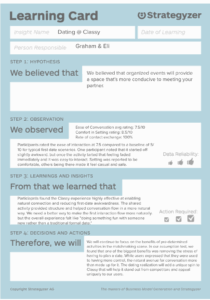
We believed that organized events will provide a space that’s more conducive to meeting your partner.
|
Process:
testing materials: https://drive.google.com/drive/folders/1HVCATjptjGMgoUoQ_inhqsnLcbA-tez_?usp=sharing
|
Set peers up on a blind date and book a class as a pretext for the two to spend time together
|
Hypoth:
|
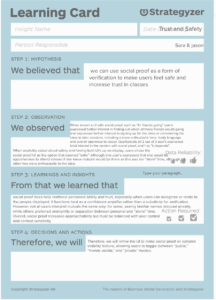
we can use social proof as a form of verification to make users feel safe and increase trust in classes
|
Testing materials: https://drive.google.com/drive/folders/1g4ap7G149eNfogctVyGms1jQjquwFQ6f?usp=sharing
test overview: created two UI prototypes with Bolt – one that had social proofing and one without to conduct an AB test(i.e reviews, friends going)
Hypoth:
|
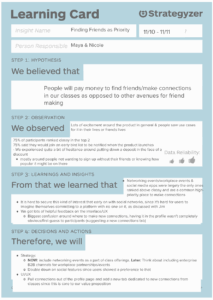
People will pay money to find friends/make connections in our classes as opposed to other avenues for friend-making
|
Testing materials: https://drive.google.com/drive/folders/1ENMosMrDiz0EUzkowO5eZ9R8xYK22YCc?usp=drive_link
Process: conduct a prototype usability walkthrough interview and ask them to rank some classy and common friend-making platforms/tactics, then test how much the user was actually interested with a “skin in the game” question.
Next Steps:
Pull together key takeaways from all three tests and highlight what worked best and what didn’t. Identify which assumptions were clearly supported — like interest in paid subscriptions and social proof — and which still need more testing.
Decide which features to keep focusing on, especially around safety, trust, and paid models. Revisit the dating angle to see if it fits naturally or should stay more of a side benefit.
Move from simple mockups to a clickable prototype that combines the strongest ideas from each test. Run a few quick user tests to see if people understand and trust the flow.
Try to include people outside our immediate circles for more diverse feedback, and test both online and in-person to see if the setting affects comfort.
Summarize findings clearly with short visuals and insights. Split up who’s handling the write-up, prototype updates, and slides for the final presentation.



