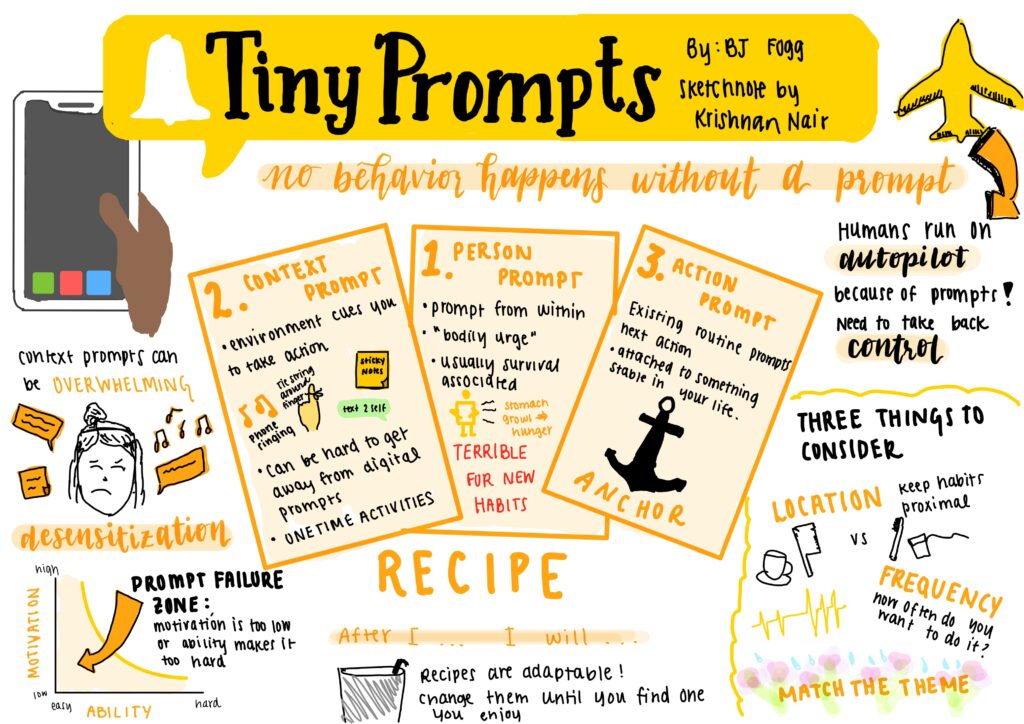
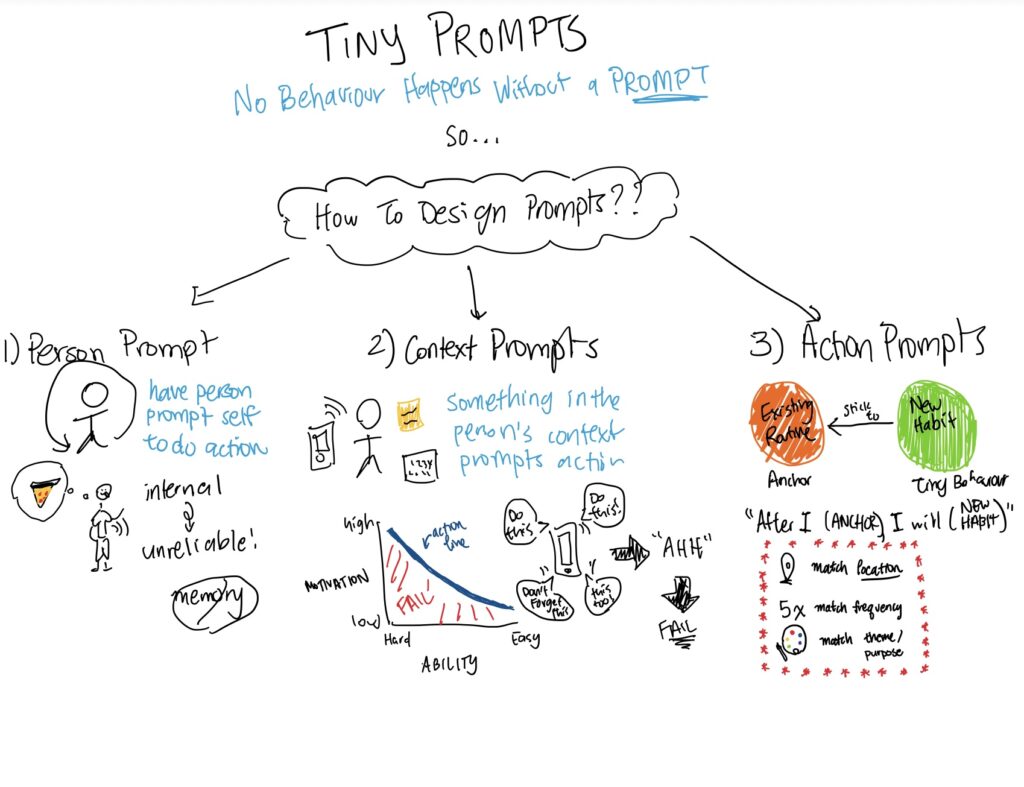
Here’s the assumption map we first made in class:

And here’s our final assumption map:
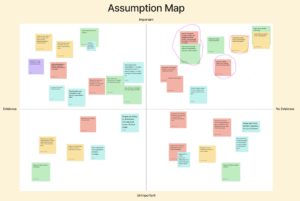
The link can be accessed here as well.
Key Insights
- We have lack of information for people’s implicit preferences within a texting app
- We also need to focus/analyze the sender’s side/preferences. Even if users respond well to nudges, are people willing to send nudges? People need to be engaged in both ends of sending and receiving for the process to work.
- People’s identities are captured through avatar cartoons, and these cartoons need to resonate with the users. In which, we need to have customization to build a stronger connection between our users and the avatar.
- Delaying responses to texts comes with many different motivations and reasons. We need to include features that suggest stronger desires to respond, including social motivation and social accountability as a heavy signal for responding.
- There are different motivations and feelings of pressure that come with nudges that come from friends and nudges that come from scheduling automatically on the app. We learned that we need to think about how to make automatic nudges feel significant to users.
Assumption Tests
A) Assumption: Because we are encouraging the behavior of faster responding and decreasing delayed texting, we assume users are in a positive or happy mood to respond to their friends quickly all the time.
- Test Name: Mood & Response Tracker
- Method: At the end of each day, track a user’s mood, along with the number of texts that they’ve avoided that day. Over the course of a week, see if their mood has a reverse correlation with how many texts they avoided that day.
- Questions:
- How do you feel today?
- How many texts did you avoid today?
- What may have impacted your mood today?
- Objective: Figure out the connection between a user’s mood and responsiveness.
- Success Metrics: A significant majority of participants experiencing heightened moods after responding to friends may indicate that they will want to get better at responding to friends.
B) Assumption: Because users are being represented as cartoon avatars, we assume our users are attached enough to avatars and seeing their friends’ avatars is strong enough for them to feel inclined to respond
- Test Name: Avatar Presence Test
- Method: Have some users respond to a message thread with an avatar present and other randomly selected group respond to generic notification with no avatar (can be an imessage photo overlay for contact)
- Questions: Does showing a friend’s avatar increase response rate?
- Objective: Find out how impacted users are by seeing their friends’ avatars.
- Success Metrics: A significant majority of participants responding more readily to the message thread with an avatar would indicate that the assumption we made is correct.
C) Assumption: We assume that users are willing to participate in nudging others and keep their friends accountable when prompted by a list of people who they are waiting for responses from.
- Test Name: Survey of Comfort during Nudges
- Method: At the end of each day, ask users to find at least one text of theirs that their friend hasn’t yet responded to. We then ask the users to nudge this text by either sending a follow up text or by ‘emphasizing’ the former text. Finally, we ask them if this felt comfortable and natural to them.
- Questions: How did you feel when bumping your previous text? How would you feel about bumping other texts that have gone unresponded to?
- Objective: Find out how willing users are to ‘nudge’ their friends to reply to texts.
- Success Metrics: A significant majority of participants who report feeling comfortable and natural bumping previous texts would indicate that our assumption is correct.