
Introduction
Our group identified two distinct types of late-night eaters: the functional eater, who eats to manage hunger and sustain productivity, and the social eater, who eats primarily as a social activity to spend time with friends. While we recognize that these categories can overlap—for example, students who attend late-night study sessions with friends at on-call cafés—we chose to separate them for clarity when developing our personas.
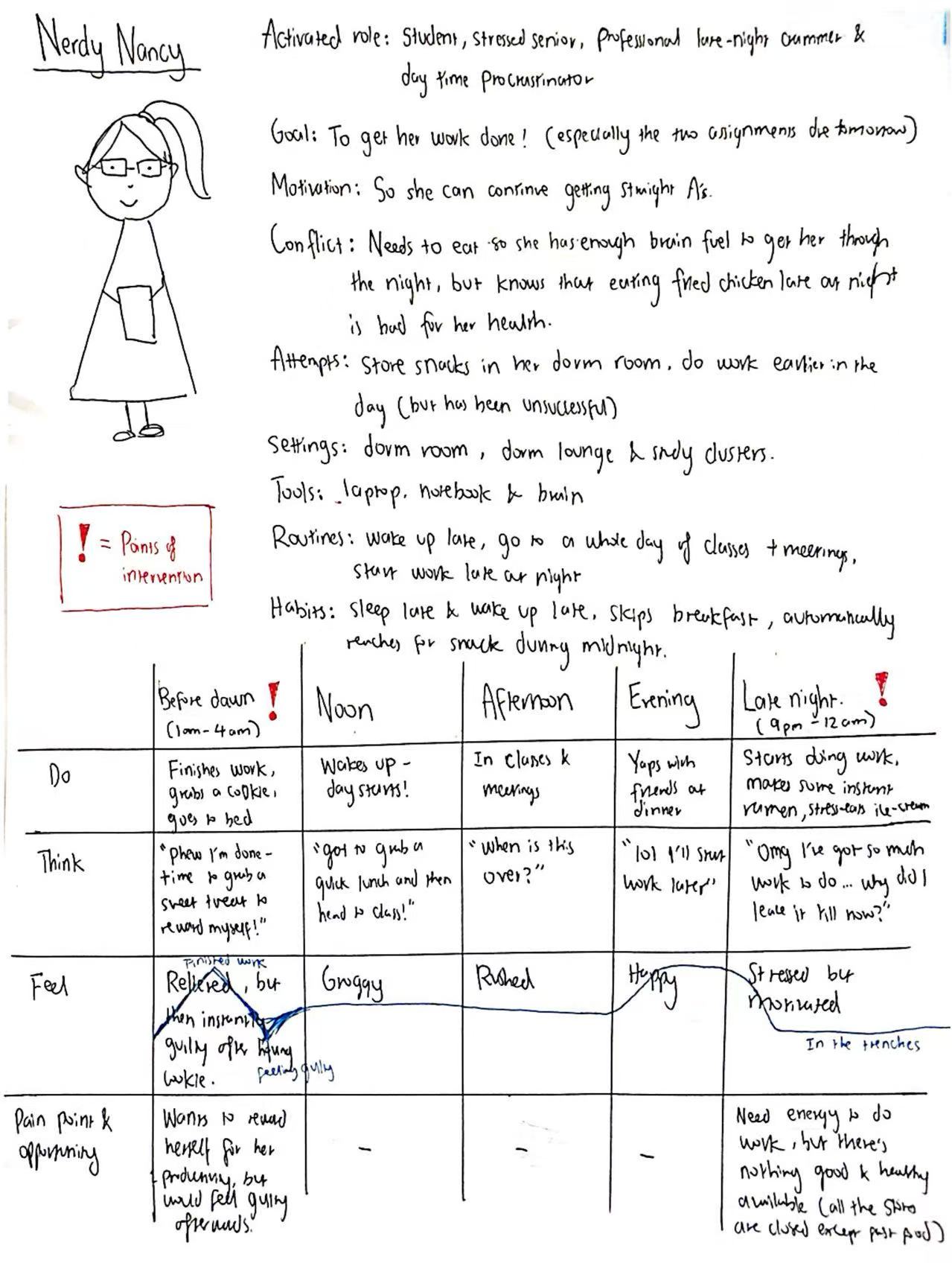
For my persona, I focused on the functional eater prototype, whom I have nicknamed “Nerdy Nancy.”
About the Persona
Nerdy Nancy exhibits several key characteristics that contribute to her tendency to work and eat late at night:
-
Her sleep and eating schedules are shifted later into the night, creating a misalignment with typical daytime routines.
-
She is a highly busy student with a packed daytime schedule filled with classes and meetings, leaving little uninterrupted time for deep work.
-
Like many students, Nancy has a tendency to procrastinate and often only begins focused work once stress and deadlines create a sense of urgency.
In addition, Nancy appears to hold a limited theory of willpower—a psychological concept suggesting that self-control is a finite mental resource that becomes depleted with sustained effort and must be replenished (e.g., through food or small rewards). At the same time, she deeply values her academic performance and is not the type to simply “go to bed” when work remains unfinished; instead, she is willing to push through fatigue and work late into the night to meet her goals.
Together, these factors create a perfect storm in which late-night eating becomes both functional and inevitable.
User journey
This journey map captures a typical day in the life of Nerdy Nancy, a high-achieving but chronically stressed student whose productivity peaks late at night. Her day begins with sleep deprivation and grogginess, moves through long stretches of classes and meetings that drain energy without relieving workload anxiety, and culminates in late-night study sessions driven by urgency and looming deadlines. While late nights allow her to finish work and feel temporary relief, they also create a recurring tension around food, health, and guilt—she needs quick energy to keep going, but the options available at night feel unhealthy and misaligned with her long-term wellbeing. This cycle reveals a key pain point: moments of highest need (late night work) coincide with the lowest access to healthy, supportive resources, presenting a clear opportunity for intervention.
Key insights
From this journey, we can glean a few key insights:
-
Nancy eats at two distinct points during the night, each driven by different needs: an earlier episode motivated by stress and functional necessity (needing energy to keep working), and a later episode driven by relief and reward after finishing her tasks.
-
Eating itself is not perceived as a problem; it only becomes an issue when it interferes with functional outcomes, such as falling asleep late or feeling worse the next day.
-
Moments of highest cognitive demand (late night studying) coincide with the lowest availability of healthy, intentional food options, forcing Nancy to choose between convenience and wellbeing.
-
Nancy’s food choices are reactive rather than planned, often made under time pressure, fatigue, and emotional load, reducing her sense of control.



