
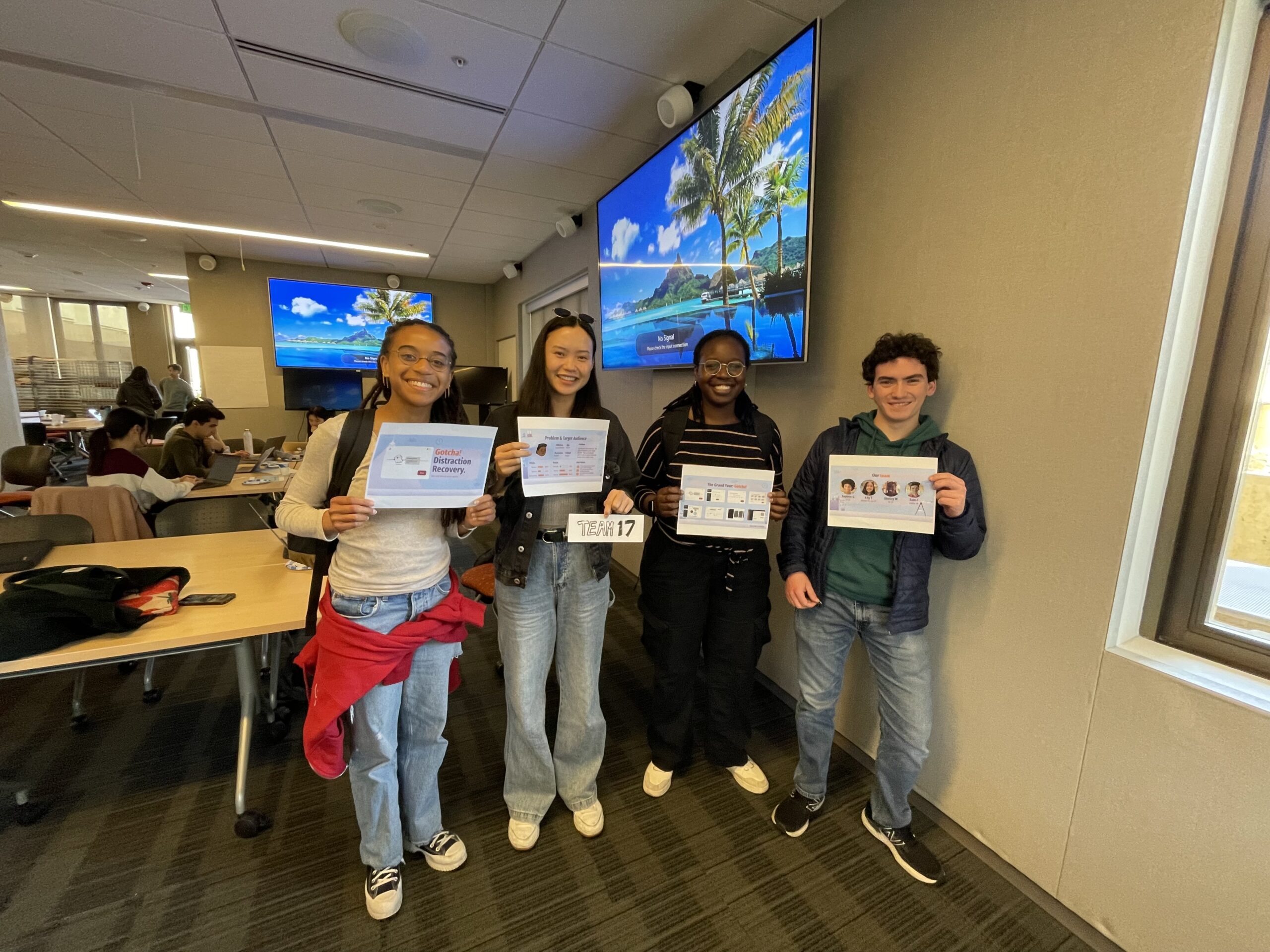
Before taking CS247B, I was excited to once again dive into a design seminar! I loved my time in CS147 and couldn’t wait to give the design process another go with a new team, fresh ideas, and a new chance to build. Simultaneously, I was a little bit worried because CS147 took a lot of time and energy. It was an extraordinarily rewarding experience, but I knew that I had a lot more going on this quarter with extracurriculars and other things in life than I did when I took 147, and I wanted to make sure I would have the same bandwidth to dedicate to my work in the class an make it something I could be proud of.
Fortunately, my fears did not materialize, and I ended up loving this class just as much if not more than CS147. My group mates were great, and after a little bump in the beginning with a teammate who left our team, we worked cohesively and collaboratively the entire quarter. My group ended up being one of my favorite parts of the class.
In terms of how the project specifically went, I think the thing I love is also the thing I dislike the most about design classes. I love that you get to iterate and totally change what you are working on over the course of a quarter, but it can also be frustrating to feel like the team is constantly pivoting to something new and working to combine five great ideas from everyone on the team, rather than building something unified and cohesive that follows one path more directly. For example, a lot of our earlier work in a quarter lead us to creating some type of iteration of a Pomodoro timer to help improve productivity. But we didn’t want to just create another Pomodoro timer because there are a million products that already feel this niche. We had great ideas based on our need-finding for how to improve upon that general idea of a combination of working and breaks; namely, we wanted to make something where work time should be able to be extended so people could stay in their flow state and breaks needed to have some way to ease you back into your work (or you were likely to abandon the system).
I’m ultimately happy with the product we ended up settling on, but at the same time, I’m not sure it would actually solve some of my personal productivity problems and I worry that a lot more work we need to be done before the idea was ready for the real world. To that end, I think one of my biggest reflections from this class is that changing behavior is really, really hard. We learned so many methods in class to help us change people’s behavior and ultimately, I think my biggest takeaway from all of it is that to do it ethically in a way that respects users autonomy, doesn’t trick them or mislead them, and creates a lasting effect, is just quite simply a difficult thing to do. After all, if it wasn’t, we would all change many of our own behaviors.
Ultimately, one thing I am proud of with regard to our project is that I do think it attempts to change behavior very ethically. We respect users’ privacy by giving them the choice about uploading a screenshots/photos or not, and letting them see exactly which data we are tracking and allowing them to edit or delete it at any time. The only nudges our product gives people are to take breaks and engage in fun activities to get back to work, like meditating, or embarking on a breathing exercise. We do gamify things a little bit by having the ghost randomly take webcam photos and screenshots while people are working, which they can share with their friends after their study session. One concern we’ve had consistently is if people might use our system an encounter many of the same problems as they do with traditional social media. Our photo and social interaction is modeled on BeReal and a major discussion point for our team was that even though BeReal is literally supposed to be the response to ‘traditional’ social media, in that it is ‘less toxic’ and ‘more fun,’ in many cases, people still use BeReal to present an idealized version of their life, rather than the ‘real’ things they’re doing every day. This would be harder with our website if we were to actually launch it, because the photos are taken at random intervals. But if we’ve learned anything from observing social networks in the real world, it’s that it’s hard to predict or even fathom the degree of harm that they can cause.
My hope is that if we were to actually launch our product, people would use it to become more productive, and take control over the ways distractions hinder their ability to achieve their goals. Another question that would be prudent to consider if we did actually launch the site would also be if simply becoming more productive is really the thing we want to enable people to optimize for at all in their own lives. There’s another argument that we didn’t fully get to unpack in our team meetings that maybe we ought to challenge the notion that doing more in the same amount of time is actually the goal people should be trying to achieve in the first place. Perhaps the ever-raising bar of productivity is precisely the problem itself, not that people can’t meet their productivity goals on a personal level.
Reflecting on the course as a whole, I think if CS147 taught me that design does not have to be a big scary process and that it can be broken down into its components to maximize success, 247 taught me that I still have a lot left to learn. The difference between knowing how to design and being a great designer has never been more apparent to me then after taking this class. It made me excited for the future and enthusiastic about the types of problems I’ll get to solve during the rest of my time with Stanford, and my work, and in life. When those experiences do arise and when I do have to solve big problems (and do so through design), I’ll be excited to look back on what I’ve learned in this class, think about everything I create in terms of its impact on the people who will use it, and use the guiding principles from this class along way to make the most of my future endeavors and the things I create.
Thank you for a fantastic quarter!
— Sam Catania



