
Story Map
https://drive.google.com/file/d/1lBiuOgoww7Oy1SHFzivYLwPXQ8bFulBB/view?usp=sharing
During brainstorming, we identified many experiences we initially wanted our users to have. In an ideal world, our app would help participants change their habits almost immediately- always having food prepared when they are short on time, feeling highly motivated by our quotes, and never forgetting to eat. However, we quickly realized that this expectation was unrealistic. When users genuinely do not have time, reminders alone are often not enough to change behavior.
To address this constraint, we decided to reduce the burden of meal preparation by offering a snack box option that can fill the gap when users are too busy to pack food themselves. This also presents a potential business opportunity. Through this process, we clarified that the most important role of our app is not to force perfect behavior change, but to reliably support users in moments when eating is easily overlooked. As a result, we have two core MVP-features: effective, well-timed reminders and an optional snack box subscription that makes eating easier during busy periods.
MVP Features
As mentioned, our high-level MVP consists of two core features: (1) effective, well-timed reminders and (2) a snack box subscription option.
To make reminders truly effective, we break this feature into three components. First, the app syncs with users’ calendars to better understand their schedules and identify potential gaps for eating. Second, it automatically detects these gaps so users do not have to manually schedule reminders themselves. Third, reminders are paired with motivational quotes that are intentionally “slay” and humorous, helping users enjoy interacting with the app and feel more motivated rather than nagged. Together, these features prioritize ease of use while making reminders feel supportive and engaging rather than intrusive.
For the snack box subscription, we found that while energy bars were helpful for participants during our intervention, relying on them long-term was neither ideal from a health perspective nor particularly enjoyable. To address this, we designed the snack box to include more appealing and satisfying options, making it both healthier and more sustainable. This approach also aligns better with a business model, as users are more likely to continue a subscription if they genuinely enjoy the food.
System Paths
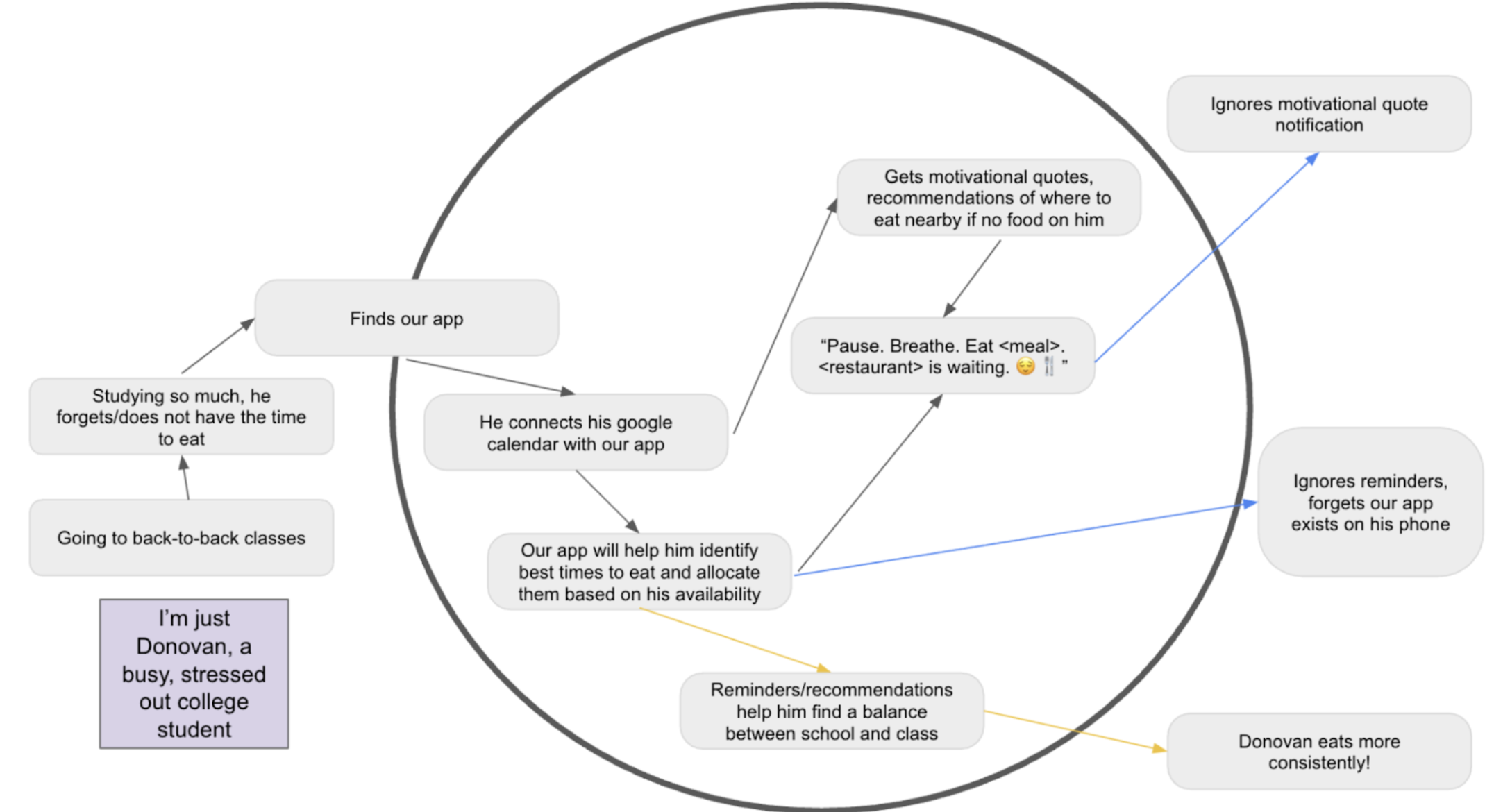
The process for which we created this system path was really stepping in the shoes of our user, namely Donovan. We heard he was a very busy student with late-night classes that ultimately led him dine at late-night on healthy options. Additionally, we heard from other interviewees how often, because of such a busy schedule, they would study so much that they would have no time to eat. They would have their first meal a day, let’s say around 9 p.m.
Additionally, we really tried to see this not only at a user level but also at a community level. In an environment such as Stanford, where everyone is very high achieving, there is some sort of pressure to be highly focused all the time, and as such there seems to be a culture of getting people to work constantly, to the point where your first meal might be very late during the day. This is not only a problem at the individual level but also at the community level.
So, by offering snacks not only to one user but multiple users within an ecosystem, we really try to work with the hyper productivity culture so that people could still be productive, but at the same time have enough fuel for that productivity in the first place.In not only giving snacks but also syncing up with their calendars and motivating them, we sought to really create a user experience that resonated with the Gen-Z culture that they are immersed in and thus create a more personalized experience for the users we are trying to affect, namely very busy individuals.
Bubble Map
Our team started with the core goal (the gray circle) which was to help people create consistent eating, which is ultimately the behavior we’re trying to change. We brainstormed solution directions and turned the biggest ones into the main bubbles
- Giving ready-to-eat healthy snacks for our users
- Syncing with a calendar for eating reminders
We then expanded each main bubble into smaller bubbles, on a second level, that captured how it would work (e.g. pre-portioned snacks; AI findings open calendar time blocks), user needs and constraints (e.g. asking for permission to access the user’s calendar/location, allowing manual entry if they don’t use a calendar app), and product/business details (e.g. subscription tiers and a free trial).
Key insights:
- Our solution naturally splits into two complementary strategies
- Reduce friction to getting food (via ready-to-eat snacks)
- Reduce friction to remembering/planning (via calendar syncing)
- Permissions are a major design requirement and we were all in agreement that it shouldn’t be an afterthought. If the product relies on a user’s location/personal calendar, we need clear opt-in and fallbacks (i.e. manual calendar entry)
- Automation still needs user control. Even if AI schedules eating blocks for the user, people should still be able to move and edit those blocks so it doesn’t feel bossy and end-all-be-all.
- Revenue can show up in forms other than ads, the subscription model fits our platform well, especially if we include a free trial to demonstrate benefits to users and make them accessible and on different levels based on a user’s needs.
Ultimately, the bubble map helped us see that reminders aren’t one feature, it’s a combination of many other components like visibility, tone, timing, personalization. All of these details affect whether people will actually follow through.
Assumption Map

Making the assumption map helped of team figure out what was actually viable versus what was a stretch. Here are the four main things we realized:
- We realized our coolest feature, the auto-detecting reminders, is dependent on users being okay with sharing their personal schedules. If people feel like the app is being too intrusive or they just don’t keep a digital calendar, the whole automation part of the app basically dies. This is why we put “Calendar Syncing” in the riskiest quadrant; it’s our biggest hurdle.
- We love the idea of using humorous quotes to make the app feel like a friend, but there were other factors we had to consider. There’s a fine line between a supportive, funny ping and a reminder that’s just annoying when you’re already stressed about a midterm. We need to make sure the “vibes” actually help people eat rather than just making them want to mute their notifications.
- A big insight was that a reminder alone doesn’t put food in someone’s hand. If a student is stuck in a 4-hour study session at Green Library and gets a “go eat” notification, they’re still going to skip the meal if they don’t have food on them. This is what pushed the Snack Box from a “maybe later” idea to a core MVP feature. We have to solve the access problem, not just the memory problem.
- We initially thought any healthy snack would work, but the map made us realize that if the food is “mid,” nobody is going to pay for a subscription. For this to actually be a business, the snacks have to be something people actually look forward to eating, not just emergency fuel.
Assumption Tests
We will be testing 1) Users are willing to link to their calendar. To test that we will ask some of our study participants whether they will be willing to sync to calendar, with different levels of access (e.g. only know when they are busy, or also know exactly what they are doing (such that we know location and can plan ahead, and if they have a meal planned automatically detect that)).
2) We want to test whether people will check their phones for reminders in time. As a test, we will send a message to some participants near meal time such that they will reply within 10 minutes if they actually got the message. This should verify whether or not they check their phones near meal times.
Intervention Study
We conducted a five-day intervention study with five participants to test whether providing ready-to-eat healthy snacks would improve eating consistency among busy students. The goal was to reduce the friction of meal preparation, especially during time-constrained academic periods. Participants incorporated the snacks into their normal routines, which included classes, studying, late nights, and other commitments. In addition to observing behavior throughout the week, we collected post-study diary survey responses to better understand participants’ experiences. Overall, both the intervention and survey data revealed that inconsistent eating is not primarily caused by a lack of awareness, but by time constraints, scheduling conflicts, and convenience barriers during high-pressure moments.
One major insight was that time scarcity is the core issue. Multiple participants reported that dining hall hours did not align with their schedules, that back-to-back classes made eating difficult, and that breakfast was the easiest meal to skip due to prioritizing sleep or waking up late. Even when hungry, productivity often took priority. This reinforces our earlier assumption that busy students skip meals because of time constraints, not because they forget that food is important. It also confirms that reminders alone are insufficient to change behavior if the structural barriers remain.
The intervention strongly validated the importance of reducing friction. When snacks were physically available and ready to eat, participants were significantly more likely to eat during short breaks. Several participants explicitly stated that having accessible food helped them stay consistent and balance their energy levels throughout the day. This confirmed that access plays a critical role. A reminder does not put food in someone’s hand; reducing the activation energy required to eat is essential. This finding solidified the Snack Box as a core MVP feature rather than an optional add-on.
The diary survey also revealed that tracking increased awareness and reflection. Many participants described logging as a helpful end-of-day check-in that made them more mindful of patterns such as meal timing inconsistency, energy crashes, emotional eating, and eating due to convenience. However, while tracking increased consciousness, it did not automatically eliminate inconsistency. This further supports our shift from an awareness-based solution to a friction-reduction solution.
Reminders were rated moderately to highly helpful overall, with participants noting that consistent timing and accountability were especially beneficial. Several mentioned that the motivational quotes made them smile or helped them stay on track. However, at least one participant felt some quotes were not particularly motivating. This confirms that tone is an important but still uncertain design variable. While humor and “slay”-style messaging can increase engagement for some users, it must be carefully calibrated to avoid becoming ineffective or annoying. This insight directly supports our placement of tone effectiveness in the critical but unknown quadrant of our assumption map.
Another key takeaway was that consistency remains difficult even with support. Some participants still skipped meals, especially breakfast, due to sleep prioritization or tight schedules. This highlights that eating behavior is embedded within a broader productivity culture, where meals can feel like interruptions rather than necessities. Our solution must therefore work within this environment rather than attempting to radically change it.
Overall, the intervention and survey shifted our mindset from trying to enforce perfect behavior change to designing a system that supports users in the exact moments when eating is most likely to be overlooked. The data validates our dual-MVP approach: reduce friction to remembering through well-timed, context-aware reminders, and reduce friction to access through a ready-to-eat snack box subscription. Together, these features create a realistic and supportive solution that addresses both memory and convenience barriers, which our study clearly identified as the primary drivers of inconsistent eating.



