
Behavior I’d like to change: Drinking more water
Measuring frequency:
- Noting once an hour if I have drank water during the past hour
- Noting once a day how much water I drank over the course of the day
Monday 1/15:
10am – No water since waking up
11am – A few sips of water with breakfast, small glass of orange juice too (still hydration?)
12pm – None
1pm – None
2pm – ⅓ of Stanley cup (~10 oz) of water
3pm – None
4pm – None
5pm – A few sips
6pm – Refilled water bottle with water + splash of iced tea for flavor (to motivate me to drink more!)
7pm – ⅓ of Stanley cup (~10 oz) of water
8pm – A few sips
9pm – A few sips
10pm – None
11pm – None
12am – None
1am – A few sips before bed
Overall: ~1 Stanley cup = ~30oz of water
Tuesday 1/16:
11am – Filled Stanley cup with water + splash of iced tea for flavor, which helped yesterday to drink more
12pm – A few sips
1pm – ½ of Stanley cup (~15 oz) of water with lunch
2pm – A few sips
3pm – A few sips
4pm – None
5pm – A few sips
6pm – Cup almost empty, refilled before dinner
7pm – ⅓ of Stanley cup (~10 oz) of water with dinner
8pm – None
9pm – A few sips
10pm – A few sips
11pm – ⅓ of Stanley cup (~10 oz) of water with dinner
12am – A few sips
1am – A few sips before bed
Overall: ~2 Stanley cup = ~60oz of water
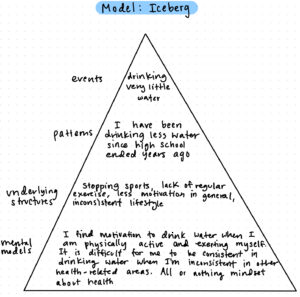
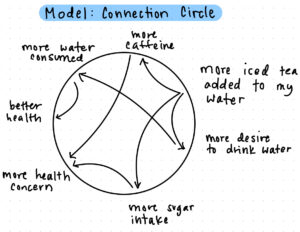
Models:
I chose to model my water drinking habits, or lack thereof, with an Iceberg model and a Connection Circle model. The Iceberg model helped me to understand the underlying reasons why I struggle to drink water, and have drank less than I did years back in high school. One mental model that affects me, for instance, is that I find it difficult to be consistent drinking water when I’m inconsistent in other health-related areas—like an “all or nothing” approach. The Connection Circle was useful for me to understand the effects of adding some iced tea to my water, for flavor, which was a tool I used to drink more water over the course of Measuring Me Part 2. It was really interesting to understand the cascading and opposing effects of this choice through the Connection Circle.
Experience:
I enjoyed the Measuring Me Part 2 experience and learned a few key things.
- Tracking a positive/negative habit serves as a reminder to do more/less of that thing. I found myself reaching for my water more when I remembered I was tracking it. Sometimes, when I checked in every hour about my water, I drank a few sips then and there so I could indicate that I drank water. It was a useful reminder for me.
- Just like in Part 1, it is hard and burdensome to track yourself so frequently. This raises the question of how worth it it is to track frequent behaviors when designing for behavior change. If I designed something to change a hypothetical user’s behavior, would they benefit from frequent reminders or be too annoyed by that? This is worth exploring as my group and I work to address our chosen behavior.
- There is no one way to curb a negative behavior or increase a positive behavior. For me, adding iced tea to my water for flavor was really helpful, but of course has negative effects too that someone else might not enjoy. There is no one size fits all approach to designing for behavior change.



