Distractions: An Analysis for CS247B’s Measuring Me 2 Project
Jack Clark
My Issues
I have a behavior where I frequently become distracted while working on one assignment and divert to another task, whether it be another assignment, texting someone, or scrolling through social media. This behavior leaves me with many unfinished tasks instead of the satisfaction I could have gained from sticking to my initial work block until I reached a natural ending point.
My Plan
I wanted to get to the root cause of my behavior. To do so, I measured myself over five days (from 1/11-1/15) worth of substantial “work” periods. The hope with tracking over multiple days is to get a representative idea of my behavior “on average”, or at least the closest I can get to achieving my typical behavior. I tracked the beginning and end times of a block of work along with what class I was focusing on during that period. Each time I became distracted, I would log the distraction in a Google Doc as I went. After I completed each work period, I wrote a few notes about how productive it felt and anything else I felt relevant.
I would like to add a caveat that timing also has a massive impact on what sort of work I am doing and for how long. I did this project over the end of week 1 and the beginning of week 2, and, as such, did not have much actual work to do. It is also coming after a break that theoretically should have refreshed me and my mind.
My Experience
I did not enjoy this exercise. The act of tracking my work periods adds stress to the already stressful task of getting things done. I felt as if I was sometimes more focused on recording distractions than I was doing what I should be doing. Despite knowing nobody cares how long I spend on any assignment, I could not help but feel bad when I realized I spent “too much” time on one task due to a combination of distractions and the work being difficult.
Certainly, a contributor to these negative feelings is the fact that I did this study over many days, but I knew I did not have much work to do. As such, I was able to still capture many hours of work’s worth of distractions despite having only a typical week 1 workload. Still, the act of recording anything about myself so frequently was difficult. I will be empathetic going into the diary studies we deploy, knowing that it is quite annoying to log activities often.
The Results
My Data
1/11 work periods
- CS161 lecture recording and notetaking: 10:30AM-11:40AM
- Distractions:
- 1x paused lecture to text roommates and girlfriend
- 1x checked my email
- Notes: pretty easy to focus. The start of my day and I was drinking coffee
- Distractions:
- CS255 lecture recording and notetaking: 12:05-12:55
- Distractions:
- 3x Checked text briefly
- Notes: also easy to focus. Lectures are chill
- Distractions:
- CS247B sketchnotes and discussion post: 2:55-4:25
- Distractions:
- 2x Checked text
- Notes: also easy to focus. Short videos and SketchNotes are engaging. Also it’s my brother’s birthday so I want to be texting him throughout the day. This work period was engaging and enjoyable.
- Distractions:
- CS247B screener meeting: 6:15-7
- Distractions:
- None
- Notes: Engaging meeting, no distractions
- Distractions:
- CS255 pset: 8:10-9:50
- Distractions:
- 1x Checked screener questions while working on CS255
- 1x Friends came in to talk, I basically stopped working
- Notes:
- I enjoy spending time with friends and it takes priority over my work in week 1
- Distractions:
1/12 work periods
- CS255 pset: 7-7:45
- Distractions:
- None
- Notes: no distractions, just struggling
- Distractions:
- CS161 pset: 7:50-9pm
- Distractions:
- None
- Notes: no distractions, just struggling once again
- Distractions:
1/13 work periods
- CS161 pset: 3:40-4
- Distractions:
- 1x Almost immediate text from groupmate for 255, went to work on that instead
- Notes:
- Some distractions are worthy
- Distractions:
- CS255 pset meeting: 4-6
- Distractions:
- None
- Notes:
- Easier to focus in group meetings
- Distractions:
1/14 work periods
- CS161 pset: 10-11:30
- Distractions:
- 1x Responded to text from girlfriend
- 1x Called my mom
- 1x Called my girlfriend
- Notes:
- Due to timezones and availabilities, this was the best time to call my loved ones
- Still got some good progress on the pset
- Distractions:
- CS161 pset: 6:45-8:45
- Distractions:
- 1x Checked texts
- 1x Checked scores on ESPN
- Notes:
- Much of it spent in OH where I was pretty locked in
- Distractions:
- CS161 pset: 9:05-10
- Distractions:
- 1x Checked texts
- Notes:
- Got tired at the end and called it a night. Will work more tomorrow
- Distractions:
1/15 work periods:
- CS161 pset: 8-10:15am
- Distractions:
- 1x Texted 247B group
- 1x Worked on our screener briefly
- Notes:
- Very productive
- Distractions:
- CS194H slides: 1:30-2
- Distractions:
- 1x went to the bathroom
- Notes:
- Quick and relatively productive session
- Distractions:
Relevant Statistics
- 9 work periods over 17.33 hours
- 19 distractions
- 2.11 distractions/work period and 1.1 distractions/hour
Habit Ecosystem Models
Connection Circle
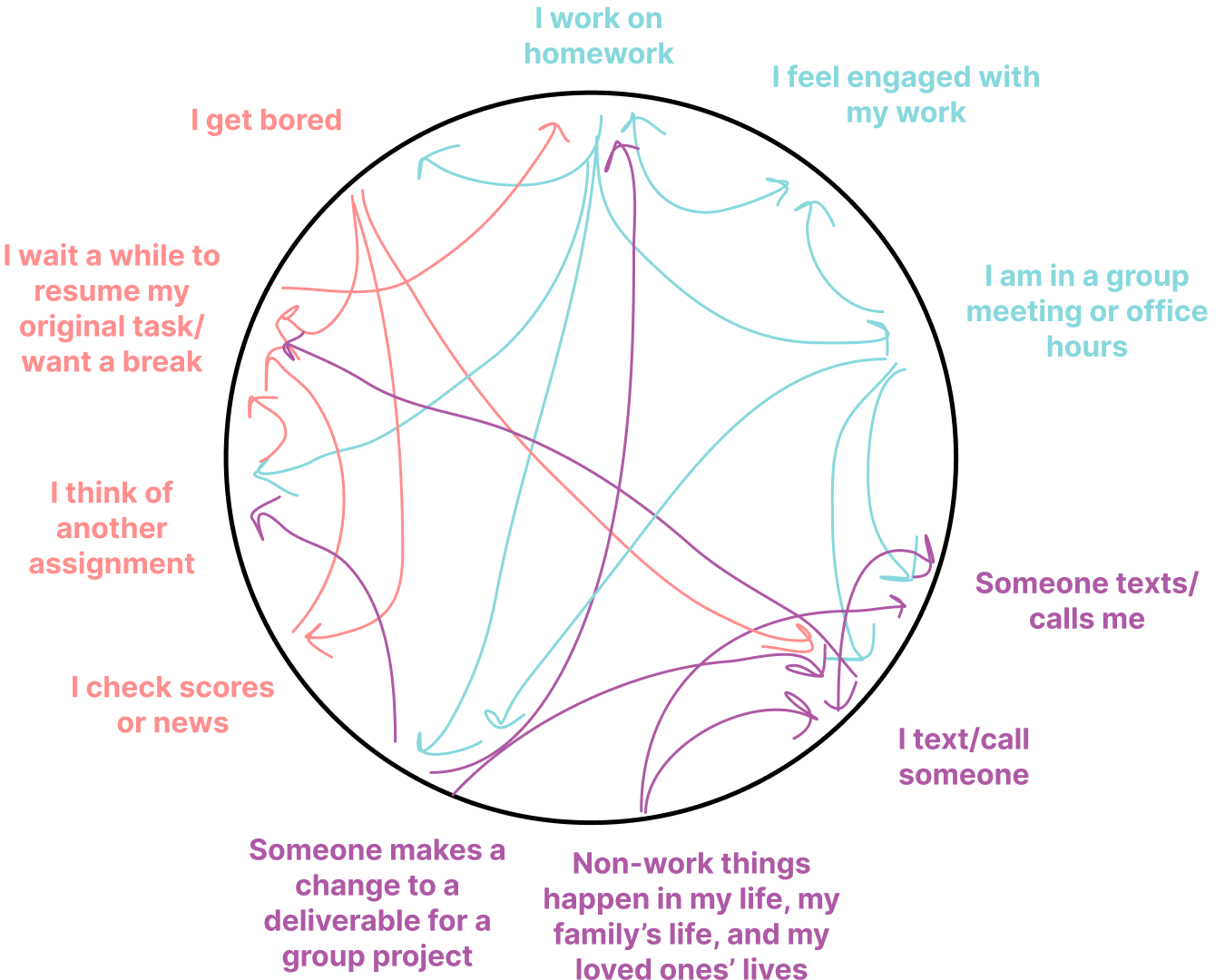
What I discovered is a relatively complicated connection circle. To try to make things easier to understand, I colored more “negative” distractions red and put them towards the left side of the circle. I colored everything “positive” and work-related as blue and put them towards the top of the circle. On the bottom right side of the circle and colored in purple are what I think are necessary and beneficial reasons to stop work, namely talking to my parents, siblings, or girlfriend.
To begin with the positive, I found a cycle of “I work on homework” to “I am in a group meeting or office hours” to “I feel engaged in my work” and back to “I work on homework”. This tells me that one way I can avoid distraction in the future and be more effective is to collaborate with others. I also found that despite “I work on homework” being a beneficial activity, some of the other good things it leads to, like “I am in a group meeting or office hours” are not necessarily a positive for my work effectiveness. For instance, “I am in a group meeting or office hours” also connects to “Someone texts/calls me” and “I text/call someone”, both of which are significant causes for distraction (making up 12 of 19 total distractions) when I am working. If being social is what keeps me energized, though, it may be worth it.
Now, to focus on the negative, the primary destination of most of the less beneficial connections is “I wait a while to resume my original task/want a break”. One common path to arrive here is “I work on homework” to “I get bored” to “I wait a while to resume my original task/want a break”. The question that this brings up, then, it how do I delay getting bored? Perhaps I should consider instituting intentional breaks to recharge and stave off boredom/burnout. I will discuss this more later. Taking a break always ended up leading back to working on homework, but it was only after a several-minute break that often broke my focus. Often other forms of distraction are what break the initial focus and then lead me into this non-work period, such as “I text/call someone” or “I think of another assignment”.
Balancing Feedback Loop

I found a balancing feedback loop where my “Level of focus over time” was impacted negatively by “Outside distractions” and positively by “Taking a break”. I framed taking a break as negative in my connection circle, but even if a break was taken for the wrong reasons, I know that breaks are necessary for me to stay fresh mentally. “Level of focus over time” then positively affects “Getting work done”, which in turn negatively affects “Level of focus over time”.
For me, this means that taking breaks is instrumental to increasing my level of focus, and, thus, work output. Additionally, I can see that two factors decrease my level of focus over time, with one being necessary and desired: getting work done. This tells me that I need to be easier on myself because my level of focus will decrease some over time even without outside distractions. I must remember, however, that outside distractions just expedite the decrease of focus over time.

The above graphs show some more temporal relationships of distractions and focus. On the left graph, “Distractions over time”, I mapped the phenomenon that the first distraction typically takes a while to occur, but from that moment on, each subsequent distraction occurs increasingly frequently. This likely has a relationship with my level of focus over time, as seen in the rightmost graph.
On the right graph, “Level of focus over time”, my level of focus drops off quickly as time moves on, and then increases from there at a much slower pace than it dropped. The trough of this graph is me taking a break, and the recharge period begins during the break and as I get back into my work. This relationship between the level of focus and time tracks with the notion of “freshness” that I mentioned earlier. It feels as if distractions become more likely as time goes on, just as the level of focus decreases.
Conclusions
In the grand scheme of things, I feel that my behavior of distraction is relatively benign. More often than not, my “distraction” is something like talking to my mom on the phone, which is something I love to do and would happily take a break from work to make time to do. I chose this behavior of mine to analyze because I thought it could be interesting to dissect, knowing that I’m in four CS classes and that balancing the work between each of them can be a challenge. I have no issues with my work output, but I do feel I could be more efficient, and I think knowing more about what sidetracks me could help me achieve this goal in the future.
My levels of focus and my distractions seem to be not only directly related but to go hand-in-hand. As my levels of focus decrease, I seem to be more prone to distraction. Moreover, with each distraction, my level of focus decreases. To aid with this, I might begin to institute on-demand micro-breaks that entail no phone or technology, but rather just give me time to think and maybe get some fresh air. I noticed in the connection circle that many of the tech-related distractions just led me back to the “I want a break” event.
Also, it is interesting that when I was doing anything group-related, I felt more energized and felt as if I had distraction impulses less often. This is something I am proud of and hope to nurture more in the future as I move closer to my professional life where I will often be working with others in an office setting.
Finally and on a more granular level, I had never considered the wide array of distractions that exist around me as I try to get work done. I don’t even have my phone near me when I’m working and I usually have notifications on my computer on Do Not Disturb, but I cannot shake the impulse to check texts or scores or just see what is going on around me. Very rarely did anything particularly important happen in the hour or two I was working, however. In the future, I might keep my phone on silent but allow ringer noises from my favorite contacts so I can still be contacted if there is an issue.