
Storyboards
For clearer images, see: https://drive.google.com/drive/folders/1-1QAJks-6LJJCN47LivdRcS2JMDKL5-7?usp=sharing
Description
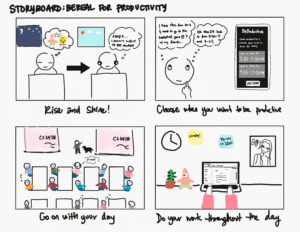
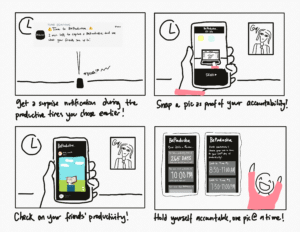
In this storyboard, we walk through a part of a day where the student is using our intervention. In the morning, the student wakes up and chooses two blocks of time that they plan on being productive that day. Then the student goes about their day and attends class. After class is over, the student follows through with their plan and works during the first block of productive time that they set in the morning. At some point during this productive block of time, the student receives a surprise notification on their phone from the BeProductive app, where they need to quickly take a picture that proves that they’re actually being productive, holding them accountable. The student snaps a picture of them working and quickly checks on their friends’ BeProductives that show them working on various tasks such as readings for a class. Feeling motivated by their friends’ productivity, the student quickly returns to work.
Pros
- Social proof is a powerful way to influence behavior, so if users know that their friends are being productive, they might be more inclined to stay productive
- Spontaneity of notifications keeps users on their toes, making them more likely to stay productive for the entire time they had scheduled for themselves.
- Little to no setup required, simply pick two time blocks to be productive to start using the intervention
- Standalone intervention that seeks to supplement and not substitute users’ existing productivity tools and methods
- Encourages users to be intentional about their day without being overly rigid like methods such as calendaring
- Allows users to capture meaningful artifacts of their productivity, which could motivate them to keep being productive over time.
Cons
- Social aspect requires the solution to overcome the ‘cold start’ problem
- Effectiveness of solution is dependent on peers also using the platform, which requires significant effort dedicated to user retention
- Notifications can be easily ignored, especially when users have ‘do not disturb’ on
- Disrupting users while they’re in a productive flow could backfire and make it difficult for users to return back to work (this might be a bigger issue for users with ADHD/ADD)
- Little to no reward to motivate users to stay using the app, as well as to celebrate them keeping up with their plans
Description
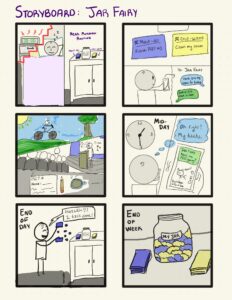
This storyboard follows a student going through a full day with the Jar Fairy system. They wake up at 8 and head to wherever their morning routine takes them. The jar is kept there on purpose so they always see it. Next to the jar are two stacks of sticky notes in different colors: one for a serious must-do task, one for a chill task that’s not mandatory but wanted.
They write down one of each (must do -> finish PSET #3 and chill want -> clean their room) then snap a photo and text it to the Jar Fairy (SMS agent). The Jar Fairy confirms and says it’ll check in later.
The student goes about their day,biking around, going to class, working on stuff, etc. The PSET stays untouched. Midday, while they’re scrolling on their phone, the Jar Fairy texts them a reminder about their tasks (*gasps*). They snap out of it and get back on track.
By end of day, they’ve finished one task. They go back to the jar, rip the completed sticky to shreds, and drop the pieces in. The unfinished task carries over to the next day. By end of week, the jar is filling up with shredded bits of everything they got done, and the failed stack on the side shows what still needs attention.
Pros
- The physical act of ripping a task to shreds and putting it in the jar is quite satisfying in a way that a fading box in a calendar isn’t. You can actually see your progress building up over time.
- Placing the jar in your existing morning routine path means you don’t have to build a new habit. You will run into it with less effort.
- Committing to just one must-do and one chill task keeps things realistic instead of an overwhelming to-do list (like picking min 3 tasks every morning).
- Unfinished tasks don’t need to be dragged around aimlessly. They can naturally carry over to following days by remaining in the designated physical space.
- Texting is how students already communicate. SMS notifications are way more likely to get seen than email or app notifications.
- The midday check-in puts your own priorities back in your head at a point where you can still do something about it. A nice reality check/wake-up call.
Cons
- The jar is physical and lives in one spot, so if the student sleeps somewhere else or has a weird schedule, the morning/evening ritual might break.
- Making the Jar Fairy texts feel human and not annoying is a hard problem. We don’t want it to feel like spam because students will probably ignore it.
- The midday reminder is only useful if it catches you at a moment when you can actually act on it. If you’re in class or at work, it doesn’t do much.
- If someone gets stuck on a task they can’t finish, the whole system stalls for that color. The growing “failed” stack could become intimidating instead of motivating.
- The system relies on the student actually remembering to text the photo every morning. If they skip that step, the Jar Fairy is out of the loop.
- Sticky notes run out, jars fill up. Need to think about what happens when the jar is full and how to keep it going long-term.
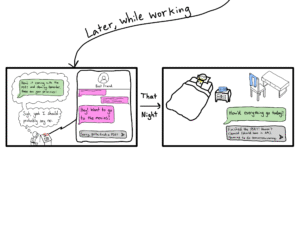
Description
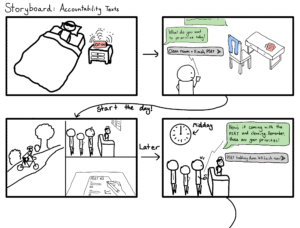
In this storyboard, we see a student going about one full day of school. In the morning, they receive a text asking them to list their priorities for the day. They do this quickly by sending a short, informal text message.
Later that day, they get a reminder text asking how their tasks are coming along and reminding them that these are priorities they set for themselves.
While the student is studying later that day, their best friend invites them to go to the movies. They think back to the text that reminded them to finish their PSET that day, and they decline the invitation in order to keep working on their homework. Finally, they reflect on how their goals turned out in the end. Although they didn’t manage to clean their room, they at least got their PSET done! The student celebrates finishing their PSET and makes a better plan to clean their room tomorrow.
Pros
- Short informal texts are easy to read and write. No annoying forms or long responses
- Students almost always have their phones with them; texting is one of the more reliable ways to communicate compared to email/Google Forms.
- The midday check-in is an automatic reminder that puts your priorities back in your mind.
- Reflection at the end of the day gives you a chance to think about why certain tasks got done while others didn’t. Reflection helps you make a better plan for the future.
Cons
- Automated texts don’t provide the same kind of accountability as a friend
- It’s very hard to send the midday text at the exact right time when a person is available to respond and able to act on the check-in. If the check-in is mis-timed, it will be far less effective.
- Making texts feel personalized/dynamic/human is not an easy problem. Even LLMs can come across as impersonal if not trained/prompted correctly.
Intervention Study Link: https://docs.google.com/document/d/19-2tJ0K21dcQtPgRSOnWDnBtRm0kkA6phUrKchFpXFM/edit?usp=sharing
Intervention Study: Visible Intentions
A 5–7 day intervention study combining social accountability (group chat) + private nudges (individual texts) to reduce the intention–action gap.
1) Study Question
Primary research question:
Does making daily priorities socially visible (in a group chat) + sending light private reminders increase follow-through on daily plans compared to baseline planning?
Secondary questions:
- Which component drives behavior change more: social visibility or private nudges?
- Does the intervention change how people plan (more realistic, smaller tasks) or mainly change execution?
- How does it affect emotions (stress, guilt, motivation, self-trust) while following through?
2) Study Overview (5–7 days)
Length: 6 days total
- Day 0 (Mon): onboarding + optional pre-study interviews (for new participants)
- Days 1–5 (Tue–Sat): daily intervention loop (morning goals → midday nudge → evening completion)
- Day 6 (Sun): required post-study interviews (or post-study survey alternative)
Intervention idea:
Participants post their 3 daily priorities publicly in a shared group chat (social accountability). Researchers send private 1:1 reminders midday and when someone hasn’t posted (notification layer). At night, participants post ✅/🟨/❌ outcomes in the group chat. The next morning, researchers post an aggregate recap (not ranking individuals).
3) Participants (Recruitment Plan)
Target: minimum 5 participants completing the study during Week 7 (aim 6–10 to absorb drop-off).
Mix of participants:
- 2–3 returning baseline participants (within-person comparison: did they improve vs baseline?)
- 2–5 new participants (tests generalizability beyond our original sample)
Eligibility criteria (same as baseline):
- Current college student
- Uses some method of planning (calendar, notes, paper, etc.)
- Has a smartphone (for GC + texts)
- Will commit to posting 2x/day for 5 days (morning commitment + evening reflection)
Recruitment method:
- Direct outreach to friends/classmates + study announcement message (template below)
- Prior baseline participants invited first
- Friends of baseline study participants
4) Study Protocol (What participants do each day)
Surface 1: Group Chat (social layer)
- Used for posting goals + posting results
- Used for daily recap (aggregate only)
Surface 2: Individual texts (notification layer)
- Used for midday reminders
- Used for nudges if someone hasn’t posted yet (“Several other participants have already submitted their priorities for the day. Whatcha waiting for?”
Daily Schedule (Days 1-5)
A) Morning (8–11 am): Goal-setting in the group chat
Participants post:
- “Day X priorities: 1) ___ 2) ___ 3) ___”
Purpose: make intentions public; reduce “soft commitments.”
If someone hasn’t posted by 11 am:
We will send a private reminder.
B) Midday (23 pmm): Private nudge (no response required)
We will send an individual message to each participant:
- Reminder to check priorities
- Optional prompt: “Pick the smallest next step.”
Purpose: interrupt drift + prompt re-engagement without spamming the group.
C) Evening (911 pmm): Outcome reporting in the group chat
Participants post results using:
✅ = done, 🟨 = partial, ❌ = not done
- “Day X results: ✅🟨❌ + one sentence reflection (optional)”
Purpose: close the loop; capture why follow-through failed or succeeded.
If someone hasn’t posted by 11 pm:
We will send a private reminder.
D) Next morning: Aggregate recap (We will post posts)
Example recap:
- “Yesterday recap: ✅✅✅ (2 people), mixed (3 people), mostly ❌ (1 person).
Top blocker: ___ | Top win: ___”
Important rule: no public ranking or shaming; recap stays aggregate.
5) What Data We Will Collect
We will collect both logistical data and content data directly from group chat + individual texts, timestamps.
Logistical data (behavioral outcomes)
- Morning post completion (Y/N) each day
- Evening post completion (Y/N) each day
- Follow-through score per day: ✅=1, 🟨=0.5, ❌=0 (max 3/day)
- Response timing (posted on time vs delayed)
- Streaks (how many consecutive days they complete both posts)
Content data (thinking + reasons)
From nightly “reflection” lines (or brief follow-ups if needed):
- Top blockers (fatigue, perfectionism, overwhelm, distraction, social plans, avoidance, etc.)
- What helped (momentum, friend/social boost, starting small, studio environment, etc.)
- Changes in planning style across days (more specific? smaller tasks? fewer tasks?)
- Emotional tone (stress vs pride vs guilt)
6) Data Collection Plan
Collection method:
- Group chat exports/screenshots (goals + outcomes)
- Individual texts for reminders + timestamps
- Manual coding into a spreadsheet after each day:
- participant ID (initials), day number, goals posted, results posted, completion score, main blocker, main helper, notable quote
Analysis plan:
- Compare each participant’s average daily completion score across Days 1–5
- Compare baseline participants’ completion/self-report patterns vs intervention week
- Identify recurring breakdown loops (ex: perfectionism → avoidance → late-night panic → guilt → avoidance)
7) Study Materials
A) Day 0 Intro Message (Group Chat)
“Welcome to Visible Intentions! For the next 5 days, we’re testing whether social visibility + lightweight reminders improve follow-through.
Daily rhythm:
- Morning: post 3 priorities
- Midday: private reminder from us
- Night: post ✅/🟨/❌ results
We’ll post an aggregate recap each morning (no ranking).
Honest updates matter more than ‘perfect’ ones, ❌ is valid data.”
C) Daily Scripts
Morning GC prompt (8 am):
“🌞 Day X: Post your 3 priorities for today (short + specific).”
Private reminder if missing (11 am):
“Friendly nudge – drop your Day X priorities in the group chat when you can 👀”
Midday private reminder2:30 pmpm):
“Midday check: look at your 3 priorities – choose the smallest next step on one.”
Evening GC prompt (9 pm):
“🌙 Close-out: reply with ✅/🟨/❌ for each priority. Optional: 1 sentence why.”
Private reminder if missing (11 pm):
“Before you sleep – quick ✅🟨❌ close-out in the group chat? Even if it’s all ❌, it helps.”
Next-morning recap (8 am):
“📌 Yesterday recap (Day X): ✅✅✅: __ people | Mixed: __ | Mostly ❌: __
Top blocker: __ | Top win: __”
Post-Study Interview Guide
Introduction (1-2 minutes)
Thank you again for participating in this 5-day study. We’re interested in understanding how the combination of public goal-setting in the group chat and private reminder messages influenced your behavior, thinking, and emotions throughout the week. There are no right or wrong answers; we are especially interested in moments where things didn’t work as expected. Everything you share will be kept anonymous in our analysis.
Section 1: Overall Experience
- Compared to a normal week, how did this week feel in terms of productivity and planning?
Did you notice any difference in how seriously you treated your daily priorities? Did the study make the week feel more structured, more stressful, more motivating, or about the same? - What part of the system had the biggest impact on you, and why?
Was it posting your goals publicly in the group chat, receiving the private midday reminders, having to report results at night, or seeing the next-day recap? Please describe what made that part stand out.
Section 2: Changes in Planning Behavior
- Did you follow through on your priorities more than you normally would?
If yes, what do you think caused that change? If not, why do you think the intervention didn’t shift your behavior? - Did knowing that others would see your goals change the way you planned?
For example, did you choose smaller or more realistic tasks? Did you avoid writing overly ambitious goals? Did you ever choose tasks that felt more “impressive” to post? - Over the five days, did you notice your planning style evolve?
Did your priorities become more specific, shorter, more achievable, or more aligned with your actual schedule?
Section 3: Execution & Breakdowns
- Think about a day when you followed through successfully. What helped in that moment?
Was it the reminder, the public visibility, the timing, your mood, or something else? Please describe a specific example. - Think about a day when you did not follow through. What got in the way?
Was it fatigue, distraction, perfectionism, social plans, unexpected events, or something internal like avoidance? Did the intervention help you recover at all on those days?
Section 4: Social Visibility & Emotional Impact
- How did the group chat aspect make you feel emotionally?
Did it feel motivating, supportive, neutral, pressuring, or stressful? Did you ever feel judged, compared to others, or competitive? - Did you ever feel tempted to report better results than reality? Why or why not?
We are interested in whether public visibility increased honesty, reduced honesty, or didn’t affect it. - How did the private reminder texts feel?
Were they helpful nudges, easy to ignore, slightly annoying, or perfectly timed? Did they interrupt unproductive moments or just add noise?
Section 5: Reflection & Self-Awareness
- Did this study teach you anything about your own planning habits?
For example, did you discover patterns in what types of tasks you avoid, times of day when you’re most productive, or moments when you tend to give up? - Did the daily “closure” at night (posting ✅🟨❌) change how you thought about your day?
Did it increase accountability, create guilt, build pride, or simply make you more aware?
Intro Email (Intervention Week)
Subject: Welcome to the Visible Intentions Study
Hi ______,
Thanks again for joining our 5-day intervention study. The goal of this study is to better understand how college students plan their days, what tends to get in the way of following through, and whether a little extra social accountability + light reminders can make sticking to daily priorities easier.
During the study, you’ll participate in a simple daily structure:
- Morning: Post 3 priorities for the day in the group chat
- Midday: Receive a short private reminder to revisit your goals
- Evening: Post a quick ✅🟨❌ update in the group chat
- Next morning: We’ll share a short aggregate recap of how the group did
A few quick notes:
- This is not a productivity evaluation, so there are no right or wrong outcomes.
- If you miss a post or reminder, that’s okay. Just jump back in the next time you can.
- Honest updates (even ❌❌❌ days) are more helpful to us than perfect ones.
We’ll start on Monday morning with the first group chat prompt. Looking forward to learning from your experience!
Thank you,
Team Raggiana
Post-Intervention Email
Subject: Thank You + Final Step
Hi ______,
Thank you for completing the Visible Intentions study this week. We really appreciate the time and consistency you put into posting your goals and updates.
Now we’d love to hear about your experience through a short post-study interview (about 20–25 minutes). We want to understand:
- Whether the group chat visibility changed your behavior
- How the private reminders felt
- What helped or didn’t help with follow-through
- What you noticed about your own planning habits
Please choose a time here:
[Scheduling link]
If none of those times work, reply with a few options, and we’ll coordinate.
Thank you again for participating. Your insights are incredibly valuable to our project.
Best,
Team Raggiana
.



