Intervention Study Ideation
Here we generate a storyboard for each potential intervention, as well as discuss pros and cons for each.
Idea 1: Financial discouragement
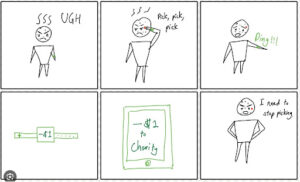
Description:
1. Ben clenches his fists, his face twisted in frustration. He has been fighting this habit for what feels like forever, and once again, the urge is creeping in.
2. Despite his best intentions, Ben finds himself picking at his skin. It’s almost instinctive—a behavior that has become second nature.
3. Suddenly, “Ding!”—an alert cuts through the moment. Startled, Ben freezes. His eyes widen as the notification sinks in: it’s a reminder he set up for exactly this situation.
4. A message flashes: “$1 deducted.” The deduction feels small, but the impact is bigger—it’s a direct response to his action.
5. That dollar doesn’t just disappear; it’s sent to charity. Even in his slip-ups, Ben’s failure becomes a small act of giving.
6. Ben straightens up, his face now filled with determination. “I need to stop picking,” he says to himself, more committed than ever. This isn’t the end of his journey, but it’s a pivotal step forward.
Pros and Cons:
Pros
- Helps users recognize subconscious behaviors in real-time.
- Users can adjust donation amounts and choose their charity, giving a sense of control.
- Donations go to a good cause, making the intervention feel purposeful.
- Financial consequences are highly motivating for many people, encouraging faster behavior modification.
- Users can track their progress and visualize improvements over time.
Cons
- The app may mistakenly identify similar movements as skin-picking, causing unnecessary donations and frustration.
- Users may be uncomfortable with continuous motion monitoring.
- For those who struggle to control the behavior initially, costs can add up quickly.
- Requires continuous access to a smartwatch and phone, limiting accessibility for those without wearable devices.
- Users might feel discouraged or anxious if they experience frequent notifications and deductions.
- Some people can’t afford to lose $1 after every compulsion.
Idea 2: Targeting likely rumination times
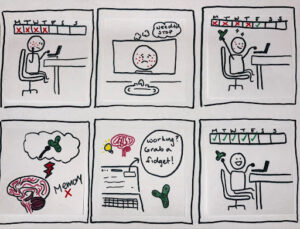
Description:
- Luke has a habit of picking at their face while sitting at their work desk. It’s causing harm to their skin.
- The imperfections make Luke self-conscious, and they wish they could stop picking, but it’s such an idle and subconscious activity that it’s hard to break.
- Sometimes, Luke remembers to grab a fidget toy, like their fidget spinner, to keep their non-dominant hand occupied while they are working. This works great because it keeps their hand off of their face!
- The problem is, it’s hard to remember to reach for the fidget spinner.
- Luke sets up this program that reminds them to grab their fidget spinner each time they log onto the computer for a work session, which replaces the need to remember it on their own.
- Luke, with the help of their computer reminder enabling habit formation, uses their fidget spinner every day at their desk, reducing the amount of time they spend picking at their face.
Pros and Cons:
Pros
- Is a preventative tool, rather than harm reduction
- Long-term habit formation
- User can customize the notification to the times and places in which they are most likely to pick; personalizable product, so it reaches a wide variety of behaviors and users
Cons
- Requires user to have some knowledge of when and where they engage in the behavior
- Requires some lengthy user set-up
- Only works if user has physical tools and distractions that work for them
Idea 3: Targeting likely rumination times
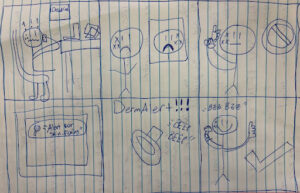
Description:
- Andy mindlessly picks at his skin when he gets overwhelmed
- He doesn’t notice until he damages skin badly
- Sometimes he catches himself picking at his skin and stops himself before damaging himself too badly
- He searches for some sort of alert system to make him aware
- He purchases the DermaLert and it alerts him anytime he tries to pick at his skin
- Andy stops himself from picking anytime the watch alerts him and his skin is not damaged any further!
Pros and Cons:
Pros
- Preventative tool
- Brings attention to issue to consciously break habit
- Minimal effort involved
Cons
- Very invasive – is annoying to people who skin pick
- Expensive and difficult to manufacture
- Can increase anxiety of anxiety prone population
4-day Intervention Study
Description
We have observed that people who skin-pick have tried tactile solutions that work for them but lose context awareness before they can use them. They might have more awareness during severe sessions but still not be able to release themselves from the compulsion. Through our intervention, we want to boost intrinsic motivation and awareness to use existing, tactile solutions before high-severity skin-picking sessions. We will choose our 2nd idea and target the contexts that people will likely skin-pick e.g. working at desk, sitting idle with phone, in car, etc.
Theory: If people think about existing solutions before entering the context of likely skin-picking, we believe that their behavior will change. They are required to reply to the reminder, which is a more active acknowledgement of reminder.
Question: Will skin-picking sessions decrease if people are reminded to use existing solutions that were effective for them in the context they specify?
Intervention
- Ask participants beforehand which context they want to target and what time would they be in the context
- Ask participants if they have been successful with an existing solution in this context
- If not, we can propose one or offer suggestions
- For 4 days, every day we will email/text ping the participant at the time to use the solution in the context they specified
- Participant will reply:
- Will use existing solution
- Will use different solution & what?
- Will not use solution, why?
- After 4 days, we will discuss how they felt about the intervention, whether it was effective in remembering to use existing solution, if there was anything they wanted to change about the context or time, etc.
Duration
- Day 0: Introduction email
- Day 1-4: Intervention Study
- Day 5: Post-study survey
Participants
- Will ask our participants from our baseline study or pull more participants from the Reddit community
- 5 participants
Data Collection Plan
We want to collect data that proves that behavior is changed after reminding participants of their existing solutions.
Pre-study:
- Collect context description and time that participant wants to be reminded
Study:
- Collect 4 email/text responses, 1 for each day, Participant will choose one option:
- Will use existing solution
- Will use different solution & what?
- Will not use solution, why?
- We will compile email/text responses into spreadsheet at the end.
Post-study Survey Form:
- How they felt about the intervention
- Was it effective in remembering to use existing solutions?
- Was there anything they wanted to change about the context or time?
- Did their solutions change over time?
Intervention Study Materials
- Introduction Doc & Discussion Guide [For Participants]
- Study Materials: Intro & Closing Emails