
Synthesis
Topic Introduction
Problem Space
In an age where TikTok (and the newly launched TikTok shop), Instagram, Amazon, and scrolling through your feed bedrotting is all too common, online shopping is easier to pick up than ever. In online environments that push rampant consumerism, teenagers and young adults often fall into temptation, leading to regretful purchases and strained wallets. Most of the time, they’re not equipped to self-regulate their impulses, especially when many digital shopping tools/platforms are geared to direct their behavior to click the purchase button. As a result, Team Axolotl is seeking to solve this problem of frequent online shopping to create a healthier, more sustainable relationship with our shopping carts.
Secondary Research: Literature Review
The problem space was corroborated by our literature review. Our studies were from all over the world. In our literature review, we first investigated the relationship between social media and online shopping. We found that while Instagram influencers/celebrity endorsements drive purchase intentions, use of TikTok significantly affects impulsive purchases, indicating that different kinds of social media use can have different effects. Then, we looked into personal factors driving online shopping, finding that low-regulation in online environments, stressful environments, boredom, and dissatisfaction all lead to online shopping addiction. Online shopping was perceived as a break and escape from the real world, and young people weren’t being taught other methods to control themselves. Overall, through our research, we identified key factors behind online shopping, and decided to target those in our studies. You can find our whole literature review here.
Secondary Research: Comparative Analysis
For our comparative analysis, we mainly looked at 1) budgeting apps, 2) shopping experience improvement apps, and 3) “distraction” apps.
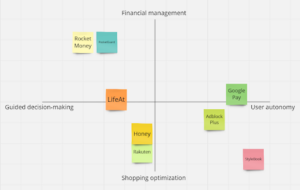
For our budgeting apps, we had Rocket Money, Google Pay, and PocketGuard. We felt budgeting apps were important because they can influence people to stop online shopping, or at least limit their spending. By visualizing their spending and actively keeping track of it, they were at least made aware of this issue. When we were analyzing our budgeting apps, we kept an eye out for how the budgeting apps communicated their spending to the consumer.
Meanwhile, for our shopping experience apps, we had Rakuten and Honey. These apps were designed to serve as an “expert shopper” that helped the user navigate their online shopping experience by finding deals and saving them money. We looked at these apps because we believed that they could prevent the user from making unnecessary purchases, and when we analyzed them, we sought to understand the unique strategies they employed to get user engagement.
Finally, for our “distraction apps,” we had LifeAt, Stylebook, and AdBlock Plus. These apps “distracted” the user from online shopping through different methods, such as looking through their existing closet, blocking flashy advertisements, and mandating focus. When we analyzed these apps, we were looking at the methods they employed to mimic the effect of online shopping or minimize the effect of online shopping.
After finding all of the companies for our comparative research, we created this comparative matrix. One large trend across the comparators that we noticed was that these tools/apps were either used to manage financial decisions or to shop more effectively. Another one that was important was that these apps relied on either guided decision-making (such as offering suggestions for budgets) or user autonomy (user is given information that they can then make decisions on). This means that for our potential solution, one successful strategy could potentially be to focus on guided decision-making to shop more effectively. You can check out our full comparative research here.
Baseline Study
Target Participants
Our target participants for our baseline study consisted of people who spent too much time scrolling through online shopping sites or spent too much money on products they did not need or did not use.
We decided to focus on this group of people partially because spending too much time on online shopping sites can, like social media, become an addiction that steals our time away from more productive, healthy, or social activities offline. Making too many purchases on impulse can also greatly inconvenience both the customer and all those involved in return processes: the customer may run out of funds for necessities or even go into debt to fuel more purchases, while returned items must go through the entire return process and perhaps end up in a junkyard despite being brand new. Helping people be more mindful about making excessive online purchases could help all involved in the related processes.
To identify our target participants, besides general identifying and demographic questions, our screener asked potential participants what factors motivated them to shop online—agreement that impulse or emotional buying was a motivator indicating that a potential participant was part of our target audience. Our screener also asked if a potential participant usually purchased less or more than what they needed when shopping online; if they reported often purchasing more than they needed, they better fit into our target group of people who over consume on online shopping sites.
The last major question on our screener asked how long it usually took the potential participant to decide to purchase an item after first encountering it on a shopping website. Making the purchase within days—or even shorter amounts of time—on average indicated that the potential participant was an impulse buyer and would be a good fit for our baseline study.
Methodology and Data Collection
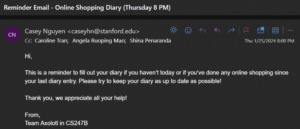
We had nine participants take part in our five-day baseline study that ran from 1/22/2024 to 1/26/2024. Participants each had access to a diary to fill out via Google Sheets (view template here) and were instructed to fill out an entry every time they finished an online shopping session, whether they had only browsed or they had made a purchase. They received a reminder to fill out their diary three times per day—at 8 AM, 12 PM, and 8 PM—via email. See one such reminder below.
The diary consisted of five pages, one for each day of the study, and asked participants 13 questions for each shopping session. This may seem like a lot, but some questions were for date and time of the entry, and some were only applicable if the participant had made a purchase, so most diary entries had many blank answer boxes. See two such entries below.

Using this method, we were able to collect data about the contexts and motivations or other feelings surrounding purchases. Participants needed to put into words why they were making each purchase or spending time browsing shopping websites, helping us understand their reasoning for certain purchase decisions and also prompting them to see the trends in their own behavior that they could then talk to us about in a post-study interview.
Synthesis
Mapping
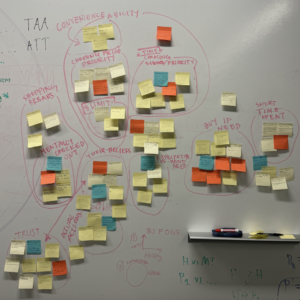
Each team member wrote sticky notes for 1-2 participants from our baseline study – extracting critical points from the pre-study interview, diary study, and post-study interview. We chose to write sticky notes for individuals we personally interviewed so that we could reference the expressed body language, emotions, and facial expressions. Due to the overwhelming number of sticky notes generated, the team decided to start with an affinity map where we grouped notes with aligning thought processes or beliefs. The resulting groupings were made with the perspectives and motivations of the participants in mind:
- Ability
- Convenience
- Prioritizing price/deals
- Money limits
- Prioritizing school
- Shopping breaks
- Mentally checked out
- Trust
- Their beliefs
- Actual actions
- Personal Goals vs. Reality
- Buy if need
- Short time spent
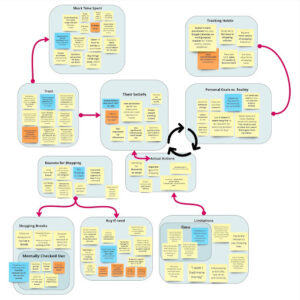
Digital Miro Board of Affinity Mapping for Shopping and Overconsumption Behaviors
There was an interesting pipe between their beliefs and the actual actions they took. Because they believed they weren’t influenced by ads, they further justified their interactions with promotional emails. There was also an interesting cycle between their beliefs, their personal goals versus reality, and the actions they took. Their beliefs and actions fueled their personal goals – which they set but didn’t seem to actually follow through with. For example, although one of our participants didn’t like promotional emails cluttering their inbox, they would rather delete the emails one by one than “take the extra step” to unsubscribe. In another case, the participant wanted to take more time researching items before purchasing. However, they also thought it would be “annoying to research every little thing.” Additionally, many participants had limitations regarding time or purchasing power (money) which affected their actions such as using price comparison tools and limiting browsing during schoolwork, or their deliberation process such as preferring items with easy returns and free shipping.
We dove deeper into these conflicts as well as the relationship between trust and the time spent shopping in our grounded theory.
Grounded Theory
In our study, we’ve developed several grounded theories that dive into the behavioral patterns of online shoppers. These theories are particularly relevant to our top three ideation concepts—Venmo Idea, Item’s Value Log, and Purchasing Things for Others—which are illustrated in our storyboards.
The core of our grounded theory rests on the notion that online shopping behaviors are multifaceted, often serving as both a distraction and a means of emotional gratification. We observed that consumers frequently use online shopping as a way to disconnect from immediate tasks or stressors, leaning into the virtual world as a mental escape. This behavior is not solely about the purchase itself but the act of browsing, which provides a temporary escape or break from the user’s environment or current state of mind.
Subsequently, our theory unpacks the post-purchase rationalization process. Here, consumers often justify impulsive or unnecessary purchases by framing them as forms of emotional coping or as rewards, suggesting a complex interplay between emotional well-being and consumerism.
Additionally, our research indicates that consumers place significant value on personal recommendations and social proof over traditional advertising when making purchase decisions. This insight informed our development of the Venmo Idea, which embeds social feedback into the shopping process.
Our grounded theory document provides a comprehensive overview of these insights. It includes detailed analyses and subtheories that further expound on the relationship between consumer emotions, rationalizations, and external influences within the digital shopping sphere. It’s within this theoretical framework that our intervention strategies were conceived, aiming to foster more conscious and reflective online shopping practices.
System Models
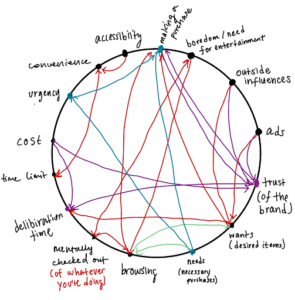
Because there were so many moving ideas in the affinity map, we decided to use a connection circle to narrow down the primary points of interest that could guide us toward possible solutions or interventions.
- Blue: Urgency and necessity encourage faster purchases. Necessity also fuels urgency, which fuels purchases.
- Red: Browsing is widely connected to boredom, outside influences, interactions with ads, and deliberation time. This color is further broken down below.
- Purple: Trust in a product or person impacts the intent to purchase. Trust is interestingly driven by both personal experience and outside influences.
- Green: There is a blurred definition between wants and needs when users are deep in mindless scrolling.
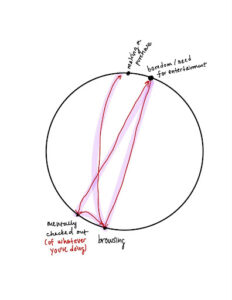
Users tend to resort to mindless browsing when they are bored or mentally checked out of the current task they’re working on. Because this is the most accessible alternative for brain stimulation, users are more likely to purchase when exposed to interactions designed to increase intent to buy. A possible area we can explore for a solution is introducing friction between mindless browsing and making a purchase. While mindlessly browsing, is there a way for us to interrupt the seamless process of adding to cart and checking out? Perhaps there is a way for users to stop and think once more before checking out? Alternatively, is there a different way for students to interact in brain stimulating activities during their study breaks?
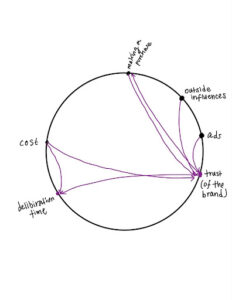
Trust was a key factor in determining a shopper’s intent to buy – especially when that trust was built from personal experience with a product or if it was from a trustworthy person like a parent or friend. We noticed that trust decreased deliberation time and led to quicker purchases and less research. We questioned whether we could capitalize on these sources of trust to create effective interventions in overconsumption. How can trustworthy individuals play a more active role in a shopper’s purchasing instance?
Our team also created a 2×2 synthesis to explore whether targeting motivation or ability would be the more fitting approach for each shopper action. For example, we see that asking for a second opinion may be hardest to start and also hard to do. If a trustworthy friend or family member of the shopper could be more active in the shopping experience, perhaps we could offload some of that ability and motivation off of the shopper? If we decide to go forward with this, we must also consider the downside of adding weight of responsibility onto the trustworthy friend or family member. Another point of interest is that taking mental breaks is easy to do and not too hard to start. When scrolling on our phones is considered a break, it is more likely that shoppers will resort to this as their first choice for a “mental break.” Rather than trying to stop them from scrolling, is it possible to use this need for screen time as a tool for developing better shopping habits?

Proto-personas & Journey Maps
Persona 1: The Low-Budget Shopper
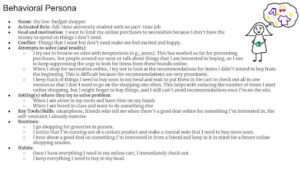
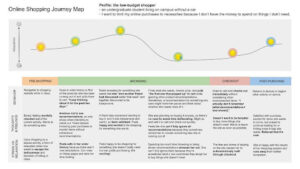
The Low-Budget Shopper is a university student without a stable source of income – the conflict is that nonessential purchases bring them more joy than necessities. Due to the income constraint, this is a persona grounded by the Foggs Behavior Model – behavior being a product of motivation, ability, and trigger. Here, the lack of a stable income represents the lowered ability to purchase nonessential items. However, there is higher motivation to purchase nonessentials as they bring more joy to the Low-Budget Shopper. The misalignment between their goal to only purchase essentials and the conflict of tempting nonessentials make for an interesting imbalance between motivation and ability. The Low-Budget Shopper is different from the “I’m just a girl” persona described below primarily because this one focuses on financial ability while the other is centered around social norms.
Persona 2: The Distracted Rationalizer
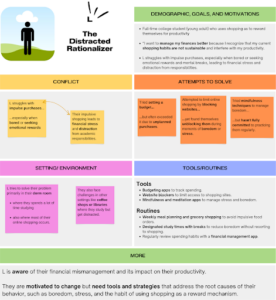
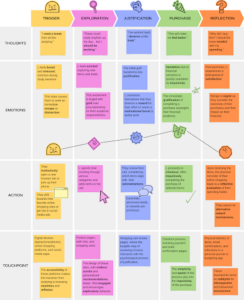
The Distracted Rationalizer is a persona who struggles with the competing desires to justify taking breaks for their well-being and to prioritize the social expectation for rational decision-making. Although this persona also seeks lower-cost alternatives, this persona is different from the Low-Budget Shopper because the crux of their conflict is an internal battle for justifying every reward they give themselves. This is a prime example of the Switch Theory. The Distracted Rationalizer struggles with meeting their goals because their rational and emotional sides do not align. One side seeks self-justification, and the other seeks socially-defined justification in making “mature” and “smart” financial decisions. Our team is exploring how we can direct our rider (rational decision-making). Perhaps guiding the Distracted Rationalizer’s reflection process with defined steps or questions may add more clarity to what factors they should consider before making a purchase? Rather than having them guess at what a mature or smart financial decision is, why not guide that reflection process more concretely?
Persona 3: I’m Just a Girl
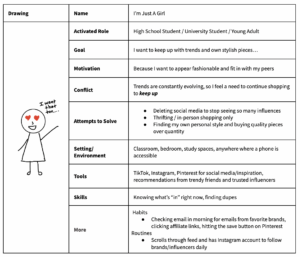
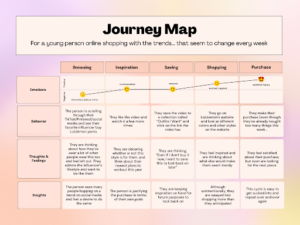
The “I’m just a girl” persona is centered on the need to appear fashionable and trendy even in the midst of trends constantly changing. This search for belonging through stylish outfits is driven by the Social Norms Theory – what is considered acceptable by the majority of their social groups primarily influences their own behavior, goals, and motivations. The “I’m just a girl” persona prioritizes their need to appear to fit in above all else – and disregards budgeting and overconsumption risks. The trigger to their purchases is seeing new trends on social media, and our team is exploring how we can use the Social Norms Theory as fuel for changed behavior. Rather than trying to stop “I’m just a girl” personas from staying trendy, we’d like to use this as encouragement to continue doing so – we wouldn’t want to take away their joys. However, we’d explore ways to add friction to the transition from inspiration to purchasing an item in order to form habits of “stopping and thinking” before purchasing.
Narrowing Down Personas:
Our team had four personas initially, with the fourth one being the Wishful Window Shopper. We decided to focus on the Low-Budget Shopper, the Distracted Rationalizer, and the “I’m Just a Girl” personas because they all required a purchase decision from the shopper. We were more interested in adding friction to the purchasing act itself rather than the explorative window shopper.
Intervention
Brainstorming Process
Our brainstorming process began with the aim of tackling impulsive purchasing behaviors identified in our baseline study and reinforced by our synthesis findings. The questions that guided our session included: “How can we reduce impulsive spending through social interaction?” and “What mechanisms can make users more mindful of their purchasing decisions?” These questions were derived from observed trends in our data, specifically the influence of social feedback on purchasing decisions and the lack of reflection in the buying process.
To frame this as a design challenge, we focused on creating solutions that could seamlessly integrate into users’ daily routines while providing meaningful interventions. This approach was informed by our empathy mapping and affinity diagrams, which highlighted users’ habits and the contexts triggering impulsive buys.
Initial Concept Sketches
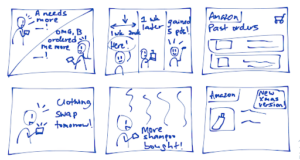
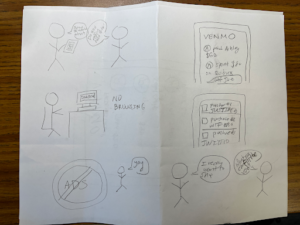
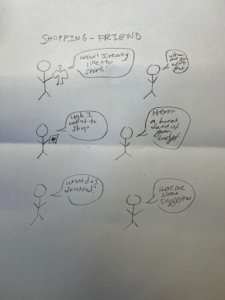
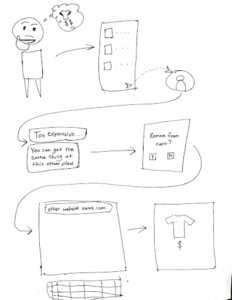
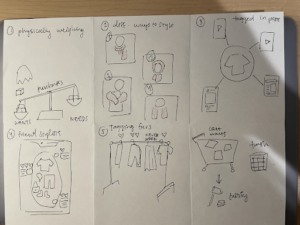
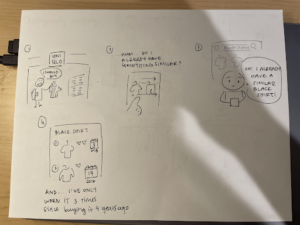
The sketches depicted preliminary ideas around social feedback mechanisms, value tracking of purchased items, and facilitating purchases for others as a form of mindful spending.


Top 3 Ideas That Emerged
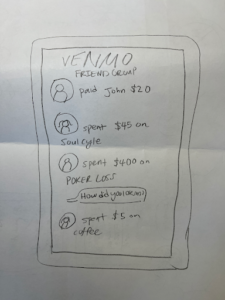
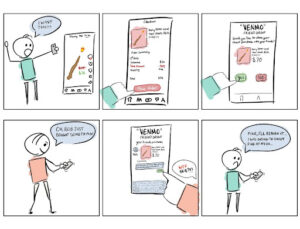
- “Venmo” Idea: Using a Venmo-like app to share purchases within a group, allowing friends to comment on and react to each other’s spending habits.
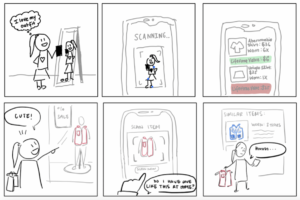
- Item’s Value Log: An application feature that tracks the usage and value derived from each purchased item, providing insights before new purchases are made.
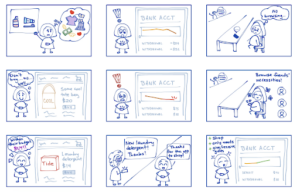
- Purchasing Things for Others: A platform feature that encourages users to buy necessities for others, shifting focus from personal impulsive buys to thoughtful spending for others.
Connection to Personas and Journey Maps
Our interventions are designed to respond to the commonalities and specific challenges highlighted by the journey maps of our personas:
The Distracted Rationalizer: Facing the lure of online shopping as a mental break from academic rigors, they could benefit from the Venmo Idea. This intervention uses social insights to temper their shopping impulses, addressing the conflict between the urge to shop and financial prudence.
The Wishful Window Shopper: Struggling with the temptation of trend-following within a tight budget, they might find the Item’s Value Log particularly useful. It encourages thoughtful consumption by providing visibility into the cost-per-use of each item, which aligns with their attempts to prioritize quality over quantity.
The Low-Budget Shopper: Constantly grappling with the tension between needs and wants, they could use both the Item’s Value Log and Purchasing Things for Others. While the Value Log helps rationalize purchases against budget constraints, the altruistic angle of buying for others could satisfy their shopping desires within a communal and budget-friendly framework.
‘I’m Just A Girl’: Motivated by staying trendy, they might resonate with both the Venmo Idea and the Item’s Value Log. The social aspect of the Venmo Idea plays into their desire for peer validation, while the Value Log helps them assess the true cost of keeping up with ever-changing trends.
In all cases, the interventions aim to introduce a reflective pause, encouraging our personas to align their actions with their goals and motivations more mindfully.
Refined Storyboards
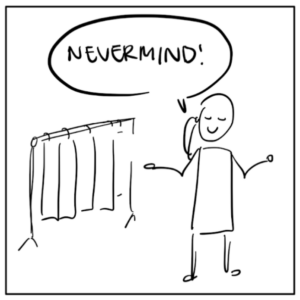
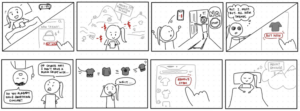
The storyboards illustrate scenarios where each intervention plays a pivotal role in altering the personas’ purchasing behaviors. For the Venmo idea, the storyboard shows how social feedback leads to reconsideration of impulsive buys. The Item’s Value Log storyboard depicts a moment of insight where a user rethinks a purchase based on past usage data. Lastly, Purchasing Things for Others showcases the satisfaction derived from altruistic spending, aligning personal values with actions. The Mindful Shopping Cards storyboard (our finalized idea) captures the journey of self-reflection encouraged by thoughtful prompts, leading to more deliberate and measured shopping choices, effectively integrating a critical pause into the often impulsive online shopping process.
“Venmo” Idea:
Item’s Value Log:
Purchasing Things for Others:
Final Idea (Mindful Shopping Cards):
Pros and Cons Analysis
- Venmo Idea
-
-
- Pros: Leverages the power of social influence; encourages accountability.
- Cons: Risk of negative feedback affecting personal relationships.
-
- Item’s Value Log
-
-
- Pros: Provides tangible insights into purchasing habits; encourages informed decision-making.
- Cons: Requires continuous user input and maintenance.
-
- Purchasing Things for Others
-
-
- Pros: Fosters community support and satisfaction from altruistic actions.
- Cons: Does not directly address the root cause of impulsive spending for the buyer.
-
- Mindful Shopping Cards:
-
- Pros:
- Promotes self-reflection at the point of purchase, potentially reducing impulsive buys.
- Easy to access and use, with minimal disruption to the shopping process.
- Encourages buyers to consider long-term value and satisfaction from purchases.
- Cons:
- May be overlooked or ignored if the buyer is in a hurry or particularly attached to making the purchase.
- The effectiveness is dependent on the buyer’s willingness to engage with the process and consider the questions sincerely.
- Pros:
Final Decision
We decided to change our intervention idea from the original three ideas created during our brainstorming process.This decision was driven by the goal to create a feasible, low-barrier, and practical intervention.
Final Intervention Idea: “Mindful Shopping Cards” is an intervention designed to promote thoughtful spending among online shoppers. This solution provides a series of digital cards, each featuring a set of questions intended to encourage consumers to pause and reflect on the necessity, value, and impact of their potential purchases. The format of these cards, sent via email or text, allows for easy access during the online shopping experience. By prompting users to consider the long-term significance and utility of the items in their virtual cart, the cards aim to foster more mindful and intentional shopping habits.
Why we changed our idea: This approach directly aligns with user habits and needs for simplicity and ease of use. Unlike our initial ideas, which depended on consistent user engagement or social network participation, these cards can be integrated into any shopping experience, prompting immediate reflection with minimal effort. This solution effectively captures the core of our original concepts into a more accessible and broadly applicable tool, encouraging intentional purchasing decisions without the need for complex behavioral changes or technology.
The “Mindful Shopping Cards” intervention integrated key elements from our initial ideas:
Insight from the Venmo Idea: Similar to the social feedback loop in the Venmo idea, the Mindful Shopping Cards invite reflection at the point of purchase. Rather than external peer pressure, these cards encourage a form of self-regulation, leading to a higher degree of personal responsibility and more deliberate shopping decisions.
Insight from the Item’s Value Log: The analytical strength of the Item’s Value Log is included in the questions on the cards, which prompt users to contemplate the practical use and frequency of the items they’re considering. This feature mirrors the log’s functionality of evaluating the real-life utility and cost-effectiveness of purchases over time.
By combining the reflective nature of these ideas for the Mindful Shopping Cards, we seek to cultivate a routine of thoughtful evaluation, blending the social awareness prompted by the Venmo concept and the analysis of the Item’s Value Log into a singular, empowering user experience.
Intervention Study
Intervention Study Concept
Our intervention study uses “Mindful Shopping Cards,” a set of digital cards designed to promote thoughtful consideration during online shopping experiences. The intervention’s core idea is to test if a moment of reflection, prompted by specific questions on a Google Slides presentation, can reduce impulsive purchases online.
Execution of the Study Over 5 Days
Participants will engage with the Mindful Shopping Cards for five days. Each time they add an item to their shopping cart, they should consult the digital cards, which are accessible via a Google Slides link. This format allows for easy access and interaction. Participants will also screenshot their shopping cart before and after reviewing the cards to capture any changes in their purchasing decisions.
Data Collection
Data will be collected through several methods:
- Post-Intervention Diary Entries: Participants will record their reflections on the Mindful Shopping Cards, assessing any changes in their shopping attitudes and the perceived impact of the intervention. These entries will document the decision-making process, highlighting how the intervention influenced their approach to online purchases.
- Shopping Cart Screenshots: Provide before-and-after evidence of the intervention’s influence on cart contents.
- Post-study Interviews: Offer deeper qualitative insights into the participants’ experiences and feedback on the intervention.
Timing and Location of the Intervention
This intervention is designed to fit into the participants’ existing online shopping routines, regardless of their physical location. The use of Google Slides for the Mindful Shopping Cards ensures that participants can access the intervention at their convenience wherever they are.
This structured approach aims to validate the effectiveness of introducing a reflective pause in the online shopping process, leveraging the accessibility and familiarity of Google Slides to facilitate this intervention.



