
by Greg Kalman, Austin Konig, Ananya Navale, Shuman Wang, Jasmine Xu
Assumption Map
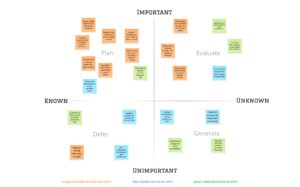
Our Assumptions
Do they want this? (Desirability)
- Who are the target customers for our solution?
- Busy, health-conscious college students who frequently study late into the night and struggle with unhealthy snacking.
- What problem do our customers want to solve?
- They want to avoid making poor food choices when they are tired and stressed, and they need a convenient way to access healthy options without disrupting their workflow.
- How do our customers solve this problem today?
- They resort to vending machines, food-delivery apps (like DoorDash), or convenience-store snacks. Some may keep a stash of snacks in their dorm, but some of these snacks or foods are unhealthy.
- Why can’t our customers solve this problem today?
- Decision fatigue is high late at night, making it difficult to resist convenient but unhealthy options. Healthy alternatives are often less accessible or require more effort than students are willing to expend in the moment.
- What is the outcome our customers want to achieve?
- To feel energized, productive, and good about their food choices, even during intense study sessions, without wasting time or energy.
- Why will our customers stop using their current solution?
- Our solution removes the in-the-moment decision, making the healthy choice the easiest choice. It offers a curated, convenient, and pre-committed alternative that aligns with their long-term health goals.
Can we do this? (Feasibility)
- What are our biggest technical or engineering challenges?
- The most critical technical challenge is building a seamless and engaging app that integrates pre-ordering, payment, notifications, and gamification features reliably.
- What are our biggest legal or regulatory risks?
- Ensuring food safety and proper handling in partnership with the food provider (Step One Foods) and complying with data privacy regulations for user data.
- What are our internal governance or policy hurdles?
- Establishing a clear partnership agreement with the food supplier that defines responsibilities, quality control, and revenue sharing.
- Why does our leadership team support this solution?
- We don’t have leadership.
- Where does our funding for this solution come from?
- Initial funding (i.e., food) is provided by the sponsoring partner, Step One Foods, as part of a study to promote healthier eating habits.
- Why is our team uniquely positioned to win?
- Our team has a unique combination of behavioral science insights (leveraging pre-commitment) and a direct partnership with a health food company, allowing us to create a targeted, effective intervention.
Should we do this? (Viability)
- What are our main acquisition channels for obtaining customers?
- Channels could include on-campus promotions, social media marketing, and partnerships with university wellness programs.
- How will our customers repeatedly use our solution?
- Habit formation will be encouraged through gamification (e.g., keeping a virtual pet alive), reflection prompts, and social accountability features that reward consistent use.
- Why will our customers refer us to new customers?
- If the app successfully helps them feel healthier and more productive, they will naturally share it with friends who face the same late-night study struggles. Social features that encourage group participation will also drive referrals.
- How does this solution support our company vision?
- It directly supports the vision of making healthy choices easier and more accessible, using behavioral science to build sustainable, positive habits.
- Who are our primary competitors to our solution?
- Primary competitors are established food delivery giants like UberEats and DoorDash, as well as on-campus vending machines and convenience stores that offer immediate gratification.
- How will our solution generate revenue?
- Through the sale of snacks. A margin will be earned on each product sold through the app, based on the partnership agreement with some food companies like One Step Foods.
The most important assumptions here are the three that we chose for our assumption tests below:
- Can social features & peer accountability drive habit adoption? This assumption tests the durability of the habit, to see if communal behavior could impact an individual’s desire to eat healthier at night.
- Will students follow through on orders placed in the morning? This assumption tests the mindset of the students, to see if they can stick to a plan they formulated for themselves at a different time and potentially in a different headspace.
- Could students find some healthy menu appealing enough? This assumption tests the larger question of whether students inherently desire only unhealthy food to sustain and entertain them late at night or if there are possibilities of healthier options (that aren’t currently available and weren’t during the intervention study) that could entice students enough to subconsciously choose healthier?
Key Insights from the Map
- The Core Risk is Behavioral Follow-Through: The single most important and unknown assumption is: Will students actually follow through on their morning pre-orders? The entire concept hinges on the idea that a pre-commitment made in the morning will hold up against the spontaneous realities of a student’s evening—changing social plans, fluctuating appetite, or simply not feeling like the snack they ordered hours ago. This is a massive leap of faith in the power of pre-commitment and must be the top priority for testing.
- Engagement and Motivation are Critical Unknowns: We are assuming that social accountability features will be compelling enough to drive repeat usage and sustain engagement. However, it is unknown if these mechanics will be perceived as genuinely motivating or as trivial gimmicks. The success of turning this intervention into a long-term habit, rather than a one-time novelty, depends on getting this right. Therefore, testing the appeal and effectiveness of these motivational loops is crucial.
- Desirability of the “Healthy” Constraint: We assume students want to be healthier, but will they find a curated menu of only healthy snacks appealing enough to choose our app over competitors that offer a variety of indulgent options? This assumption in the Evaluate quadrant highlights a potential conflict between the students’ stated goals (to be healthy) and their in-the-moment desires. We must validate whether the convenience and pre-commitment are strong enough to overcome the allure of a late-night burger or ice cream-covered cookie from another service.
Assumption Tests
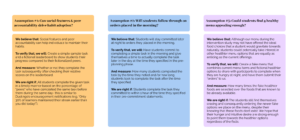
Main Assumption 1: Can social features & peer accountability drive habit adoption?
We believe that: Social features and peer accountability can help individuals to maintain their habits.
To verify that, we will: Create a simple sample task and a fictional leaderboard to show students their progress compared to their fictionalized peers.
And measure: Whether or not they complete the task subsequently after checking their relative scores on the leaderboard.
We are right if: All students complete the given task in a timely manner based on the percentage of “peers” who have completed the same task before them during the same day- this is similar to Duolingo’s encouragement notifications (e.g. “Only 30% of learners maintained their streak earlier than you did today!”).
Main Assumption 2: Will students follow through on orders placed in the morning?
We believe that: Students will stay committed later at night to orders they placed in the morning.
To verify that, we will: Have students commit to completing a simple task in the morning and give themselves a time to actually complete the task later in the day at the time they specified in the pre-planning phase.
And measure: How many students completed the task by the time they noted and/or how long students took to complete the task after the time they specified.
We are right if: Students complete the task they committed to within 1 hour of the time they specified in their pre-commitment statements.
Main Assumption 3: Could students find a healthy menu appealing enough?
We believe that: Although our menu during the intervention study may not have offered the ideal food choices that a student would gravitate towards naturally, students could potentially take interest in other healthier menu options that are equally as enticing as the current offerings.
To verify that, we will: Create a fake menu that combines current menu items and fictional healthier options to share with participants to complete when they are hungry at night, and have them submit their “orders” to us.
And measure: How many times the fake healthier foods are selected over the foods that are known to be already available.
We are right if: The students still find themselves craving the newer fake options we place on the menu, despite their knowing that these foods don’t exist. We hope that their hunger and intuitive desire are strong enough to point them towards the healthier options regardless of the facts.



