
Team 3A: ArtCo
Comparative Research
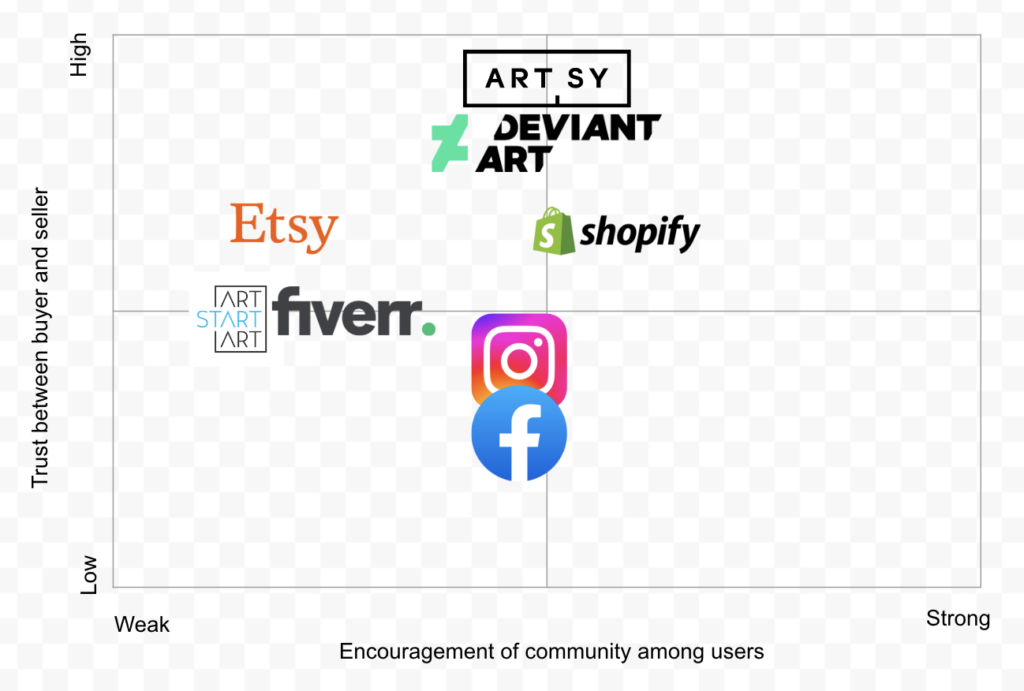
Summaries on findings:
- Deviantart has a subscription based community. Each user can subscribe to an artist. However, I didn’t find strong support to inter-user community by its features. On the other hand, most of the transactions between artists and buyers on the website are followers buying art from the artists that they have been following and knowing the quality of the artist’s work. As a result, the trust between sellers and buyers are relatively high.
- Fiverr is a commission-based platform. I didn’t see obvious support for the user community. However, the buyer can filter the geographical location of the sellers, which can promote the local community (though the filter might be a bit too broad because the “Local” option only filters out foreign sellers.) Trust between users are boosted by past reviews.
- Etsy is a marketplace where there is no strong support for the community, as it is very oversaturated. Trust is also boosted by past reviews.
- ArtStartArt focuses on art students of top art universities. They have their own system of criteria for curating, and they also help students with pricing their art. They are focused on being an online marketplace for young and upcoming artists. However, it seems like they are less present with the community, as their Twitter does not seem to have taken off, and their other social pages are stagnant at the moment.
- Artsy is an online marketplace focused on a broader spectrum of artists, generally on the high end of art. They have online showcasings as well as scheduled in-person galleries. In terms of purchase, they have a bidding system that opens daily, and has a guarantee statement regarding transactions and quality. They engage with the community through regular editorials and newsletters.
- Shopify is a service/platform that helps independent businesses set up their own online shop. They help take care of the site, from design, to marketing, to transactions. They provide a lot of tools to users to customize their own shop site, which in turn can allow lots of seller-to-buyer interaction. However, there is no clear seller-to-seller community, and Shopify has been prone to past data breaches.
Participatory Roadmaps
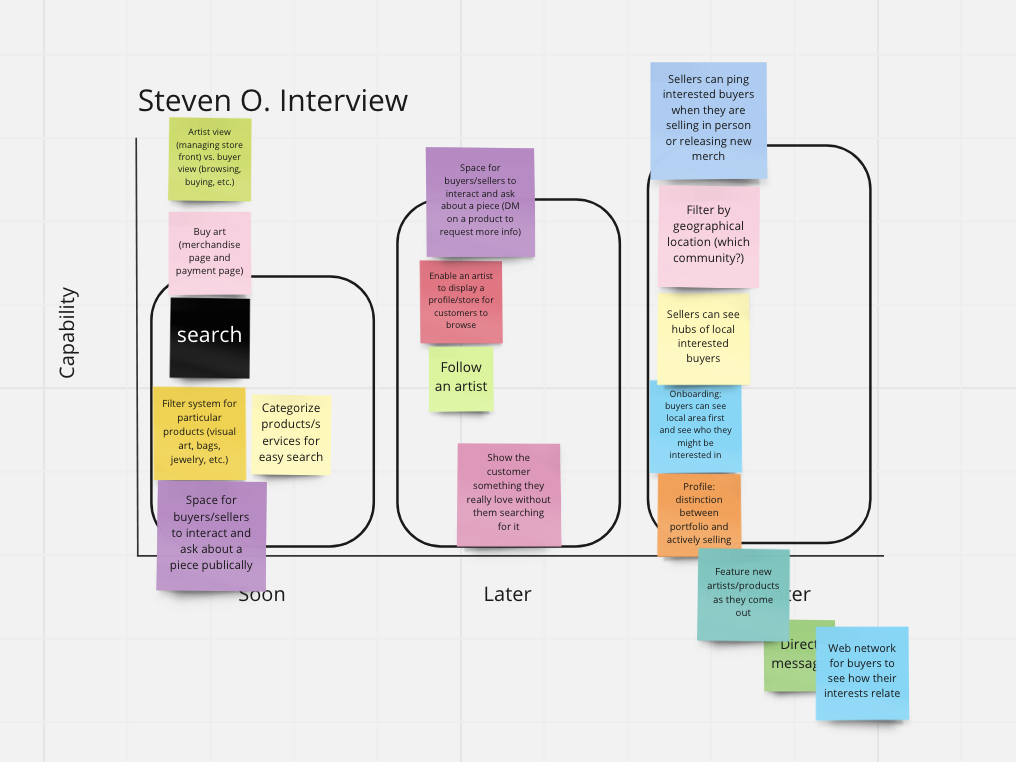
Notes:
- Buyer side
- Not aware of any student artist scene on campus
- Discovers student artists via seeing their merch (stickers)
- Doesn’t want things marketing at him, would rather initiate the search and find an artist himself
- Finds difficulty with shipping delivery estimates, lack of guest checkout, and scale of products (finds reviews to be helpful)

Notes:
- Seller side
- Got her start with feedback from friends on private insta, then decided to create her own separate insta platform for it since she didn’t want uninterested people to see it on her main account
- Finds it really rewarding to connect to fellow artists and with the community, even if it started as a side thing
- Mentioned how growing her business has been not only from the business side, “In order to be a small business owner, you have to be a content creator”
- Experiences selling through insta, Etsy, Ravelry, Shopify for her personal site
- Also advertises through Tiktok
- Wants to focus her sales through her site, though her other commitments take time away from that
- Aware of the demographic of her buyers, aware that being too expensive isn’t really feasible
- Struggles with good pricing on her end, doesn’t want to be too unaffordable, doesn’t want to undersell herself, doesn’t want to undercut those do sell full time
- Really would love to see a more central community on campus, flea markets/pop up shops/collabs
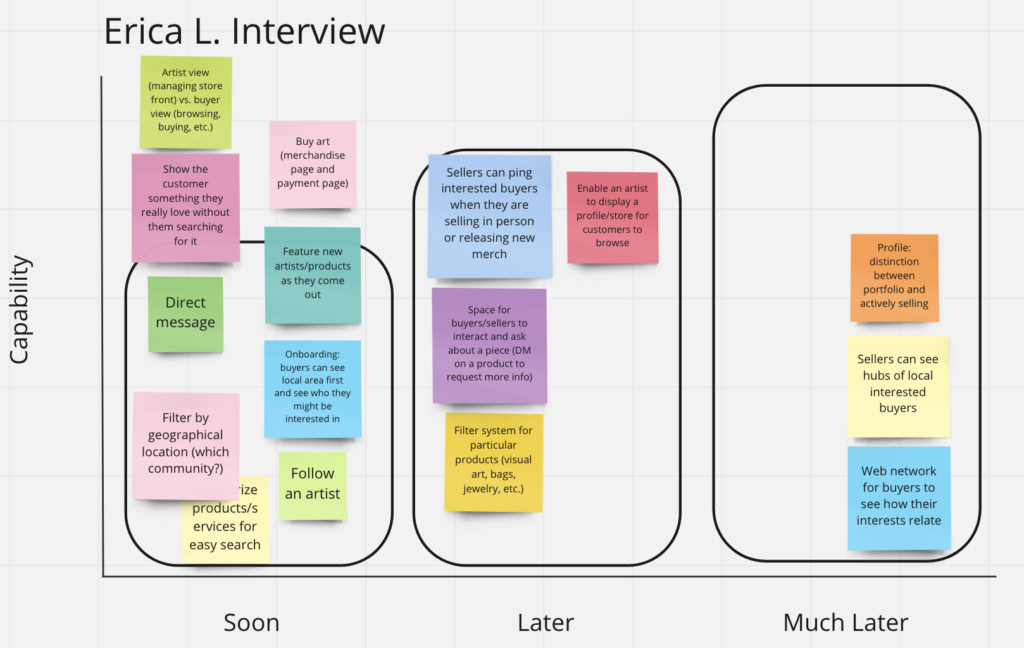
Notes:
- Buyer side
- Love to support all kinds of talent
- “When I just open this app, I want to see what product or products you can offer us in that instead of the people, because you know, like we’re paying in like at the end of the we are paying for products instead of getting to know which kind of artist it is,”
- Would like to meet the artists in person and see what they have to offer
- Would definitely want to see new products and new artists featured because if it is not updated, it’ll be less interesting and people are less prone to check it.
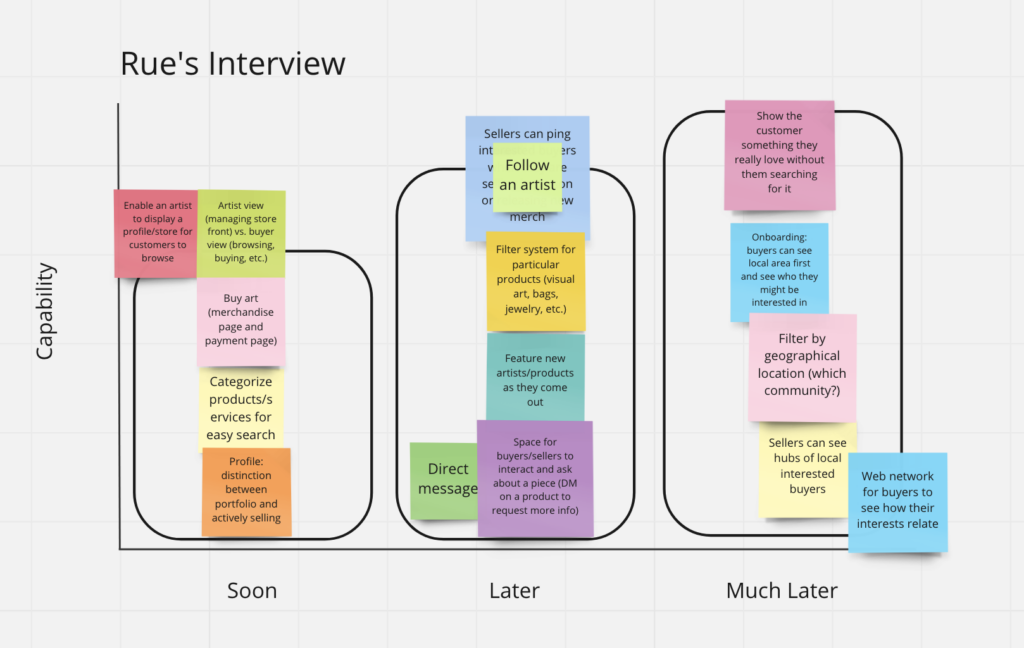
Notes:
- Buyer side
- Takes art classes (not majoring in it)
- Likes 2D art, has prints and photos up in her room (her own work and bought online)
- Gets Art Update emails from art dept. (which showcases some student work and presents upcoming events)
- Thought student artists would be linked to the school’s art department somehow since it would be expensive getting materials on their own. Not aware of many people selling their own creations on campus.
- Not sure about student creator scene on campus if they aren’t with the school art program
- Hasn’t bought anything from students.
- Perceived barrier to purchasing art from student artists: “I can’t find them!”
- Thinks it would be kind of creepy to look up the social media of someone whose art she saw and liked.
- Anecdote: In class, students were critiquing each other’s work. One stood out to her; she complimented the artist. The artist seemed very dissatisfied with her own work, though. Said she wanted more time to make it better, “something that someone who knew art would pay for.”
- Usually pretty smooth when buying online. Once there was a scratch on the print, though. She just gave a lower review.

Notes:
- Both seller + buyer side (creator who doesn’t sell, buys art from small creators online)
- Makes physical art (laser cutting to make earrings, projection artwork, crocheting, …)
- Her art is very personal and special to her. It revolves around her identity.
- Has made gifts but not confident enough to sell (people often ask or request her creations, say that if she ever sold they’d want to buy)
- The scene for student creators on campus is “welcoming, small, and exciting”
- Would look on Instagram for student creators. Would look for a community of like-minded people; doesn’t feel that it would be too hard to find other creative people on campus.
- She was in product design in undergrad (currently CS coterm in HCI). Found others in that space who tried to be creative outside of school/work as well. They did painting, digital art, sculpting.
- She knows people on campus who sell their artwork. To find more, might look on reddit.
- Buys art online from small artists and people who share her identity. Wants to support people who value art in the same way (cultural identity appreciation). Finds artists on Instagram or Twitter. She likes supporting small artists.
- She’s bought from artists who used a Google form to facilitate the transaction (with instructions for how to Venmo them; customer needs to calculate amount to pay). Small artists may not have a more sophisticated form of sale. It’s “confusing”
- Finds artists through recommendations/reposts from friends, organizations, or just luck. A lot of it is personal networking.
- She mentioned a similar app people on campus use (like her cousin): THRIFTHOUSE (DMing is important to coordinate buying there)
- Also mentioned Depop
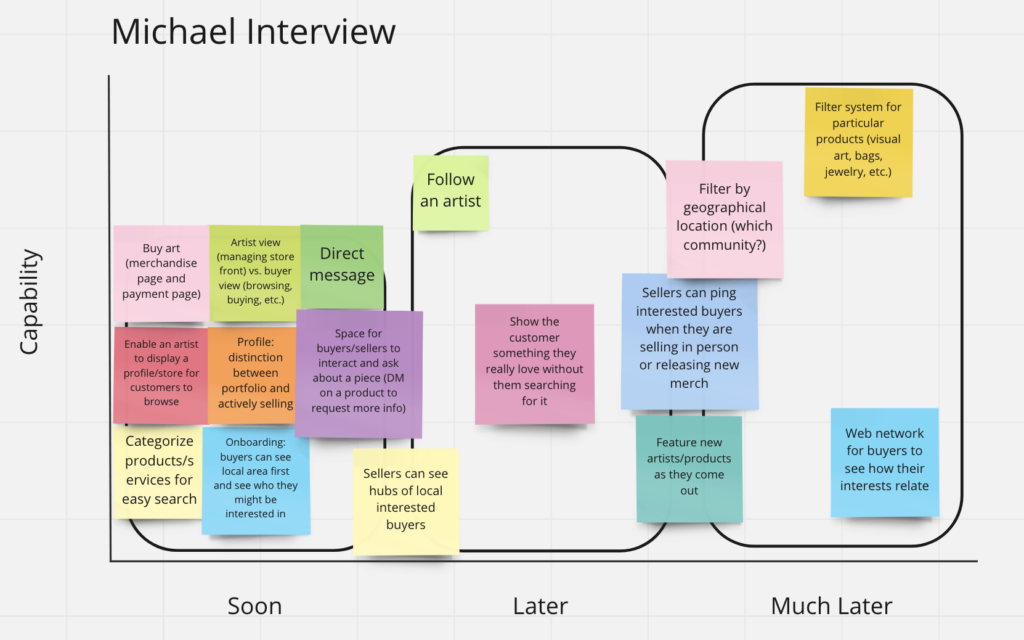
Notes:
- Buyer side
- Like to buy things that have personal connections, either that he knows the artist or the art work is connected to part of his identity
- One of the best experiences was buying from a flea market, when he could walk around and talk to the artists themselves. Having face-to-face interaction made him want to buy stuff from the artists.
- Never bought art online because the whole transaction process is a whole nother thing.
- Important to separate products for sell and not for sell because the buyer’s attention span is short
- Brought up the Cubby, a similar startup that recently shut down
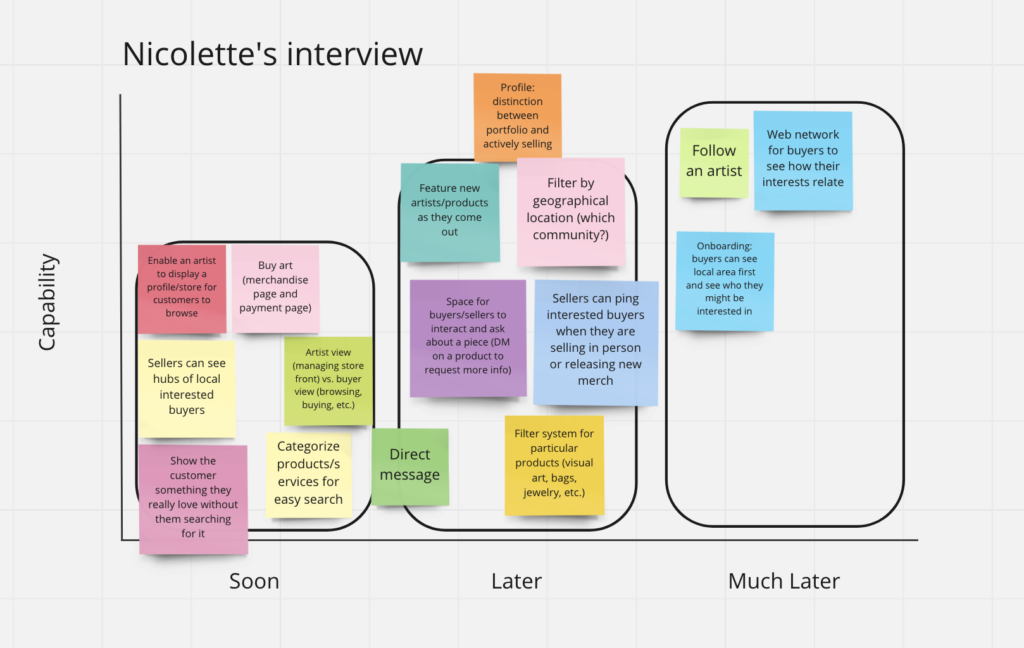
Notes:
- Seller side
- Has her instagram account (and link to own website) and also posts her work on Minted at the same time.
- The reason for posting on two platforms is that the two platforms have different customer groups (different age for example)
- Loves making videos of the process of her making the artwork for fun; those videos also attract customers to her
- One of the best customer interactions was once when she received a personal email from a customer saying how she loved the product she received. “that made me feel really good, because I think sometimes as an artist. It’s hard to figure out how to price your work, and you know, Make sure it’s worth your time. Um, but make sure it’s not alienating, alienating people from buying your work. So just to get that message from her like this was kind of a big purchase for her. But she was really excited and happy about it. That was a good customer experience.”
- The scene for student creators on campus “…was very broken up. It was like people who painted knew other people who painted, and people who did fashion design knew people who did fashion design, but I didn’t see a lot of opportunities for us to collaborate and work with each other.”
- Would love to see campus-wide events like craft fairs to come and sell their work
- [FEATURE] Sellers being able to see hubs of interested buyers: “That’s a pretty interesting feature to me. I’m really interested in, like the analytic side of, who’s looking at my work, and who’s buying it, or who might potentially be interested. So I’d say soon for that.”
- “Show the customer something they really love without them searching for it. I think. Sometimes I find that on minted or etsy, It’s hard to become discovered as an artist. So some way to show customers artists that they might not have heard of and bring that to like their front page or something, it would be great.”
