
What is your project concept?
We are building Flowy, an AI-powered speech coach. When a user records their speech, Flowy offers personalized feedback on 3 major components: error correction (e.g., grammar), language (e.g., vocabulary, paraphrasing), and delivery feedback (e.g., pace, filler words, and intonation).
Why is your value proposition statement correct (e.g., the research says so!)?
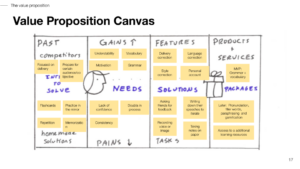
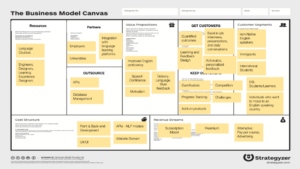
For non-native speakers who want an easy and systematic way to improve their English speaking skills, Flowy will provide AI-enabled feedback on the content and delivery of their spoken English.
What motivated your choices for the MVP?
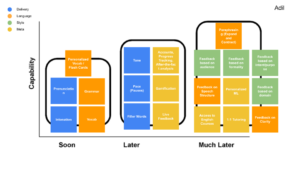
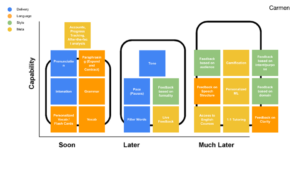
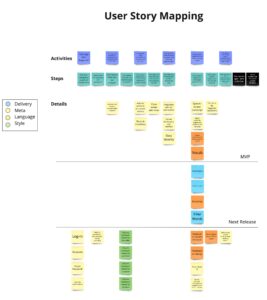
Our MVP was motivated by our findings from our participatory exercises. We identified our must-have features (i.e., paraphrasing, vocabulary) through user research while balancing the product’s technical feasibility.
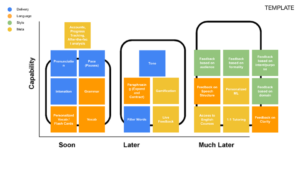
(Some) Results of the participatory exercise:

What is the goal of the project; how are users’ lives changed by your product?
Our goal is to empower non-native English speakers to speak with confidence. We hope to increase their proficiency in English, oral communication skills, and confidence English.
What assumptions are you still worried about?
The assumptions we are primarily focused on are:
- Individuals will value speech feedback from an AI.
- An NLP model that provides speech recommendations is doable.
- Non-native English speakers would go out of their way to practice their spoken English.

What experience prototypes have we done, and why? How did they turn out?
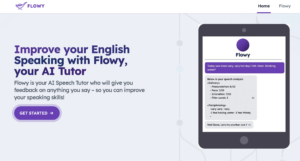
So far, we have done an implementation prototype. This has working speech-to-text functionality. It turned out great. The users we have tested on mentioned that they are very likely to use Flowy with the speech-to-text interface. To interact with the prototype, visit Flowy here.
Test Card 1: Role Prototype
We believe that non-native English speakers would practice their spoken English and be open to speaking to an app in order to get personalized speech feedback. To verify that, we will create a speech-to-text chatbot and measure users’ willingness to record their voice (using a range from 0-very unlikely to 5-very likely). We are right if we receive an average likelihood score above 4 from 4 users.
Are there experience prototypes that you may need to build next?
Yes, below we have the test cards for the next 4 prototypes.
Test Card 2: Look and Feel Prototype
We believe that individuals will value speech feedback from an AI. To verify that, we will create a visual identity for Flowy AI. We are right if more than 80% of users say that Flowy is trustworthy based on its visual identity.
Medium: Figma
Test Card 3: Role Prototype
We believe that individuals value speech feedback from an AI. To verify that, we will perform a Wizard of Oz prototype of the Flowy AI. We are right if more than 80% of users we test on say that they are willing to take feedback from the Flowy AI.
Medium: Wizard of Oz
Test Card 4: Implementation Prototype
We believe that an NLP model that provides speech recommendations is doable. To verify that, we will build a speech-to-text chatbot that can provide AI-enabled feedback on someone’s delivery (i.e., filler words). We are right if the bot is right 80% of the time.
Medium: Back-end development
Test Card 5: Role Prototype
We believe that individuals value speech feedback from an AI. To verify that, we will send out a form asking for people’s impressions of different feedback designs from Flowy. We are right if 90% of users say that they are satisfied with the designs presented.
Medium: Google Form
How viable is our product as far as we know, with the assumptions we currently have and the experience prototypes we have done?
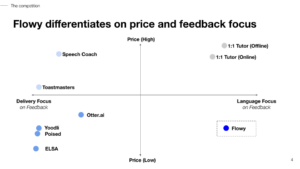
With the assumptions we currently have and the experience prototypes we have done, the Flowy product seems currently viable. I believe that a potential concern is Flowy’s product differentiation from existing competitors. That remains a question.
What advice do you want from your reviewers?
Who would be the best to talk to about Flowy’s differentiation from existing competitors?
