
Team Name: Green Plate
- Rationale for Selected Assumptions: After reviewing all mapped assumptions as a team, we selected the three below because they represent high-impact, high-uncertainty risks that directly influence demand, positioning, and business viability. If any of these assumptions are proven false, the product would require fundamental redesign or the business model would become financially non-viable.
Top 3 Riskiest Assumptions:
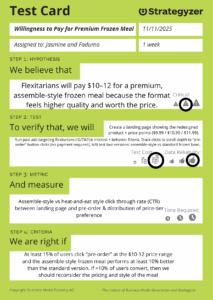
- Flexitarians will pay $10–12 for a premium frozen meal and believe the “assemble-style” format justifies the price
-
- Risk Type: Desirability + Value Proposition Risk
- This is our most critical assumption because it determines whether our core target audience (flexitarians) perceives the product as worth buying at scale. Price sensitivity in frozen foods is extremely competitive (shoppers are used to $4–8 meals). If the assemble-style experience doesn’t justify the premium price, demand collapses. If wrong, we must rethink pricing or the product format, both major pivots.
- Test Card:
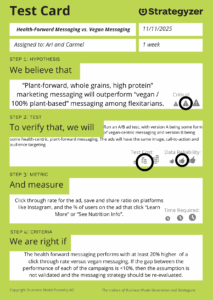
- Health-forward messaging (“plant-forward, whole grains, high protein”) is more persuasive than “vegan” messaging to flexitarians
-
- Risk Type: Positioning + Marketing Risk
- Our entire rebrand, packaging, and marketing strategy is built on the belief that “plant-forward” language converts flexitarians better than identity-based messaging (“vegan”). If this assumption is false, our core strategy fails and we either attract the wrong audience or convert no one. If wrong, the brand would need an immediate messaging pivot, which impacts packaging, advertising, and distribution.
- Test Card:
- Green Plate has access to high-quality ingredients and manufacturing at reasonable prices
-
- Risk Type: Financial + Operational Feasibility Risk
- Even if demand and positioning are validated, the product is only viable if we can source premium ingredients and packaging without destroying margins. If ingredient costs are too high, the $10–12 price point becomes impossible or profits disappear. If wrong, the business model is not financially sustainable, even with strong customer interest.
- Test Card:

Why we did not pick other assumptions
-
- “Flexitarian-focused rebranding will not alienate core vegan customers” is important, but not a top 3 existential risk because losing some vegans would not kill the business. Vegans are a smaller secondary segment, and Green Plate is intentionally pivoting away from them as the primary audience. If this assumption fails, we lose an audience, not the entire market.
- “Consumers are comfortable with a frozen meal experience that requires “light assembly” instead of heat-and-eat”. This is testable and important, but it is secondary to price acceptance. Even if people like the format, the product still fails if they won’t pay $10–12 for it. So this assumption becomes meaningless unless we first validate willingness to pay.
- “Rising interest in plant-based eating will continue over the next 3–5 years”. This is a macro trend, not a team-controlled variable. It’s a background condition, not a product-breaking risk. Even if plant-based hype slows, frozen plant-forward meals still compete in the “healthy convenience” category. Failure here would shift messaging, not destroy the business model.
