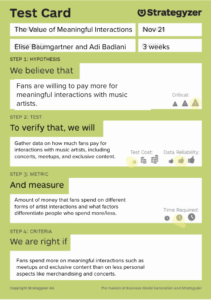
We chose these assumptions as the riskiest because they address the core pillars of our platform’s success: engagement, immersion, and access. They were the three assumptions in the upper-right quadrant of our risk map—high-impact (if wrong, the product fails) and high-uncertainty (we currently lack behavioral evidence to support them).
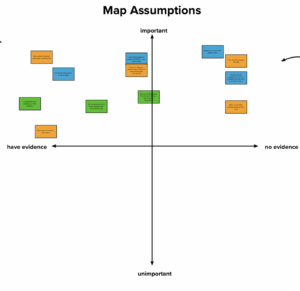
1. “We believe fans want to engage virtually.”
This is risky because our platform depends on fans’ willingness to participate in digital interactions beyond simple music streaming. If fans are not motivated to engage in online activities—such as live chats, fan challenges, or artist Q&As—our core premise of virtual fan connection collapses. We currently have limited evidence showing that fans see virtual communities as meaningful extensions of their real-world fandom.
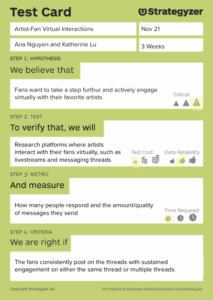
2. “We believe virtual concert experiences can be transformed into more than just a video.”
This assumption defines the product’s experiential value. We are betting that immersive design, interactivity, and shared participation can make virtual performances feel distinct from standard livestreams or recordings. If fans do not perceive added value in these experiences, we risk becoming another content delivery platform rather than a new entertainment medium.
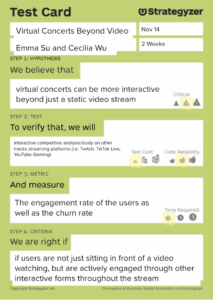
3. “We believe fans want to engage virtually with their favorite artists.”
This is risky because it directly determines our monetization strategy. The platform’s success depends on whether fans perceive virtual engagement—like exclusive chats, behind-the-scenes access, or personalized experiences as valuable enough to spend money on. If fans don’t see these interactions as authentic or worth paying for, our revenue model and feature prioritization will need to pivot toward lower-commitment or ad-based experiences.