Introduction
70% of Americans admitted that they procrastinate, and among these people, about 20%-25% of adults are considered chronic procrastinators. Procrastination has been a major challenge for me throughout my life as well—especially since high school. I often ask people, “How do you avoid procrastinating?” but I also want to use this course as a chance to actively work on changing the habit, even though I know it won’t be easy.
Measurement & Logged Habit Incident
I tried to log my behavior over the span of three days, not in a specific time interval (since it might be disrupting), but when there were incidents where my behavior changed.
Day 1 (1/9):
- 10:15 AM: wake up and get ready
- 11:00 AM: brunch
- 11:30 AM: arrived at a cafe and started doing work
- 12:30 PM: doing work
- 1:30 PM: doing work
- 2:30 PM: taking a break – walked around downtown
- 3:00 PM: went back on campus and went to class
- 4:30 PM: went back to dorm and did work
- 6:00 PM: dinner
- 7:00 PM: hang out with friends
Day 2 (1/10):
- 9:00 AM: wake up & breakfast
- 10:00 AM: meeting
- 12:00 PM: chat with roommate
- 1:00 PM: went to gym
- 2:30 PM: scroll on phone
- 3:30 PM: doing work
- 6:00 PM: dinner
- 8:00 PM: watch movie
Day 3 (1/11):
- 10:00 AM: wake up & brunch
- 11:30 AM: did work
- 12:30 PM: team meeting
- 2:00 PM: grabbed food with friends off campus
- 3:30 PM: driving back to campus
- 4:30 PM: doing work
- 6:00 PM: doing work
- 7:00 PM: dinner
- 8:00 PM: chill with friends
- 12:00 PM: sleep
Observations
I’ve noticed that I tend to work more efficiently when I’m logging my behavior. Because changing a habit requires extra effort (in this case, the act of logging itself), it makes me more intentional about how I spend my time. Logging also creates a subtle sense of being supervised or “proctored,” which helps keep me accountable.
Interestingly, I’ve also realized that I can focus more easily in busier environments, like cafés or other public spaces. I think this happens for two reasons: (1) I push myself to tune out background noise, and (2) seeing other people around me working makes me want to match that level of focus—I don’t want to be the outlier.
Model Representing the Habit Ecosystems
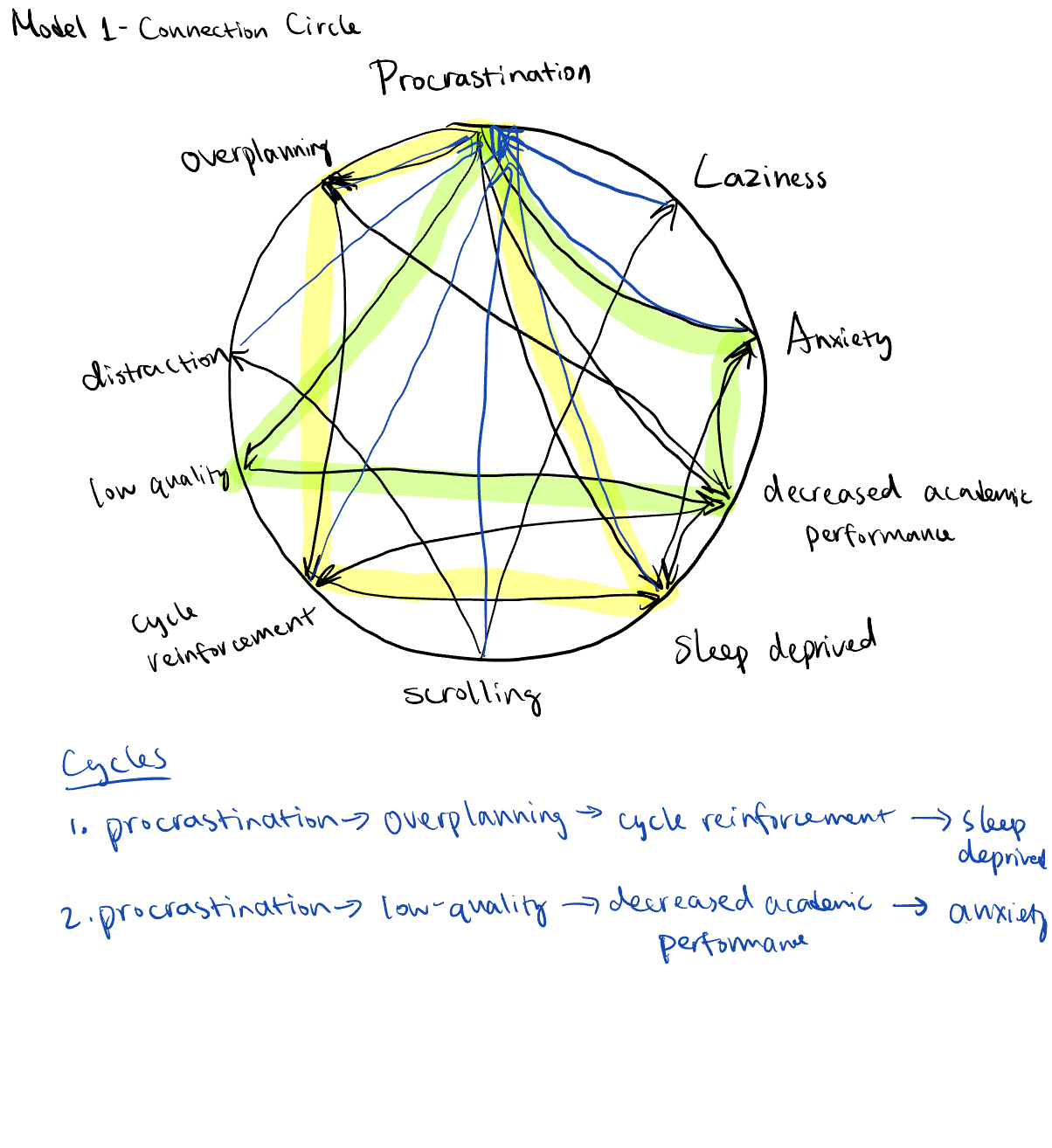
- Connection Circle
The connection circle helps me understand problems by identifying interconnected variables and potential feedback loops. I was able to break the components down — trying to figure out which factor contributed to which and vice versa. This model highlights the loops that can potentially cause me to procrastinate and how each factor could lead to the others, increasing the chance that I would procrastinate in my behavior.
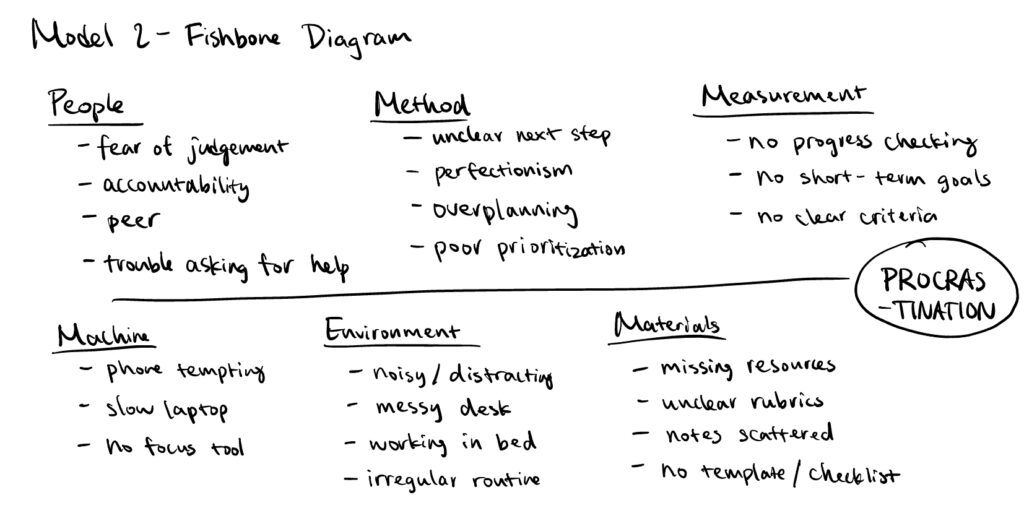
2. Fishbone Diagram
The fishbone diagram visually maps all potential causes of a specific problem (the “effect”) by branching them into main categories. While I was working on this model, I identified more (potential) factors and problems that I never thought about before, which is helpful for me to eliminate procrastination in the future. Instead of thinking of the simplest causal relationship between procrastination and my everyday behavior, I was able to find more causes that contributed to the behavior.
What I’d do differently next time
In conclusion, procrastination isn’t a problem that people can solve in just days. However, taking action step by step brings it closer to overcoming it. A common issue is that people (including me) might give up since we don’t see results immediately in the short term. Thus, setting short-term goals, daily/weekly check-ins, or even having someone who is also working toward the same goal are very important. Additionally, tracking my own behavior and doing work in public spaces significantly helps with my procrastination. Comparing behavior logs regularly should also be a helpful tool going forward.