
Comparative Research – Team Bison
 Strava (Anthony)
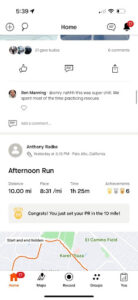
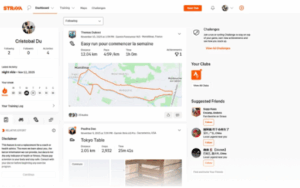
Strava is the leading platform for tracking physical activity (primarily running, cycling, walking) with a heavy emphasis on social competition and performance data.
The target audience is fitness enthusiasts, “weekend warriors,” and data-driven athletes who want to quantify their progress. The platform fulfills the market need of social validation and performance comparison in fitness. Its unique features include “segments” (leaderboards for specific stretches of road/trail), Beacon (safety tracking), and “Clubs” for local communities. Its strength primarily lies in its strong network effects. There is high “stickiness” due to competitive leaderboards, and the application integrates with almost every wearable device (e.g. Garmin and Apple Watch), reducing friction to usage. Meanwhile, the weaknesses include the fact that it can feel “intimidating” or “elitist” for casual walkers; focus on data can make going outside feel like work rather than a break, and there is high “performative” pressure. Can even make people not want to work out if they think they will not perform well (e.g. don’t want to be judged by a “slow” workout). Our opportunity lies in addressing this “intimidation gap.” While Strava is for athletes, our product can be for anyone who wants to go outside. We can focus on the mental health benefits of just being outside, rather than the pace or heart rate of the activity.
 Geocaching (Anthony)
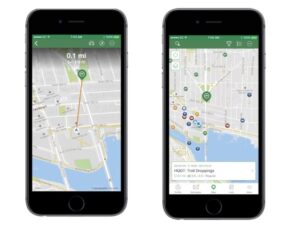
Geocaching is a real-world, outdoor treasure hunting game using GPS-enabled devices. Participants navigate to a specific set of GPS coordinates and then attempt to find the geocache (container) hidden at that location. While the branding makes it looks older, there still are a large amount of users that are still active (gemini exists 3 million active users, especially internationally)
The target audience primarily consists of families, hobbyists, and “explorers” who need a specific destination or objective to motivate them to go outside. The platform fulfills the market need for purpose and gamification in the outdoors, providing incentives that make outdoor activity adventurous and fun. Its unique features include digital logbooks, physical “trackables” that travel from cache to cache, and difficulty/terrain ratings for every location. The platform’s main strength lies in the sense of adventure it creates. There is a high mystery, high reward loop, and it benefits from a large database of locations that add novelty and never-ending journeys for the user. At the same time, its main weakness is the steep learning curve it poses for beginners. The interface can feel dated, and there is limited social interaction between users in real-time, as it’s mostly solo or small groups. While Geocaching is a “solo-mission” app, our opportunity lies in improving the user experience by focusing on social coordination. Geocaching tells you where to go, but your app can help people decide who to go with, solving the “busy person’s” problem of loneliness and scheduling.
 1000 Hours Outside (Ben)
1000 Hours Outside is a relatively popular app that encourages people to spend time outside by offering trackers and challenges to go outside. It also allows you to discover new places to spend time outdoors.
The target audience appears to be adults and families spending time together. The unique features are time tracking, challenges, and discovery of local resorts and parks. The market need the app fulfills is aiding adults who want to spend more time outside but face friction in planning and tracking. The strength of the platform is feature completeness. It offers full tracking, discovery of locations, challenges, and more. The weakness is that it is a busy app without focus. Alternatives for discovery exist: Google, maps, and the like. Tracking apps exist as well. The challenges, however, are strong, but there is no social component to the app. Thus, we have an opportunity to lean into the challenges and potentially a social component while maintaining simplicity.
 Instagram (Ben)
One of the most popular social media applications amongst college students, Instagram competes with us to capture college student’s time. Instead of spending it outside, they spend it on Instagram and social media in general.
The target audience of Instagram is pretty broad, considering they have billions of users, but their power users tend to be Gen Z and millennials. The unique features of Instagram are the density of the network, social content, and features. All of your friends are on Instagram, any content you could wish or not wish to see is there, and almost every social feature imaginable is available. Instagram pulls its users in daily to see what their friends are doing. The market need they fulfill is entertainment, and to some degree, connectedness.

Instagram’s login screen highlights their stories feature, as they push the idea of being connected to friends and family through their application. Furthermore, the images are primarily of get togethers and interactions outside, implying their app can fit into an active outdoor lifestyle or healthy social lifestyle.
Instagram has strength in that it’s already an integral part of people’s lifestyle and time spent on phones. Everyone is on it, the entertainment value Instagram provides is known and addictive. However, the weakness is that spending time on Instagram can make you feel like you wasted time and can actually hurt your well being and happiness. Our goal is to get people to go outside more, having healthier experiences and activities. Thus, our opportunity is to address the weaknesses of Instagram, and potentially counter the strengths by adding a social component to pairing people to go on outdoor activities together.
 Alltrails (Armita)
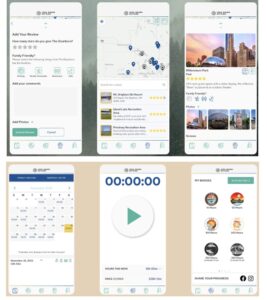
Alltrails is a location-based outdoor exploration platform that helps users discover hiking, walking, biking, and running trails near them. The app provides detailed information on the trail maps, difficulty ratings, distance and duration, user reviews, and photos.
The target audience is primarily outdoor enthusiasts, hikers of all experience levels, and families. The market need it fulfills is enabling low-pressure, exploratory, and enjoyable physical activities. Through making outdoor exploration personalizable and easy, it lowers the barriers to being active. Notably, what stands out about Alltrails is its ability to effectively cater to a broad target audience through its unique features. For instance, through allowing the user to customize trails by factors such as difficulty level and length, it effectively caters to both beginners and experienced individuals. Meanwhile, filters such as kid-friendly make it accessible to families, while filters focused on the nature of the location (parks, rivers, beaches) enable a personalized experience. Other unique features of Alltrails include user reviews and ratings that benefit from network effects, the ability to save trails and create custom trails and maps, and the opportunity to build a trail journal consistenting of your photos and reviews. Through tapping into “reliving” these experiences, Alltrails adds an emotional and sentimental component that transforms the platform from a mere functional experience to a personal one. This not only creates a practical desire to return to the platform (to access one’s stored data and information), but also a sentimental one (to look back on the memories made on these trails). In this way, these features further add an enjoyable element to going outdoors, incentivizing the behaviour.

In the first screenshot, we see that the primary focus is on the image of the trail, with the text being minimal. The images are aesthetic, bright, and vibrant, immediately giving the user a sense of wanting to go outdoors. Meanwhile, the text at the bottom includes the most important information for the user (rating, difficulty level, length, and duration). If you scroll in the top bar (where it says nearby, epic views), you can further customize the trail to your needs. The second two screenshots illustrate how the app leverages a sentimental and emotion-based appeal, by using terms such as “create memories” and “relive…”
One of the core strengths of Alltrails is how it offers differentiated user experiences even within a given market, and effectively captures a larger audience through this variation. Given that users can adjust factors such as difficulty and duration, a complete beginner can use the platform and do a very short hike; meanwhile, an avid outdoor enthusiast can find challenges and difficult trails suiting their needs. Both gain the same benefits the platform offers, and for beginners, it can be the starting point for a habit. There also isn’t much performance pressure, as it isn’t a social app for sharing your progress; instead, that progress is portrayed as being for oneself to revisit, further encouraging those who could be dissuaded by social pressure. At the same time, the platform benefits from network effects through users adding images, reviews, and helpful information on trails.
One of the weaknesses of Alltrails is that it is largely a solo experience. While that can be a benefit, the minimal social interaction leaves a gap for those who want a more group-based and social outdoor experience. Furthermore, while it can be great for discovering new trails as one travels, users may have limited motivation to return to the platform regularly once they know their local trails. Similarly, despite allowing customization, it focuses more on physical activity that requires a scheduled time frame, rather than done spontaneously or in between errands. This presents an opportunity for our solution to incorporate a social component that 1) encourages activity in a group manner and 2) further lowers barriers to participation by focusing on activity that requires less time (and equipment), i.e. a walk between classes/meetings, or a night run.
 Walkr (Armita)
Walkr is a gamified fitness app that encourages walking by embedding it in a fictional space exploration game. The app tracks users’ steps and converts them into in-game energy, which can be used to discover planets, unlock creatures, and progress through a virtual universe. The platform portrays walking as a means of advancing the playful narrative, rather than exercise or fitness.
The target audience primarily consists of young adults and individuals who have the goal to walk more but struggle with motivation or consistency in traditional fitness apps. It particularly focuses on those who respond well to game-like incentives and who want to add a fun spin to their fitness goals. The market need it fulfills is providing motivation for everyday physical movements for users who are intimidated or not motivated by performance-focused fitness platforms. What stands out about the platform is how it doesn’t mention health or fitness metrics. Instead, just like any other game where you have to dedicate time or perform some form of activity to advance in levels, Walkr uses walking as a means to proceed in the game. In terms of unique features, the core of the platform is its missions. Users are to discover new planets using energy from their walks, and they can then select a relevant mission to complete in exchange for rewards. These can then be used to acquire new spaceships that have enhanced features. Another feature is the opportunity to go on missions in teams, where you are collectively working to discover new planets. This creates a sense of social accountability as the user’s steps have an impact on their team, incentivizing activity.
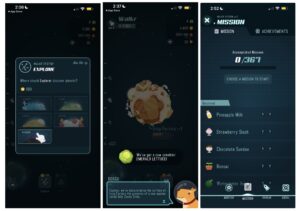
Upon first glance, one would think this is any other game, rather than a physical-activity focused one. It has many of the features of game platforms, such as tasks to complete and achievements that encourage continual use of the platform with increased commitment/engagement at each stage. There is a strong link between the user taking action and reward, reinforced by messages that tell the user they have discovered something new, or completed a certain number of accomplishments.
One of Walkr’s key strengths is its ability to encourage low-effort, everyday movement. The walks don’t need to happen at once, so the user can do multiple short walks whenever they have time, or even do something simple like parking their car further back in a parking lot to get additional steps in. Tying progress to steps rather than scheduled workouts enables the app to easily fit into daily life. The gamified reward system can build short-term engagement and excitement.
However, a weakness of Walkr is that the motivation is largely extrinsic and game-dependent. Once the novelty of the game mechanism fades, users may lose interest, especially since the missions can be quite repetitive over time. Given that the focus is on the game rather than the health benefits for the user, one can question whether this is truly an effective intervention that will lead to long-term behaviour change for the right reasons. We have an opportunity to address this by focusing more on the individual’s health/goal journey. Rather than the incentive being advancement in a game, we will highlight how continued engagement can help advance one’s personal goals. We will combine this focus with the low barrier to participation that Walkr offers without centering a game in our solution.
 Pokémon Go (Tina)
Pokémon Go is a location-based mobile game where the player feels that the world of Pokémon has been integrated into their reality.
The target audience of the app includes any fan of Pokémon— whether they’re a nostalgic millennial or a recently-introduced kid— that finds the appeal of walking/traveling for in-game progress. The gameplay relies on users to leave their homes and explore new places, so it meets the market need for a game that encourages going outside, walking, and visiting community sites, using incentives that contribute to a sense of fantasy rather than burdensome reminders. Unique features include the ability to unlock new Pokémon and items as a user physically moves from one place to another as well as core gameplay mechanics like catching wild Pokémon (with or without AR), battling, and leveling up their Pokémon. The strength of the app lies in getting people to initially download and play the mobile game. The Pokémon franchise already has massive popularity and the location-tracking being integral to the gameplay experience is still relatively novel, so I believe these factors get new users over the cold start problem. However, a big weakness of the app (as someone who was briefly obsessed then hasn’t touched it since) is that gameplay gets monotonous and stagnant quickly, especially when your life is limited to a finite set of locations (e.g. you live in a rural area, you’re a college student who doesn’t go off campus often, etc.). Leveling up is quick in the beginning, but then progress becomes slow. Plus, you may end up catching the same Pokémon and completing nearly identical daily quests, so using the app has lost its initial allure. Our opportunity is to ideally address these weaknesses by maintaining a habit of outdoor recreational activity in a consistently fun way that doesn’t heavily rely on novelty or nostalgia. For example, we could implement unique daily nudges with low-hanging prompts to encourage going outside.

 Focus Friend (Tina)
Focus Friend is a “cozy, gamified, focus timer app” where anybody who easily gets distracted by their phones yet wants an incentive to focus (target audience) can make their personal anthropomorphic bean happy by setting and abiding by focus timers.
The unique feature the app is most viral for is that picking up your phone and trying to switch apps when you’ve set a focus timer will cause your bean to “get distracted,” stop knitting, and look sad. Additionally, the user can unlock new decorations for your bean’s virtual home if they leave their phone alone as they work. Thus, a big strength of the app is the parasocial pal and how compelling it is to keep it happy. New decorations and the ability to use these unlocked items to curate a visually pleasing home also helps the app retain users. However, the app’s main weakness is its paywall. From the get-go, though the app is free to download and use in general, many cute bean avatars and decorations require spending money, so ultra-desirable options are not accessible by using the app as a normal user would. Our opportunity is to create a product that could get users to get off their phones and go outside by using similar parasocial-pal/ or accessory-unlocking mechanics and “outdoor time” timers, but most importantly, the app would be entirely free with no paywall to avoid the aforementioned issue.

 Randonautica (Philippe)
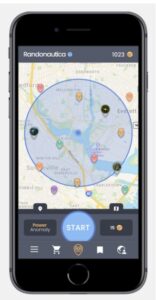
Randonautica is a location-based app that generates random GPS coordinates for users to explore. Users set an “intention” in their mind, the app generates a random nearby point using quantum random number generation, and they travel there to see what they find. The app went viral on TikTok in 2020 when users documented strange discoveries, reaching over 10 million downloads.
The target audience consists of Gen Z and millennials interested in mystery, spontaneous adventure, or breaking out of their daily routine. Its unique features include Quantum random number generation, intention-setting before generating points, different point types (attractors, voids, anomalies), and a Discover feed for sharing trip reports. The market need it fulfills is the desire for spontaneous adventure, giving people a game-like reason to explore unfamiliar parts of their area. Its main strengths include the fact that viral mystery appeal creates shareable content, intention-setting creates psychological investment, and the platform breaks users out of routine. Moreover, there are low barriers to entry for participation, further incentivizing use. Core weaknesses include safety concerns with points landing on private property or sketchy locations, a controversial reputation, pseudo-scientific framing, solo experience with no social coordination, and the fact that novelty wears off quickly. Randonautica proves people want a reason to go somewhere new. But it lacks safety, retention, and social features. Thus, we have an opportunity to create an app that can offer discovery and spontaneity while adding the social coordination layer Randonautica ignores.
 Meetup (Philippe)
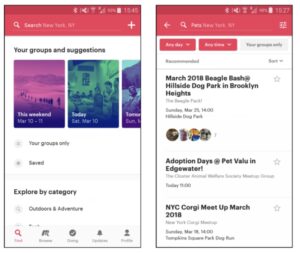
Meetup is a platform for finding and joining local groups organized around shared interests, including many outdoor activity groups like hiking clubs, running groups, and nature walks. Users browse events, RSVP, and show up to meet people with similar hobbies.
The target audience is primarily adults who are looking to meet new people around shared interests, particularly those new to an area or seeking to expand social circles post-college. Its unique features include group-based structure with recurring events, organizer tools for hosting, location-based discovery, and RSVP system showing attendees. The market need it addresses is adult loneliness by providing structured opportunities to meet people through shared activities. Its main strengths include the “who to go with” problem when wanting to do hangouts, removing the awkwardness of initiating plans, the fact that many outdoor groups exist, and that it works without an existing friend network. Its weaknesses include the fact that showing up alone to meet strangers is a high anxiety (or often trust barrier), inconsistent event quality and groups can become cliquey, as well as that it is not outdoor-focused, it’s a general platform. Meetup shows people want help coordinating outdoor activities with others, but the stranger-focused model is intimidating. We have an opportunity to lower that barrier by facilitating coordination among existing connections.
2×2 Map
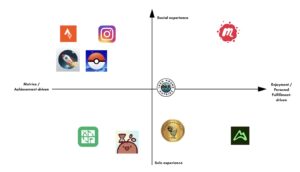
Explanation of Axes & Key Takeaways
The x-axis examines whether the application is more driven by metrics and achievement, or enjoyment and personal fulfillment, a contrast that was central to many of the competitors we examined. Notably, in incentivizing their users to go outdoors, exercise, or otherwise build a habit, platforms ranged from gamifying the process and offering extrinsic rewards for pursuing the desired action, to creating personal, intrinsic rewards for doing so. For instance, does an app encourage the user to go outside because doing so allows them to advance on a leaderboard and/or achieve a certain award, or do they focus on the personal memories and progress made? Overall, the incentives and reward structure at play are instrumental to any behavior change, and the x-axis labels reflect what emerged most frequently from the competitor research.
The y-axis examines whether the platform prioritizes solo or social/group-focused action. This was another prominent theme among our competitors. Specifically, research shows that group-based interventions can create incentives for outdoor activity due to social benefits, increased fun, or accountability to show up. At the same time, the social pressure can also dissuade participation, or shift incentives from personal payoff to external factors. All applications we researched illustrated deliberate thought given to how social or solo the platform would be. While some were entirely focused on oneself, others centered on group activity, while some added social components as an additional feature rather than a core one.
Our methodology for these rankings particularly focused on the unique features and strengths and weaknesses of each platform. Specifically, platforms that incorporate leaderboards, rewards for progress, and new achievements unlocked through activity are largely metrics-driven. Meanwhile, those that emphasize personal goals and memories are enjoyment-focused. Moreover, platforms that have deliberate social components, benefit from strong network effects, or emphasize the social aspect in the service offered rank highly on the social component. Those that center individual activities or aren’t driven by group/community are considered solo.
From the 2×2, we can see that applications that have a social component are often more driven by metrics and achievement, rather than intrinsic motivation. This is stronger for platforms whose core focus is on group/social engagement, illustrating a correlation between solo vs. group and the reward structure. Interestingly, among the apps we looked into, there aren’t any focused solely on outdoor activity that include a primarily social experience while being enjoyment/personal fulfillment-driven. The one application high up on the top right quadrant is focused on meeting groups of people with shared interests, rather than outdoors specifically. This reflects the fact that the platform is focused on building community, rather than generating concrete metrics (e.g. steps taken).
However, apps that are solo do not always correlate to being only enjoyment/personal focused vs metrics-driven. For instance, Alltrails is largely solo but emphasizes a personal experience, where you can revisit images you took on trails or reviews written to relive those memories. Meanwhile, Focus Friend is solo, but the desire to keep the para-social pal happy and unlock new decorations gamifies the process. In this way, behaviour change is a means toward achieving something outside of one’s personal goals.
The key takeaway from this is to research whether there have been attempts to create platforms that have a social component and/or focus, while emphasizing enjoyment and fulfillment over achievement and metrics. If so, how has this been received by the target audience? Given that one of the main opportunities we uncovered from our research was to create a more effective social/community component to outdoor activity, this can provide a wedge for meaningful differentiation. Specifically, we can create a group-focused platform that relies on personal fulfillment and long-term behaviour change rather than mere gamification, addressing many of the weaknesses we identified.




Comments
Comments are closed.