
Baseline Study
Study Overview
Our target audience are Stanford undergraduates who live on-campus and are not student athletes. This is because we want to study how often undergraduates who live in the dorms at an academically challenging college balance work with going outside for recreation. We specifically want to focus on undergraduates who live on campus and are not student athletes, as student athletes already find themselves exercising or being outside for long periods of time regularly. The goal of our study is to analyze the existing behaviors of these students in order to determine the effectiveness of a future intervention to increase the amount of time students spend outside recreationally. By gathering this “baseline” data, we aim to determine the potential effectiveness of future interventions designed to help undergraduates increase their time spent outdoors, which has been linked to improved mental well-being and academic focus.
Study Methodology
In our study, we collected logistical data. Specifically, we collected the frequency of spending time outdoors for recreation, the type of activity in each instance, and the number of steps the participants have per day. These behaviors are central to our research because we want to understand the impact of interventions on students spending time outdoors recreationally with sports, hiking, running, etc. We are also asking which activity the students participated in for each instance of time spent outdoors.
From Tuesday, January 20th to Saturday, January 24th, study participants kept a daily log of how many times they engaged in outdoor recreational activity; in other words, participants shared each time they went outside for the for the sake of outdoor enjoyment, including the nature of the activity (e.g. walk, hike, run, sports, etc.). Participants were provided a template Google Sheet with an example log to track this logistical data. In addition, participants opted in to tracking their steps on their personal iPhone device for the duration of the study, and they attached a screenshot of this information for each day to the aforementioned Google Sheet by the end of the week. The goal was for participants to update their Google Sheet activity log as they occur but if not, by the end of each day.
Participant Recruitment
We developed a screener (https://docs.google.com/forms/d/e/1FAIpQLScNrvoVfE4b5m-Yp-lwf7uBJaQ-xZ7En-fNI4Lta_tu8PJCbA/viewform) to filter participants to ensure they are an active undergraduate student at Stanford, living on campus, use an iPhone and willing to share their daily number of steps for a week, do not work professionally in market research, are not a student athlete, and are willing to log the information for our study. This ensures they fit the criteria we have identified for our target audience while removing potential confounding variables or participants who may not best represent the behaviors of this target audience, such as student athletes.
Key Research Questions
Our key research questions were understanding why students go outside when they do, how often they go outside, what activities they do when they go outside, and what the barriers to going outside are. In particular, we wanted to obtain answers that would allow us to pinpoint the current landscape (pun intended) of how students spend their time outdoors. This would allow us to form well backed hypotheses for how we could encourage specific behaviors that lead to going outside. For instance, if students spend time outdoors when they are with friends, we could bring friends together more often. If students find homework to be a barrier, we could help them manage time more effectively.
Data & Grounded Theories
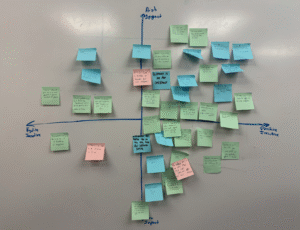

Grounded Theories
Grounded Theory 1: Students want to spend more time outside, but outdoor time must be justified. This includes being productive, being social, or a health pressure.
- Subtheory: Outdoors is easiest when it piggybacks on obligations.
- This effectively means that outdoor time happens most reliably when it is attached to something students already do. Graham describes outdoor walking as something that happens in between commitments (moving between meeting rooms, walking to lunch or coffee) rather than as a standalone.
- Questions:
- Which “obligation paths” (to class, coffee, library, gym) are most common and easiest to convert into outdoor time?
- What makes an obligation walk feel viable: distance, time buffer, route quality, or habit?
- Subtheory: Outdoors becomes a tool for self-regulation (mood and clarity), not a destination.
- Students often treat outdoor time as a functional intervention rather than as a planned recreational goal. This framing increases the likelihood they’ll do a short outdoor moment, because it becomes “useful” rather than indulgent. An example was Sophie when she repeatedly used walking as a “brain break” and a stress-response tactic: she goes after class to reset, and when work stress spikes she takes shorter 10–15 minute walks as a pressure-release valve.
- Questions:
- What triggers a self-regulation walk (stress, boredom, fatigue, stuckness), and what’s the minimum “dose” that helps?
- How do students decide whether a 10–15 minute outdoor reset is worth it compared to pushing through work?
Grounded Theory 2: Accountability artifacts (diaries, step counts, “someone will see it”) convert intention into action, but can create pressure that users may resist long-term.
- Subtheory: “Needing data” drives behavior.
- Some students responded by saying that having to track data changed their behaviors. Amelia explicitly says she didn’t want to “not have data,” and also didn’t want it to look “pitiful” to have done nothing, so she kept her walks consistent during the study week. Agustine: diary made them try to be more consistent and “check myself.”
- Questions:
- Which motivates more: private “data completeness,” social visibility (“someone will see it”), or contributing to a project?
- What “minimum action” do people do to avoid reporting nothing (short walk, coffee run, steps laps)?
- Subtheory: Accountability increases consistency and self-checking but can feel intimidating.
- Amelia says a friend seeing her daily walking status would “definitely affect” her, but she’s not sure she’d “sign up for that,” because it could feel intimidating, especially if someone is checking.
- Questions:
- Where is the line between helpful accountability and unwanted surveillance or pressure?
- What “visibility controls” would make this sustainable?
Grounded Theory 3. Comfort and “stationary exposure” silently controls outdoor behavior
- Subtheory: Movement-based outdoor activities are tolerable but standing or waiting outdoors is avoided.
- This shows up in how participants frame outdoor time as something you do while “going somewhere.” Students will walk somewhere in the cold, but dislike waiting outside (bus stops, standing around).
- Questions:
- Which outdoor formats feel worse: waiting for transit, standing around, or “outside with no destination”?
- How can we convert passive exposure into purposeful movement (“walk while waiting”)?
- Subtheory: Discomfort reshapes outdoors into indoor substitutes or “indoor-adjacent” outdoors.
- When it’s cold or dark, students default to gym or indoor exercise or brief outdoor moments close to home/campus. Agustine says his “time outside is the time I spent at the gym,” particularly at night and Graham notes difficulties going on runs during this time of the year
- What weather or time-of-day conditions create the “drop-off cliff” (cold, dark, rain)?
- When it’s cold or dark, students default to gym or indoor exercise or brief outdoor moments close to home/campus. Agustine says his “time outside is the time I spent at the gym,” particularly at night and Graham notes difficulties going on runs during this time of the year
Grounded Theory 4. Metrics shape behavior, but steps misrepresent “meaningful activity”
- Subtheory: If the metric doesn’t count it, students discount it even if it was real effort.
- For example, gym or sports (if you don’t have a wearable) does not add to step count, so users feel like they “didn’t do much” despite exertion. Agustine notes: “I don’t know how the app does counting steps about exercising at the gym… can it really be representative?”
- Questions:
- Which high-effort activities feel “invisible” to steps (gym, sports, biking), and how does that change self-evaluation?
- How do you track these activities accurately without a sophisticated wearable?
- Subtheory: Students want recognition for meaningful activity, not just movement.
- This could include a walk with a friend, a mood reset outside, or a nature moment, all of which can matter more than steps. Sophie’s outdoor habit is explicitly about brain breaks and stress regulation, not chasing step totals
- Questions:
- What should “counts” really be? For example, should it be: minutes outside, mood shift, social outdoor time, or steps?
- How do we avoid pushing “step-friendly” behavior over the activities students actually value?
Grounded Theory 5: Outdoor time scales when it becomes a “social container”
- Subtheory: Social purpose makes outdoor time “worth it.”
- If the same 15 minutes outside also accomplishes connection, it stops feeling like time stolen from work. Graham repeatedly frames outdoor as enabling social connection while still fitting into the day: walking to lunch with teammates, meetings outside with coffee, easier conversation while walking.
- Questions:
- Which social formats most reliably generate outdoor time (walk-to-coffee, walking meeting, walk-and-talk)?
- What makes the social component feel “productive enough” to justify the time?
- Subtheory: Low-commitment social outdoors beats planned outings.
- Big group outdoor plans fail from coordination; casual recurring micro-invites (walk loop, “call while walking”) succeed. Agustine’s unplanned coffee meetups show how social outdoors works when it’s lightweight and opportunistic rather than scheduled and “event-like.”
- Questions:
- What is the smallest viable social invite that consistently works (vs “let’s hike”)?
- What rituals make it repeatable without feeling like a recurring obligation (same route, same time window, opt-in invites)?
Identified Trends
We identified 7 core trends across the data that support out grounded theories:
Trend 1: Outdoor time is mostly “micro” and opportunistic, not planned
- People go outside in short, low-commitment bursts (walk breaks, commute moments), not big outings.
- Evidence pointers: Sophie, walk as refresher, diary-style “walked to class” moments appear repeatedly
Trend 2: Productivity pressure is a dominant suppressor of going outside
- When workload rises, outdoor time either drops or must be justified as improving work.
- Evidence pointers: Sophie: multiple walks tied to stress while working, productivity pressure decreases outdoor time
Trend 3: Outdoors is frequently used as regulation (stress/mood/clarity), not as a destination
- Outside functions like a cognitive reset button.
- Evidence pointers: Participants mention “refresher” break, walks triggered by stress
Trend 4: Social “containers” make outdoor time easier (walk-and-call, walk-and-talk)
- Outdoor becomes more “worth it” when it double-counts as social time.
- Evidence pointers: Price: biking/walking while calling parents; outdoor social activities → enables outdoor time.
Trend 5: Accountability artifacts nudge behavior (tracking/logging makes people do something)
- “Having to report” changes behavior, even if subtly.
- Evidence pointers: Price: step count influenced thinking). Other evidence showed accountability nudge → increases outdoor time.
Trend 6: Comfort constraints reshape activity choice (weather/darkness pushes indoors)
- It’s not only about time but rather more about its friction and comfort. When it’s cold or dark, being outdoors becomes less likely or shifts to an indoor gym.
- Evidence pointers: Graham: gym because cold/dark; “Comfort Barrier” loop
Trend 7: Measurement mismatch creates “I feel active but the steps say otherwise”
- Step counts can distort perceived effort and create confusion about what “counts.”
- Evidence pointers: Alyssa: felt same energy, steps varied, Sophie: step counts not surprising but salient
Identified Contradictions
We also identified 4 core contradictions across the data that complicate our conclusions, bringing nuance into our grounded theories:
Contradiction 1: People value outdoors, but still treat it as optional unless it serves another goal
- Outdoors is “good,” yet it gets cut first under deadline pressure unless framed as improving productivity/wellbeing.
- Evidence pointers: Stress spiral loop causes people to prioritize other things
Contradiction 2: Users want spontaneity, but also want routine or structure to make outdoors happen
- Spontaneous outdoor moments are desired, yet planning friction makes them fail so routine becomes the workaround.
- Evidence pointers: planning commitment language shows up (Price: even small plans feel like commitment)
Contradiction 3: Accountability helps action, but can create pressure that users resist long-term
- Logging/steps can motivate, but “being watched” or needing to perform can feel controlling.
- Evidence pointers: See grounded theory 2
Contradiction 4: Metrics feel objective, but don’t match lived effort
- Students trust step, but also experience the metric failing to capture exertion and meaning.
- Evidence pointers: See grounded theory 4
Identified Tensions
Finally, we identified 5 core tensions across the data that supports our conclusions:
Tension 1: “Productivity vs wellbeing” (permission problem)
- Going outside can feel like “stealing time” from work, even when it improves work later.
- Shows up as: productivity pressure suppressing outdoor time; outdoors reframed as regulation to become acceptable.
Tension 2: “Planning burden vs social outdoors”
- Social outdoors is powerful, but planning it is costly; low-commitment formats win.
Tension 3: “Measurement vs meaning”
- Steps are easy to track, but meaning (mood lift, connection, nature) is what students actually value.
- Risk: optimizing for steps can distort behavior away from preferred activities.
Tension 4: “Comfort vs intention”
- People may intend to go out, but cold/dark/waiting flips the decision, especially when outdoors is stationary rather than moving.
Tension 5: “Accountability vs autonomy”
- Logging helps people follow through, but too much structure and visibility can reduce intrinsic motivation over time.
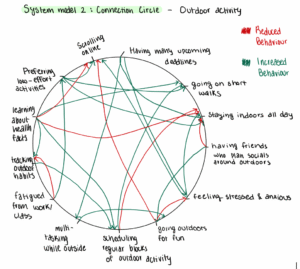
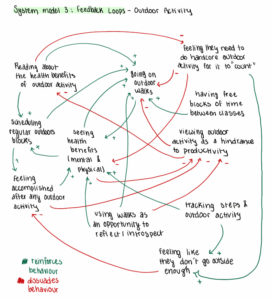
System Models

Additional Sketches: 
Secondary Research
Our secondary research found several key insights.
- Nature can be effective at improving mood, but is most effective through repeated habitual engagement with being outdoors.
A Nature-Based Intervention for Promoting Physical Activity in Older Adults: A Qualitative Study Using the COM-B Model
This research paper was published in 2024 and specifically focuses on outdoor-based walking interventions that encourage physical activity among older adults. It specifically uses the COM-B model, where Capability, Opportunity, and Motivation lead to a given Behaviour. The researchers conducted a 12-week walking program in rural Scotland, motivated by understanding the antecedent and emergent properties affecting behaviour change. The study found that group outdoor walks in particular increase physical and psychological capability while boosting social and physical opportunities. Importantly, these changes persisted after the end of the intervention. This study illustrates that programs that incorporate both a social and outdoor component can be quite effective in promoting physical activity.
Efficacy of a theory-based and tailored mHealth intervention promoting walking behavior: a preliminary randomized controlled trial
This research paper was published quite recently, in July 2025, and focuses on the use of a mobile health intervention designed to promote walking among physically inactive adults. They specifically use the HAPA model (Health Action Process Approach), which focuses on motivational (self-efficacy) and volitional (implementing and maintaining the behaviour) factors. In a 30-day randomized controlled trial, they assigned 193 participants to 1) tailored HAPA-based messages, 2) non-tailored messages focused on well-being, or 3) no messages. All participants engaged in goal-setting and self-monitoring via a mobile app. Interestingly, the results found increased physical activity across all three groups, indicating the role that goal-setting and self-monitoring can play. Toward the end of the intervention, those who were receiving HAPA-based messages demonstrated more sustained improvements. The study illustrates the importance of motivational and psychological factors, digital tools, and self-monitoring in promoting long-term behaviour change, with potential added value from tailored communication.
Influences of Outdoor Experiences During Childhood on Time Spent in Nature as an Adult
This research paper published in 2024 focuses on the causative link between spending time in nature during childhood on the propensity to spend time in nature as an adult. This provides insight into how to encourage people to spend time outdoors, they find that time in nature in childhood creates a continued habitual behavior of spending time outdoors. This validates the approach of pushing people to spend time outdoors a few times in order to create a habit that continues past the initial nudge. Activities that build connection to nature, such as camping or backpacking, seem particularly effective from this study, providing new ideas for how to change behavior.
Associations between Nature Exposure and Health: A Review of the Evidence
This narrative review was published in 2021 and synthesizes a decade of research on the relationship between nature exposure and health, drawing on theoretical frameworks like the biophilia hypothesis, Attention Restoration Theory, and Stress Reduction Theory. The researchers found evidence linking nature exposure to improved cognitive function, brain activity, blood pressure, mental health, physical activity, and sleep quality. Importantly, the review highlights the “equigenic effect”, evidence that nature exposure disproportionately benefits disadvantaged populations, potentially reducing health inequalities. The review also identifies key gaps in the literature, including inconsistent definitions of “nature exposure” and insufficient research on optimal dose (duration and frequency).
Minimum Time Dose in Nature to Positively Impact the Mental Health of College-Aged Students, and How to Measure It: A Scoping Review
This scoping review was published in 2020 and specifically targets college students which are a population experiencing unprecedented levels of stress, anxiety, and depression. After screening nearly 11,000 titles, the researchers included 14 studies and found that as little as 10-20 minutes of sitting or walking in green spaces produces measurable reductions in stress, anger, and anxiety compared to equivalent time in urban settings. The findings support low-barrier interventions: students don’t need extended wilderness experiences, and even brief campus green space exposure is effective. This connects to emerging “NatureRx” programs at universities where practitioners prescribe nature time as part of students’ health records.
2. Impacting long term behavior through social motivation can be effective but also harm wellbeing.
“If It’s not on Strava it Didn’t Happen”: Perceived Psychosocial Implications of Strava use in Collegiate Club Runners
This research paper published in 2022 focuses specifically on the impact of Strava, an app to track physical activity with a focus on running. It looks at college students, which is particularly relevant for our research. They find that Strava effectively uses social pressure and presentation of self to social peer groups to motivate users to run more, but are potentially utilizing harmful mechanisms that could influence mental health. More specifically, Strava creates a potentially unhealthy level of social pressure to keep up a running streak due to the social accountability the app enforces. While this may cause users to run more, it also may negatively impact mental health, which provides an insight for us to be careful to understand how our mechanisms of behavior change work and the broader impact they have on wellbeing beyond the amount of time outdoors.
Kudos make you run! How runners influence each other on the online social network Strava
This research article published in 2022 focuses on the impact of Kudos on Strava, an app to track physical activity with a focus on running. Specifically, it finds that Kudos act as an effective social nudge from peers to increase the frequency and duration of running time. It offers a research-backed approach for us to increase the amount of time people spend outside by creating a reward that utilizes social feedback. Furthermore, the concept of pairing individuals who give kudos directly to each other as a form of social accountability to maintain a habit was shown to be quite effective, which may be a creative method of behavior change for our project as well.
Kudos and K.O.M.’s: The Effect of Strava Use on Evaluations of Social and Managerial Conditions, Perceptions of Ecological Impacts, and Mountain Bike Spatial Behavior
This dissertation published in 2020 focuses primarily on mountain bikers who use Strava instead of runners. Specifically, it analyzes the “spatial data” – GPS data – of these mountain bikers along with their self-reported responses. A significant though easily overlooked insight from this work was that Mountain Bikers had significantly different responses from other activity types. It suggests that proto personas may be productive to construct around different activities depending on the data and behavioral preferences we see from the diary studies.
3. The advantages of being outdoors are very powerful. Even time near green space can improve health risks and all cause mortality.
The health benefits of the great outdoors: A systematic review and meta-analysis of greenspace exposure and health outcomes
This article evaluates the impact of greenspace exposure on a wide variety of physical health outcomes. By analyzing 143 studies covering over 290 million people, researchers found that proximity to nature significantly correlates with reduced stress markers like salivary cortisol and improved cardiovascular metrics such as heart rate and blood pressure. The data also suggests that living near green areas lowers the risk of type II diabetes, preterm births, and all-cause mortality. While the findings indicate substantial well-being benefits, the authors note that results are sometimes limited by high study heterogeneity and varying quality. Ultimately, the report advocates for urban planning strategies that prioritize accessible parks and greenery to combat socioeconomic health inequalities.
Acute mental health benefits of urban nature
This Nature Cities article synthesizes the evidence on the extent to which urban nature improves mental health. The authors systematically review 449 peer-reviewed studies and run a meta-analysis on 78 field-based experiments, quantifying effects across 12 mental health outcomes. Overall, exposure to urban nature is associated with meaningful improvements in well-being, with urban green spaces (especially parks and urban forests) showing the clearest benefits for reducing negative mood states like anxiety and depression and improving broader mental well-being. The paper also reports that effects are most pronounced for young adults, while still remaining consistently positive across age groups This supports the idea that protecting and expanding accessible urban nature can function as a scalable public-health intervention in cities
Campus Nature Rx: How investing in nature interventions benefits college students
Published in 2022, this paper outlines “Campus Nature Rx” as a pragmatic, prevention-oriented approach to addressing the growing mental health burden on U.S. college campuses. Rather than testing a single intervention, the authors describe the growing Campus Nature Rx (CNRx) Network (originating in 2019 and expanding to 50+ U.S. institutions at the time) and organize campus strategies into categories like nature prescriptions through health services, green infrastructure improvements, interactive campus greenspace maps, curricular offerings, communications, and nature-based activities. The article highlights why campuses are a uniquely “high-leverage” setting: nature engagement can be integrated into student routines via short, low-barrier exposures (e.g., brief microbreaks, short walks) while also reducing strain on counseling systems by complementing clinical care with scalable environmental and behavioral supports.
Comparative Analysis
We also closely examined the current solutions on the market and their effectiveness.
- Strava

Strava is the leading platform for tracking physical activity (primarily running, cycling, walking) with a heavy emphasis on social competition and performance data.
The target audience is fitness enthusiasts, “weekend warriors,” and data-driven athletes who want to quantify their progress. The platform fulfills the market need of social validation and performance comparison in fitness. Its unique features include “segments” (leaderboards for specific stretches of road/trail), Beacon (safety tracking), and “Clubs” for local communities. Its strength primarily lies in its strong network effects. There is high “stickiness” due to competitive leaderboards, and the application integrates with almost every wearable device (e.g. Garmin and Apple Watch), reducing friction to usage. Meanwhile, the weaknesses include the fact that it can feel “intimidating” or “elitist” for casual walkers; focus on data can make going outside feel like work rather than a break, and there is high “performative” pressure. Can even make people not want to work out if they think they will not perform well (e.g. don’t want to be judged by a “slow” workout). Our opportunity lies in addressing this “intimidation gap.” While Strava is for athletes, our product can be for anyone who wants to go outside. We can focus on the mental health benefits of just being outside, rather than the pace or heart rate of the activity.
2. Geocaching

Geocaching is a real-world, outdoor treasure hunting game using GPS-enabled devices. Participants navigate to a specific set of GPS coordinates and then attempt to find the geocache (container) hidden at that location. While the branding makes it looks older, there still are a large amount of users that are still active (gemini exists 3 million active users, especially internationally)
The target audience primarily consists of families, hobbyists, and “explorers” who need a specific destination or objective to motivate them to go outside. The platform fulfills the market need for purpose and gamification in the outdoors, providing incentives that make outdoor activity adventurous and fun. Its unique features include digital logbooks, physical “trackables” that travel from cache to cache, and difficulty/terrain ratings for every location. The platform’s main strength lies in the sense of adventure it creates. There is a high mystery, high reward loop, and it benefits from a large database of locations that add novelty and never-ending journeys for the user. At the same time, its main weakness is the steep learning curve it poses for beginners. The interface can feel dated, and there is limited social interaction between users in real-time, as it’s mostly solo or small groups. While Geocaching is a “solo-mission” app, our opportunity lies in improving the user experience by focusing on social coordination. Geocaching tells you where to go, but your app can help people decide who to go with, solving the “busy person’s” problem of loneliness and scheduling.
3. 1000 Hours Outside
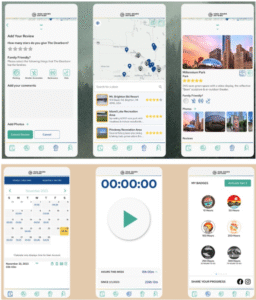
1000 Hours Outside is a relatively popular app that encourages people to spend time outside by offering trackers and challenges to go outside. It also allows you to discover new places to spend time outdoors.
The target audience appears to be adults and families spending time together. The unique features are time tracking, challenges, and discovery of local resorts and parks. The market need the app fulfills is aiding adults who want to spend more time outside but face friction in planning and tracking. The strength of the platform is feature completeness. It offers full tracking, discovery of locations, challenges, and more. The weakness is that it is a busy app without focus. Alternatives for discovery exist: Google, maps, and the like. Tracking apps exist as well. The challenges, however, are strong, but there is no social component to the app. Thus, we have an opportunity to lean into the challenges and potentially a social component while maintaining simplicity.
4. Instagram

One of the most popular social media applications amongst college students, Instagram competes with us to capture college student’s time. Instead of spending it outside, they spend it on Instagram and social media in general.
The target audience of Instagram is pretty broad, considering they have billions of users, but their power users tend to be Gen Z and millennials. The unique features of Instagram are the density of the network, social content, and features. All of your friends are on Instagram, any content you could wish or not wish to see is there, and almost every social feature imaginable is available. Instagram pulls its users in daily to see what their friends are doing. The market need they fulfill is entertainment, and to some degree, connectedness.
Instagram’s login screen highlights their stories feature, as they push the idea of being connected to friends and family through their application. Furthermore, the images are primarily of get togethers and interactions outside, implying their app can fit into an active outdoor lifestyle or healthy social lifestyle.
Instagram has strength in that it’s already an integral part of people’s lifestyle and time spent on phones. Everyone is on it, the entertainment value Instagram provides is known and addictive. However, the weakness is that spending time on Instagram can make you feel like you wasted time and can actually hurt your well being and happiness. Our goal is to get people to go outside more, having healthier experiences and activities. Thus, our opportunity is to address the weaknesses of Instagram, and potentially counter the strengths by adding a social component to pairing people to go on outdoor activities together.
5. Alltrails
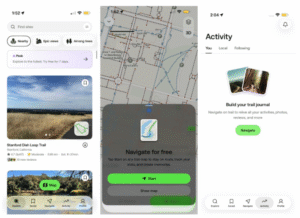
Alltrails is a location-based outdoor exploration platform that helps users discover hiking, walking, biking, and running trails near them. The app provides detailed information on the trail maps, difficulty ratings, distance and duration, user reviews, and photos.
The target audience is primarily outdoor enthusiasts, hikers of all experience levels, and families. The market need it fulfills is enabling low-pressure, exploratory, and enjoyable physical activities. Through making outdoor exploration personalizable and easy, it lowers the barriers to being active. Notably, what stands out about Alltrails is its ability to effectively cater to a broad target audience through its unique features. For instance, through allowing the user to customize trails by factors such as difficulty level and length, it effectively caters to both beginners and experienced individuals. Meanwhile, filters such as kid-friendly make it accessible to families, while filters focused on the nature of the location (parks, rivers, beaches) enable a personalized experience. Other unique features of Alltrails include user reviews and ratings that benefit from network effects, the ability to save trails and create custom trails and maps, and the opportunity to build a trail journal consistenting of your photos and reviews. Through tapping into “reliving” these experiences, Alltrails adds an emotional and sentimental component that transforms the platform from a mere functional experience to a personal one. This not only creates a practical desire to return to the platform (to access one’s stored data and information), but also a sentimental one (to look back on the memories made on these trails). In this way, these features further add an enjoyable element to going outdoors, incentivizing the behaviour.
One of the core strengths of Alltrails is how it offers differentiated user experiences even within a given market, and effectively captures a larger audience through this variation. Given that users can adjust factors such as difficulty and duration, a complete beginner can use the platform and do a very short hike; meanwhile, an avid outdoor enthusiast can find challenges and difficult trails suiting their needs. Both gain the same benefits the platform offers, and for beginners, it can be the starting point for a habit. There also isn’t much performance pressure, as it isn’t a social app for sharing your progress; instead, that progress is portrayed as being for oneself to revisit, further encouraging those who could be dissuaded by social pressure. At the same time, the platform benefits from network effects through users adding images, reviews, and helpful information on trails.
One of the weaknesses of Alltrails is that it is largely a solo experience. While that can be a benefit, the minimal social interaction leaves a gap for those who want a more group-based and social outdoor experience. Furthermore, while it can be great for discovering new trails as one travels, users may have limited motivation to return to the platform regularly once they know their local trails. Similarly, despite allowing customization, it focuses more on physical activity that requires a scheduled time frame, rather than done spontaneously or in between errands. This presents an opportunity for our solution to incorporate a social component that 1) encourages activity in a group manner and 2) further lowers barriers to participation by focusing on activity that requires less time (and equipment), i.e. a walk between classes/meetings, or a night run.
We have further analysis of additional competitors in our full blog post.
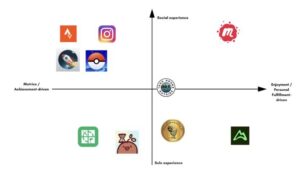
Explanation of Axes & Key Takeaways
The x-axis examines whether the application is more driven by metrics and achievement, or enjoyment and personal fulfillment, a contrast that was central to many of the competitors we examined. Notably, in incentivizing their users to go outdoors, exercise, or otherwise build a habit, platforms ranged from gamifying the process and offering extrinsic rewards for pursuing the desired action, to creating personal, intrinsic rewards for doing so. For instance, does an app encourage the user to go outside because doing so allows them to advance on a leaderboard and/or achieve a certain award, or do they focus on the personal memories and progress made? Overall, the incentives and reward structure at play are instrumental to any behavior change, and the x-axis labels reflect what emerged most frequently from the competitor research.
The y-axis examines whether the platform prioritizes solo or social/group-focused action. This was another prominent theme among our competitors. Specifically, research shows that group-based interventions can create incentives for outdoor activity due to social benefits, increased fun, or accountability to show up. At the same time, the social pressure can also dissuade participation, or shift incentives from personal payoff to external factors. All applications we researched illustrated deliberate thought given to how social or solo the platform would be. While some were entirely focused on oneself, others centered on group activity, while some added social components as an additional feature rather than a core one.
Our methodology for these rankings particularly focused on the unique features and strengths and weaknesses of each platform. Specifically, platforms that incorporate leaderboards, rewards for progress, and new achievements unlocked through activity are largely metrics-driven. Meanwhile, those that emphasize personal goals and memories are enjoyment-focused. Moreover, platforms that have deliberate social components, benefit from strong network effects, or emphasize the social aspect in the service offered rank highly on the social component. Those that center individual activities or aren’t driven by group/community are considered solo.
From the 2×2, we can see that applications that have a social component are often more driven by metrics and achievement, rather than intrinsic motivation. This is stronger for platforms whose core focus is on group/social engagement, illustrating a correlation between solo vs. group and the reward structure. Interestingly, among the apps we looked into, there aren’t any focused solely on outdoor activity that include a primarily social experience while being enjoyment/personal fulfillment-driven. The one application high up on the top right quadrant is focused on meeting groups of people with shared interests, rather than outdoors specifically. This reflects the fact that the platform is focused on building community, rather than generating concrete metrics (e.g. steps taken).
However, apps that are solo do not always correlate to being only enjoyment/personal focused vs metrics-driven. For instance, Alltrails is largely solo but emphasizes a personal experience, where you can revisit images you took on trails or reviews written to relive those memories. Meanwhile, Focus Friend is solo, but the desire to keep the para-social pal happy and unlock new decorations gamifies the process. In this way, behaviour change is a means toward achieving something outside of one’s personal goals.
The key takeaway from this is to research whether there have been attempts to create platforms that have a social component and/or focus, while emphasizing enjoyment and fulfillment over achievement and metrics. If so, how has this been received by the target audience? Given that one of the main opportunities we uncovered from our research was to create a more effective social/community component to outdoor activity, this can provide a wedge for meaningful differentiation. Specifically, we can create a group-focused platform that relies on personal fulfillment and long-term behaviour change rather than mere gamification, addressing many of the weaknesses we identified.
Proto-Personas & Journey Maps
Proto-Persona #1
Inda Trenches is a health-motivated, time-constrained student who wants to spend more time being active outdoors. They recognize the importance of it for their health and well-being, especially as they spend most of their day studying behind a desk. Inda also has a heavy course load that means they are often very stressed. They try to integrate outdoor walks into their daily schedule as they know it will make them feel much better. However, Inda often is inconsistent with the behavior from a lack of a concrete or recurring plan. When they do follow through, they realize they are getting far less activity than they had hoped or is needed for their well-being. Inda has high motivation and an orientation toward goal-setting, but hasn’t found the tools or support they need to achieve their aims in this area of their life.
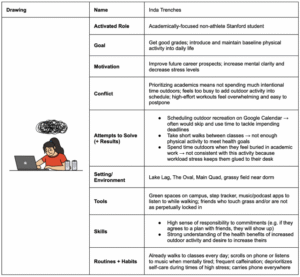
Proto-Persona #1’s Journey Map
Inda’s journey map depicts their daily experience when they finish a class or meeting and have a brief block of free time. They’re often very busy and don’t have big chunks of free time to devote to outdoor activity, but they can nonetheless take advantage of these short windows. Whenever Inda finds themself with this extra time, it’s hard to motivate themself to actually do outdoor activity, as they could use it to take a social media app break or make progress on her to do list. However, every time they do decide to do the activity, Inda comes back not only feeling more refreshed and calm, but also says to themself that they should make this a regular habit. Though, without tracking or a structured habit for doing so, the activation energy required is often too high when they find themself deciding in real-time. Inda needs a way to convert these spontaneous bursts of motivation into a structured, routine habit.

Proto-Persona #2
Team Bison is interested in getting Stanford students to touch grass. During our 5-day diary study, one archetype we encountered was the kind of student who likes going outside, especially for the sake of having fun with friends, yet they find it too much of a hassle to plan and organize these social outdoor recreational events. They possess a moderate sense of motivation when it comes to spending time outside with friends, but they perceive themselves to not have enough ability. Thus, their behavior doesn’t change— passivity is the easier alternative to action, and action doesn’t guarantee the desired outcome. No-Plan Dan was created to embody this outlook and its common traits.

Proto-Persona #2’s Journey Map
This journey map represents a student who wants to spend more of their free time outside and doing spontaneous activities with friends but actively avoids the social pressure and effort that comes with planning. These individuals value flexibility and spontaneity, preferring plans that fit naturally around their existing schedules rather than requiring advance coordination or ownership. The journey highlights a recurring pattern: a genuine desire to go outside is often followed by hesitation to initiate, resulting in outcomes that either work seamlessly or fail to materialize at all. By mapping this behavior, we can better understand how routines form around spontaneity, where friction arises, and where interventions might reduce planning burden while increasing the likelihood that these moments actually happen.

Thank you for reading! We are excited for the next phase of the study.



