TAM/SAM/SOM
The interviews revealed that the process for scheduling private events is smooth and rather enjoyable. Scheduling a meeting with people within the same company also seemed straightforward as the same Calendar software is used and employees have access to the meeting attendees calendars. This way free time blocks can be identified across multiple people within the organization.
But the most painful scheduling experiences by far were related to semi-professional, academic settings where lengthy back-and-forths via email or scheduling tools such as when2meet add to the frustrations encountered during the scheduling process.
To estimate the pricing model for our product, we looked at how Slack charges organizations for its product suite. Slack operates with a subscription model and charges per head at an annual rate of $100. Since our product is less powerful but still provides value to the user, we estimate that an annual rate of $5 per head is realistic. Multiplying this price with the number of users we can capture gives us the TAM/SAM/SOM estimates below.
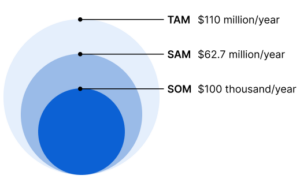
We defined our Total Addressable Market (TAM) as all college affiliates in the US, calculated by finding the sum of all college students and all employees in the US. Based on our pricing model, this market would yield $110 million per year in revenue.
We calculated our Serviceable Addressable Market (SAM) by looking at the adoption rate of an analogous product in our TAM. A rough analog for our concept is the productivity and communication tool Slack. We found that about 57% of US colleges have adopted Slack and assume that our solution would see a similar trend. Based on our pricing model, this market would yield $62.7 million per year in revenue.
Finally, we defined our Serviceable Obtainable Market (SOM) as the population of Stanford’s campus. With a population of approximately 22,000, our pricing model projects a market that would yield $100,000 per year in revenue.
User Interviews
I conducted two user interviews, one with a first year MS student, also known below as Participant 1, and a second year MS student who is also a startup founder, know below as Participant 2. Some of the key insights from these interviews include:
- The biggest pains in scheduling centers around academic scheduling or professional scheduling settings that are outside of a unified workplace
- “It’s more gratifying when I’m planning something with my friends” [Participant 1]
- “For more formal things like study groups or anything to do with classes, I usually have to check my calendar and there’s a whole process of getting people to respond” [Participant 2]
- Conversely, social scheduling is much more casual and spontaneous. It can even be enjoyable.
- “When I’m making plans with friends, it’s never really concrete. The planning process feels more nebulous and unstructured” [Participant 2]
- As groups become larger, with more than about three people. scheduling becomes significantly more challenging.
- “I usually end up trying to make events work for 5 to 7 people. Sometimes I’m the initiator, I don’t leap on it but I know that scheduling for a big group usually sucks” [Participant 1]
- “Once for an event with 15 to 16 people I had to manage 8 different message threads” [Participant 1]
- “When it’s more than 2 people, scheduling gets so much more complicated to manage [Participant 2]
- One of the most uncomfortable aspects of scheduling is the uncertainty around the response/time taken to schedule and the uncertainty around the eventual time/place of the event.
- “I don’t like the uncertainty, I’m not sure how people will react to my proposed times or when they will come back with a response” [Participant 1]
- “The uncertainty of not having something scheduled makes it hard to plan life and get things done.” [Participant 2]