Right now, millions of Americans are sitting on millions of dollars worth of unredeemed rewards earned by their participation in brand loyalty programs. Personally, I have more than 1000 stars wasting away in my Starbucks app that I have no plans to use, as I stopped going to Starbucks in favor of Peet’s – if only I could trade my Starbucks loyalty points for Peet’s loyalty points. Or, better yet, imagine a world in which I wouldn’t even need separate apps (or physical punch cards) to manage all my brand rewards. Our team is building a product that will make these dreams come true: we’re working to develop an app that uses the blockchain to help users keep track of, earn, and trade loyalty points. First, we’re going to target bars in San Francisco, so that SF bar hoppers will be able to earn loyalty rewards while they drink and then trade those rewards for rewards at other bars, to help them explore bars around the city. In order to gauge the market’s initial attitude towards this idea, I interviewed several young bar-hoppers living in the SF area about their views towards loyalty rewards programs in general and how loyalty rewards programs could help SF bars.
The people I talked to had a positive view towards loyalty rewards programs in general – they had earned and used points at places like Starbucks, Sephora, Amazon, and airlines. They also recognized that they did not make the most out of brands’ loyalty rewards programs: one person I interviewed noted, “I won’t sign up for a loyalty reward program if I’m not convinced I’ll go to that place enough for it to add up to something. The time it would take to sign up isn’t worth it if I’m only trying a place once.” Another stated, “I have a physical loyalty card for a boba place, but I almost never use it because it isn’t convenient. I also know that Square has a loyalty point thing, but I feel like it’s too much work to put in my phone number every time I want to use Square’s program, and I’ve never seen anyone use it.” The main reason those I interviewed did not make the most out of loyalty programs was because of the inconvenience or signing up for a loyalty program. I’m sure many of us have felt the same way when cashiers at any number of stores try to encourage customers to sign up for their loyalty program, only to embark on a lengthy sign up process. In order for our product to be successful, it must be as convenient and easy as possible. We imagine that even the act of consolidating loyalty rewards under one app may make using loyalty points more convenient.
Interestingly, both people I talked to stated that they were not particularly sensitive to prices when they went out to bars. One participant stated, “If I’m going out to a bar and buying something I’m gonna get what I want, if I’m getting a cocktail I’ll spend cocktail money, but I also know what to expect in terms of the price…maybe if I’d never been to a bar before I would be surprised to hear the price.” All participants seemed to understand that bar prices were particularly high, but they seemed willing to pay those prices in order to have a night out.
All those I interviewed listed businesses that they wished has some form of loyalty rewards program. These businesses included workout classes, transportation (bus services and Uber), subscription services like Netflix, and engineering parts businesses like McMaster-Carr. However, participants were split on whether or not they’d actually like to trade their loyalty points for other loyalty points. While one interviewee seemed excited by the possibility of trading in his Starbucks points for Amazon points, the other wondered, “If I’m loyal somewhere, why would I want to give those points to someone?” However, that same interviewee also conceded that it may be nice to trade airline points for other airline points if there was some flight that was only offered by particular airlines.
My group has yet to actually talk with businesses themselves about this loyalty point system – it will be interesting to hear if this is something businesses would find helpful or useful.
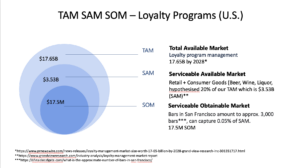
Our TAM/SAM/SOM analysis is as follows: