
1. Problem Domain
Over the past six weeks, Team 12 has explored motivations and interventions for food waste in buffet-style dining places, a common example of which is dining halls on college campuses. While we hear a lot of (fair) rhetoric addressing corporations’ food waste activity, we noticed that food waste on an individual level filled up multiple compost bins by the end of a meal. We took on a challenge to design an intervention to help a single person lower their own food waste.
2. Baseline Study
What makes reducing food waste difficult for students on campus? To understand the gap between individuals’ goals and reality around food waste, we tracked 5 participants’ food waste for 5 days. They all had a goal of reducing their food waste and primarily ate in dining halls and co-ops, which have set menus each day and almost overwhelming options.
Pre-study interviews showed us how participants navigate filling their plate(s), giving us insight into how agency, hunger, and guilt play into the entire dining experience. During the study, we asked our participants to log at least 1 meal a day, which included the percentage of food they wasted, what they did during their meal, why they threw out their food, and their feelings towards their waste.
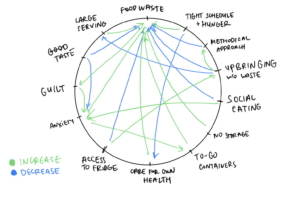
Our raw data told us that the most common reason for throwing out food was fullness or unappetizing food, which are aspects of a meal that are hard to anticipate and prevent for busy active students. Further analysis through a Connection Circle showed us that emotions like guilt decrease waste and factors such as social meals increase waste.
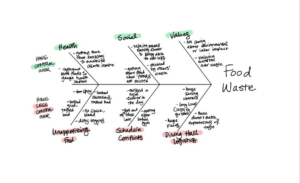
Additionally, a Fishtail Diagram showed us factors of waste that participants have control over (values, health) vs. what they don’t have control over (dining hall layouts, their schedule). While the latter is hard to overcome, this gives us insight into aspects of meals where we can tap into participants’ agency. We then asked: how can we help students take control of their food waste?
Read more about our baseline analysis here.
3. Comparative Research and Analysis

Through comparative research, our team found that there are currently no competitors for individual food waste in college settings. Instead, we analyzed apps that targeted food waste in domestic and commercial settings for inspiration around the user experience and apps that target plastic waste as an analogous waste tracking tool.
Weaknesses that are pertinent to our product:
- lacking general simplicity in the interface such as a clear visual hierarchy.
- requiring users to log behavior or information manually as opposed to using scanning or photo features.
Strengths that are pertinent to our product:
- separating different methods of food waste reduction by sections or tabs.
- estimating the positive impact of users’ behavior.
- reducing user inputs by scanning or taking photographs.
- making sustainable efforts fun through “leveling up” or visual graphics that quantify effort.
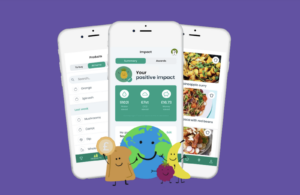
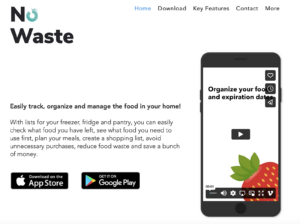
Kitche and NoWaste are two important analogous apps. Kitche allows users to reduce grocery food waste by scanning their grocery receipts and sending reminders about expiration dates, which provides inspiration for how users would experience reminders and tracking. NoWaste similar helps users track groceries bought, eaten, and thrown out but requires manual logging (huge barrier to entry).
Find more information about our comparative research and our own position in the market here.
4. Literature review
In our review of scholarly literature, we found agreements and contradictions. Studies 2, 3, and 4 find that food-reduction campaigns negligibly impact students’ beliefs about food waste; however, 2 & 3 find a decrease in food waste but 4 does not.
Studies 1 and 8 both find that organization and systematicity help reduce food waste: their findings concern awareness of food locations in a refrigerator and grocery stores, which relates to locations of different foods in a dining hall.
Study 6 presented a surprise: food waste is a very emotional subject, and people who want to waste less, paradoxically end up wasting more if they have negative emotions.
Because the literature presented changes in the environment (color coding in fridge, organization of ingredients, ovular dining plates) are the most effective interventions for food waste in domestic and restaurant settings, there are not many insights we can directly apply to our study. Given the findings of 2 and 3 that food waste did decrease based on given reminders, and based on study 1 and 8’s systematicity findings, we decided to design a regular reminder-based intervention. Given study 6’s findings of how emotional the topic is, we chose to personally message reminders and conduct post-study interviews with our participants instead of setting up iPhone reminders.
For the nine studies’ names, summaries, and links, please see here.
5. Personas and Journey Maps
Personas
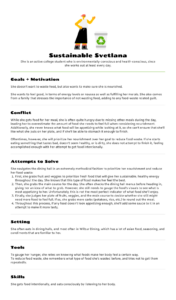
Based on conducted interviews, we created two personas: Typical Tatiana, who represents most of our interviewees, and Sustainable Svetlana, who represents 2-3 sustainability-oriented interviewees. While Tatianas are a lot more present than Sevtlanas on college campuses, every single Tatiana we interviewed mentioned she knows a Svetlana and thinks of her when she wastes food. Our interviewed Svetlanas are imperfect too, though.
Even though the two occasionally hang out and both want to not waste, their motivations differ. Svetlana does it for the better of the planet. Tatiana does it for her: she worries peers would judge her and wants to do the ‘right thing’ in areas beyond food waste.
Their profiles are below.

Journey Maps
Having defined two personas, we outlined a journey map of getting a meal for each one, starting from entering the dining hall to clearing her plate. Our key insight from the journey maps is that both Svetlana and Tatiana fail to recall the act of food waste while getting food despite how different they are. Tatiana wastes due to lack of time and poor estimation when getting food. In contrast, Svetlana wastes because she cares about her health as much as about the planet, and chooses not to force-feed herself the food that her body rejects due to poor taste.
Tatiana
| Think |
|
|
|
|
| Feel |
|
|
|
|
| Do |
|
|
|
|
| Entering the dining hall | Grabbing food | Eating | Clearing plate |
Svetlana
| Think |
|
|
|
|
| Feel |
|
|
|
|
| Do |
|
|
|
|
| Entering the dining hall | Grabbing food | Eating | Clearing plate |
Please see Personas and Journey Maps sections for more information here.
After synthesizing our journey maps, we asked:
- How might we make participants consider food waste while they are filling their plates?
- How might we give participants more agency over their food?
6. Intervention/Product Ideation
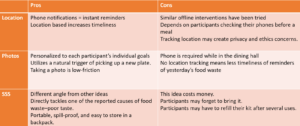
To address these questions, we came up with three intervention ideas:
- Location-based reminders to reduce food waste.
- Visual reminders of yesterday’s waste.
- Supplying small portable SSS kits (Spice, Seasoning, Sauce).
7. Intervention Study
After considering the benefits and drawbacks of each intervention, we decided to pursue #2, viewing previous waste as our target intervention, based on its novelty and incorporation of key course concepts. For more information, please see our blog post here.
In summary, our intervention asked participants to take a photo of their empty plate upon entering a dining hall, a trigger to review their previous food waste; and to take a photo of their leftovers after their meal. Our intervention protocol, recruitment population, and data collection can be found here.
After the study, we gathered to synthesize our findings:
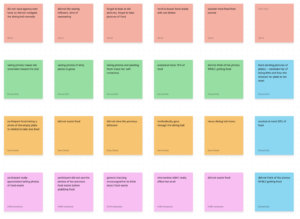
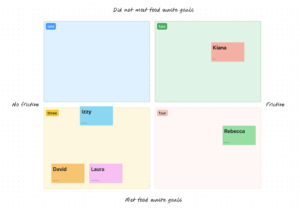
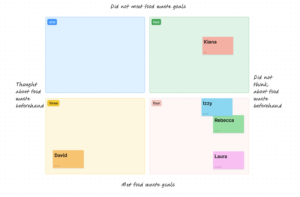
As is shown from our mapping exercises, our results were highly divisive and inconsistent with regard to the effectiveness of our intervention. However, there were some common trends we synthesized below:
- Reviewing previous food waste was a high-friction and ineffective intervention. Even participants who met our goal of thinking about food waste before getting their meal did not do so due to reviewing previous food waste, but due to other aspects of the intervention.
- Text notifications were also highly ineffective at reminding participants to participate during dinner time, perhaps due to “notification fatigue.”
- Agency remained a major determinant of waste.
- Participants who checked the dining hall menu and had a strong understanding of dining hall dishes reported feeling confident and empowered, and wasted less.
- Participants wasted more if they were overwhelmed by options or found unexpected options, such as specials, upon entering the dining hall.
- Participants enjoyed the action of taking photos and found it to be low friction.
8. Storyboard
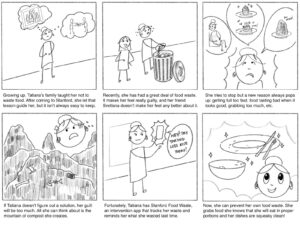
We heard many stories from our users, and they were best captured (and distilled) in Tatiana’s persona. While Svetlana is a separate persona, her reasons for still wasting food despite her principled nature (throwing out food that doesn’t taste good or grabbing too much) aren’t that distinct from Tatiana’s.
Most of our users wasted food because they thought about waste after their meal rather than while grabbing food. Users grabbed too much food because they overestimated their hunger, they were misled by the appetizing appearance of the food, or they simply grabbed too much. Our product will attempt to target users’ decisions while grabbing food so that they do so with waste prevention in mind.
9. Current direction you are moving in
Due to the mixed results from our study, we are currently considering how we may improve upon our intervention or develop ideas for pivots that stay true to our knowledge of our users’ goals and motivations. One potential idea is to shift away from phone-based products, which may be high-friction and unnatural in a dining hall environment, as our study showed, to wearables such as a product for a smartwatch or AR glasses. Another direction is to create a product based upon increasing users’ agency in dining halls, since that was determined to be a major factor for producing waste.
10. Questions
- Given the non-convergent results of the study, can we steer in the direction that feels right to us and test our assumptions along the way? Due to the small sample size of the study, how much weight should we give to the results when making subsequent decisions?
- Regarding the final deliverable, what modality can it be besides an app? Would you encourage building an app? If not necessarily, what level of fidelity should we aim for?
Word count: 1948.



