
Our final proposed solution is a mobile planner-game that activates an avatar inside a dining place who helps you plan out your meal via assembling a cartoon plate using food props created from real dining hall menus. You and your avatar then eat together!
1. Solution Ideation
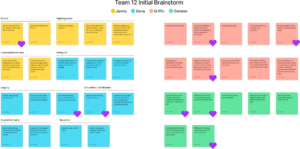
After synthesizing our intervention study, we brainstormed ideas both during our team meetings and in class.
After the first outside-of-class brainstorming, we were going in the direction of a wearable with a sort of reminder to not waste food (avatar in a wearable, reminder on a student id), a notification-based digital solution, and a competition with friends to waste less food.
In class, we came up with the following:
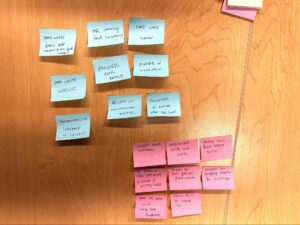
This left us with two potential final candidate ideas:
Candidate #1:
a therapeutic game with the goal of sorting food waste from plates and washing dishes: our study subjects who managed to lower their food waste indicated the study helped them because food waste was “in the back of [their] mind”.

Candidate #2:
a social media app for dining halls with crowdsourced food reviews: an particularly successful interviewee shared he always knows exactly what he is getting, which helps him waste less.
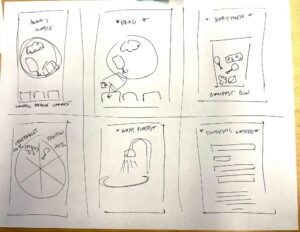
Upon further discussion and interview data analysis, we decided to keep iterating on the two candidates. From our studies, we found a need for a preventative solution, as most interviewees did think of food waste but too late. For this reason, we chose to keep the plate with food idea from candidate #1, but instead of after-meal context, we shifted to pre-meal – letting people plan their meals by assembling a plate of food. To emphasize the pre-meal nature, we decided to activate the app only once a user reaches a dining hall (using their consented geolocation). Influenced by candidate #2, we decided to import menu items from real dining hall menus to create visual food assets.
2. Assumption Map
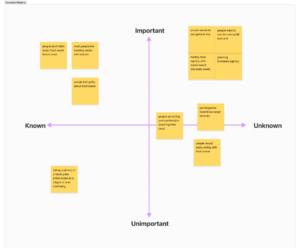
Our assumptions are a combination of known ideas, such as what we learned during our baseline study and intervention study, and unknown ideas crucial to our solution, such as the timing of the game and the mechanics of using the app (scanning their meal, planning their meal, reading the menu, engaging with an avatar).
3. Testing Assumptions
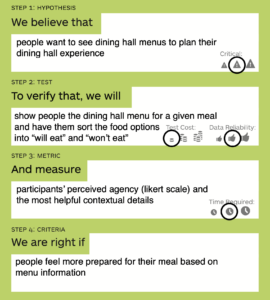
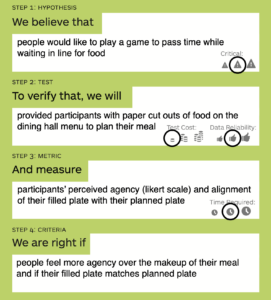
Our two assumptions we’d like to test are 1) surrounding the timing and environment of our game, waiting in line at a dining hall, and 2) the benefit of menu context before navigating a dining hall.
We would like to ensure that the workflow point we target users during is appropriate for their conceptual model of their meal, and that the information we provide through it is relevant to their food consumption and food waste.




Comments
Comments are closed.