
WasteNot
Jan 9 – Mar 19, 2023.
by Jianna So, Griffin Somaratne, Dana Chieuh, and German Enik.
Introduction 👋
Welcome! We are team 12. This quarter, we aimed to increase individual agency over lowering one’s food waste in buffet-style dining settings. Through iterative user-research, design, and prototyping process, we built WasteNot, a mobile application prototype that we present below. Try our prototype:
~\(≧▽≦)/~ PROTOTYPE ☆-(^з^)/~

Problem Finding (The Challenge) 🕵️
We are college students who frequently eat at dining halls. Over time, we began to notice how much food is wasted after meals. While we hear a lot of (fair) rhetoric addressing corporations’ food waste activity, we noticed that food waste on an individual level filled up multiple compost bins by the end of a meal. We took on a challenge to design an intervention to help a single person lower their own food waste.
What Is Already Known? 🤔
Literature Review 📖
We conducted a literature review on the existing solution space directly and tangentially addressing our targeted problem. We found agreements and contradictions. Studies [2], [3], and [4] find that food-reduction campaigns negligibly impact students’ beliefs about food waste; however, [2] & [3] still find a decrease in food waste but [4] does not.
Studies [1] and [8] both find that organization and systematicity help reduce food waste: their findings concern awareness of food locations in a refrigerator and grocery stores, which relates to locations of different foods in a dining hall.
Study [6] presented a surprise: food waste is a very emotional subject, and people who want to waste less, paradoxically end up wasting more if they have negative emotions.
For the nine studies’ names, summaries, and links, please see [here].
Noteworthy Facts 📝
Our literature review reinforced our belief in the importance of our problem: Eaters (consumers of food) are responsible for 60% of waste along the food cycle in developed countries [2]. Additionally, as [4] points out, food waste negatively affects the environment via increased carbon footprint.
Market Overview 💹

Through comparative research, our team found that there are currently no competitors for individual food waste in college settings. Instead, we analyzed apps that targeted food waste in domestic and commercial settings for inspiration around the user experience and apps that target plastic waste as an analogous waste tracking tool.
Weaknesses that are pertinent to our product:
- lacking general simplicity in the interface such as a clear visual hierarchy.
- requiring users to log behavior or information manually as opposed to using scanning or photo features.
Strengths that are pertinent to our product:
- separating different methods of food waste reduction by sections or tabs.
- estimating the positive impact of users’ behavior.
- reducing user inputs by scanning or taking photographs.
- making sustainable efforts fun through “leveling up” or visual graphics that quantify effort.

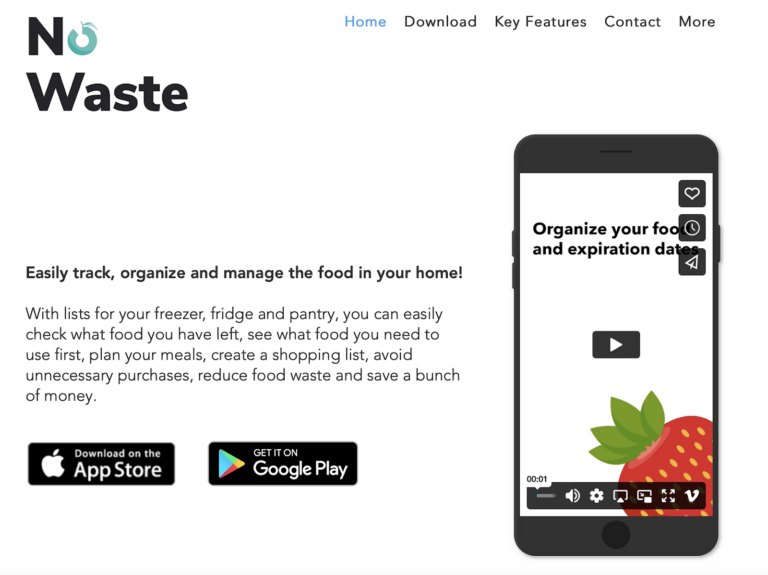
Kitche and NoWaste are two noteworthy apps. Kitche allows users to reduce grocery food waste by scanning their grocery receipts and sending reminders about expiration dates, which provides inspiration for how users would experience reminders and tracking. NoWaste similar helps users track groceries bought, eaten, and thrown out but requires manual logging (huge barrier to entry). Both of them focus on groceries instead of dining hall settings, though.
Find more information about our comparative research and our own position in the market [here].
Baseline Study & Synthesis 🙇♂️
Our target users are college students eating at dining halls with at least a mild wish to waste less food (for a variety of reasons, like upbringing, financial, or sustainabilty, to name a few). Importantly, we don’t target people with a difficult relationship with food (as we noted in our screener when recruiting) because we don’t want to accidentally negatively affect them.
When choosing what to track and ask during interviews, we looked for answers to these high-level questions:
- What are some root causes for individual food waste?
- What emotions does one encounter throughout the dining hall meal experience?
- What goals does one have regarding food waste?
- What motivates those goals?
To understand the gap between individuals’ goals and reality around food waste, we recruited 5 participants and tracked their food waste for 5 days. They all had a goal of reducing their food waste and primarily ate in dining halls and co-ops, which have set menus each day and almost overwhelming options.
Pre-study interviews showed us how participants navigate filling their plate(s), giving us insight into how agency, hunger, and guilt play into the entire dining experience. During the study, we asked our participants to log at least 1 meal a day, which included the percentage of food they wasted, what they did during their meal, why they threw out their food, and their feelings towards their waste.
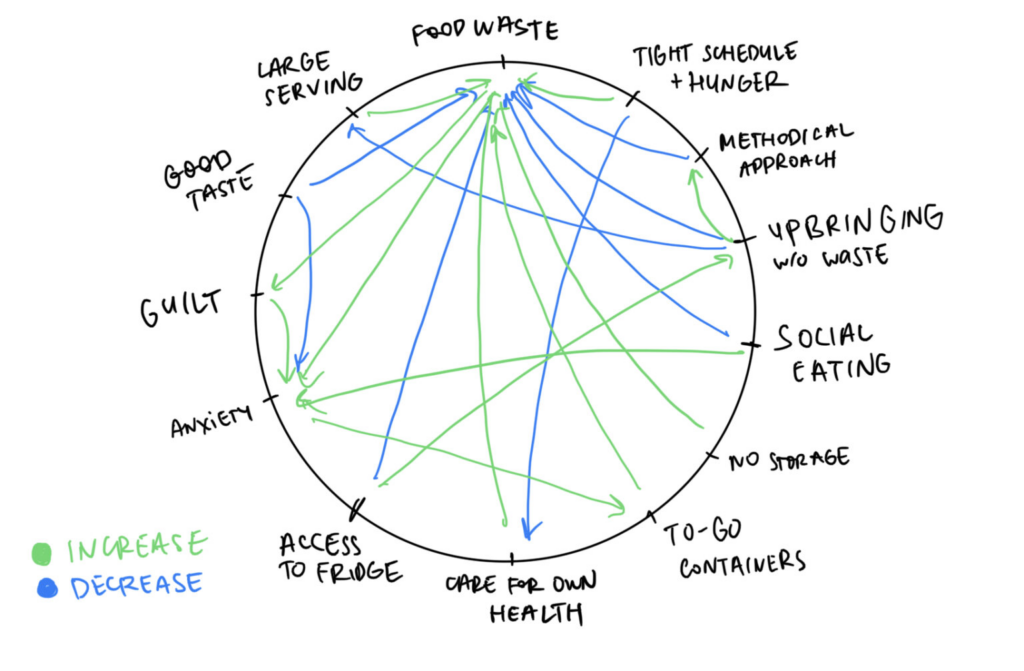
Our raw data showed that the most common reason for throwing out food was fullness or unappetizing food, which are aspects of a meal that are hard to anticipate and prevent for busy active students. Further analysis through a Connection Circle showed us that emotions like guilt decrease waste and factors such as social meals increase waste.
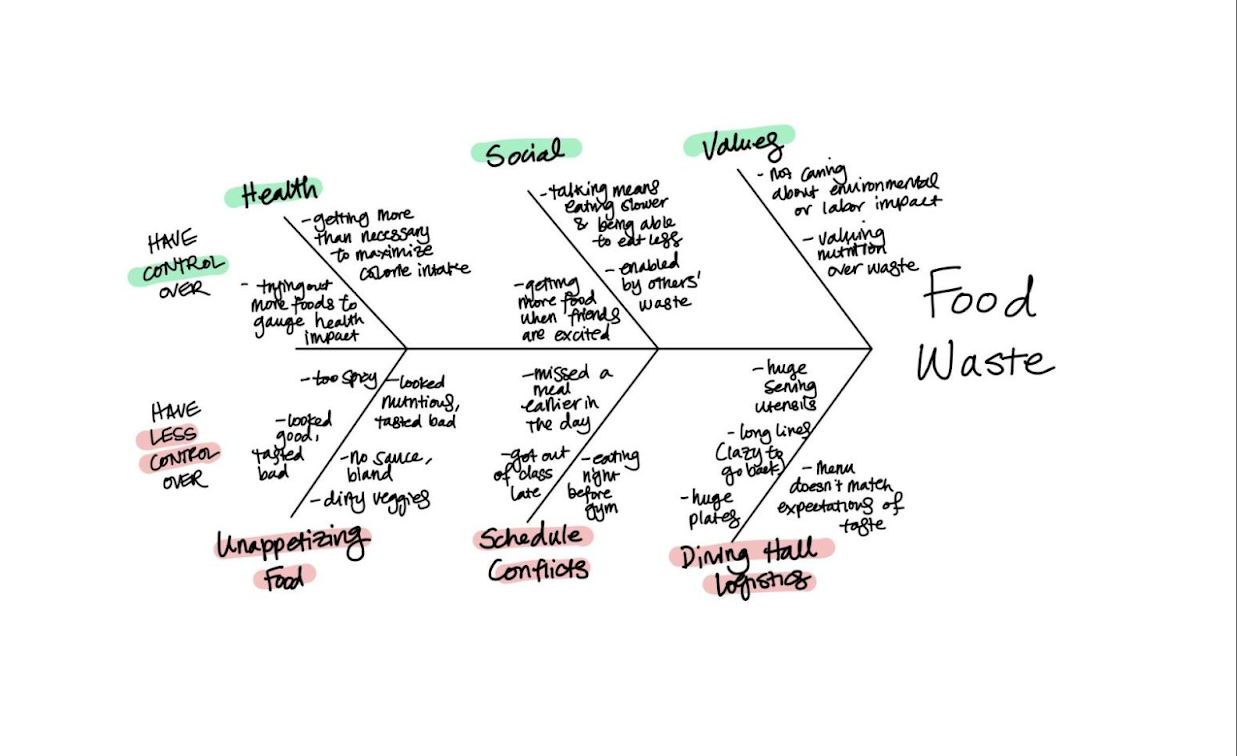
Additionally, a Fishtail Diagram showed us factors of waste that participants have control over (values, health) vs. what they don’t have control over (dining hall layouts, their schedule). While the latter is hard to overcome, this gives us insight into aspects of meals where we can tap into participants’ agency.
The synthesis helped use refine our problem statement: how can we help students take control of their food waste?
Read more about our baseline analysis [here].
Personas and Journey Maps 👯♀️
We derived two distinct personas based on conducted interviews: Typical Tatiana, who represents most of our interviewees, and Sustainable Svetlana, who represents 2-3 sustainability-oriented interviewees. While Tatianas are a lot more present than Sevtlanas on college campuses, every single Tatiana we interviewed mentioned she knows a Svetlana and thinks of her when she wastes food. Our interviewed Svetlanas are imperfect too, though.
Even though the two occasionally hang out and both want to not waste, their motivations differ. Svetlana does it for the better of the planet. Tatiana does it for her: she worries peers would judge her and wants to do the ‘right thing’ in areas beyond food waste.
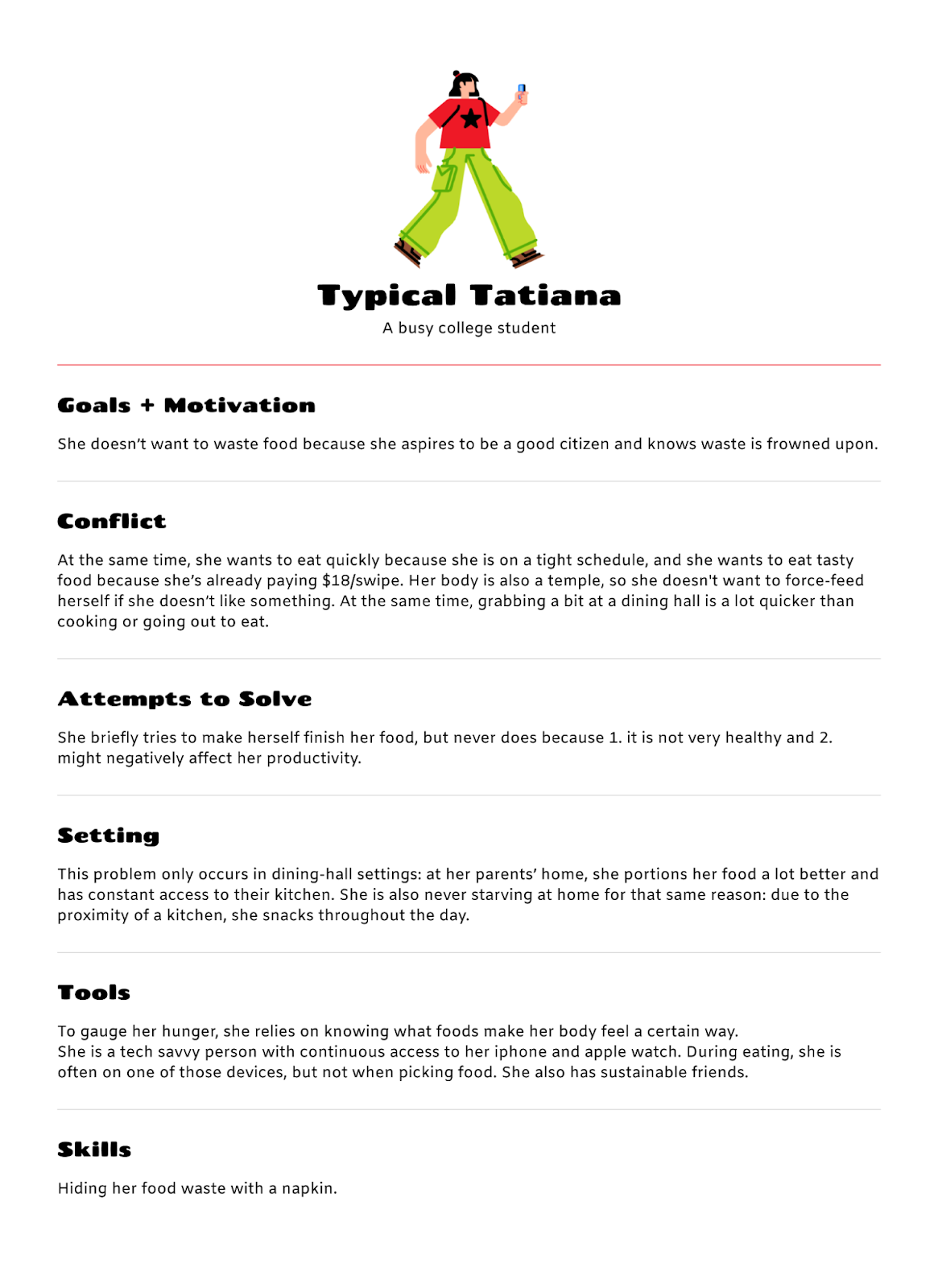
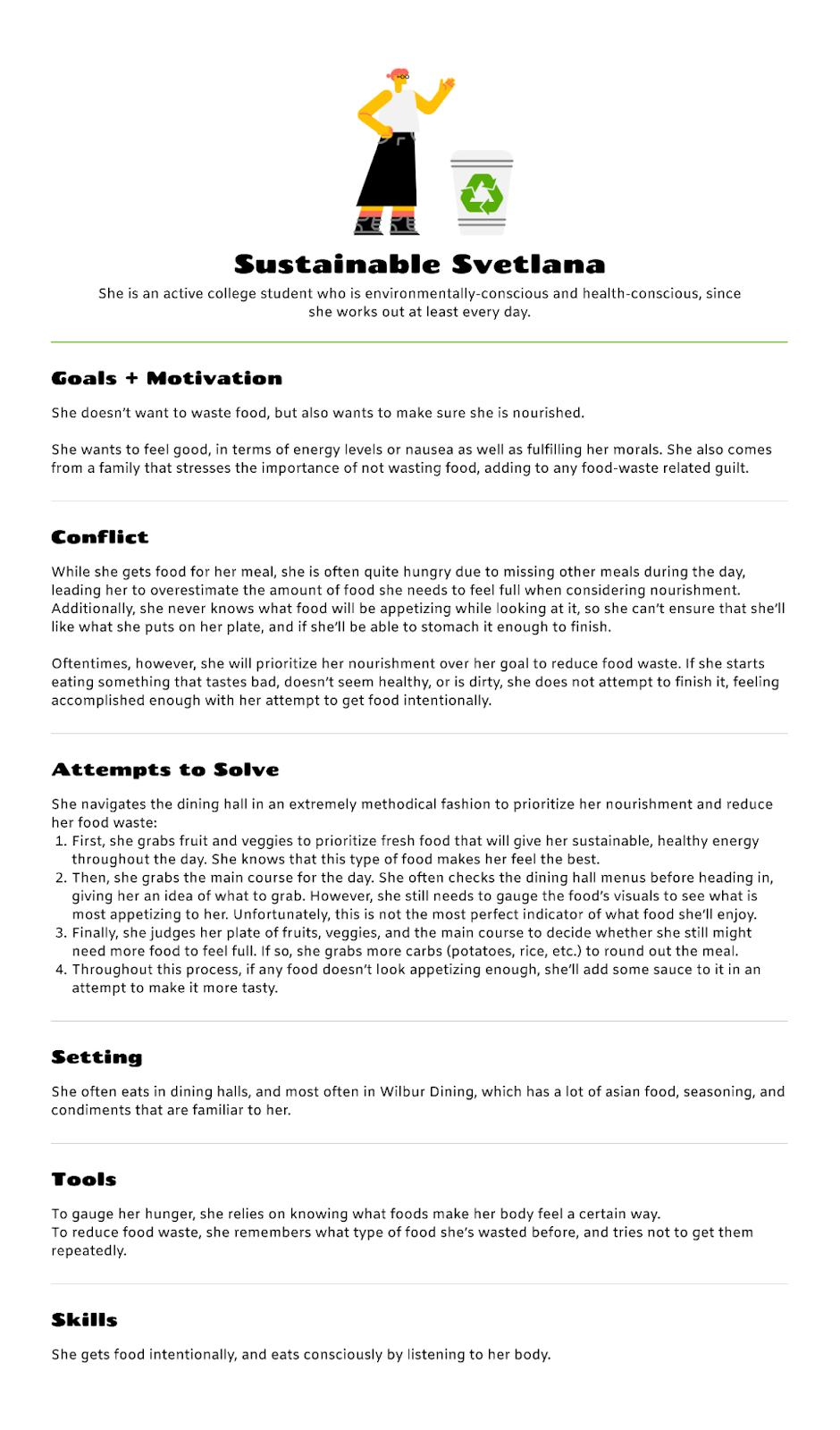
Having defined two personas, we outlined a journey map of getting a meal for each one, starting from entering the dining hall to clearing her plate. Our key insight from the journey maps is that both Svetlana and Tatiana fail to recall the act of food waste while getting food despite how different they are. Tatiana wastes due to lack of time and poor estimation when getting food. In contrast, Svetlana wastes because she cares about her health as much as about the planet, and chooses not to force-feed herself the food that her body rejects due to poor taste.
Tatiana |
| Think |
|
|
|
|
| Feel |
|
|
|
|
| Do |
|
|
|
|
| Entering the dining hall | Grabbing food | Eating | Clearing plate |
|
Svetlana |
| Think |
|
|
|
|
| Feel |
|
|
|
|
| Do |
|
|
|
|
| Entering the dining hall | Grabbing food | Eating | Clearing plate |
Please see Personas and Journey Maps sections for more information [here].
After synthesizing our journey maps, we asked:
- How might we make participants consider food waste while they are filling their plates?
- How might we give participants more agency over their food?
Solution Finding ✅
Intervention Study ✋
We drew inspiration for our intervention study from our learnings from user research and interviews. We tried to approach the intervention from different angles, and came up with the following three:
- Location-based reminders to reduce food waste.
- Visual reminders of yesterday’s waste.
- Supplying small portable SSS kits (Spice, Seasoning, Sauce).
We asked: how much would a timely visual reminder of one’s food waste from yesterday affect their food waste today?
We asked our participants to follow the protocol every day for 5 days:
- Each day, participants will be texted a reminder photo of their previous day’s food waste around 5-6PM.
- Upon entering a dining hall, participants are asked to take a photo of the empty plate they have selected before getting their meal and send it to the organizers. While sending the photo participants are asked to view their previous day’s food waste.
- After their meal, participants will take a photo of their leftovers and send them to the organizers.
- This process will be repeated for 5 days (dinner).
At the end of each day, we collected photos of food waste after meals. We also conducted post-study interviews. We analyzed images we received and drew the following insights:
- Our intervention idea was extremely time-sensitive – if our participants missed our reminder, they recall food waste until it was too late.
- People are already overwhelmed with notifications, so expecting them to check their phone specifically for our message was too bold.
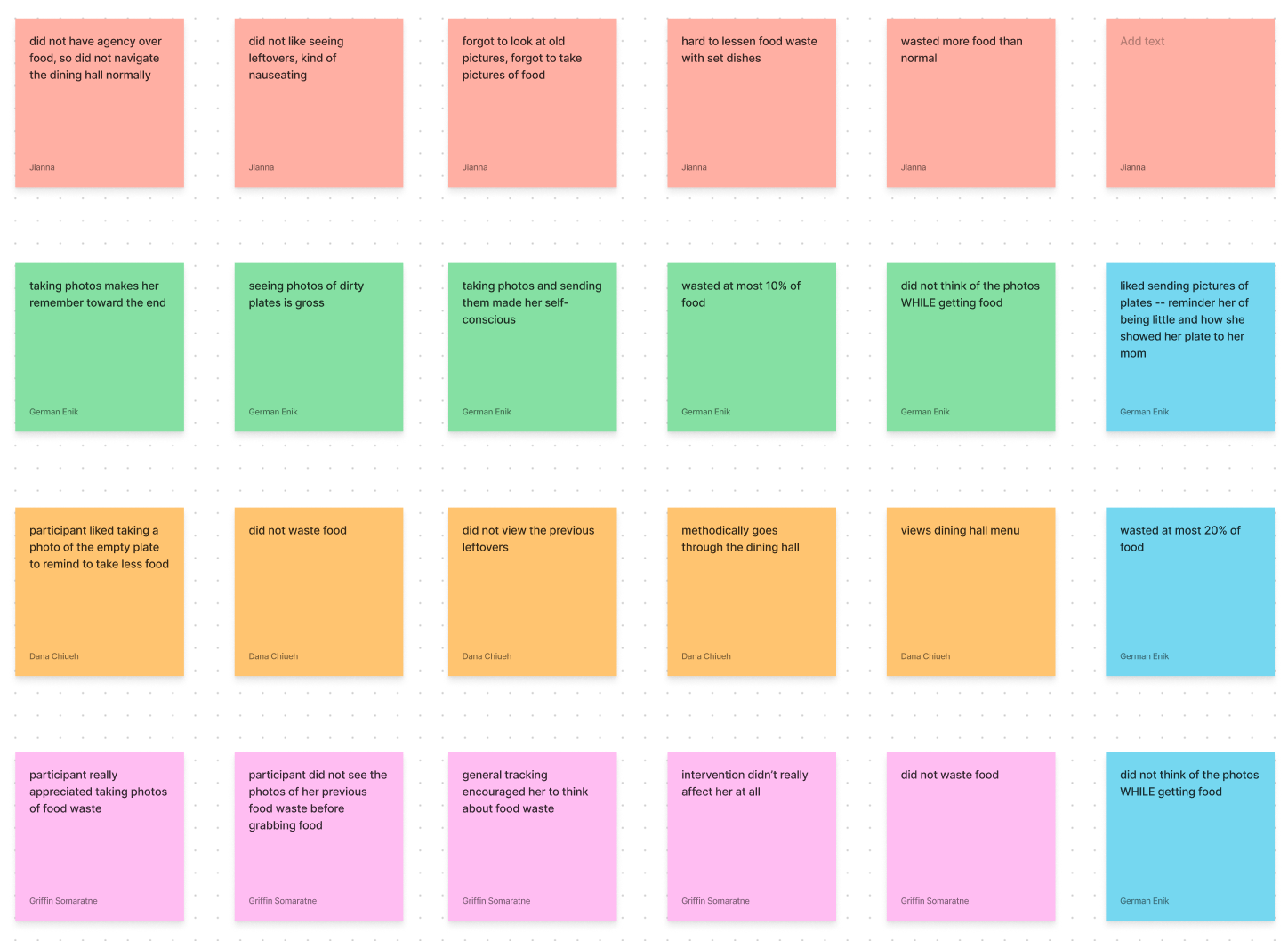
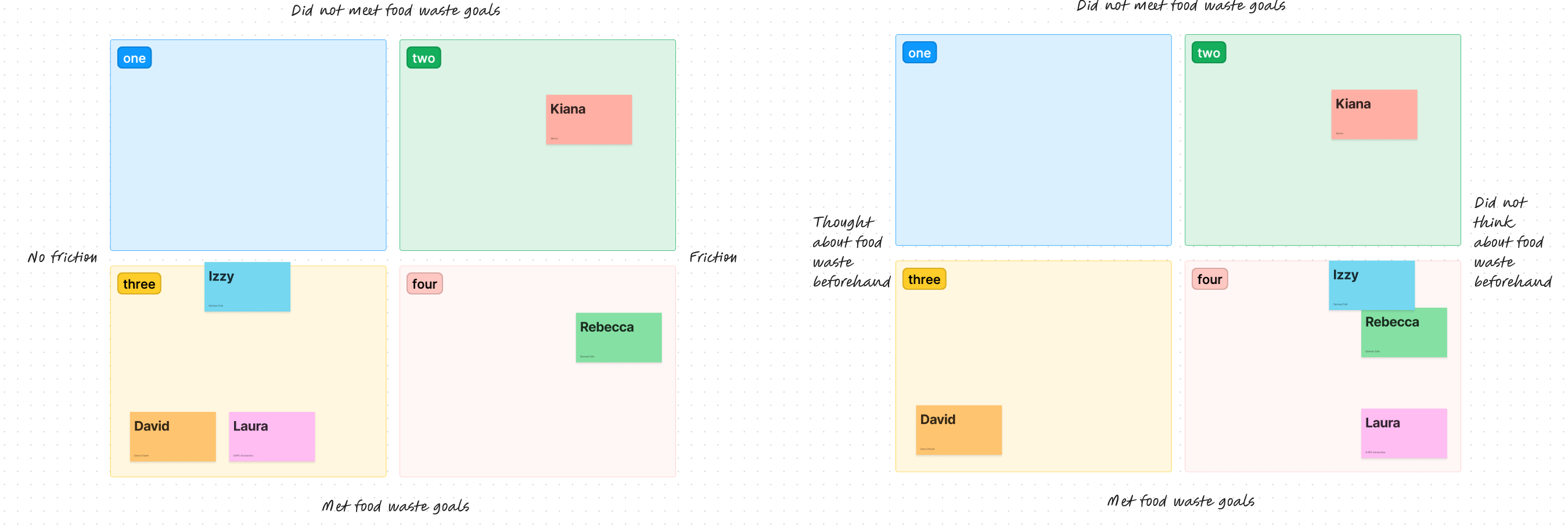
While our results lacked a particular cohesive direction, the study results were priceless in encouraging us to slightly change intervention direction and explore solutions that the user would find fun and useful enough to turn to themself.
Read more [here]!
Design Architecture 🏛️
When working onn the design architecture, we used our bubble map to consider three main areas of our app: settings, meal planning, and meal eating. In settings, we provide onboarding and setup for the rest of the app experience (avatar upload ad dietary restrictions). In meal planning, we provide context around dining hall menu options and an interactive game to plan a digital plate with menu items. In meal eating, after users have gotten their food, we provide a chance to eat alongside digital avatars, log waste, and a diary/analytics screen to foster understanding of general consumption and waste habits.
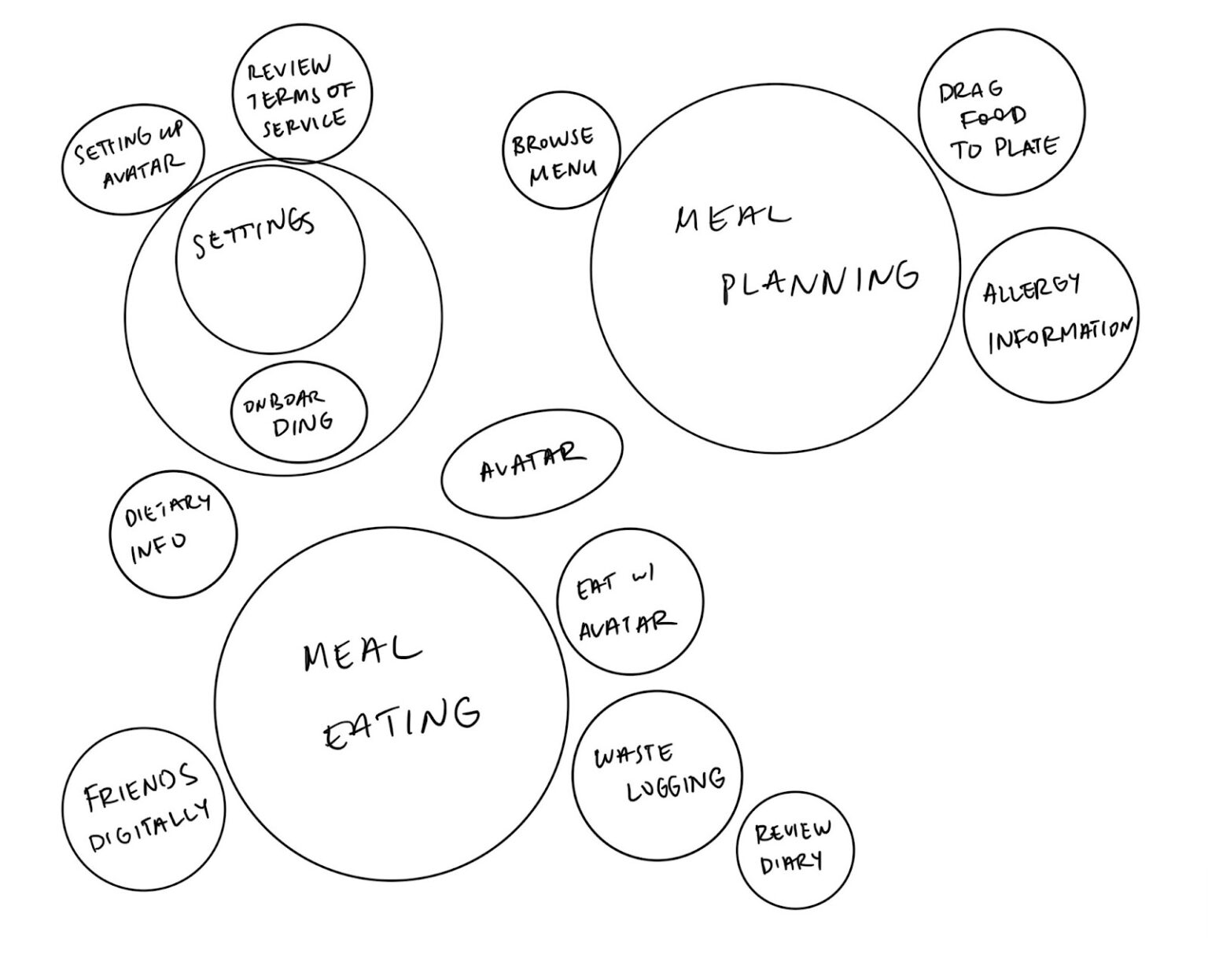
We mapped an ideal system map for our use case: using our app (a game to plan your meal) while waiting in line at a dining hall. Because of this, our 2 personas have the same entry point to begin their journey, since additional steps (planning meal, eating with avatar, logging waste) are sequential and not available without completing the previous step.

Read more about our design architecture [here].
Assumption Mapping & Testing 🗺️
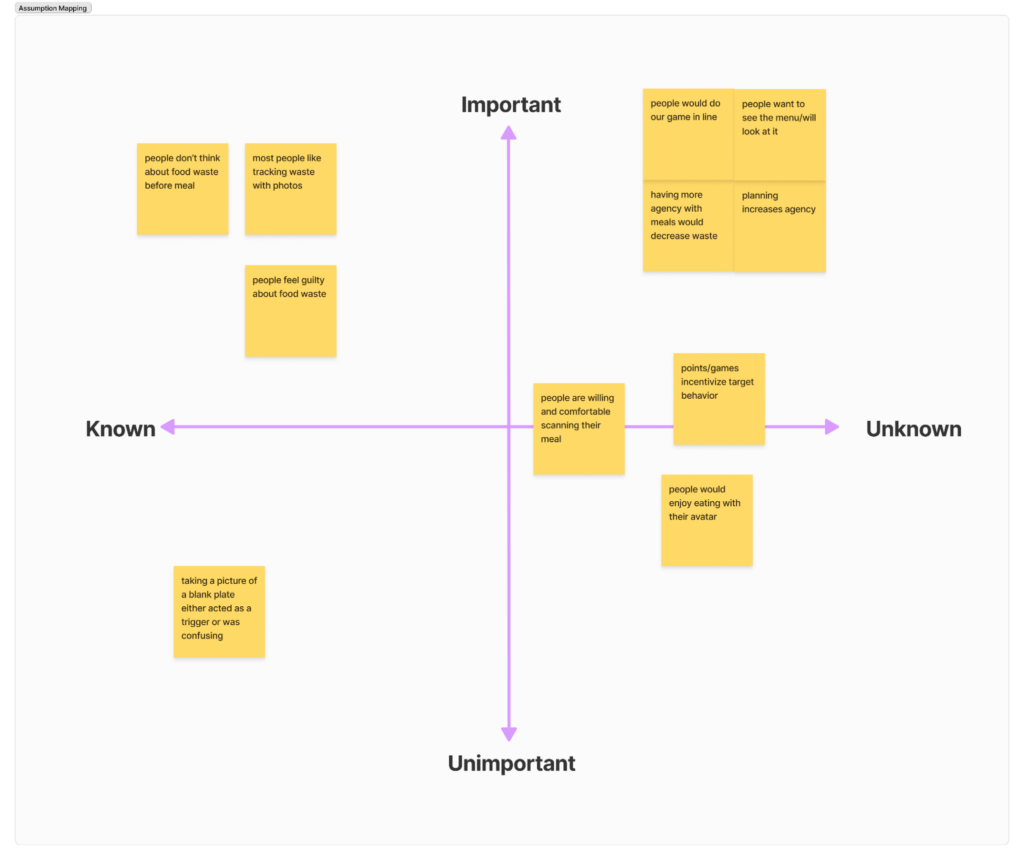
When mapping the assumptions on which our product’s success depended, we identified two main assumptions that were both important and unknown: first, that students would want to do our “game” while in line and second, they would want to see the menu before getting food at the dining hall.
In planning our tests, we tweaked these assumptions to be more precise:
- We believe that participants would benefit from visually planning a digital plate of food.*
- We believe that participants would want to know the dining hall menus to plan their dining hall experience.
To test the first assumption, we provided participants with a Figma template to interactively plan their meals before grabbing food and measured their sense of agency, similarity between digital plate and actual plate of food, and overall emotions. Participants enjoyed viewing the menu items and visually manipulating their proportions, and noted that they felt less overwhelmed by the options once they were in the dining hall because they knew what they wanted. They also said it was fun. These results validated our approach to implement a digital plate experience.
To test the second assumption, we called people over the phone and read out the dining hall menu before they went to grab food. We measured their sense of agency and preparedness. Participants took less time in the dining hall food section because they first grabbed the things they had heard on the call and wanted then grabbed additional items. They expressed feeling more prepared. These results confirmed that users should look through the menu before grabbing food.
Further studies are required to examine the long-term effectiveness of these features in increasing agency and reducing students’ food waste.
Please see our [Assumptions Mapping] and [Assumptions Testing Synthesis] sections for more information.
Solution Building 🏗️
Wireflows to sketchy screens 🔀
Wireflows
We created the below wireflow to capture the functionalities of our app as well as the sequence in which users would interact with them.
The happy path we designed for our app included a brief onboarding, planning a meal, eating with the avatar, and logging waste. Planning ahead for our minimum viable product, we removed the social component from our app. Though we found the idea exciting, ultimately our intervention focuses on individual agency—navigating the dining hall is usually an individual experience.

Sketchy Screens ✍️
To illustrate our user interface, we created the above sketchy screens, focusing on the interactions that are most useful to users in the happy path. Across the screens, we relied on traditional components such as pill selector buttons and pop-ups to create an intuitive and easy-to-use interface. Some novel UI elements include the pie chart selectors that allow users to estimate their average leftovers after a meal and set a goal for future waste.
To learn more about our UI design choices and our previous iteration, read [here].

Branding: Mood Boards & Style Tile ✨
To imagine our product’s brand personality and visual language, we created and consolidated individual moodboards into one team moodboard. This helped communicate what the color palette and iconography of our interface would be, specifically bright and organic colors that beckoned to sustainability and food. The subsequent style tile established the exact color palette, typography, imagery, and example components that would be used in our interface. Overall, we designed our brand and visual language to make users feel welcomed and eager to use our interface
To learn more about our branding journey, read [here].


Usability Testing 🤳
To tailor our interface and app experience to users, we conducted usability testing. We asked users to complete three tasks: planning a meal, logging their waste, and viewing their food waste overview. The three largest issues we uncovered were users misunderstanding how to add menu items to the digital plate, users wanting the option to change the size of the digital good, and users wanting their leftovers displayed in the waste stats screen, not the digital plate. The first issue was resolved with a guided interaction in the onboarding. The second issue was a limitation of Figma’s prototyping and could not be resolved. The third issue was resolved by adding an example image instead of the digital plate.
To read more about the issues uncovered in usability testing and the solutions we designed to address them, read here. The script we used during the testing can be found here.
Prototype 🥦🥦🥦
(^^ click on me!)
Below are the final 4 flows of WasteNot: onboarding, planning a meal, logging waste, and viewing waste.
Onboarding 👩🏫
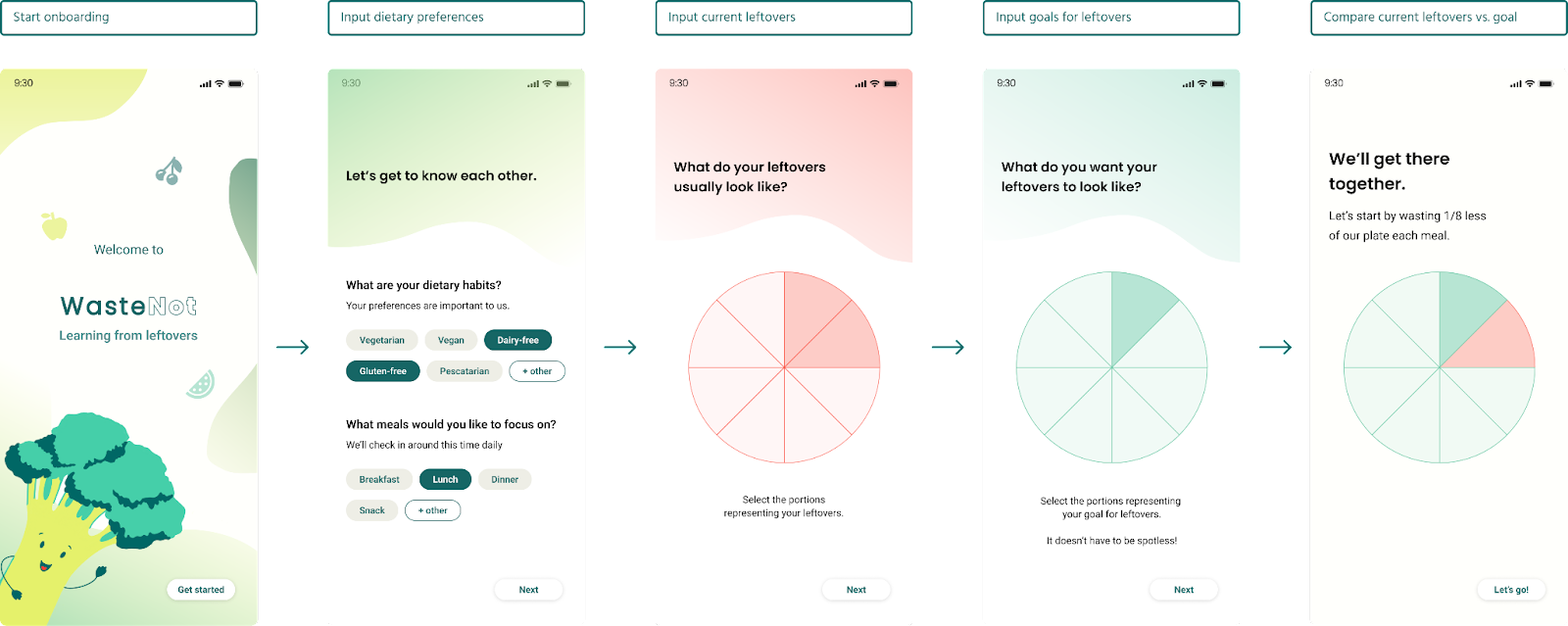
We maintained a simple onboarding to get to know users and help set their expectations around how the app might help them reduce food waste through planning and reflection. Users input their dietary preferences and food waste goals (in the form of current and ideal leftover portions).
Planning a Meal 🥗
Users ideally use this “Plan Meal” flow before they enter a dining hall. Here, they can view the menu for a meal, accompanied by menu item details and photos. Menu items can be placed onto the plate by dragging from the food card onto the plate. Users can view what menu items fit their dietary preferences and food waste goals (in the form of projected waste based on their selections). After planning their digital plate, users are prompted to get their physical plate in the dining hall and can eat with the broccoli character.

Logging waste ♻️
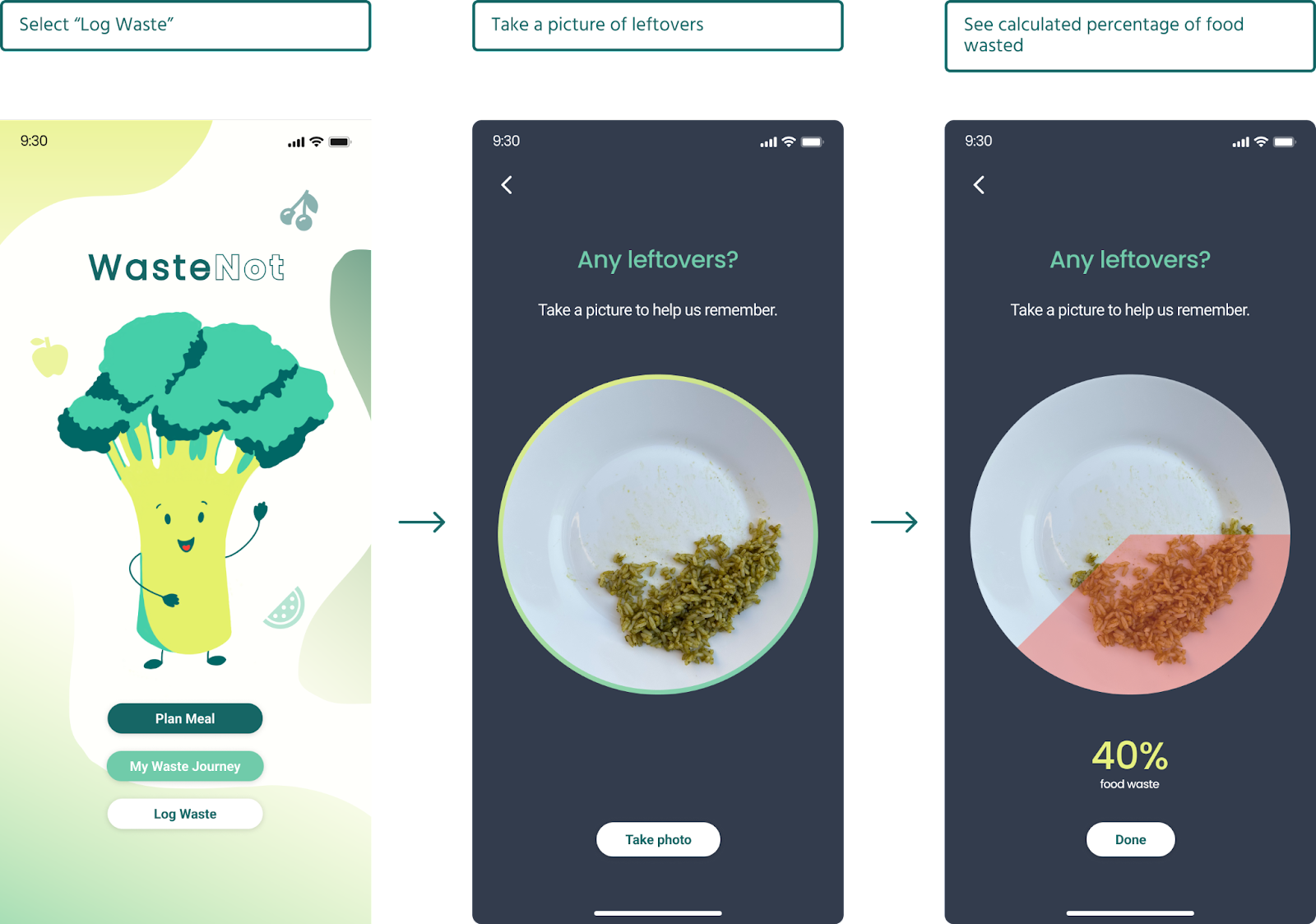
After eating their meal, users can take a picture of their leftovers and see a percentage of how much leftovers they have.
Viewing Waste 🗓️
After eating and logging their waste, users can view their “Waste Journey” in terms of waste per day, in which they can see the photo they took on a given day as well as the percentage waste calculated, and waste over time, visualized in a calendar view.

Ethics ⚖️
One of the initial motivations for our team to pursue the topic of individual food waste was to help college students put their ethics of sustainability into practice even in an overwhelming and chaotic environment like a buffet-style dining hall. We believe that WasteNot can do good for the planet by reducing unnecessary food waste, and as our insights have shown over the quarter, the best way to achieve this is by empowering users’ personal agency and allowing them to make the right decisions for them.
To avoid any potential for manipulation, we deliberately ensure that our app aligns with users’ goals and provide flexible ways for them to achieve self-stated goals.
In our class discussions on accessibility arising out of “The Invisible Work of Accessibility”, one thorny topic our team grappled with was regarding the user group of people with eating disorders, or those with a history of difficulty regarding eating. Out of an abundance of caution, during the baseline and intervention studies we aimed to exclude this disability from initial tests, wondering if our experiments may inadvertently do more harm than good without much prior background in the issue. However, as the “Technically Wrong” reading states, it’s important not to think of such users as minority “edge cases,” but actually “stress cases” whose consideration can significantly strengthen an app. Although people with eating disorders are not necessarily recommended to use our app, one of our design goals was to create an app about reducing personal waste that does not encourage users to take on disordered habits like dieting. Rather, the focus is on personal agency: in our onboarding, users can set personalized goals for their waste, and track their progress. Portion sizes can be adjusted on the app to match each user’s preferences, and no calorie counts or prescriptive portion sizes are provided.
One significant nudge we chose to implement in our final app design resurfaces personalized waste insights for users at the point of meal planning. In the detailed view of each food item, users can see whether it was an item that was frequently wasted in the past. When such an item is planned, the user is also prompted to change the plan in order to reduce waste, based on data on previous habits. In our design, we sought to preserve user freedom and flexibility during this nudge. “Nudging and Manipulation” defines manipulation as requiring an intentional actor – essentially, a bad guy that wants a certain outcome out of a user. In WasteNot, the intentions are set by the user themself. The primary goal of our intervention is to remind users of their personal previous habits and make it easier for them to implement that data into their meal workflow, not to force them to change their planned meal.
Conclusion ✌️
Throughout the project, we learned how to prioritize having fun, whether while working as a group, when planning our user studies, or actually building our prototype. When working on a topic such as sustainability and food waste, we motivated ourselves and our participants by making it enjoyable to engage with. In frameworks such as B=MAT, motivation seemed to be the hardest aspect to intentionally design for, as ability and triggers can be set or logistical. Finding the sweet spot of what might personally motivate students to think about the impact of their meals beyond personal nourishment, which is already difficult to prioritize, was a huge learning experience. We approached the problem by reframing food waste as a symptom of a logistical issue: a lack of agency in dining hall experiences. The positive reception of our plate planning prototype taught us that addressing core issues can be beneficial for impacting related behavior, including but not limited to our behavior change goal.
To develop this further, we would consider the technical implementation and scalability of our plate planning feature. Dining hall menus are posted daily, so we would likely pull that information directly from the R&DE website, then use an API to find the first related photo on Google using each menu item as a search query. We would also extend the logging feature to implement more rewards and encourage sustained use, as our current prototype mostly focuses on plate planning instead of waste logging. Since we didn’t get to test with users over an extended period of time, we still need to explore what type of information would provide value to users– would it be enough to see their waste over time, or would they seek more granular analysis of their food waste patterns?
In our next behavior design effort, we will be intentional about scoping down the focus to actionable change, as we went through many problem space iterations before focusing on food waste in dining halls, which set us up to have a strong niche and powerful insights throughout our project. We will also focus on the context of behavior, such as what core values drive users and what core issues prevent them from reaching their goals. Finally we will implement actionable and fun ways to make progress. Sustaining inspiration and motivation comes in manageable steps– we’ve learned that we can always reach our goals, as long as we do it together (whether as a team or with our users).
Thanks for a great quarter!



