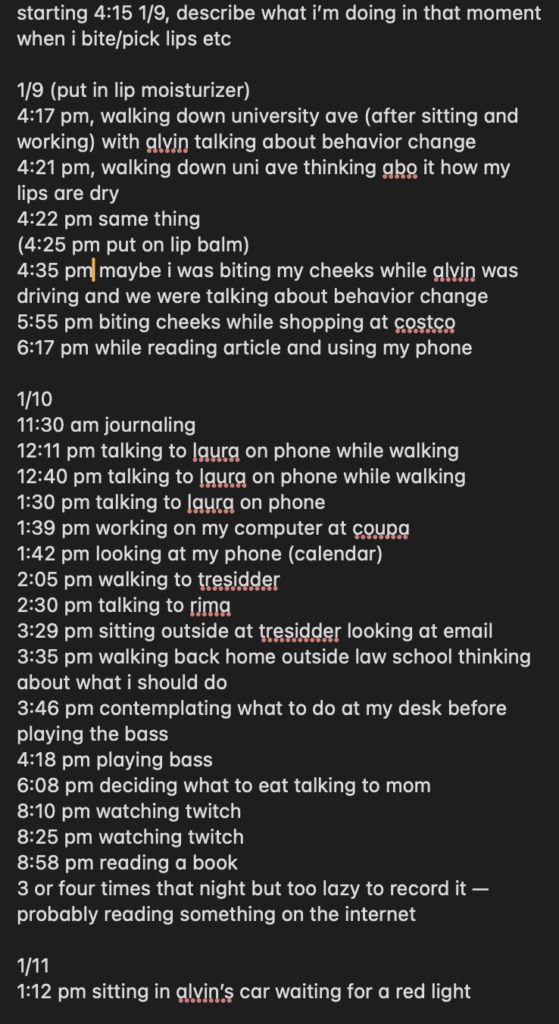
For this assignment, I’ve decided to change my automatic behavior of mouth picking — i.e., any sort of biting my lips or biting the inside of my cheeks.
I started this experiment at 4:15 on 1/9, and decided to track my lip biting by describing what I’m doing in that particular moment whenever I notice that I’m biting or picking my lips for 2 days.
The technique I used — to be as low friction as possible — is to jot it down on my phone, in my notes. This is so that it would feel low-stakes, and relatively easy to do no matter where I was. I also wanted to know what sort of things I was doing in the moment that I was picking my lips.
There were multiple problems with this technique. First, because I was consciously keeping track of whenever I picked at my lips (an unconscious behavior) I would start picking my lips more or picking less — being conscious of it meant that I was more conscious of my lips in general (meaning more picking) but it also meant that I could stop myself from picking in its tracks (picking less). Plus, there must have been lots of times that I wasn’t conscious of when I was actually picking my lips. There is no way that this exercise measures a true “baseline.”
Secondly, tracking like this was really tedious and got difficult. By Day 2, I was really tired; there were many times that I noticed that I was picking my lips but forgot to track it, or was (honestly) too lazy to. Writing it down just made me realize that I did it so often — and often without consequence, which decreased my motivation for tracking at all. The fact that it wasn’t “helping” made me not want to do it anymore.
Next time, I think for this particular habit (not tracked by behavioral cues), I would simply note the time that the habit occurred, so that the ‘study’ is in itself the habit-reducing mechanism. (By merely noting the habit, it makes me more conscious of it, and therefore seems like the first step to change it.)
Some things that I noticed — there seems to be no discernible pattern to specifically when I pick my lips, since this just seems to be a pretty random sample journal of my day. I even do it when I talk to people –not just mindlessly on my phone. Since this behavior is so automatic, it’s not triggered by something as distinct as, say, “I see ping on my phone.” Without an obvious cue pattern, it’s hard to know where to start intervening — the cue seems to be just “I’m thinking” or “I’m lightly bored” or “my lips feel dry.” (“My lips feel dry” is probably the best candidate, in this case, for stopping this behavior.)
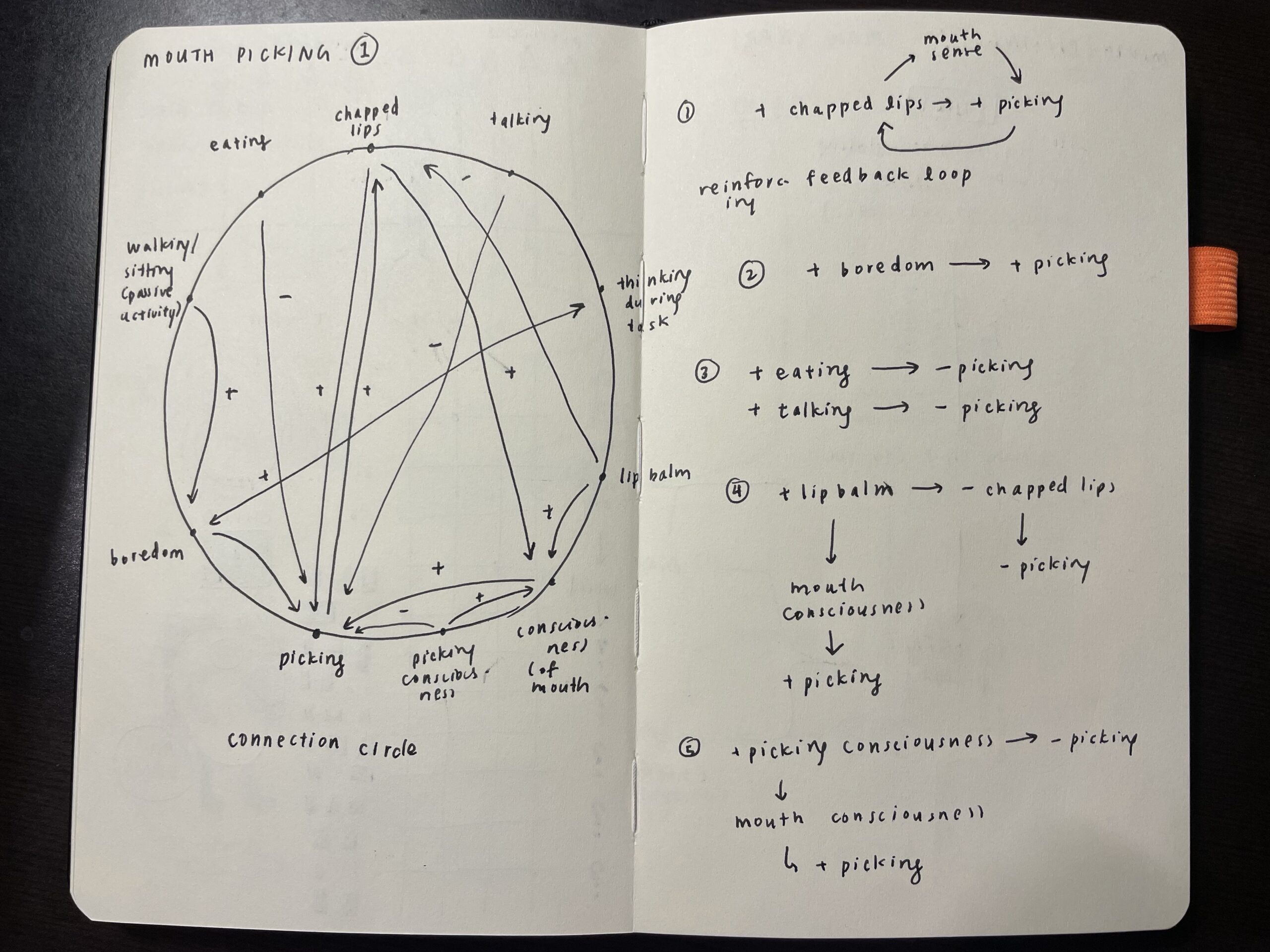
Fig 1. Connection circle.
This connection circle models various feedback loops and connections between different aspects of picking, and trying to deduce causality — but I think it’s a poor representation of the behavior, since the behavior doesn’t have obvious triggers. There are some useful things though, like the chapped lips -> picking -> chapped lips loop, which seems like an obvious point of intervention. “Picking consciousness” was also a factor in this model because I noticed that noticing made me pick more … which doesn’t help, say, mindfulness’s case in this regard.
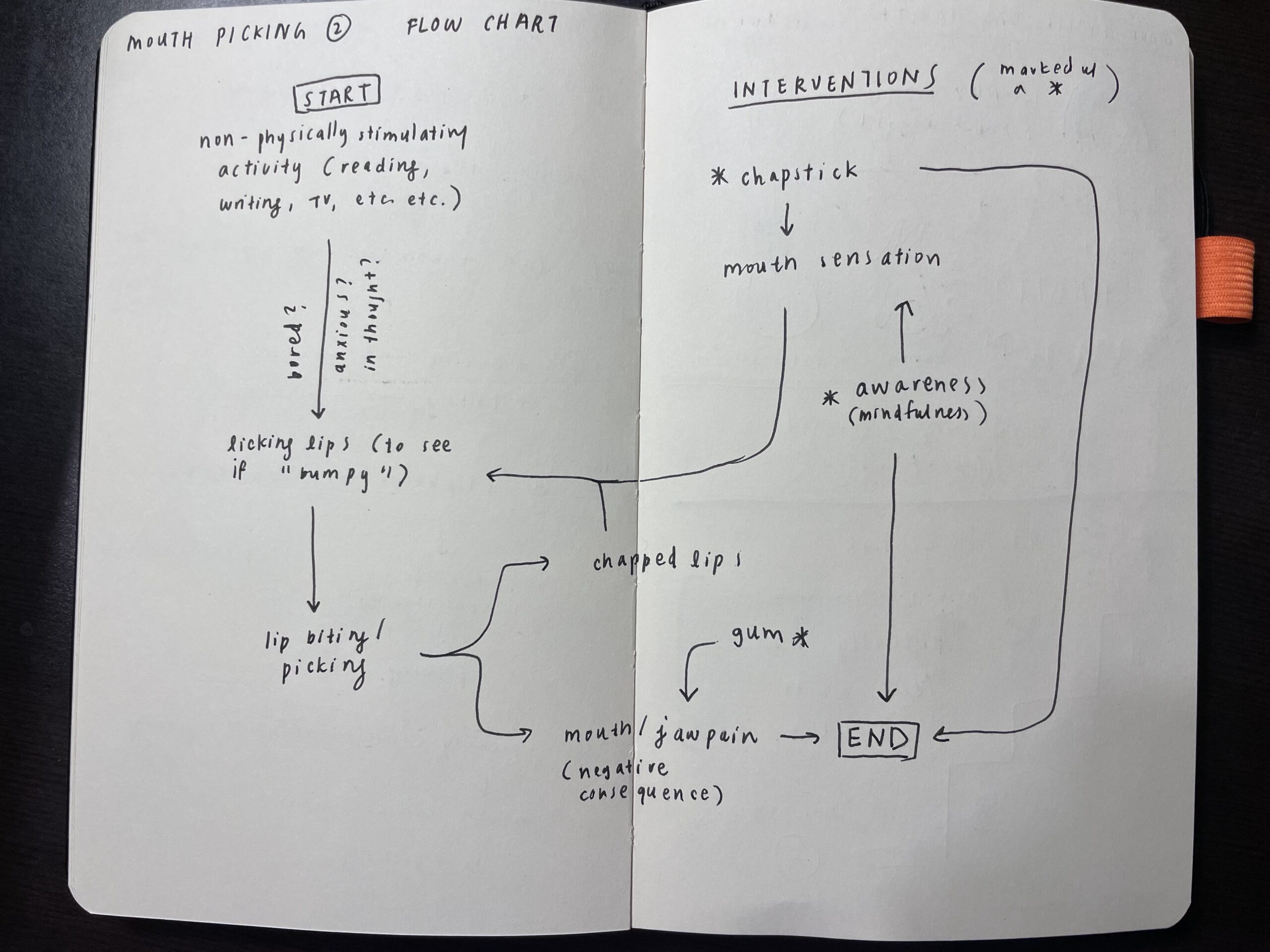
Fig 2. Flow chart.
The second model I produced is a flow chart, which I think models this process more. It starts from any non-physically stimulating activity (can’t bite my lips when I run, for example) and starts up the “biting” loop. First, I check to see if my lips have obvious bumps or imperfections on them, and then I start the process — either that results in chapped lips, which means I bite more, or it results in jaw pain (from biting too much). When it starts hurting, I stop. There are various interventions that help — for example, chapstick — but sometimes they also backfire. The second is mindfulness or gum, but being conscious of it at all indeed often backfires. What is needed in this case is actually, maybe just a retreat into naivety, into the before-times when picking wasn’t at the forefront of my mind; it isn’t a big enough problem for me that it warrants getting rid of altogether.
The final results are attached: