
Miro Link: https://miro.com/app/board/uXjVGMbhjMI=/?share_link_id=376431413127
For better image access ^ –> please use the miro link above
- Description of Intervention Study
We conducted a 7-day intervention study with six participants who reported irregular sleep schedules. Most participants either went to bed after 11:00 PM or had bedtime variability greater than 45 minutes. The main goal of the study was to test whether a personalized, human-like “sleep companion” could improve sleep consistency and encourage earlier bedtimes compared to typical reminder systems.
Each participant identified their main sleep challenge, such as phone scrolling, stress, or procrastination. They completed a daily sleep diary where they recorded their bedtime, estimated sleep time, wake time, naps, and sleep quality. In addition, they received personalized text messages from a “virtual teddy bear” designed to feel supportive and conversational rather than clinical. These messages were meant to provide encouragement and accountability throughout the day.
At the end of the week, participants completed a short survey about their experience. On average, they rated the intervention 4.17 out of 5 for improving sleep consistency. Two-thirds reported that they slept more consistently during the study. Enjoyment averaged 3.83 out of 5, suggesting that while the experience was generally positive, there is room for improvement.
Overall, the results suggest that a supportive, human-centered approach may help improve sleep consistency in the short term. However, the findings are based on self-reported data and a small sample size, so further testing is needed.
- Key Insights
One key insight was the role of accountability. Several participants mentioned that being able to “talk to someone” or feel supported made it easier to stay motivated. The emotional aspect of the interaction seemed to matter more than simple reminders. This supports the idea that human-like engagement can influence behavior.
Another important insight was the need for better timing. Some participants felt that reminders did not always come at the most helpful moments. This suggests that personalization should include not only tone but also timing that adapts to a person’s schedule.
We also noticed some tension around using phones for delivery. A few participants did not enjoy having to check their phone for reminders. This reinforces the concern that screen-based systems may unintentionally contribute to late-night phone use.
Participants also pointed out that workload and stress affected their sleep. This suggests that reminders alone may not fully address sleep inconsistency. Broader lifestyle factors play a significant role.
Finally, some participants expressed interest in a longer study period. A one-week intervention may show short-term improvement, but it does not reveal whether the behavior change would last over time.
- Design Changes
These findings suggest several improvements to the solution. First, the design should rely less on phone-based messaging. A physical teddy bear companion with simple cues such as soft light or gentle sound may better support earlier bedtimes and reduce screen use.
Second, the system should use adaptive timing. Instead of sending fixed reminders, it should adjust based on the user’s goals and recent sleep patterns. This would make the companion feel more responsive and relevant.
Third, personalisation should include practical strategies, not just supportive language. For example, the companion could suggest placing the phone away from the bed or guide short relaxation exercises.
Fourth, adding brief sleep tips or structured routines could increase value for users who want more guidance.
Finally, future studies should compare the companion directly to traditional sleep apps and include longer testing periods. Using more objective measures, such as bedtime consistency, would strengthen the evaluation.
Overall, the study reinforces the core idea that emotional, human-like support may play an important role in improving sleep consistency.
System Path
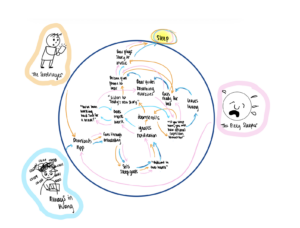
Process & Insights
The system path diagram was created by tracing how all three personas (The Screenager, Always in Huang, and The Picky Sleeper) move through a unified nightly routine using the Teddy Bear solution, diagramming shared touchpoints. The thought process involved identifying the common entry point (downloading the app and going through onboarding) and the universal goal (sleep), then mapping the messy middle where each persona’s distinct barriers and needs create different pathways through the same system. While the core features (Bear guides, breathing exercises, app notifications, sleep goal setting) are shared infrastructure, each persona engages with them differently based on their primary sleep barrier. The key insight from this mapping was recognizing that “Does more work” vs. “Listen to Teddy’s new story” vs. “Ignored notifications” are predictable persona-specific responses that our system needs to gracefully accommodate rather than fight against. For instance, Always in Huang will inevitably choose work over sleep some nights, so the Bear’s response shouldn’t be scolding but rather helping her make an informed decision (“If you sleep now, you’ll have 6 hours”) and offering compressed wind-down when they eventually do go to bed. The circular flow with multiple feedback loops (“Downloads app” → “Goes through onboarding” → “Does more work” → back to notifications) highlights the ongoing support system that meets users wherever they are in their nightly decision-making, whether that’s 9 PM or 2 AM. This insight validated our design choice to make the Teddy Bear adaptive and non-judgmental.
Story Map
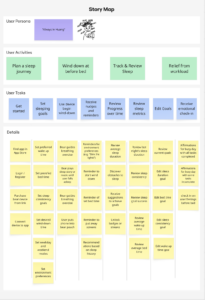
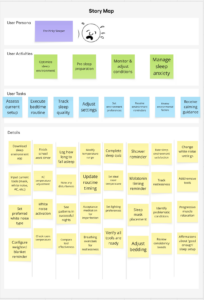
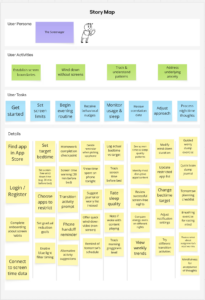
Process & Key Insights
“Always In Huang” is a college student perpetually overwhelmed by coursework, whose sleep suffers from their inability to wind down and disconnect. Mapping her journey revealed four core activities: planning a sleep journey, winding down before bed, tracking and reviewing sleep, and getting relief from workload stress. We found that these aren’t four separate needs, they’re a sequential nightly routine. Our solution needs to support each phase of that routine rather than only one.
The most important insight we discovered was the centrality of the wind-down phase. The density of user tasks in that column told us that the moment before sleep is where our intervention has the most leverage. Users aren’t failing to get good sleep because they lack data about their sleep; they’re failing because they struggle to transition out of their busy day. This reframed our solution away from being primarily a tracker toward being primarily a wind-down companion, with tracking as a supporting feature rather than the core one.
The second insight was the importance of emotional scaffolding alongside behavioral nudges. The “Relief from workload” activity and the affirmations column showed that users need acknowledgment of their stress, not just instructions to sleep. The bear can’t just be a timer. It needs to meet the user where they are emotionally before it can help them.
“Screenager” is a user who struggles with screens at night. We organized the experience into four main activities: setting screen boundaries, winding down without screens, tracking patterns, and addressing anxiety. By breaking this into small tasks — like setting a target bedtime, receiving screen warnings, logging actual sleep times, and reviewing screen-time data — we were able to see exactly where the breakdown happens. The most critical window is the 30–60 minutes before bed. That is when good intentions often collapse into scrolling.
One key insight was that willpower is not the real problem — friction is. If the phone is still in hand, the user will likely stay on it. So the solution must step in at that exact moment with gentle nudges and structured alternatives. Another insight was that users need visible proof that their behavior matters. If they cannot see how screen time affects sleep quality, they lose motivation. We also realized that anxiety is deeply connected to screen use. Many users scroll because they feel restless or overwhelmed, so removing the screen without offering emotional support would fail.
These insights directly shaped the MVP. Sleep goal setting came from the need to create clear, personalized boundaries. The wind-down routine became the core behavioral intervention — replacing scrolling with guided breathing, reminders, and calming prompts. Nudges and reminders reflect the idea that small, timely interventions matter more than strict rules. The alarm and morning check-in create a consistent loop while keeping logging simple. The sleep dashboard and goal tracking give users visible feedback, and emotional check-ins ensure the app supports how users feel, not just what they do.
“The Picky Sleeper” is someone who cares deeply about their sleep conditions and routine quality. We organized the experience around optimizing the sleep environment, preparing before bed, monitoring patterns, and managing sleep anxiety. Mapping out details like adjusting temperature, choosing white noise, tracking disturbances, and rating environment satisfaction helped us see that this user struggles less with discipline and more with comfort and control.
A key insight was that this user wants predictability. Small disruptions — lighting, temperature, bedding, restlessness — feel amplified at night. We also noticed that tracking needs to go beyond hours slept. For this persona, understanding why sleep felt off is just as important as how long they slept. Another important insight was that perfectionism can increase anxiety. When users try to create the “perfect” setup, they can spiral if something feels slightly wrong. This means the product must not only support adjustments, but also reduce pressure and normalize imperfection.
These insights also led to the MVP features. Sleep goal setting helps stabilize rhythm and create structure. The wind-down routine supports preparation and lowers restlessness before bed. Nudges and reminders help users begin their routine on time and feel ready. The alarm and morning check-in anchor the sleep window and capture reflection with minimal effort. The sleep dashboard and goal tracking support experimentation and pattern recognition. Emotional check-ins are especially important here, helping users feel reassured rather than judged as they work toward better sleep.
MVP App Features
-
- Sleep goal setting: users set their target bed time, wake time, and weekday/weekend preferences. This is the personalization layer that makes everything else feel tailored rather than generic.
- Wind-down routine: guides users through breathing exercises, reminders for limiting screen time and turning off the lights, plays sleep audio. This is initiated by the bedtime reminder. This is the core behavioral intervention and the feature most unique to your solution.
- Alarm: Sets the wake-up time, triggers a morning check-in, and passively captures the bookends of the user’s sleep window without requiring manual input.
- Morning check-in: surfaces at alarm dismissal to capture sleep quality, duration, and stress. Keeps logging frictionless by meeting the user at a moment they’re already in the app.
- Sleep dashboard: visualizes self-reported sleep data over time, showing trends in duration and consistency. Gives users a reason to keep engaging and gives your study meaningful outcome data.
- Sleep goal tracking: users can visualize their self-progress over time, learning how well they are accomplishing their goals. This also helps users understand in which ways they can improve their sleep habits to hit their goals.
- Edit goals: based on progress reports and feedback, users can edit their stated sleep goals if they are making progress and want to set more advanced goals, or if they need to scale back their goals to make them more realizable.
- Nudges and reminders: helps reminder users of their daily/nightly goals as well their time to wind down, put down phones, get in bed etc. Helps create a gentle way to keep users on track and holds them accountable for their goals.
- Emotional check-ins: provide periodic check-ins on user’s emotions, general feeling about their progress, and overall feelings. Provides a way for users to feel comforted in the process and guided by the app.
Bubble Map
Process
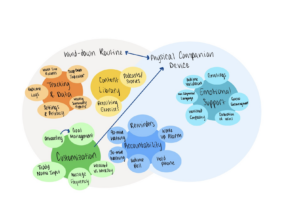
The bubble map was constructed by first identifying all the functional components of the Teddy Bear solution across both the physical device and mobile app, then organizing them into thematic clusters based on user activity rather than technical architecture. Bubble sizes were determined by weighing three factors: time spent interacting with the feature, its strategic importance to our unique value proposition, and the density of sub-features it contains. This revealed that the Wind-Down Routine and Physical Companion should dominate the map despite traditional sleep apps centering on tracking and analytics. The spatial relationships between bubbles reflect both user workflow (onboarding feeds customization, which personalizes the companion experience) and our core hypothesis that emotional attachment to a physical object enables behavioral accountability in ways that purely digital reminders cannot.
Insights
The bubble map reveals that our solution operates on a fundamentally different architecture than traditional sleep apps.
- The Wind-Down Routine emerges as the largest bubble not by accident, but because it represents the critical intervention moment where behavior change actually happens. Our personas helped validate our core hypothesis that users don’t fail to sleep well because they lack sleep data, but because they struggle to transition out of their busy day. This insight reshapes our entire value proposition: we’re not building a tracker that happens to provide comfort, we’re building a companion that happens to collect data.
- The Physical Companion Device bubble sits as one of the largest on the map highlighting that the teddy bear isn’t just a cute product but invokes the structural innovation that enables emotional attachment, reduces phone dependency, and creates physical accountability in ways a purely digital solution cannot.
- The Emotional Support cluster rivals traditional functional features in size and importance, supported by numerous small bubbles that collectively build the relationship users need to actually follow guidance.
- The map also exposes a critical dependency chain: Onboarding & Setup feeds Customization, which personalizes both the Physical Companion and Emotional Support, which together power the Wind-Down Routine, which generates Tracking & Data, which informs Accountability & Reminders.
Perhaps most tellingly, the clustering reveals that our solution requires orchestrating seven distinct functional areas (onboarding, physical device, wind-down, content, tracking, emotional support, and accountability) into a cohesive nightly ritual, which explains both the complexity of building this intervention and why no existing sleep app has successfully replicated this approach. The bubble map ultimately validates that we’re solving the right problem—not “how do we track sleep better” but “how do we help stressed, phone-addicted users actually wind down.”
Assumption Testing
Assumption Test 1: People Will Accept and Feel Comfortable with a Talking Sleep Companion
WE BELIEVE THAT
We believe that college students and individuals with inconsistent sleep schedules will feel comfortable having a talking teddy bear in their bedroom and will not perceive it as childish, intrusive, or socially embarrassing.
TO VERIFY THAT, WE WILL
Conduct surveys and short concept-testing interviews with potential users, presenting them with visuals and a clear description of the talking teddy bear prototype.
AND MEASURE
Measure comfort level on a Likert scale, willingness to place the device in their bedroom, likelihood of long-term use, and qualitative concerns about privacy, embarrassment, or dependency.
WE ARE RIGHT IF
A majority (e.g., >70%) report moderate to high comfort (4 or 5 out of 5), and major concerns raised are minor or solvable through simple design adjustments.
Assumption Test 2: Users Will Respond to and Follow Guidance from a Humanized Agent
WE BELIEVE THAT
We believe that people are more likely to listen to and follow bedtime guidance when it is delivered by a humanized, emotionally supportive agent rather than a neutral, app-style reminder.
TO VERIFY THAT, WE WILL
Run a controlled comparison where participants receive bedtime prompts framed either as generic reminders or as messages from a personalized “sleep companion,” and observe differences in response and behavior.
AND MEASURE
Measure immediate compliance (did they go to bed within 30 minutes of the prompt), changes in self-reported belief or motivation after interaction, perceived trust, and perceived emotional support.
WE ARE RIGHT IF
Participants show higher compliance rates, higher trust scores, and stronger motivation ratings when prompts are framed as coming from a humanized companion.
Assumption Test 3: Users Will Form Emotional Attachment to the Companion
WE BELIEVE THAT
We believe that college students and individuals with inconsistent sleep will form a meaningful emotional connection or sense of attachment to a humanized sleep companion, and that this attachment will increase their willingness to follow its guidance.
TO VERIFY THAT, WE WILL
Conduct short-term prototype testing using a low-fidelity physical teddy bear paired with scripted or Wizard-of-Oz interactions that simulate personalized, emotionally supportive dialogue over several consecutive nights.
AND MEASURE
Measure perceived emotional connection (using attachment and companionship scales), frequency of voluntary interaction with the bear, likelihood of naming or personalizing it, perceived accountability, and willingness to continue using it after the study.
WE ARE RIGHT IF
Participants report moderate to high emotional connection (4/5 or above), demonstrate repeated voluntary engagement, and indicate that the sense of companionship influences their bedtime decisions.
Assumption Test 4: The app and Bear will not compel users to access their phone more before bed
WE BELIEVE THAT
We believe that college students will not be more likely to use their phones for an extended period before bed while interacting with the bear and any setup in the app required before bed.
TO VERIFY THAT, WE WILL
We will run a short study to measure self-reported phone time with a low-fidelity prototype of our app to gather data on phone usage before bed time both related and unrelated to usage of the prototype.
AND MEASURE
Measure baseline phone usage before bed and track both total phone usage during the night period as well as total phone usage required to interact with the app prototype before bed.
WE ARE RIGHT IF
If users report that little phone setup or usage of the app was required during their nightly routines and that their baseline phone usage did not increase while interacting with the prototype.
Assumption Mapping
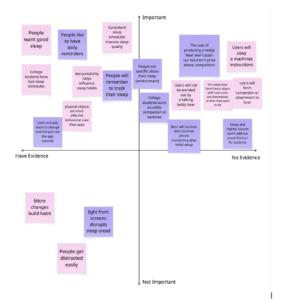
The three most critical unvalidated assumptions in our intervention are identity fit, emotional attachment, and user compliance. These three assumptions form a single chain of dependency.
For the intervention to work, users first need to genuinely connect with the bear as an object. Our hypothesis is that a warm, personalized companion with its own personality is inherently more inviting than a sterile app or device, and that this distinction is what makes someone want to bring it into their most private space. From there, sustained physical proximity needs to develop into real emotional attachment, because attachment is the mechanism that makes the final link possible: a user who has bonded with the bear is far more likely to actually follow its guidance than one who sees it as just another piece of technology or an expensive bedside decoration.
This chain is what distinguishes our solution from a standard sleep app. The physical, characterful form factor is our core design hypothesis. If we can validate that a personalized, friendly companion builds the kind of relationship that a phone simply cannot, we have evidence for something genuinely novel in the behavioral intervention space.



