
Assumption Test 1: Gamification of AI use can reduce poor AI prompting
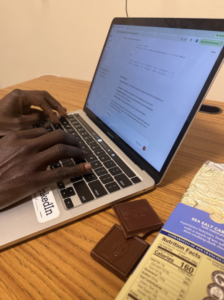
We believed that students who receive real-time, gamified feedback on their AI prompts will become more intentional about how they use AI. To test this assumption, we ran a live AI use session with two of our Stanford friends who are students who use AI from day to day. We picked these participants because they were people we knew, and they would be comfortable using AI whilst having us look at how they were prompting it, without feeling like they were being watched or having the need to change the way they would normally use AI. We were evaluating their AI prompts and rewarding them with chocolate when they had a good prompt and took the chocolate away when they had a bad prompt. We also asked the two participants about their motivations to start using AI more intentionally after we finished the assumption test.
Here is the Test Card:
Gamifying AI
- We believe that gamifying intentional AI use will make poor AI use less desirable.
- To verify that, we will monitor one AI use session in person and provide visual/verbal feedback in a game format.
- We will measure participants’ motivation to use AI less, before and after, and the participants’ enjoyment of the AI game session
- We are right if participants are more motivated to use AI less and they enjoy the game session
Game:
- Moderator watches user and evaluates their prompts in real time – they are given 10 pieces of chocolates to begin with
- If a user inputs good prompt, moderator cheers them on with another piece of chocolate
- If a user inputs a bad prompt, the moderator takes away a piece of chocolate.
Here are the results:
All three participants also noted that the exercise was interesting, but that after sometime it felt uncomfortable to have a moderator looming over them. As for our product, the idea being interesting is a good signal that shows that users will want feedback on how they are using AI, but they also want privacy. This is good because our extension will be able to provide both of these, as once opened it will always be there to provide visual feedback as well as we won’t be keeping their data on what they use the AI for on our database. As for the chocolate reward system failing, this means that we need to implement a reward system that is richer, like have streaks, badges, and better analytics that build overtime unlocking new rewards.
Learning Card:
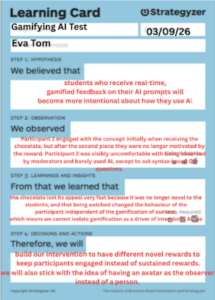
Image of Test #1:
Assumption Test 2: Users would have greater empathy with Barry the Brain
Our team wanted to test what type of visual representation (specifically to show the user’s progress) users prefer when using our AI brainrot app.
We hypothesized that users would feel more attached to an avatar-based indicator (specifically Barry, the brain avatar) compared to more traditional indicators like progress bars or percentages.
To test this, we showed participants three different visual representations of progress and asked them to rate each one from 1–10 based on how appealing they found it.
The three indicators were:
- Progress Bar
- Percentage Indicator
- Barry the Brain
Participants were asked: “Assume you are using an app that tracks your progress. Which visual indicator do you prefer? Please rate each one from 1–10.” After rating each visual indicator, we also asked follow-up questions to understand why they preferred certain designs. Our assumption would be validated if Barry ranked among the highest across participants.
Participants Recruited
We recruited three Stanford students who regularly use AI tools like ChatGPT, Claude, or Cursor. Two of the participants are heavy AI users, meaning they use all three of the mentioned tools for at least 3 hours/day. One of the participants uses only ChatGPT for around 20 minutes/day.
We chose these users because they are seeking changes to their AI usage and are also very open to trying new apps and ideas to accomplish their goals, meaning their feedback would reflect product usage rather than hypothetical “what ifs”.
Results
Participant 1: Pratham H.
AI Usage: Heavy
Ratings:
- Progress Bar: 7
- Percentage: 5
- Brain Avatar: 9
Qualitative Feedback: “The brain felt a lot more motivating because I was able to see what happens to it when I start using AI poorly versus when I use it well. Kind of interesting to see how it could change in real time. It might actually affect my behavior, but the percentage tells me close to nothing.”
Participant 2: Robby M.
AI Usage: Heavy
Ratings:
- Progress Bar: 6
- Percentage: 4
- Brain Avatar: 8
Qualitative Feedback: “The avatar definitely is more engaging than the other two options but don’t know how much it’ll change my behavior. It reminds me of the dying tree app that some people use. I can see how some people would get attached to it, but maybe I’m not one of them?”
Participant 3: Anant S.
AI Usage: Light
Ratings:
- Progress Bar: 5
- Percentage: 5
- Brain Avatar: 9
Qualitative Feedback: “The brain isn’t even close to the percentage or progress bars. It definitely beats them by a mile. Seeing the eyes and smile and everything is so, so much better. Definitely recommend that you keep that”
Overall Average Statistics:
- Progress Bar: 6
- Percentage: 4.67
- Brain Avatar: 8.67
Final Synthesis
Across the three participants, the Barry the brain ranked as the most engaging visual representation of progress.
Users reported that the avatar:
- Felt more motivating
- Carried more emotional weight for them
This suggests that users may prefer progress indicators that represent emotional appeal rather than simple numerical progress.
However, one insight was that some users still liked traditional indicators alongside avatars, meaning a hybrid design may, in fact, be ideal here.
Learning Card:
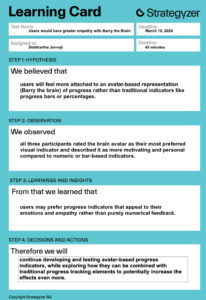
Image of Test #2:
Assumption Test #3: An avatar on the AI platform will make users feel more self aware.
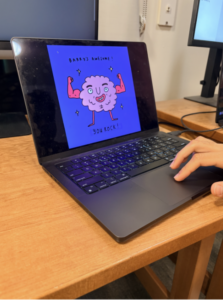
Our team wanted to test whether the presence of an on-screen avatar would change how test participants behaved when using AI. Specifically, we wanted to understand whether a brain avatar placed on the screen would make users feel more judged, and whether this feeling would nudge them to use AI more intentionally and ethically.
Drawing from our baseline and intervention studies and general understanding of human behaviors, we hypothesized that participants will act more carefully if they have a brain avatar present on the screen. We thought that this perception of being observed might make them more self aware about the kinds of prompts they entered and the way they relied on AI.
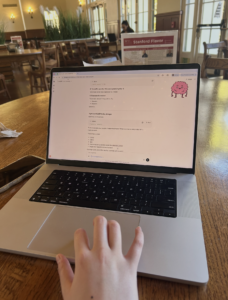
To test this, we asked participants to complete a brief 10-15 long AI use session while a small brain avatar prototype remained in the corner of their window. Participants were told that the avatar was tracking their AI usage, even though the prototyped avatar did not actually record or analyze their behavior. During the session, we observed their reactions, body language, trends and changes in prompting behaviors, and verbal feedback and compared it to their actual AI use patterns based on previous students and interviews. Our assumption would be validated if participants appeared more self aware and if their prompting behavior changed in an intentional direction.
Participants Recruited:
We recruited 3 Stanford students who are day to day users of AI tools such as ChatGPT, Claude, or Gemini. These participants were chosen because they (a) use AI everyday as part of their existing workflows and (b) have participants in at least one of the baseline synthesis study and the intervention study. We predicted that these individuals would be able to reflect more clearly on their behavior given their consistent past AI use, and because we already had a solid understanding of how they typically use AI in a normal setting.
Results:
Participant 1: Isaias M.
AI Usage: Medium to heavy user; uses AI numerous times a day for academic and personal purposes.
Observed Behavior: Isaias had a rather laid back body language, but he occasionally looked at the brain avatar and even clicked it twice. However, as we proceeded through his typical workflow, he did not appear to change his behavior due to the feeling of being “watched” by the brain avatar.
Qualitative Feedback: “Am I able to see what data this brain collects?”
“I have a really busy week and I’m strapped for time so I am just going to do an assignment like I usually would.”
“I guess this could be cool if I get feedback from the brain in real time but I don’t see anything on this version.”
Participant 2: Kristine M.
AI Usage: Medium user; uses AI several times a day, primarily for academic purposes. She specified that she uses it for rigorous quantitative classes rather than writing and creativity based tasks.
Observed Behavior: Kristine was fairly aware of the brain avatar being present on the right side of her screen and repeatedly asked questions about what the brain does and whether it was tracking her usage. She indicated that she did not want to get a bad AI usage score, and she carefully thought through how to construct prompts that best suited her intention of learning and understanding the material comprehensively.
Qualitative Feedback: “Wait, why does this actually make me feel like it’s watching me use ChatGPT”
“Now I feel like I should be using AI properly. I’m nervous I’m going to mess up something and the brain gets mad.”
Participant 3: Diego L.
AI Usage: Casual user, usually for homework or personal projects
Observed Behavior: While observing as Diego submitted his prompts, I could see his eyes periodically glancing at the brain to see if its expression changed. He also asked various questions about how the brain would be judging him, expressing that he wanted to be judged favorably.
Qualitative Feedback: “Now that I knew someone was watching and judging my prompts, I felt more guilty if I wanted to ask for direct answers”
Learning Card:
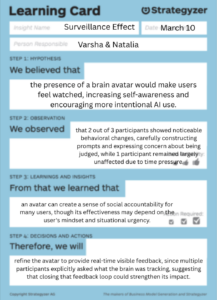
Image of Test:
Final Insights for Test #3:
Across all three participants, the presence of the brain avatar created a noticeable sense of being observed and judged.
Users reported that the avatar:
- Made them feel accountable for how they used AI
- Motivated them to construct more thoughtful, intentional prompts
- Sparked curiosity about what data was being tracked
This suggests that an avatar-based observer can meaningfully shift user behavior toward more ethical AI use, even without any real tracking functionality.
However, one key insight was that the effect varied based on individual mindset, users under time pressure were largely unaffected, meaning the avatar may work best when paired with actual real-time feedback to sustain engagement across different user types.



