
Intervention Study Synthesis
Assumption Mapping and Testing
Our assumption map:

The highlighted (black box) assumptions, transcribed from left to right:
- target audience is really motivated to stop/reduce their habit
- customers need awareness to use current solutions
- everyone has different severities for skin picking and different solutions that work for them
- solutions are not established in audience’s routine
- need to make a sticky solution that does not rely on user memory
These are the assumptions that are critical parts of the solution we designed, and these were primarily the assumptions we tested in our assumptions tests.
We ran 2 experiments, testing various assumptions: personalization is crucial, solution needs to be cued and habitual. The test designs are shown below, titled “test 2” and “test 3.” We also did “test 1,” testing whether a penalization tactic would be effective as negative reinforcement, or an anti-cue, but the results of the test demonstrate that it wouldn’t be a fruitful method, and therefore we are excluding that test and its results from this synthesis.
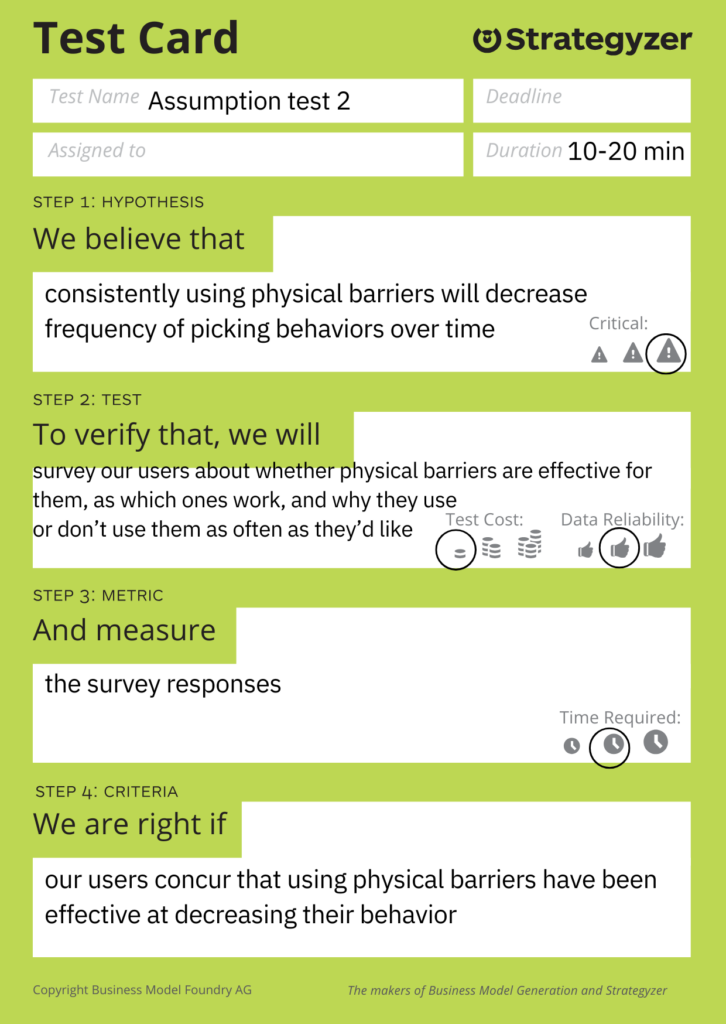
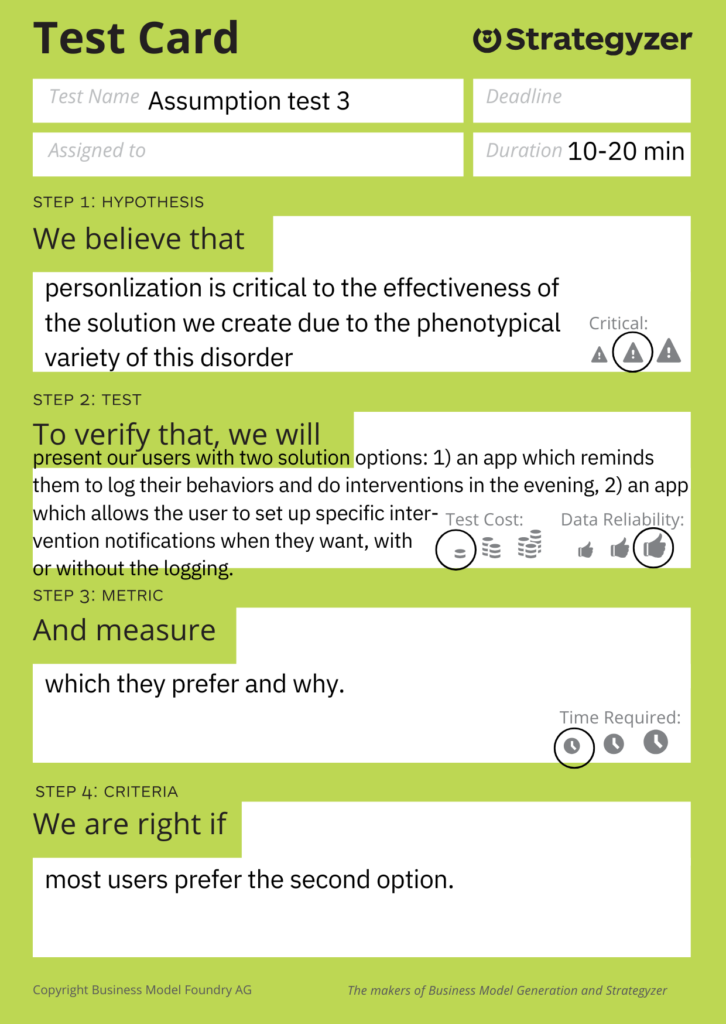
These two tests were run on 3 people, with the results demonstrating that our target audience contains individuals who have solutions that work for them, and the biggest issue they confront is remembering to use them. In other words, our audience lacks the behavioral cues to use the solutions that work for them, and would benefit from habit-building, behavior-cueing solutions.
Test 1 is excluded from synthesis.
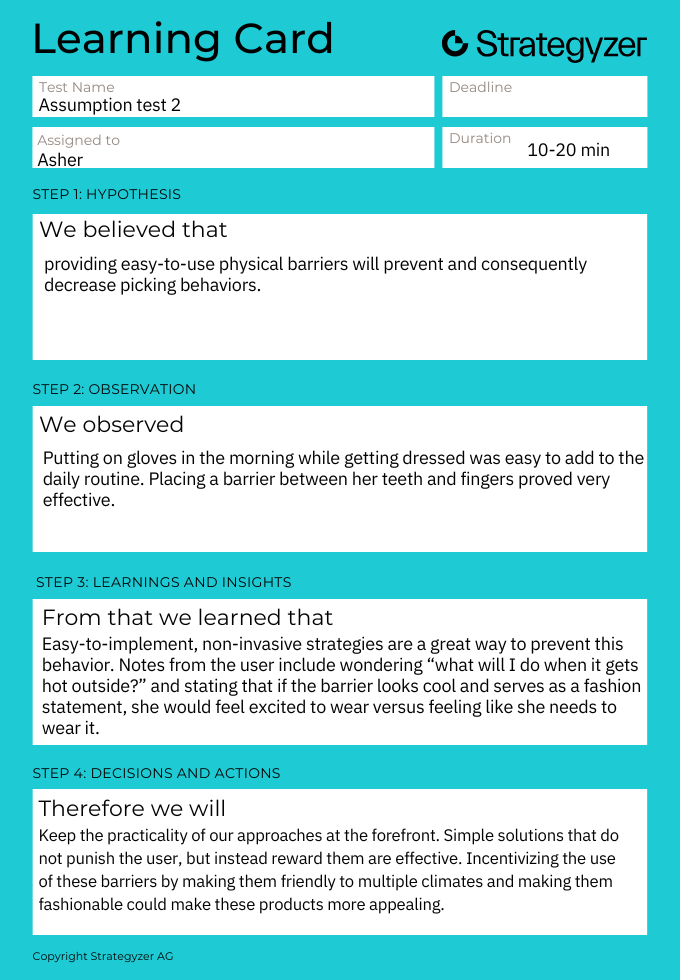
Results of test 2:


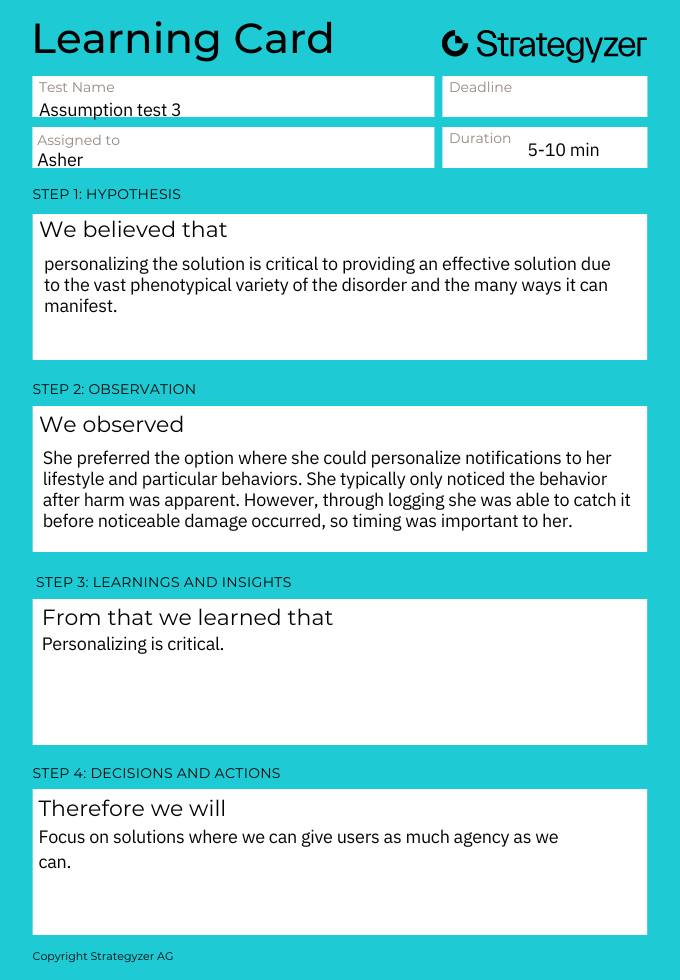
Results of test 3:


Thanks to the results of our assumption tests, we were able to pinpoint a target for intervention that we used in our intervention study.
Intervention Study
From user interviews and assumption testing, we realized that many people who struggle with skin-picking do not necessarily lack effective interventions. Instead, their primary challenge is recognizing their skin-picking behaviors and remembering to apply the interventions that already work for them. Therefore, we designed our intervention to address this issue. Our goal was to determine whether we could successfully remind individuals to use their existing interventions rather than introducing a new, unfamiliar intervention, which might create a higher barrier to adoption.
We recruited five individuals who struggle with skin-picking and already have helpful, personalized interventions. First, we conducted pre-study interviews to identify the triggers for their skin-picking behaviors and determine the most effective format for sending reminder messages. We aimed to personalize both the timing and content of the reminders to best suit each individual’s circumstances. For example, one participant frequently engaged in skin-picking when stressed. To address this, we sent her a message during class—when she was most likely to be stressed—containing two personalized questions. First, we asked her how she was feeling, and then we reminded her not to forget to apply cream, which was her existing and effective intervention. Her task was to reply as soon as possible to report how she was feeling. This approach was designed to make her more aware of her anxiety, thereby helping to mitigate her skin-picking behavior.
We implemented this strategy with five participants over four consecutive days. One of the most interesting findings was that, although it was challenging, some participants were able to respond to the messages almost instantly. Initially, we hypothesized that those who replied immediately would be more likely to apply their intervention. However, our results were surprising—whenever participants saw the reminder, regardless of whether they responded immediately or later, the likelihood of them applying their intervention increased by a similar amount.
Another key insight was that participants appreciated personalized messages and valued knowing that a real person was sending them. They were significantly less likely to ignore messages when they were aware that they came from an actual individual. Additionally, they reported that the optimal number of questions per message was around two; any more than that began to feel burdensome.
These findings will shape the design of our solution. We realized that it is not necessary to send reminders at specific times. As long as participants see the message, they are more likely to apply their intervention.
System Paths

Taking into consideration the effectiveness of personalization from the intervention study, we modeled different personas that have different intervention desires and histories of interventions. We included three personas: two had pre-existing preferences for interventions and one did not. To incorporate these differences, we have an optional step in the onboarding process where new users can choose to browse through a catalog of recommended interventions. Those who already know what interventions work for themselves can skip this step.
Additionally, all personas utilized different interventions to highlight that the efficacy of every intervention may be dependent on the person. We incorporated meditation solutions, free-write solutions, and minigame solutions to highlight the different reasons one may have for skin-picking (release from anxiety, activity to occupy hands, and self-image issues). We derived these solutions from cutting-edge literature about the causes of skin-picking and skin-picking interventions. The most effective solutions, according to current research, are meditation, activities that occupy the hands, and creative writing about skin-picking.
We also took into account the preference for minimal notifications from the intervention study when providing our users autonomy over their notification schedule and by only optionally polling them about the effectiveness of their interventions once a week.
Our main takeaway from this step is catering to the variety of people who will be using this application! The diversity of potential users requires that we include solutions of varying time commitment and mode of action. The ability for our users to customize their own shortcuts is instrumental in our product’s success. We also discussed frequency of check-in notifications to strike the balance between helping our users get the most out of our product and burdening them with required interaction.
Story Maps
View FigJam for better quality images.
We have two story maps for two different personas: Social (Media) Sarah and Road Rage Rachel.
Social (Media) Sarah focuses on an intervention that is closely related to the apps on her phone, in this case social media e.g. Instagram. Skin-picking is related directly to using social media, which we identified in our diary study as a context in which anxiety can increase and people are more idly. We can help the user create a shortcut that intervenes after clicking the app and redirects the user to their specified skin-picking solution. Opening social media can be very subconscious so we want to create an intervention that is sufficiently disruptive to the habit.

Road Rage Rachel focuses on an intervention that is closely related to the context of skin-picking, in this case, the car. Skin-picking occurs frequently when people are idle in the car, as seen in our diary study. Other factors such as traffic, waiting for someone, etc. can make being in the car stressful, as well. We can help the user create a shortcut that intervenes after entering the car context because shortcuts can conveniently identify if a phone connects to the car via bluetooth, maps, Apple Carplay. If the shortcut can’t identify the context, the user can identify times in which they might enter a context (e.g. they drive to work between 7-8am every day). Ideally, we want to remind when the user first enters the car and not while they are driving, for safety reasons.

How did this lead to our MVP features?
For both personas, we want them to be able to set up effective shortcuts for their circumstances, whether the skin-picking intervention is related to apps they use or in the physical/temporal context.
One drawback is that creating shortcuts will take time. Firstly, users have to recognize the contexts in which they skin-pick. Secondly, there might be multiple contexts that they want to intervene in. For the beta version, it would be nice to have a more automated mechanism of creating shortcuts. For example, you could ask AI to create a shortcut based on a more informal prompt about the user’s needs. Or have a more advanced recommendation system where the app suggests shortcut interventions based on user input. For the MVP, we choose to keep the creation of shortcuts in the hands of the user (manual) and only show the user examples of what shortcuts could be (not personalized).
Another drawback is that reminders and interventions can easily be waived / exited by the user. We don’t want users to easily ignore notifications about using their skin-picking solutions, but we don’t want to force users to use the solution. There are effective mechanisms of locking apps until a certain task is done. Or there could be a way for the user to actively engage with the notification in order to remove it, so that they would have to engage with the reminder. However, for the MVP, we won’t design for dsyaffordances where users are locked out of certain apps until they use the skin-picking solution. But, we will design disaffordances where users are interrupted when using certain apps (like social media) and where users actively engage with the reminder for it to go away.
MVP Features:
Our MVP features include a shortcut walkthrough that teaches users how to set environmentally aware notifications, personalized notifications, redirections to other apps for interventions, suggested interventions / shortcuts, and weekly check-ins to provide guidance about selecting interventions.
Bubble Map
Based on our story map, we realized that there are more areas to our solution that just notifying the user to use their skin-picking solution via shortcuts. The 4 areas that we identified include Notifications, Intervention Recommendations, Personal Data, and Shortcut Creation.

Notifications: Our intervention study tested whether notifications would be effective to use skin-picking solutions if it was (1) designed by the user themselves and (2) had an active engagement component where they need to respond to the reminder before it goes away. The notification content will be personal depending on what the user specifies for the context of the reminder; and which skin-picking solution they want to use. Additionally, users should also be able to move the reminder around in the moment if it’s not a good time.
Creation: Users must create shortcuts in order to have effective reminders for their skin-picking solutions. For example, if someone knows that they will start skin-picking while they are anxious on Instagram, the user can set up a shortcut so that they are forced to do a breathing exercise on the calm app. There are many possibilities for what a shortcut could be because it utilizes all the apps you have on your phone. It can be as simple as a reminder to use moisturizer. Because there are a lot of possibilities, we want to guide users with a tutorial on how to use these shortcuts for skin-picking intervention. Users could use shortcut templates to inspire their own shortcut creation. Finally, they should be able to add multiple, edit, and delete shortcuts as they please.
Personal Data: Because we are potentially dealing with sensitive information about skin-picking (e.g. medication, interventions, medical history), we have decided that any personal data will be stored locally and not aggregated. Users will specify what time, at what frequency, and which skin-picking solutions work best for them. Our app wants to recognize what already works for a particular user but will not compare that user to other users. For the MVP, we will discuss having the user be able to indicate whether a shortcut has been effective or not in their intervention process just for the user’s own progress. The beta version of this solution could include more comprehensive uses of their personal data like making shortcut recommendations or automatic watch detection, but we don’t engage in these areas for the MVP.
Recommendations: Recommendations are tricky because we want to be able to give the user ideas for how to use shortcuts for their skin-picking intervention, but we don’t want to suggest interventions that would potentially not work. For the MVP, we want to create a resource library that shows general (not personalized) examples of how shortcuts could be used for skin-picking intervention. We could also show common skin-picking solutions like moisturizer, fidget toys, in-app fidget games, habit recognition techniques, etc. that might help people think about potential solutions. As mentioned above, for the beta version, this solution could have more personalized recommendations based on user input, but we aren’t considering this for now.
Key Insights:
- The 4 areas that we identified include Notifications, Intervention Recommendations, Personal Data, and Shortcut Creation.
- Notifications should be (1) designed by the user themselves and (2) have an active engagement component where they need to respond to the reminder.
- We want to guide users with a tutorial on how to create shortcuts for skin-picking intervention. Users could use shortcut templates to inspire their own shortcut creation.
- Personal data will be stored locally just for the user’s own progress i.e. being able to indicate whether a shortcut has been effective or not in their intervention process
- We want to create a resource library that shows general (not personalized) examples of how shortcuts could be used for skin-picking intervention.



