
This was a great class! I loved learning about why some tactics were more persuasive than others and why some attempts at behavior change are ineffective compared to others. I am glad that I learned many of the ideation tools from the class! However, sometimes I felt like it was more of a challenge to convey the thoughts, ideas, and realizations I had adequately in some of the representations. For example, system models make sense for broad operations that have many moving parts, but I felt like for the purposes of this class, they were more of a burden to conceive than a helpful tool to organize my thoughts. I felt similarly about the pyramid model because I already got an idea of the ins and outs of the whys from our interviews and secondary research. I also found journey maps to be tedious, but they were ultimately helpful because they allowed me to think about the key mechanisms preventing behavior change and eliciting bad behavior. Assumption mapping and tests were fun and felt like one of my favorite tools from this class. Unfortunately, given the time we had to complete them, I feel like our tests weren’t as meaningful as they could have been if we were given more time. I was not completely sold on storyboards until the guest speaker came in and described her experience. The insights gathered from guest speakers always felt very valuable and like some of the most memorable parts of the class. Perhaps if you could get more speakers to come in for each crucial point in the design process and provide their insights about it, it would be easier to see the value of some of the exercises we are doing before we do them. The system map and story map were also helpful to figure out how to support different needs and which needs we should prioritize. I did not like the bubble map because the information layout is not intuitive to me nor does it tie the information together efficiently. I would prefer going to the wireflows and sketchy screens instead.
I was surprised by how effective using drawings to convey my ideas was. I really enjoyed the guest lecture where we learned how to draw stick figures with different expressions because it helps tremendously to organize one’s thoughts.
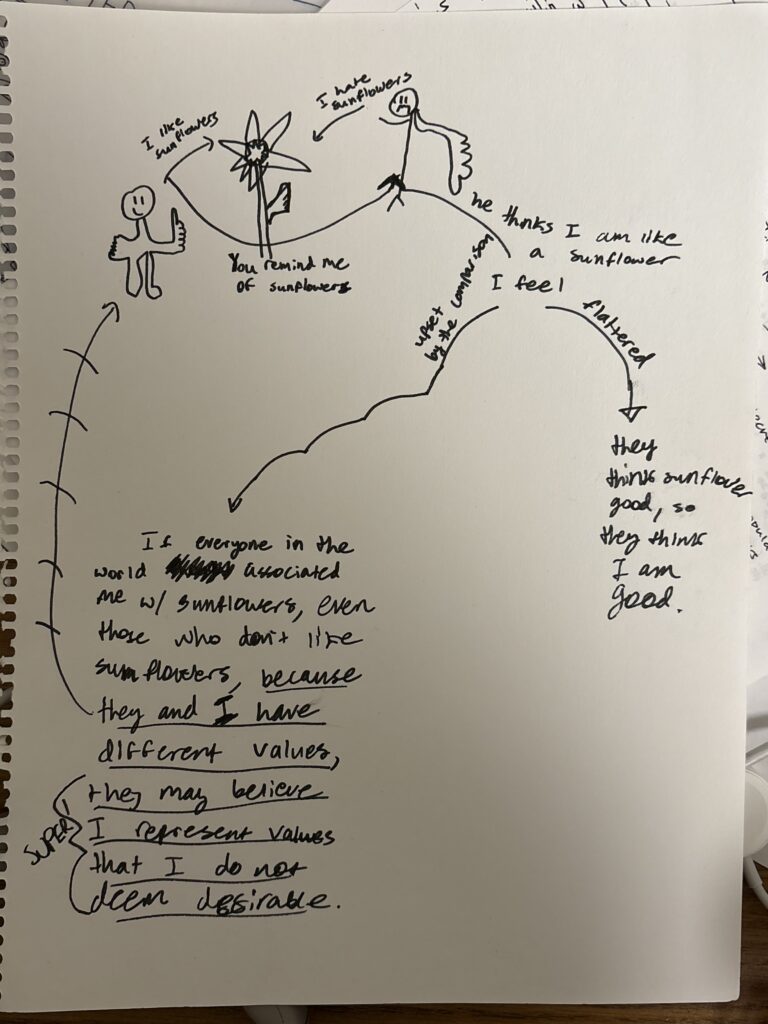
Use of stick figures in example for a discussion with a friend
I feel like I would like to find more effective ways to encourage users. Not only do I want to provide them with the tools they need to prevent themselves from skin-picking, but I would have loved to discover more effective ways to make them feel good about their actions without manipulating them. Perhaps the rewards could be tailored to different people, like completing an intervention unlocks a daily joke or a daily quote from a movie or book. Of course, this would merit further consideration like ensuring our motivators are not manipulative and that our rewards, if they are rooted in taste, satisfy a range of users from different demographics.
My project uses notifications tied to users’ contexts and environments to nudge them to complete a task. Since users fully set these notifications and interventions up themselves to prevent themselves from harming themselves, I deem these nudges acceptable. Moreover, giving them the ability to accept or decline the notifications further increases its acceptability. We don’t make the notifications or completion of the actions enticing by any means. The only form of reinforcement users receive is data that tells them how likely they are to respond to different interventions. If users deem skin-picking as a behavior that is not harmful and feel as if they are being pressured by society to quit skin-picking, this app could potentially be enforcing the expectation that skin-picking is bad.
Right now, all user provided data remains locally in the app and is not collected. In the future, if data were collected to suggest shortcuts more accurately, I could see a development where different companies that make skin barriers try to buy this data or try to incentivize us to push their product on users. To ensure this development does not occur, we could provide a very transparent data policy that is easy for our users to read the minute we begin collecting their data. We could also decline any involvement with any external party. External apps could also try to collaborate with us to make better interventions. This could be a great thing unless they create alternatives that aren’t as effective as the existing interventions and still try to get us to push the product. Perhaps we could provide a ranking of the most effective skin-picking solutions according to users to prevent this kind of thing from happening.
From this class, I have improved my ability to convey my thoughts through visual mediums. I have also learned how much impact every seemingly innocuous design decision can have. Elements ranging from font to color really impact how your users think and feel about your product. Accurately presenting your product is crucial for treating your users with respect and allowing them to make as many informed decisions as possible.
Ultimately, when trying to convince/persuade people in the future, I have more tools in my arsenal to do so. However, I have also learned that this power needs to be used with restraint and with others’ well-being and autonomy in mind. Transparency is key. Perhaps an about section can talk about all the ways my future projects use color theory, incentives, and rhetoric to try to elicit a desired behavior.



