Assumption Map
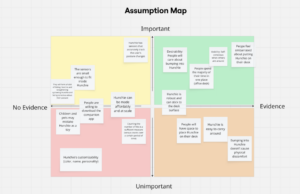
https://miro.com/app/board/uXjVG4Zo9Z0=/
Key Insights
- Social influences
- People may feel self-conscious about bringing a gadget to work
- They fear judgement from their co-workers
- They worry about being seen as immature or unprofessional
- Hardware
- The sensors must accurately capture user hits
- Units must be small, lightweight, and easy to mass produce
- Hunchie must be robust enough to withstand hundreds of hits
- Onboarding Friction and Usage
- Users are willing to download and use a companion app
- Users are comfortable with bringing a physical object with them around work
- Users are willing to undertake the process of setting Hunchie up in their new environment
Based on these insights, we can see that Hunchie’s effectiveness depends on the user’s willingness to bring and engage with a physical object that is visible to others around them. While this element may deter more self-conscious users, it could also provide an opportunity for social monitoring. Our MVP could incorporate a social connection and gamification element that connects Hunchie users in the workplace and normalize the behavior, fostering a community of users who gamify their posture together. Additionally, to address the risk of users forgetting to bring Hunchie with them, the companion app should include habit notifications and onboarding instructions to ensure Hunchie is readily synced and beside the user when they need it.
Assumption Tests
- Assumption: People spend the majority of their work time in one fixed location (office desk).
-
- Test Name: Workspace Environment Audit
- Method: Conduct a “Typical Day” diary log with office workers and remote professionals. Participants will track the various environments for which they complete their work on a typical weekday.
- Questions:
- How many hours of your day is spent at a primary, dedicated work desk? (0-2 hours, 2-4 hours, 6 hours+)
- What alternative places do you go to complete your work? (e.g. couches, bed, cafes)
- Objective: To determine if a static intervention like Hunchie that requires a platform to be set up upon is viable for the modern workforce.
- Success Metric: A finding that more than 70% or more of the target audience spends at least half of their working hours located at a specific desk.
- Assumption: Hunchie is a socially acceptable tool to use in a professional or public environment.
-
- Test Name: Social Friction
- Method: A questionnaire reflection on how users felt about setting Hunchie up at a public location and the reactions of others around them.
- Questions:
- On a scale of 1-10, how self-conscious did you feel having Hunchie on your desk?
- Were you distracted by Hunchie’s presence and worried about how others might react?
- Did any coworkers comment on Hunchie? If so, was the reaction positive, confused, or negative?
- Were there times when you felt compelled to remove Hunchie?
- Objective: To gauge the level of social stigma associated with having a physical posture aid in public.
- Success Metric: Participants reporting that Hunchie’s average level of distraction is below 2/5 and there was very little negative feedback from co-workers and peers.
- Assumption: Users are willing to download and maintain a companion app for Hunchie.
-
- Test Name: App Friction Poll
- Method: Conduct a targeted poll among users who already use hardware gadgets that have a companion app (smart scales, workout apps)
- Questions:
- How many apps do you currently have on your phone that is connected to a physical device?
- If a posture tool is functional without an app, would you still download it to track your progress and data?
- What is the primary reason you delete “companion apps” for hardware?
- On a scale of 1-5, how likely are you to compete with friends on a leaderboard or “Hunchie health score”?
- Objective: To validate if the companion app is useful and attractive to users
- Success Metric: Over 60% of respondents consider data tracking to be a necessary or desirable feature.