
Assumption Map
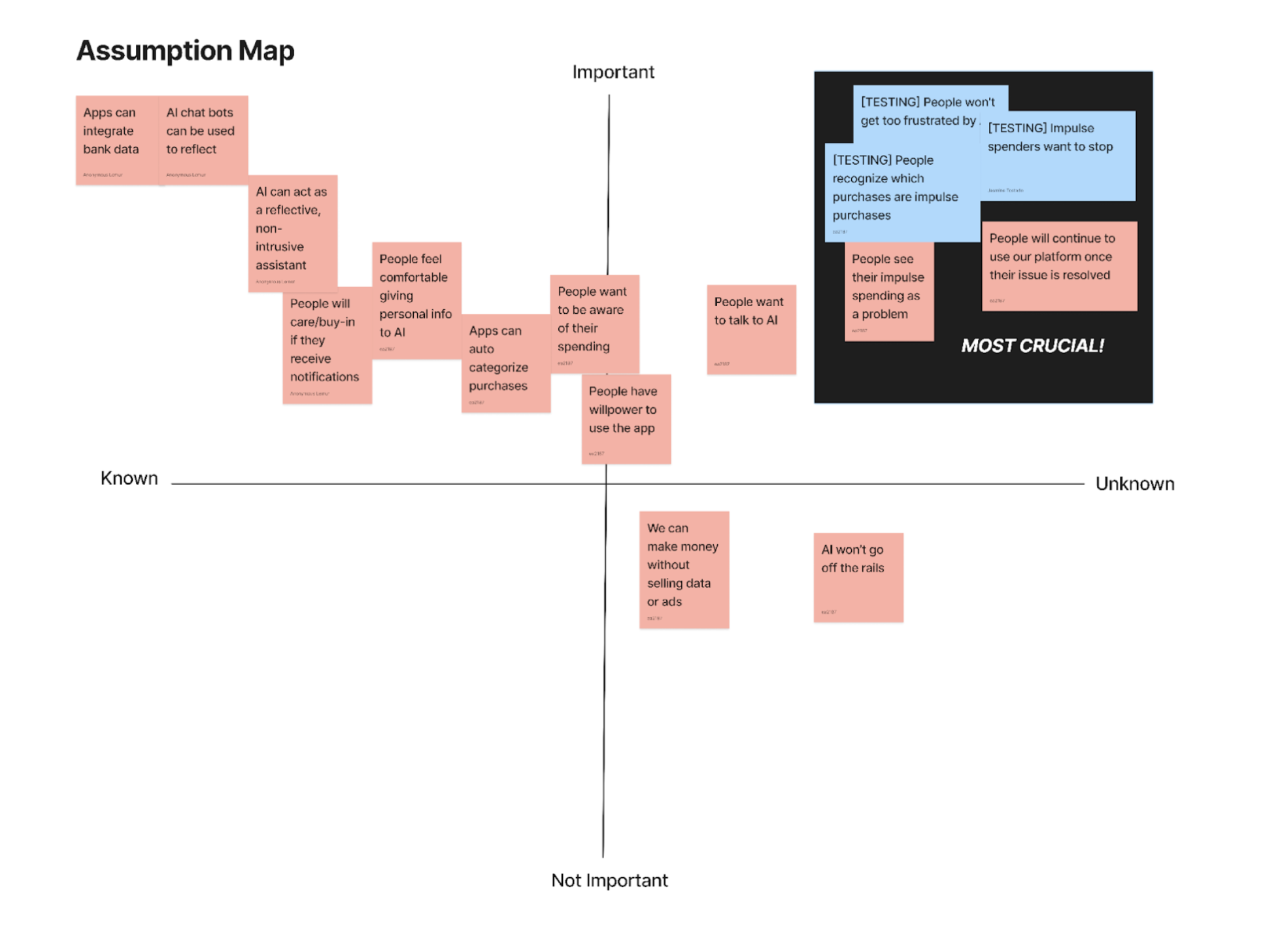
Key Insights from Creating Our Assumption Map
After mapping our assumptions, we realized that the biggest risks in our idea are psychological.
Most of the assumptions in the “most crucial” quadrant relate to whether people actually see their impulse spending as a problem and whether they genuinely want to stop. If users don’t feel internal tension about their spending habits, then the product won’t matter, no matter how well the AI works. This suggests that motivation is the core dependency of the entire idea.
Another key insight is that recognition comes before intervention. If people cannot correctly identify which purchases are impulse purchases, then reflection with AI will not be effective. The product relies on users agreeing, at least somewhat, with the framing of their behavior. If the AI labels something as impulsive and the user disagrees, trust could break down quickly.
We also noticed that frustration is a major retention risk. Even if people want to change, they will stop using the platform if interacting with the AI feels annoying, repetitive, or judgmental. So emotional experience may matter just as much as functional accuracy.
Finally, this map clarified that we are building for a specific type of user: someone who already feels uneasy about their impulse spending and wants to improve. The product likely will not work for users who do not perceive their behavior as problematic.
Overall, the assumption map helped us see that the success of this idea depends more on user psychology and readiness for change than on technical capability.
Designing Assumption Tests
Assumption #1: Impulse Spenders Want To Stop.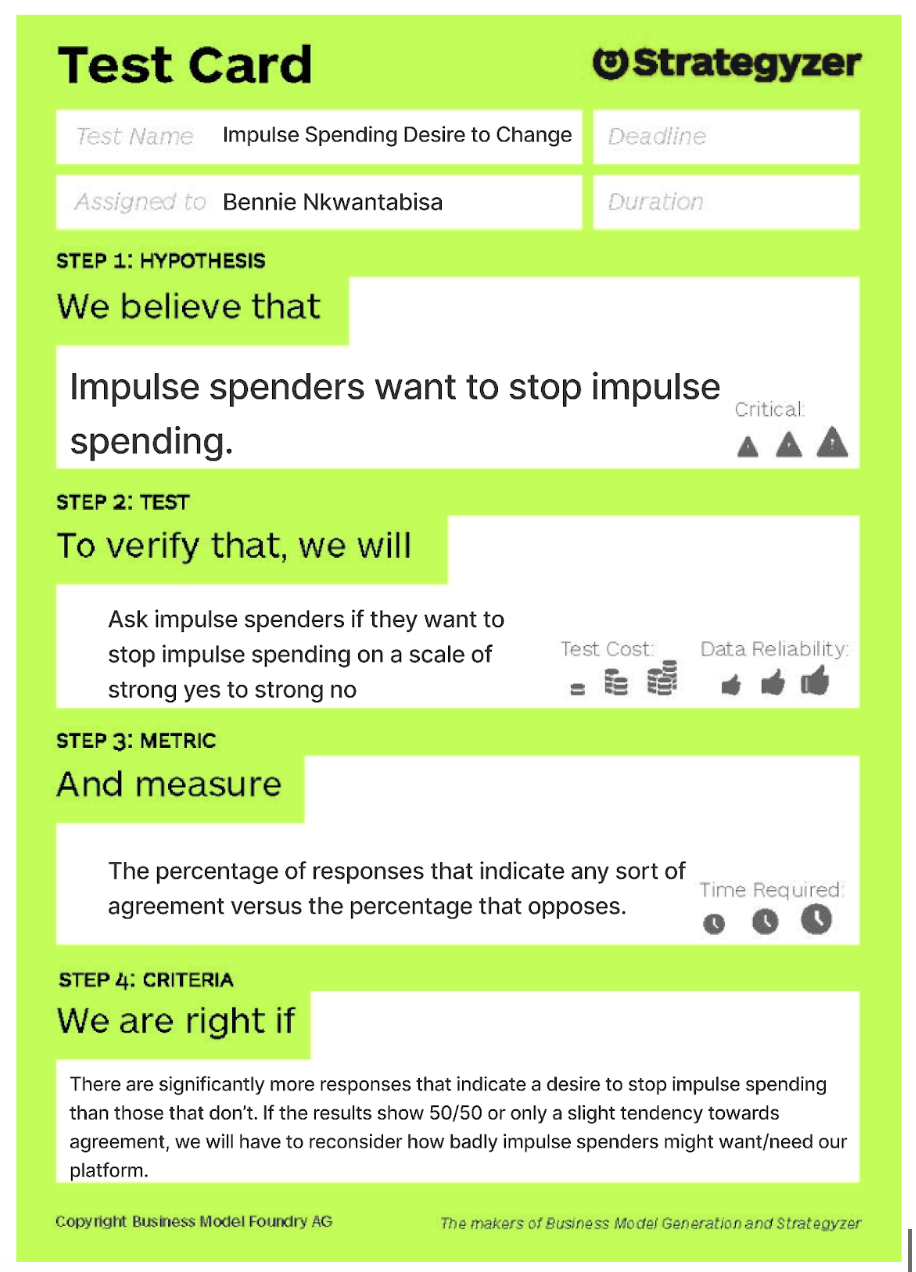
- Why this matters: Because our platform is centered around helping impulse spenders stop impulse spending, it is critical that they actually have a desire to do so; this matters in terms of both discovery and retention since we need the desire to stop to drive users onto the platform and keep them there. Without this assumption being true, the crux of our current approach to financial betterment will need to be redefined.
- Methodology: I plan to ask in as many spaces as I can whether or not, depending on if you consider yourself to be an impulse spender, you want to stop impulse spending. I’ll provide the options of “Yes, Kind of, Not really, & Not at all” to see if providing a range of feelings shows more than a binary response that might fail to capture nuance. If there is time, I’ll follow up with some people who responded with each answer to better understand their reasoning for their selection, and from there, these insights will better inform the validity of the assumption. As far as medium goes, I plan to use the polling features on Instagram, GroupMe, and WhatsApp within the different community spaces I’m a part of.
- Timeframe: Due to the tight turnaround time and the length of polls on Instagram/GroupMe/WhatsApp, I’ll collect responses over 24 hour periods.
- Hypothesis: Because our platform’s current frame relies on this assumption so heavily, I predict that the testing will confirm that assumption is correct.
Assumption #2: People won’t get too frustrated using AI
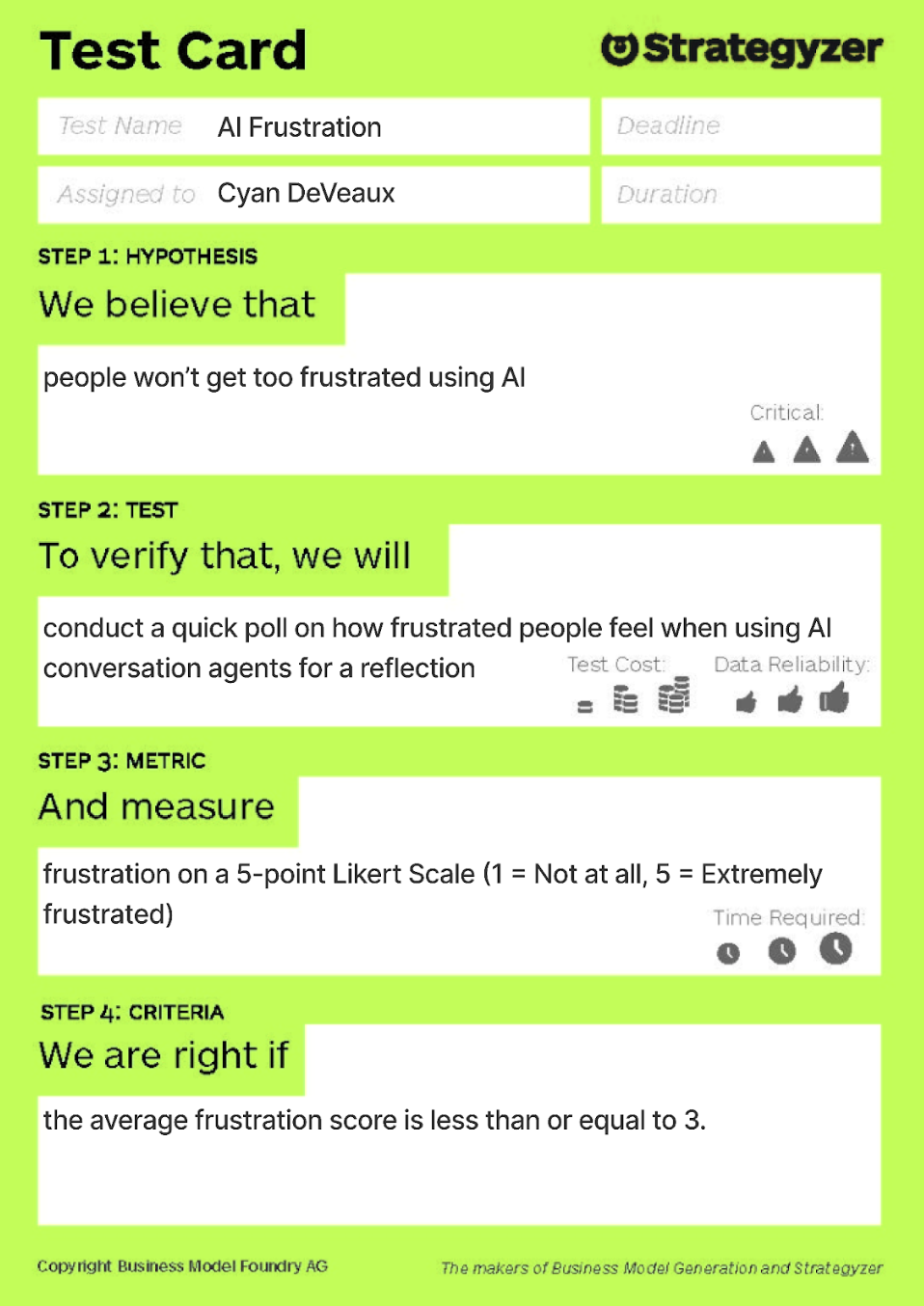
- Why this matters: Interacting with a conversation AI agent to reflect on spending is a core aspect of our application. If users experience high levels of frustration during this interaction, then they may choose to opt-out of this core part of the intervention.
- Method: We will conduct a quick poll on how frustrated people feel when using AI conversation agents for reflection-based use cases:
- Questions:
- On average, how frustrated do you feel when using AI tools to reflect on your thoughts or experiences?
- 1 – Not frustrated at all
- 2 – Slightly frustrated
- 3 -Moderately frustrated
- 4 – Very frustrated
- 5 – Extremely frustrated
- What types of reflection have you used AI for?
- Timeframe: We will collect responses over the course of 24-48 hours.
- Hypothesis: There will be an average frustration score less than or equal to 3.
Assumption #3: People recognize which purchases are impulse purchases.
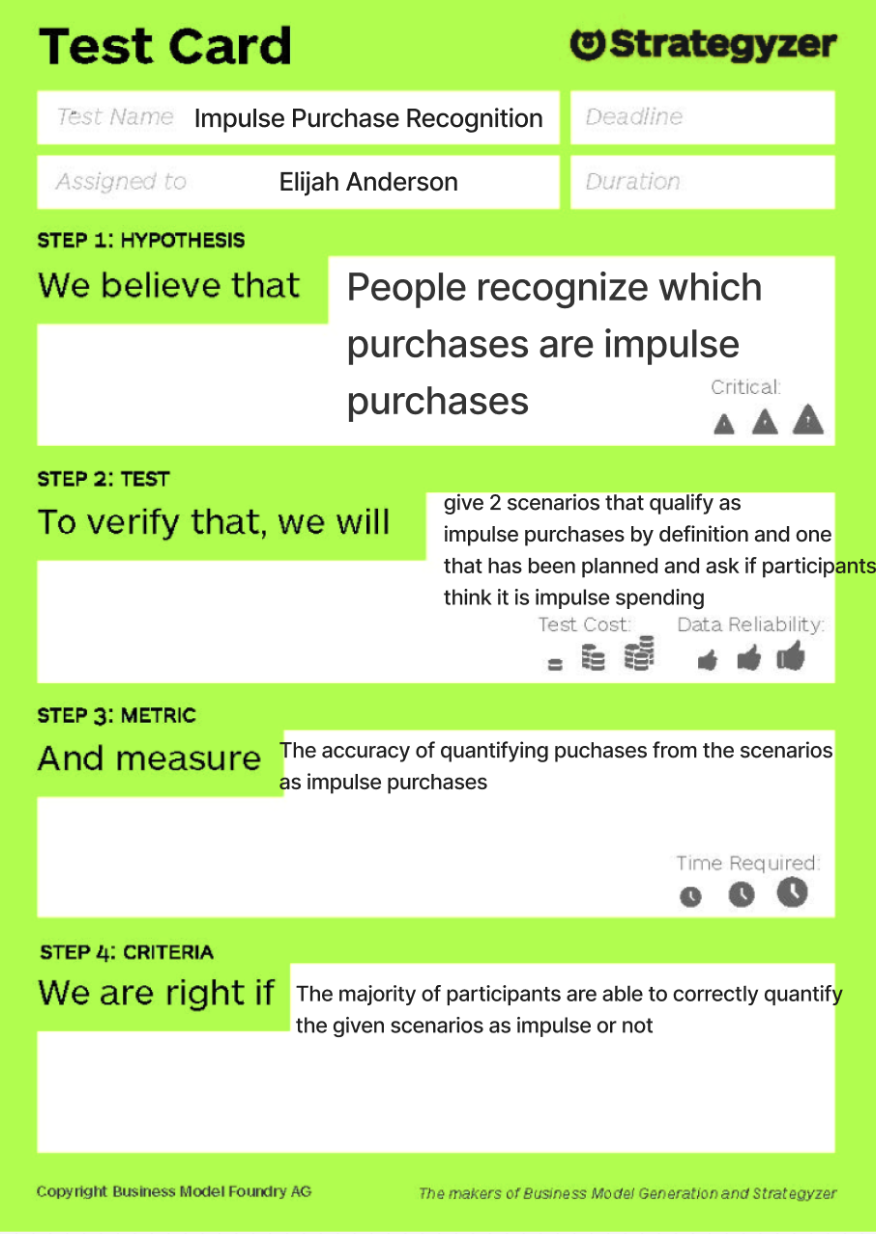
- Why this matters: To validate the hypothesis that people can accurately recognize impulse purchases. This matters for our application because without it, our application will not be able to reliably track impulse spending and support meaningful reflection on impulse purchases.
- Method: Present participants with three short purchase scenarios, two that qualify as impulse purchases by definition and one that has been clearly planned. Then ask participants to classify each scenario as either “Impulse” or “Not Impulse.
- Scenarios
- Kathy has been thinking about buying an iPad for two months and went yesterday to go buy it
- Mario was passing by Starbucks, realized he felt tired, and bought a coffee.
- John was at the store and bought three bags of chips since he saw they were on sale
- Hypothesis: At least 70% of participants correctly classify the scenarios according to the predefined impulse criteria.



