
Assumption Map
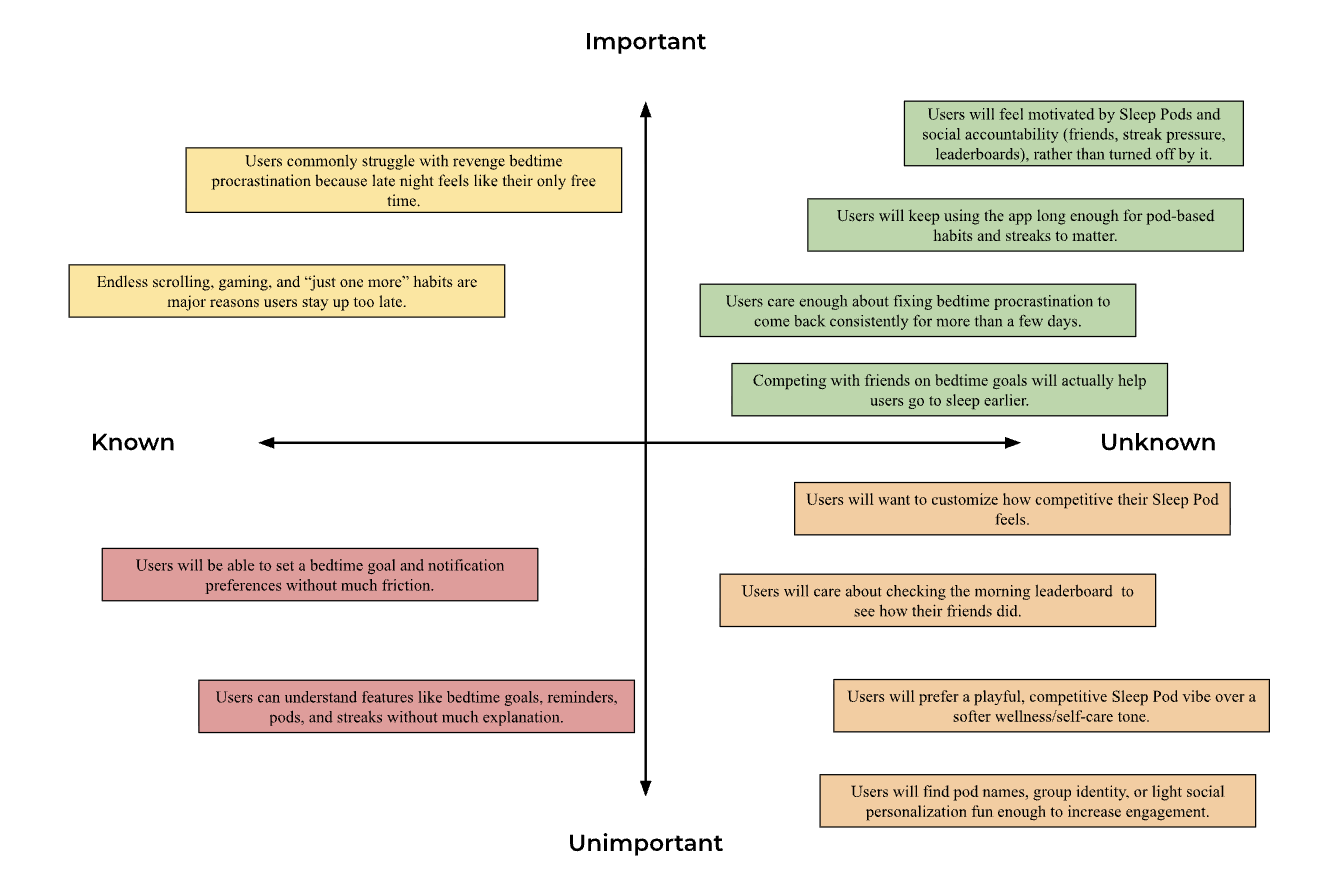
The biggest thing this map made clear is that the risky part of this app is not the app itself, it is the social bet behind it. We already know the problem is real. People stay up too late because nighttime feels like their only real free time, and the whole “just one more scroll, one more episode, one more game” loop is very real. What is still shaky is whether our solution actually works. The biggest unknowns are whether people will want bedtime accountability from friends, whether a little competition will genuinely help them go to sleep earlier, and whether they will stick around long enough for pods and streaks to matter. That is the part we really have to prove.
This also helped separate the stuff that feels core from the stuff that is honestly just polish. Questions like onboarding, feature clarity, customization, and whether the vibe should feel more playful or more wellness-focused do matter, but they are not the things that will make this concept live or die. If Sleep Pods are not actually motivating, then it does not really matter how clean the onboarding is or how cute the group names are. So the clear next move is to test the social accountability piece first, because that is the real engine of the whole idea. If that lands, everything else becomes worth refining. If it does not, then we probably need to rethink the concept instead of just dressing it up better.
Assumption Tests
Test Card #1: Sleep Pod Motivation Test
We believe that users will feel motivated by Sleep Pods and social accountability, like seeing friends’ progress, streak pressure, and light competition, rather than feeling judged or turned off by it.
To verify that, we will show users a simple prototype of the Sleep Pod feature and walk them through the experience of joining a pod, seeing group progress, and being compared with friends. Then we will interview them and ask how motivating, awkward, stressful, or appealing the feature feels.
And measure how many users say the Sleep Pod feature feels motivating, whether they say they would realistically use it with friends, and what percentage react positively versus negatively to the social accountability aspect.
We are right if a clear majority of users say the Sleep Pod feature feels motivating or helpful, and most say they would be willing to use it with friends instead of avoiding it because it feels annoying, embarrassing, or too intense.
Test Card #2: Bedtime Competition Behavior Test
We believe that competing with friends on bedtime goals will actually help users go to sleep earlier.
To verify that, we will run a small pilot where users track their bedtime for several nights while participating in a lightweight competitive pod system with shared progress, streaks, or a leaderboard. We will compare their behavior during the test to their normal bedtime habits and ask whether the competition changed their choices at night.
And measure changes in average bedtime, number of nights users meet their bedtime goal, and how often users say the pod competition influenced them to stop scrolling, gaming, or staying up late.
We are right if users meet their bedtime goal more often during the test period and a strong portion of participants report that the competitive pod feature directly pushed them to go to bed earlier than they normally would.
Test Card #3: Retention and Consistency Test
We believe that users care enough about fixing bedtime procrastination to come back consistently for more than a few days, giving pod habits and streaks enough time to matter.
To verify that, we will ask users to use a basic version of the app over the course of a week, including reminders, pod progress, and streak tracking. We will observe whether they keep checking in, logging progress, and engaging after the first few days instead of dropping off once the novelty wears off.
And measure daily return rate, number of consecutive days users engage with the app, and how many users are still actively participating after the first three to five days.
We are right if most users continue engaging with the app beyond the first few days and enough of them stay active through the end of the test period for streaks and pod accountability to start feeling meaningful.
These test cards make it pretty obvious that the real challenge is not building the app, but proving that the social layer actually works. The core gamble is that Sleep Pods will feel motivating and fun, not awkward, forced, or weirdly guilt-inducing. They also show that it is not enough for users to say the idea sounds good, because the bigger question is whether that social pressure actually gets people off TikTok, out of one-more-episode mode, and into bed earlier. Another big insight is that retention is a huge deal here, since pods, streaks, and accountability only start to matter if people stick around past the first burst of curiosity. In other words, this concept lives or dies on whether users both like the social experience and change their behavior because of it. That gives us a pretty clear next move: test the social accountability piece first, because if that part flops, the rest of the app is basically just a nicer-looking reminder tool.



