We chose these assumptions as the riskiest because they address core pillars of Classy’s success: trust, motivation, and monetization. They were the three assumptions in the upper right quadrant of our map so both high-impact (if wrong, the product fails) and high-uncertainty (we currently lack behavioral evidence to support them).
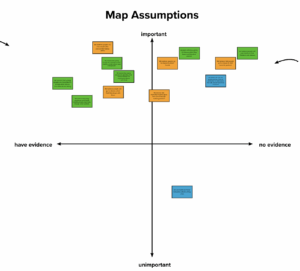
Assumption choice rationale:
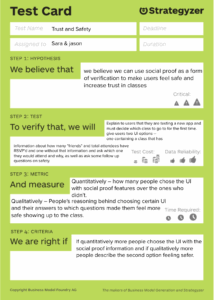
1. “We believe we can use social proof as a form of verification to make users feel safe and increase trust in classes.”
This is risky because our entire marketplace depends on perceived trust and safety between users and hosts. If social proof (e.g., mutual friends, shared classes, or ratings) doesn’t effectively create that trust, users may hesitate to book or engage socially. We have little evidence that social cues alone will offset the risk of attending local events with strangers.
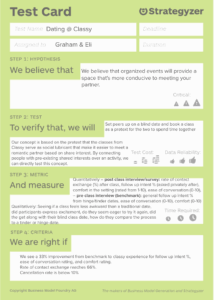
2. “We believe that people go to classes to meet romantic partners.”
This is a core user motivation we decided to explore after our product pitch, so we lack any user insight around it. However, we think it would be a great differentiator for us and we want to learn how we could spin the romantic motivation angle, if at all. Misunderstanding the emotional “job” people go to Classy for would lead us to design around the wrong value proposition.
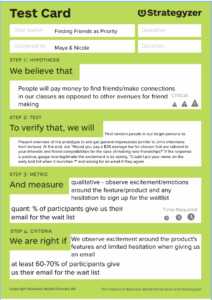
3. “We believe people will pay money to find friends in our classes.”
This is risky because it defines our business model viability. If people don’t perceive this avenue of social connection creation as something worth paying for, Classy’s subscription model won’t work. Without a clear willingness to pay, we’d have to reconsider how to design our features such that they add value to classy in a way that would spur more growth on the platform.
Test Cards:
sorry the writing is small hopefully you can zoom
paying for classy assumption
Trust and safety on classy assumption:
Dating at classy assumption