
Intervention design
The intervention involved automating the scheduling process for participants’ interactions with friends – especially friends with whom they didn’t regularly interact with. For each participant, we suggested one friend who they have not interacted with in some time. Then we selected and suggested a low-stakes activity that they can do during the interaction. We also provided conversation prompts to the participant to get the interaction going. By synthesizing our findings and results from the intervention study, . . . we aimed to answer the following questions: . . .
(if we aren’t answering each question directly, include this part and delete the questions) . . . we aimed to identify whether low-stakes activities and automatic scheduling helped participants increase the quantity of social interactions, and also whether they helped participants feel less stressed about the opportunity cost of social interactions . . .
- Do low-stakes activities increase the quantity of social interactions for someone with a busy schedule?
- Do low-stakes activities help individuals feel less stressed about the opportunity cost of social interactions?
- Does automatic scheduling cause individuals to interact more?
- Is suggesting specific friends that individuals don’t often interact with effective for helping them reconnect with that friend?
Part 1, Planning and Scheduling:
At 10 am every morning, we sent a text message nudge to each participant telling them which friend they should try to connect with for that day. The friend chosen was selected from a list of friends that was provided by the participant.
We suggested a low-stakes activity that the participant could engage in, such as grabbing a meal, going to the gym, gaming, going for a walk, etc.
We also gave them conversation starters or topics to use to get the conversation underway. Examples include: interests of participants and friends, trending topics, memes, and fun/woke/weird questions. We found that participants were not
Finally, we provided a potential time for the interaction to take place (morning, afternoon, evening) and sent the participants off to reach out to and interact with their selected friends (sending them a gentle reminder of the interaction just before the selected time).
Part 2, Reflecting and Documenting:
At 10 pm every evening, we prompted each participant to provide us with a summary of their daily interactions as they relate to the intervention.
First, we had them tell us which of their friends from their list they interacted with during that day. This would influence who we asked them to reach out to the next day. Next we asked them to elaborate on their feelings and emotions before and during the interaction.
If they did not follow through with the interaction, we made them explain why.
Results
In the end, our results were mostly mixed, some positives and some negatives.
Logged data
In the end, we calculated that about 63% of our participants went through with the social interactions they were nudged to do that day. Given that planning and following through with social interactions is not a daily activity for most, we find that this was a very good statistic for our five day study.
Attitudes and mindsets
To the automated scheduling:
Participants had positive attitudes toward the automated aspect of the intervention. Some participants expressed frequently wanting to reach out to certain friends, but rarely acting on that desire. By having the interactions involuntarily presented to them, they experienced a lower activation barrier which helped them easily take action and increase the frequency of interactions. One participant noted, “I didn’t have to think about what I was going to do with [friend]. I just followed the instructions and immediately sent them a DM.”
To the selected activities:
Participants tended to prefer activities that are already part of their daily routine. For example, grabbing lunch or dinner were relatively popular activities among all participants. One participant who loves playing video games was very excited about finding out that gaming with a friend was the selected activity for a particular day.
To the conversation prompts:
Participants had more adverse feelings to the idea of the conversation prompts. All across the board participants thought of it as mandatory, which they felt detracted from the authenticity of each interaction. Of the participants who used the conversation prompts, none felt that they were particularly helpful to maintaining the interaction. This suggests that the participants did not need help or have trouble with finding ways to communicate with the other person during the interactions.
Insights

After interviewing our participants, we synthesized a few key insights:
- Low stakes activities that integrated with one’s routine were dramatically less stressful. For example, many of our participants’ favorite way to catch up with people was grabbing a meal or coffee. Their shared rationale was that 1) there’s a natural rhythm to talking, and less pressure to always have to maintain conversation. It’s easy to take a break if something’s not going well. 2) It’s convenient, since everyone has to eat everyday, and there is no opportunity cost of doing something else i.e work.
- Low stakes and high stakes activities aren’t always characteristic of the activity itself. During our interaction study, we tried to separately analyze low-stakes e.g. studying, walking to class together, grabbing a coffee and high-stakes interactions e.g. grabbing a meal, activities that involved heavy scheduling, trips; however, during our post-study interviews, we realized that the metric for stakes was more based on personal obligations and moods rather than activity itself. For example, some seemingly low-stakes activities like studying with a friend felt high-stakes for a participant because they were already socially drained and just wanted to be by themselves.
- The suggested conversation prompts felt inauthentic and unnatural to some of our participants. Talking about predetermined conversation topics instead of the topics they wanted to about sometimes felt more like an obligation, almost like checking off a checklist. This made the interaction feel forced and unnatural. We did have participants who used the conversation topics, but they didn’t report them as particularly helpful or more engaging than what they would have talked about sans the conversation topics.
- Social nudges sometimes felt obligatory and chore-like. For people who usually schedule interactions at least a day in advance, the nudges felt like pressure to complete a certain task within a constrained time frame. This could be attributed to the nature of our study being everyday (most likely we wouldn’t send nudges to a user every single day for five days straight), AND that our participants mostly came from our friends. In our post-interview studies it sounded like there was a mini social contract where our participants felt obligated to help us out instead of feeling obligated because of the nudge. Therefore, it would be interesting to run our study on a wider population that includes strangers and see if the nudges still feel obligatory. Another path of obligatory-ness we analyzed was semantics and how we created our nudge messages. Each of us had a different way of nudging, some of our participants received nudges worded like a task they had to do for the day, others received nudges that were supposed to feel very optional, and a third group received nudges that were supposed to feel very optional, but were prefaced with a “please” or nicer tone. From our study, we didn’t see a really big difference in nudge commitment across these three groups, and we attribute this to the aforementioned mini social contract with friends.
- Social interactions had a tendency to be socially draining. When there were competing, more favorable obligations on peoples’ plates, participants were less inclined to initiate, follow through, and enjoy their social interactions. The competitor we noticed the most was work. Participants cited that they were “too depressed from work” some days so they had no bandwidth to even think about socializing. In other instances, people flaked because they had more appealing plans with people they were closer with, they weren’t certain that they would enjoy the outing, or they had already had multiple interactions throughout the day, which had drained their social battery.
- Nudges helped people conquer the social activation barrier. We saw that in many of our participants, the nudges for social interactions were beneficial in that they moved the person to take action and become motivated to be social. One of our participants actually enjoyed the somewhat obligatory aspect of the nudge as it made him be more accountable to take action. Two of our participants also mentioned that a big, natural trigger for them to reach out to someone was that they ran into each other spontaneously. This gave them the spark to think about this person again and a reason to reconnect. The spontaneous run in followed up by our nudge was very effective in helping people initiate.
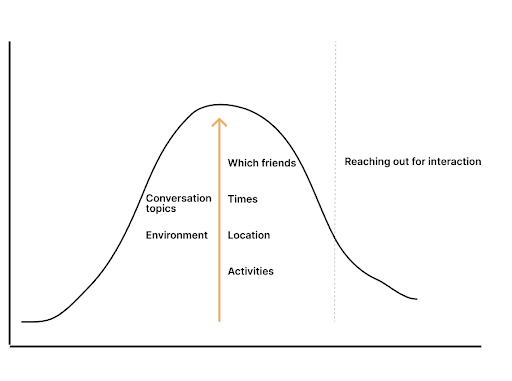
- Scheduling remained difficult. We didn’t integrate any scheduling help efforts into our intervention study, so we continued to see that it was an issue for our participants. One participant said that scheduling added to the social interaction barrier and made it harder to fulfill the nudge. Back and forth scheduling felt inconvenient and awkward, making our participants view the interaction as less worth it for the amount of the effort that it was taking to plan.
- Reflections correlated to more friendship appreciation. Participants felt that consciously taking time to try doing more things with their friends led them to greater appreciation of their friends and conversations, even if the interaction itself was low-stakes and casual.
Conclusion
At the beginning of our intervention, we set out to answer four questions.
- Do low-stakes activities increase the quantity of social interactions for someone with a busy schedule? Answer: Low-stakes is a blurry adjective when describing interactions. Interactions depend on a lot of variables such as people’s moods and schedules that day, not just the activity. Therefore, we’re not sure if there was quantitative increase with low-stakes activities because there were a lot of confounding variables and a low-stakes activity could not have always been attributed to as the cause.
- Do low-stakes activities help individuals feel less stressed about the opportunity cost of social interactions Answer: As said above, low-stakes activities themselves can become high stakes when one is having a stressful day or has a busy schedule. Therefore, although suggesting low-stakes activities can help make a participant feel less stressed, on paper it wasn’t always enough.
- Does automatic scheduling cause individuals to interact more? Answer: Yes, automatic scheduling does. In general, we saw that most participants found it beneficial to just interact – no constraints, obligations, tasks – just simply interact. Our nudges helped individuals stay in contact with their friends more and also make their interactions feel more meaningful
- Is suggesting specific friends that individuals don’t often interact with effective for helping them reconnect with that friend? Answer: Yes, many participants found it useful that the nudges suggested specific friends. In our post-study interviews, we also revealed that we were choosing friends that the participants hadn’t interacted with often during the study, and many enjoyed the idea because it kept them in contact with friends they sometimes didn’t think about.
In conclusion and through our insights, we realized that the nudging system we implemented in our intervention study might’ve been too complex, and that it might be better to strip out a lot of the extras e.g. conversation prompts, activity suggestions, etc. People simply enjoy hanging out with their close friends, and there is no need to add potentially awkward or unnatural add-ons to our nudges. Additionally, adding these extra factors may cause participants to have to spend more effort and cognitive load on their interactions, when our goal is to have people initiate and complete interactions with more ease. With this feedback going forward, we want to focus on how we can best formulate nudges that lower effort e.g. the semantics of the message, the frequency of the nudges, the choice of friend in the nudges, the ease of scheduling.



