
Baseline Study
Study Overview
Our baseline study examined the barriers new graduates face when learning a non-native language without formal structure while working full-time jobs. Focusing on individuals within five years of graduation, the study sought to understand how language learning fits into the everyday lives of new professionals, and why their practice time and fluency fluctuate from day to day. Specifically, we aimed to characterize participants’ unstructured language-learning behaviors, including when, where, and how often they practiced, as well as the barriers that shaped their ability to increase practice time and progress toward fluency. Establishing this baseline was essential for understanding how learning happens in the absence of external structure, and for identifying leverage points to support more consistent, sustainable practice and long-term language fluency during the subsequent diary study.
Study Methodology
The baseline study used a mixed-methods approach, combining semi-structured interviews with a 5-day daily check-in survey to examine how new graduates practice a non-native language in the absence of formal structure, and how daily context influences practice time and fluency-related behaviors.
Pre- and Post-Study Interviews:
Participants completed semi-structured interviews that explored their daily routines, current language-learning practices, perceptions of practice quality, prior attempts to build consistency, and attitudes toward progress and tracking. These interviews provided qualitative insight into participants’ motivations for learning a language, their experiences learning without external structure, and the emotional and cognitive barriers that shaped their engagement.
Daily Check-In Survey (5 Days):
In addition to interviews, participants completed a brief daily survey over five consecutive days. Each check-in asked participants whether they practiced that day, how long they practiced, what type of practice they engaged in, and what factors helped or hindered their learning on that specific day. The survey also captured contextual details such as fatigue, work demands, illness, social plans, reminders, and tool use. This daily format enabled us to observe day-to-day fluctuations in practice time, identify moments of drop-off or increased engagement, and directly link practice behavior to situational barriers and supports
Participant Recruitment
Participants were recruited using a screener targeting post-graduate working professionals engaged in self-directed language learning. Eligibility criteria included working at least 30 hours per week, practicing a non-native language at least three days per week, and learning primarily outside of formal classes or job requirements. Individuals working at language-learning companies or enrolled in intensive language programs were excluded to reduce bias and externally imposed practice routines. The final participant group represented individuals with varied work schedules, energy levels, and learning contexts, enabling the study to capture a broad range of real-world constraints affecting habit consistency.
Key Research Questions
The baseline study was guided by the following research questions:
-
What does a “typical” language-learning routine look like for working professionals?
(When, where, how often, and using which tools do participants practice?) -
What factors motivate or trigger language practice on a given day?
(e.g., reminders, routines, streaks, personal goals, available time) -
What barriers most commonly prevent or reduce practice?
(e.g., fatigue, workload, forgetting, lack of structure, emotional resistance) -
How do participants perceive the quality and sufficiency of their current practice?
(What defines a “good” vs. “missed” practice day?) -
How aware are participants of their own practice patterns, and how do they feel about tracking them?
Raw Data –> Grounded Theory Report
Synthesis
To synthesize our qualitative data, we first analyzed our raw interview and diary study observations, color-coded by participant. We then used affinity grouping and frequency of surface patterns, contradictions, and tensions across participants. Through this synthesis process, several grounded theories emerged that help explain how working professionals experience and manage their language-learning habits in the context of busy, cognitively demanding lives.
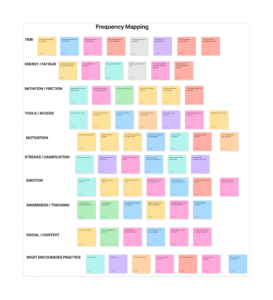
Frequency Mapping
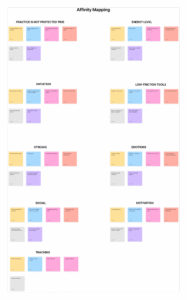
Affinity Mapping
Below, we outline the key grounded theories and subtheories that emerged from our analysis, supported by participant narratives.
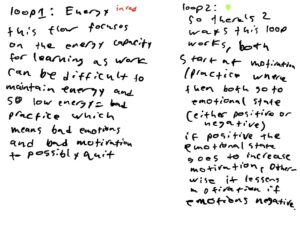
Grounded Theory 1: Motivation is present, but energy and initiation barriers determine whether practice actually happens
Across participants, we observed that inconsistency in language learning was rarely caused by a lack of motivation. Instead, participants consistently expressed strong personal reasons for learning a language: identity, relationships, travel, or self-improvement, yet still struggled to practice regularly.
Subtheory 1.1: The primary barrier to practice is starting, not caring
Many participants described the moment of non-practice as passive rather than deliberate. Practice was postponed until it was “too late,” often without a conscious decision to skip. Participants emphasized that once they actually began practicing, it felt easier and more grounding than expected. This suggests that initiation friction, rather than resistance to learning itself, is the dominant failure point.
Tension: Participants believe they lack discipline, but their behavior suggests they lack low-friction entry points.
Open questions:
-
How might systems reduce the cognitive load of deciding how and when to start?
Subtheory 1.2: Energy levels outweigh motivation in determining behavior
Participants repeatedly cited mental fatigue after work as the strongest predictor of skipped practice. Language learning, especially when unstructured or cognitively demanding, felt insurmountable at the end of the day—even when participants cared deeply about their goals. Interestingly, once participants did begin practicing, many reported feeling calmer or more energized, indicating that the perceived energy cost was higher than the actual cost.
Contradiction:
Practice is avoided because it is assumed to be draining, yet often feels restorative once started.
Grounded Theory 2: Tools shape whether practice happens, while meaning shapes how it is experienced
Participants relied heavily on tools to scaffold their language-learning habits, but tools played different roles depending on their structure and emotional affordances.
Subtheory 2.1: Low-friction, structured tools enable consistency under fatigue
Apps like Duolingo were consistently described as easy to start, especially on low-energy days. Structured prompts, reminders, and predefined next steps lowered the activation energy required to practice, making short sessions feasible even late at night.
However, participants also noted that these tools often encouraged minimum-effort behavior, such as practicing only to maintain a streak rather than to meaningfully engage with the language.
Tension:
Ease enables consistency, but can undermine depth.
Subtheory 2.2: Meaningful use of language increases fulfillment but is harder to sustain
Participants described real conversations, travel, and relational contexts as the most meaningful and motivating forms of practice. These moments reinforced identity (“this matters to me”) and provided tangible feedback on progress. However, such experiences were irregular and difficult to integrate into daily routines.
Open questions:
-
How can meaning be preserved without increasing cognitive or logistical burden?
-
Can systems simulate or scaffold meaningful engagement in low-energy contexts?
Grounded Theory 3: Streaks and gamification create a double sword between motivation and guilt
Gamified features such as streaks played a complex emotional role in participants’ experiences.
Subtheory 3.1: Streaks motivate action on bad days but amplify guilt on missed days
Participants acknowledged that streaks often pushed them to practice when they otherwise would not. At the same time, missed days triggered guilt, avoidance, and emotional discomfort, sometimes leading participants to disengage entirely. Several participants described practice as becoming “performative,” focused on maintaining a number rather than learning.
Contradiction:
The same mechanism that sustains engagement can also discourage re-entry after failure.
Open questions:
-
What forms of accountability motivate without punishing inconsistency?
-
How might systems normalize fluctuation rather than framing it as failure?
Grounded Theory 4: Practice is emotionally grounded and closely tied to self-identity
Participants consistently underestimated the emotional weight of their learning habits.
Subtheory 4.1: Skipped practice creates lingering emotional residue
Participants described low-level guilt, disappointment, or self-judgment following missed days, even when those days were understandable given work or health constraints. Conversely, successful practice days produced pride, relief, and a sense of self-efficacy.
Subtheory 4.2: Reflection increases emotional awareness more than behavioral change
Daily tracking and reflection did not always increase practice frequency, but it significantly increased awareness. Participants reported greater honesty with themselves and clearer recognition of patterns, reframing inconsistency as a design problem rather than a personal failure.
Insight:
Awareness alone does not guarantee behavior change, but it shifts how users interpret their own actions.
Grounded Theory 5: Language learning feels isolating, yet social connection dramatically increases engagement
Despite learning languages to connect with others, most participants practiced alone.
Subtheory 5.1: Social interaction provides meaning, accountability, and motivation
Conversations with partners, friends, or native speakers were repeatedly cited as moments of heightened motivation and clarity. Participants felt more compelled to practice when learning was tied to real people rather than abstract progress metrics.
Subtheory 5.2: Lack of social scaffolding increases drop-off
Without accountability partners or shared routines, practice felt optional and easy to deprioritize. Several participants expressed that simply knowing someone “cared” or was paying attention increased follow-through.
Open questions:
-
How might social accountability be lightweight rather than burdensome?
-
What forms of shared practice feel supportive rather than evaluative?
Core Tensions
Across all grounded theories, several core tensions emerged:
-
Consistency vs. Meaning: What sustains habits is not always what makes them fulfilling. Meaning after defines why our participants want to learn and motivates them
-
Ease vs. Depth: Low-friction tools enable action but risk superficial engagement
-
Motivation vs. Energy: Desire exists, but fatigue governs behavior
-
Accountability vs. Guilt: Tracking helps awareness but can heighten self-judgment
Synthesis Summary
Overall, our findings suggest that inconsistent language practice is less a problem of motivation or intention and more a mismatch between users’ energy levels, emotional states, and the systems supporting their habits. Participants want to practice, care deeply about learning, and recognize what helps them, but lack structures that adapt to low-energy contexts, normalize inconsistency, and preserve meaning without increasing burden. These grounded theories suggest intervention opportunities that focus on reducing initiation friction, aligning structure with energy, reframing accountability, and including personal meaning into everyday practice.
System Models
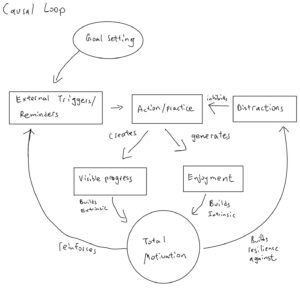
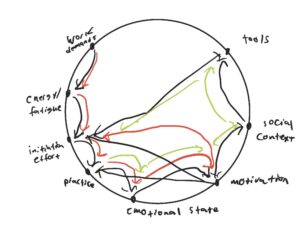
Secondary Research
Our literature review and competitive analysis revealed a consistent tension in language learning products: systems tend to optimize either for habit formation or for real-world skill transfer, but rarely both. This divide became visible when mapping competitors across our 2×2 framework.
-
Market splits between Engagement and Fluency:
A dominant trend is the separation between platforms that are highly engaging and those that produce deeper language competence. Habit-driven programs like Duolingo and Babbel excel at reducing activation energy. Features like streaks, gamification, and push notifications produce strong daily return loops. Literature on behavioral cueing and spaced repetition supports the effectiveness of these mechanisms. Automated review systems and reminders reduce decision fatigue and help users re-engage even when motivation is low.
While all that is true, we do see in our comparator analysis that this engagement does not always translate to speaking confidence or real conversational ability. Many learners optimize for points or streak maintenance rather than skill application.
In contrast, immersion and speaking-focused platforms such as Rosetta Stone, Pimsleur, and Speak drive stronger skill transfer. These tools emphasize pronunciation, recall, and live conversation practice. Research on scaffolded interaction and guided speaking shows that structured dialogue and feedback can significantly improve communicative competence. But these platforms often rely on user discipline rather than behavioral scaffolding. High activation energy, longer sessions, or social anxiety create drop-off risk. Learners may value the outcomes but struggle to sustain consistent practice.
-
Structure Reduces Cognitive and Emotional Barriers
Across the literature, structure repeatedly emerged as a critical driver. Studies on online language learning environments highlight that learners disengage when they must self-direct themselves. The lack of scaffolding increases cognitive load and reduces follow-through in users. Similarly, research on self-directed adult learners shows that autonomy alone does not guarantee consistency. External routines, milestones, and guidance are often necessary to sustain engagement.
This pattern appears in the market as well. Platforms that provide clear lesson sequencing, guided routines, or automated review loops tend to retain users longer than those that rely on open exploration. The implication is that motivation is not enough. Systems must translate intention into action through environmental design.
-
Social Learning is Powerful but Anxiety inducing
Peer conversation and real-time dialogue are among the most effective ways to build fluency. However, unstructured social environments introduce emotional barriers. Learners often experience fear of judgment, embarrassment, or linguistic inadequacy.
Comparators like HelloTalk demonstrate this tradeoff clearly. While they offer authentic conversation exposure, they also create high social activation costs. Without scaffolding, many users hesitate to start interactions or stop after negative experiences.
Literature on guided social interaction shows that structured prompts, scenario cards, and goal-oriented exchanges significantly reduce anxiety and increase participation. When learners are supported with conversational frameworks, they are more willing to engage and persist. This suggests that the barrier to speaking is not just skill, but also emotional readiness.
-
Personalization supports Motivation
Adaptive learning systems also emerged as a key driver of engagement and performance. Research shows that dynamically adjusting difficulty, pacing, and feedback based on learner behavior improves both retention and outcomes. Fixed curriculums risk boredom when too easy and discourage people when it’s too difficult.
Many existing platforms offer some form of personalization, but often at the content level rather than the behavioral level. There is less support for adapting habit expectations, session length, or motivational framing based on real-life variability. This creates an opportunity to personalize not only what learners practice, but how they sustain practice.
2×2:
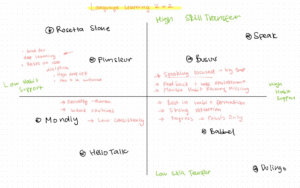
- High Habit / Low Skill: Engagement engines (Duolingo)
- High Skill / Low Habit: Discipline-driven mastery systems (Rosetta Stone)
- Low Habit / Low Skill: Novelty or unstructured social tools (Mondly, HelloTalk)
- High Habit / High Skill: An underdeveloped but high-potential quadrant
From our 2×2 map we saw there were very few platforms that fully integrate behavioral scaffolding with meaningful conversational practice.
Ideation:
-
Designing for Consistency and Competence
Rather than choosing between habit formation and fluency, our focuses should be on integrating both.
This includes:
- Automated daily practice loops informed by spaced repetition research
- Low-friction session entry points for busy or low-energy days
- Speaking-first activities that build real conversational ability
The goal is to ensure users both show up and improve their skills.
-
Reducing Emotional Activation Costs
Given the anxiety associated with speaking, our product should explore scaffolded interaction models:
- Guided conversation prompts
- Scenario-based speaking drills
- Gradual transitions from AI to human interaction
This lowers the barrier to participation while preserving social learning benefits.
-
Embedding Structure Without Removing Autonomy
Literature shows that learners value self-direction but need external scaffolding for it:
- Default routines and suggested goals
- Flexible session lengths
- Recovery pathways after missed practice
This supports persistence without imposing rigid compliance systems.
-
Personalizing behavioral support
Finally, adaptive systems research informs our focus on dynamic support.
Future features may include:
- Difficulty adjustment based on performance
- Habit targets responsive to engagement patterns
- Context-aware reminders tied to user routines
This reframes personalization as behavioral, not just curricular.
Generally our research suggests that we should focus on better integration of behavioral science and skill development. Platforms currently make practice easy but shallow or make practice difficult to continue, so designing a system that supports engagement while also improving real-world skills.
Behavorial-Personas
| Dimension | R — Structure-Fragile Learner | E — Identity-Driven Learner | E&E — Emotion & Energy Driven Learner |
| Activated Role | Adult learner engaging in self-directed language learning outside required obligations | Working professional (software engineer) learning languages as a personal practice; socially active, night-owl schedule | New-grad software engineer learning a language outside formal requirements; practice shaped by emotional energy and cognitive fatigue |
| Primary Goal | Practice a second language consistently to make travel and cultural experiences feel more immersive and authentic | Achieve conversational fluency to connect more deeply with people and cultures | Achieve fluent, automatic speaking tied to relationships and personal growth |
| Motivation Type | Internally motivated, values language learning as meaningful, but motivation is abstract | Strongly identity-driven; language learning reinforces self-image as culturally connected | Deeply emotional and relational; motivation tied to partner, intimacy, and self-growth |
| What Practice Means to Them | A “should” that represents long-term growth | A way to become a more culturally fluent version of themselves | A way to connect emotionally and relationally; intention/meaning matters more than metrics |
| Core Conflict | Practice relies on willpower rather than structure, making it fragile under fatigue or ambiguity | Days are unstructured; practice disappears when evenings run late, creating guilt and frustration | High emotional investment + low cognitive energy at practice time; caring deeply increases guilt when skipping |
| Main Drop-Off Point | Transition from intention to action (no protected time) | Evenings when energy is low or schedule runs long | Transition from work into relaxation; once “done for the day,” practice rarely happens |
| Attempts to Solve | Ambitious daily goals, night practice, unstructured materials, occasional app use | Duolingo streaks, practicing at gym/train, late-night studying | Duolingo streaks, daily time goals (30 min/day), conversations with partner |
| Outcomes of Attempts | Inconsistent; works only when starting effort is minimal | Streaks maintain habit but create “maintenance mode” and fake progress | Streaks reduce friction but amplify guilt; time goals collapse under stress |
| Setting / Environment | Evenings at home; low-energy contexts; occasional mobile breaks | Late evenings at home; scrolling in bed; socially full nights | Primarily at home after work; phone-based, opportunistic |
| Tools Used | Smartphone, language apps, flashcards, physical materials | Duolingo, translation apps, Reddit, pen pals, travel planning | Duolingo, Anki, conversational practice, passive media |
| Key Skills | High self-awareness; intrinsic interest in learning | Reflection, curiosity, intrinsic motivation | Acute emotional awareness; strong intrinsic motivation |
| Primary Friction | No fixed time, high cognitive load to start, unclear next steps | Practice competes with rest, scrolling, and social time | Activation cost on low-energy days; emotional pressure from guilt |
| Emotional Pattern | Calm optimism to detachment to overwhelm to relief or disappointment | Pride after practice, guilt after skipping | Pride after practice, compounded guilt after skipping |
| What They Don’t Need | More motivation | More motivation | More motivation |
| What They Do Need | Structure that reduces ambiguity and protects time | External accountability and well-timed cues | Reduced friction + emotional permission on low-energy days |
Journey Maps
R

E

E&E
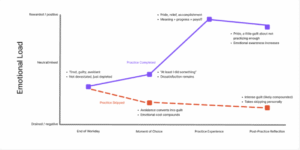
Photos came out blurry:
Use this link to access our google doc for images:
https://docs.google.com/document/d/1ezfdqGr0c0znudD3XGRhArbEnEUZoxMSywMddyofO0Q/edit?usp=sharing



