
Baseline Study
Study overview
Our baseline study focused on “follow-through” in social and extracurricular commitments among busy Stanford students. We wanted to understand why plans that feel genuinely intended in the moment still end up getting forgotten, softened into “maybe,” rescheduled, or canceled close to the start time. The goal was to build a grounded picture of what actually drives flaking (and what makes follow-through easier) so we can design an intervention that helps students keep commitments they want to keep, and cancel responsibly when they should.
Study methodology
We ran a 5-day diary study (Monday to Friday) paired with short interviews. The diary captured both:
- Quantitative/logistical data (counts of plans per day, whether plans were kept vs. changed, acceptance time, cancellation timing, distance from event start, and communication channel used).
- Qualitative/content data (emotions at commitment time, reasons for uncertainty, what changed, and reflections on how the day’s commitments played out).
Entries were submitted daily in a structured Google Sheet with a mix of short-answer fields and longer reflections. Participants could optionally attach artifacts like screenshots of messages to provide context. Our team sent daily reminders in the morning and did an evening check-in to reduce drop-off and keep entries consistent.
Participant recruitment
We recruited Stanford undergraduate and graduate students using a Google Form screener. We specifically targeted students who have “room to improve” on follow-through so the study would surface real friction, not idealized behavior.
Screening criteria:
- Must be a Stanford student.
- Must be socially and/or extracurricular-active enough to generate data during the 5-day window (at least weekly plan-making or accepting invitations).
- Must have canceled or rescheduled at least one plan in the last two weeks (to ensure the behavior exists in their current life).
- Students who rarely initiate/accept plans (less than once a week) were screened out because they were unlikely to produce meaningful diary entries during the sprint.
We also collected lightweight background data (response latency to invites, and what system they use to track commitments) to contextualize diary patterns.
Key research questions
- Where do plans fail? At what point does a plan become “at risk,” and what signals that risk early?
- What drives uncertainty and late-stage changes? What emotional, situational, and social factors push someone from “yes” to “maybe” to “no”?
- What makes commitments feel binding vs. flexible? How does commitment level vary by relationship type, event type, and effort required?
- What norms govern “respectful” cancellation? How do timing, channel, and explanation shape perceived fairness and relational impact?
- What support would actually help? What interventions could reduce forgetfulness and avoidance without making social life feel rigid, guilt-driven, or over-managed?
Secondary Research
Our secondary research (literature + comparator analysis) suggests that “flake culture” is not just a motivation problem. It is usually a coordination problem plus an action-initiation problem, amplified by ambiguity about how committed a plan actually is.
Key insights from the literature
1) Not all “yes” responses are the same.
Work on intention and commitment highlights that people often form plans as mere-intentions or provisional plans (“unless something comes up”), rather than true commitments. That matters because provisional plans are designed to be revisable, so the “flake” is sometimes the system behaving as intended. A core design implication is that products should help users choose the right level of commitment for the situation instead of treating every plan as equally binding.
2) The intention-action gap is real, even when people mean it.
Research on implementation intentions shows that follow-through improves when people specify concrete if-then execution details (when, where, what the trigger is). This reframes flaking as a failure of action initiation under cognitive load (fatigue, distraction, competing tasks), not simply weak character. For ideation, this points toward interventions that turn vague commitments into concrete “show-up scripts,” not just reminders.
3) Uncertainty drives the need for signaling and confirmation.
Commitment signaling research suggests that when people are unsure whether someone else will follow through, they seek stronger signals. That maps cleanly onto real social planning: the less confident you are in a plan, the more you want a lightweight way to confirm without it feeling awkward or needy. Design implication: build “confidence calibration” into the planning flow so users can confirm when uncertainty is high, and avoid over-confirming when trust is already high.
4) Cancellations are judged more by process than outcome.
Mixed-methods work on cancellations shows timing and communication channel dominate. Early notice and direct communication reads as respectful; last-minute or avoidant behavior reads as dismissive. This suggests a practical design direction: make early cancellation and rescheduling the path of least resistance, and make avoidance harder.
5) People overestimate how unacceptable canceling is.
There is evidence that people systematically think cancellations will be taken worse than they actually are, which can increase avoidance and cause worse outcomes (no-show, ghosting, last-minute bail). This opens a counterintuitive intervention: reduce anxiety about early canceling (with norms and scripts) while still preserving accountability.
Trends from the comparator analysis
Across products, we saw a consistent split:
- Personal productivity tools (Google Calendar, Notion, LunaTask) excel at individual organization and memory, but do little to manage the interpersonal reality of coordination, uncertainty, and social repair.
- Social planning tools (Partiful, Apple Invites, Howbout, When2Meet) make it easier to create an event container and centralize logistics, but most stop at RSVP and scheduling. They do not deeply support follow-through, and they rarely address the psychology of uncertainty, commitment level, or respectful exit ramps.
A pattern that emerged is that most tools are high on individual motivation features (tracking, reminders, organization) but low on social pressure / shared accountability. Meanwhile, tools that add visible social features often sacrifice individual planning depth, likely because users want to keep their personal planning space private while still coordinating socially.
2×2 takeaway
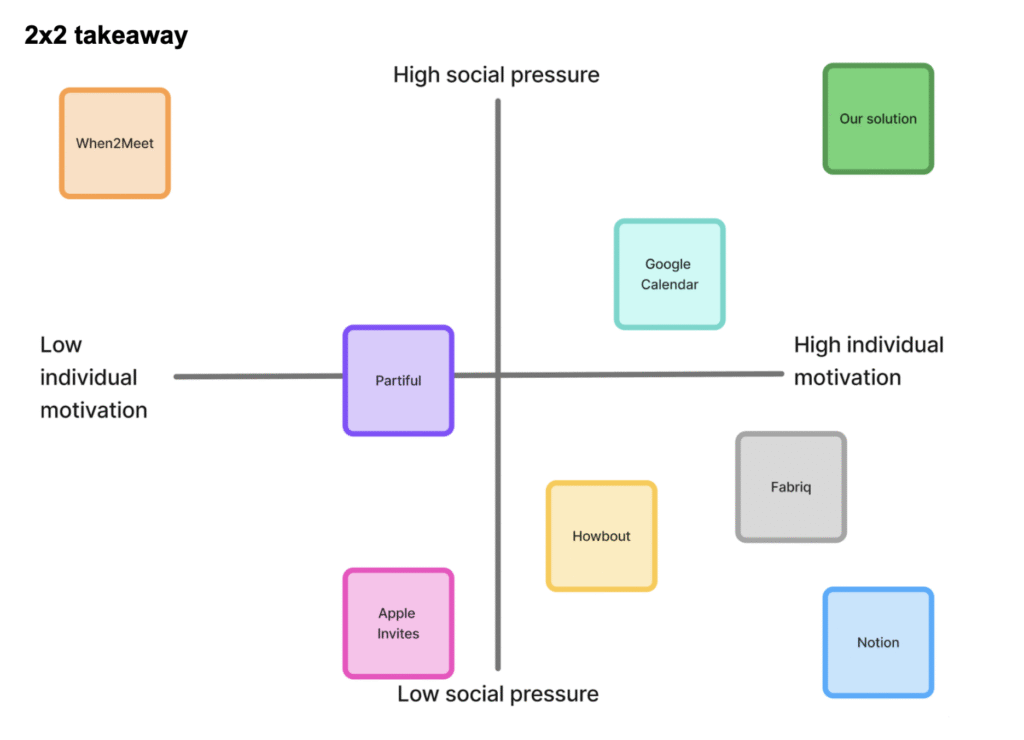
Our working market tension can be summarized as:
- Many products are built around individual motivation and organization, with minimal interpersonal scaffolding.
- Products that create social visibility and pressure often avoid deeper planning functionality, or they are limited to single events.
This pushes our ideation toward a hybrid: a system that preserves a student’s private, lightweight planning workflow while adding selective, situational social scaffolding when it is most needed (high uncertainty, high cost of failure, or high relational stakes).
What this means for our design phase
These findings suggest our intervention should not try to “force” everyone to always show up. Instead, it should:
- Help users name the commitment level (soft vs. firm) at plan time.
- Convert intentions into follow-through by prompting implementation details (when/where/how).
- Provide lightweight confirmation loops when uncertainty is high.
- Make early cancellation + repair (reschedule, communicate respectfully) easier than avoidance.
- Reduce cancellation anxiety by calibrating norms and offering scripts, while still reinforcing respect for others’ time.
Net: the opportunity is not a prettier invite or a better calendar. It is a behavior-aware commitment flow that makes follow-through more automatic, and makes honest cancellation more socially safe than last-minute failure.
From Raw Data to Grounded Theory
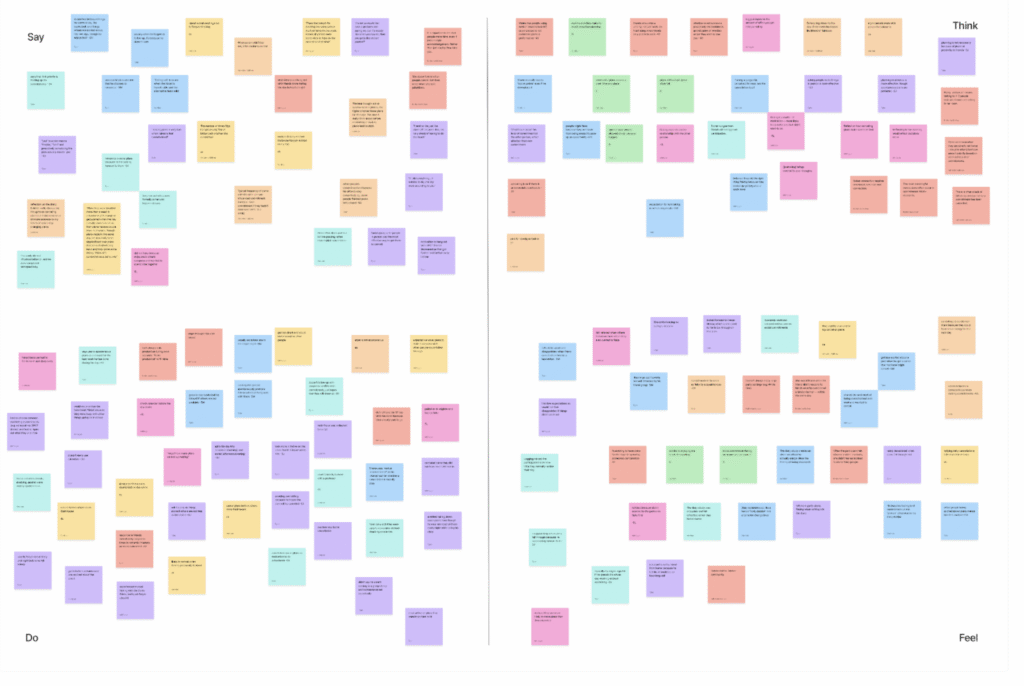
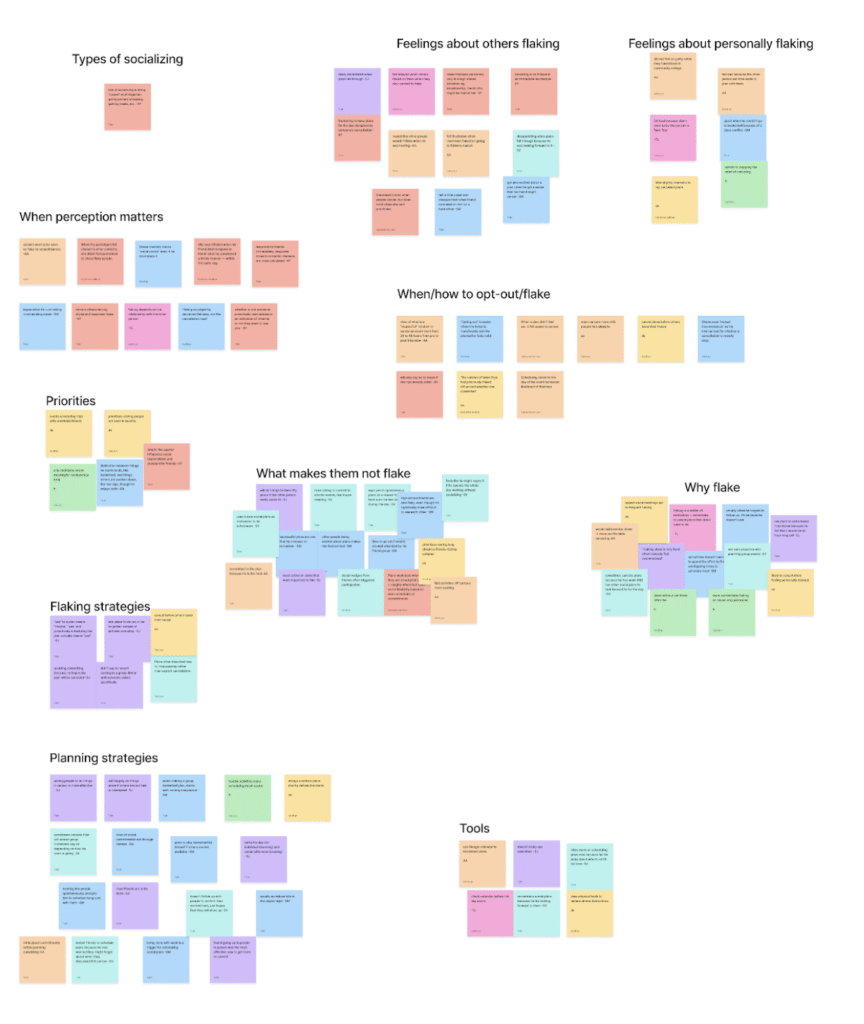
Across pre- and post-interviews and the diary study, we extracted key information onto sticky notes, color-coded by participants. Our full jam board can be viewed here.
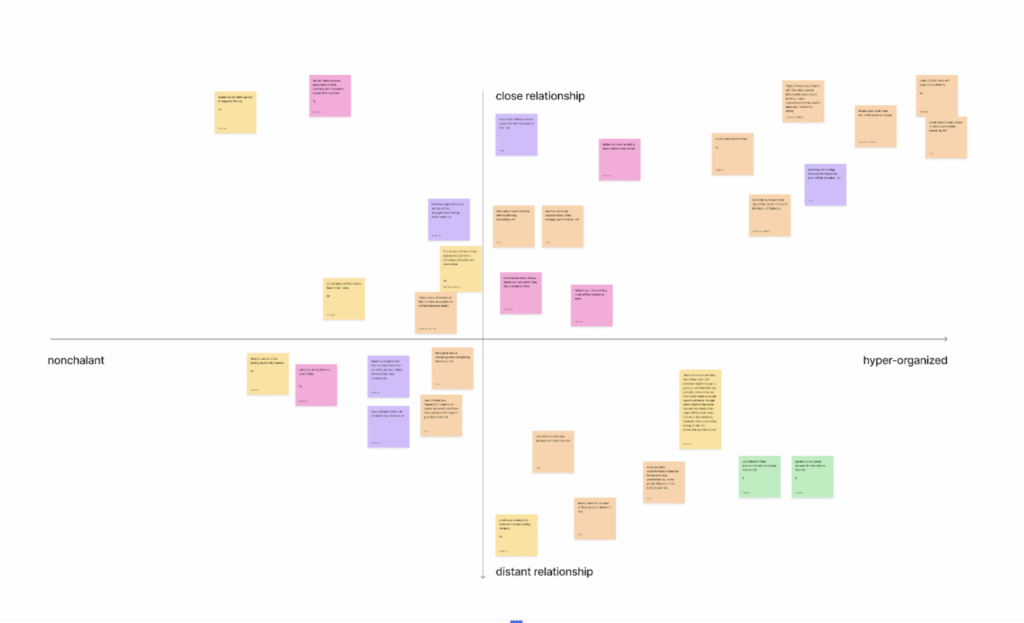
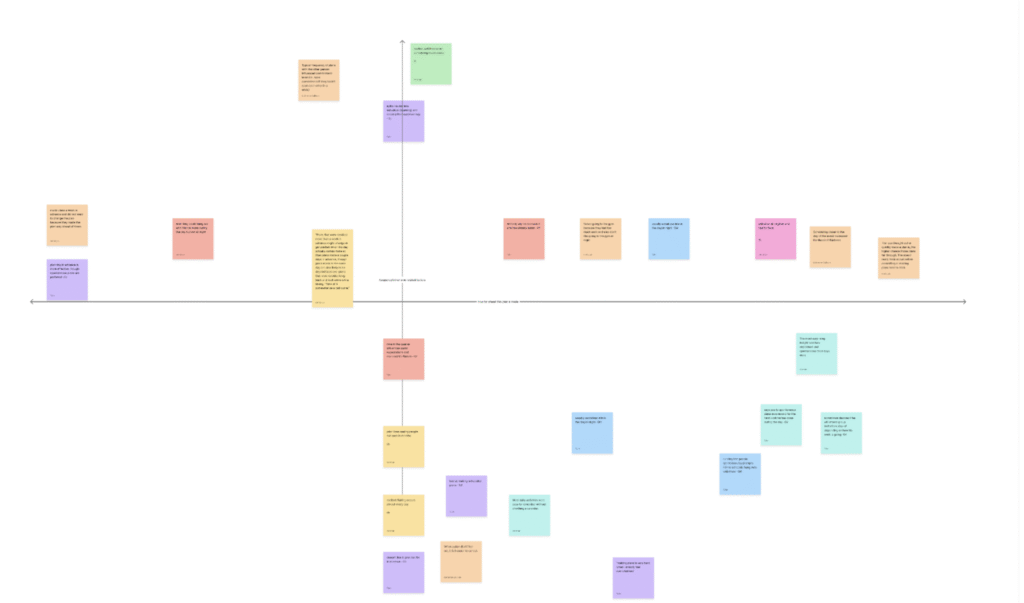
We organized this information according to various synthesis techniques, including empathy maps, affinity maps, 2x2s and timelines. From these we inductively identified our grounded theories.
Visualizations
2×2 Grid
Timeline
Empathy Map
Affinity Map
Insights
One of the major insights from our grounded theory is that what makes people commit versus cancel is highly contextual and personal. Throughout our theories we identified several factors that affected flaking, though in many cases the specific effects were different across our participants. In some instances we even identified directly contradictory subtheories. In other cases we identified patterns that only held strongly for 1-2 participants, suggesting that our behavioral personas are an important driver of the behavior we are studying. Overall this suggests that our intervention should be highly adaptive, taking as contextual factors the habits and cues that make each individual likely to commit, follow through, or flake.
Terminology note: We often use “co-participant(s)” to refer to the person/people who are included in a social plan, typically to contrast these people with our study participants. Though we largely refrained from using the word “flake” in our interviews and diary study, participants often used the word themselves, either out of personal habit or because they deduced that this was the behavior we are studying; thus, it frequently appears in our data. In our synthesis, we tend to use “cancel” to refer to the logistical side of committing and then reneging on a social plan, whereas we sometimes use the term “flake” to highlight the social connotations and perceptions of the behavior. We try to use the word “commit” to indicate that someone has said yes to a plan, whereas “follow through” indicates that they actually attend said plan.
See our full grounded theory here: Grounded Theory Document
System Models
fishbone model: https://drive.google.com/file/d/1O9zFcm5PwQBI61rPpQ7QhJdkEfMjpab0/view?usp=sharing
mind map model: https://drive.google.com/file/d/1O9zFcm5PwQBI61rPpQ7QhJdkEfMjpab0/view?usp=sharing
Behavioral Personas
- The People Pleaser
| Drawing | Name | Lisa “The People Pleaser” |
| Activated Role | Student (socially active) | |
| Goal | To stay on good terms with everyone and earn their approval by being accommodating and valuable. | |
| Motivation | Maintain belonging and a positive image in relationships. | |
| Conflict | Lisa says yes to activities or commitments she doesn’t truly want to attend because she is afraid to say no. | |
| Attempts to Solve | Commits to multiple events → Overcommits → Asks herself if she really wants to go → Ignores her true desires and priorities → Ends up stressed, flaky, or resentful | |
| Setting/ Environment | Social environments:
|
|
| Tools | Messages (iMessage, DMs, Whatsapp, Discord, Slack)
Social Media (Instagram, Snapchat, BeReal, Tik Tok) Calendar Notes App |
|
| Skills | Reading social cues
Appeasing others Write sweet/apologetic text messages Managing emotions |
|
| Routines | Adds social plans to her calendar immediately
Reviews her calendar before attending events Re-reads text messages multiple times before replying Prioritizes events based on external perception |
|
| Habits | Smiles or avoids conflict when stressed
Over-apologizing Avoids saying no directly (e.g. “we’ll see”, “I’ll let you know”, “maybe!”) Puts others’ needs over her own Says “yes” by default Feels guilty when choosing her own priorities |
|
| More | Lisa trades her time for social approval — ending up burned out, anxious, resentful, and “flaky”. |
Journey Map
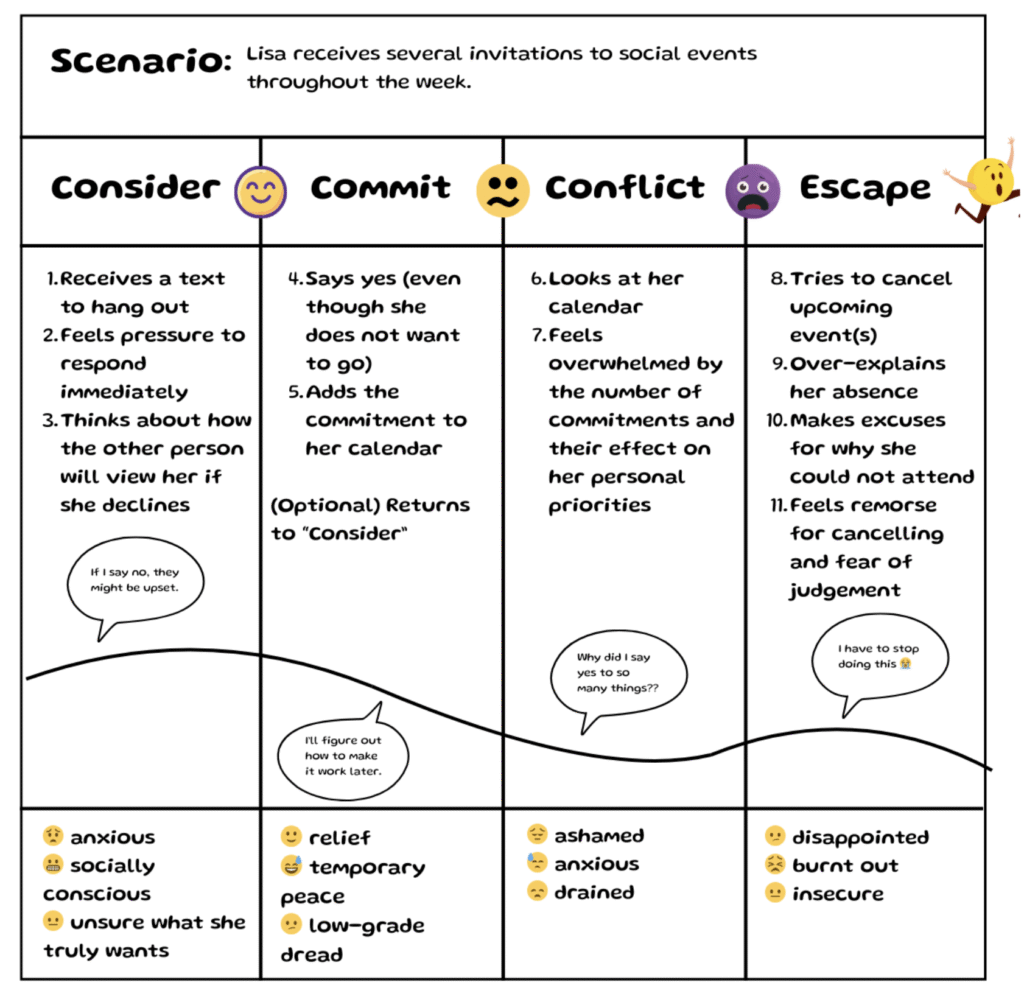
AI Disclaimer: I used Generative AI to create the persona illustration and to generate emojis representing emotional states.
2. Just a Chill Guy
| Drawing | Name | “Just a chill guy” |
| Activated Role | Student (socially active peer)
Not defined by a stereotype (“party guy”), but by a situational role: someone frequently navigating casual social interactions, group plans, and low-stakes social signaling. |
|
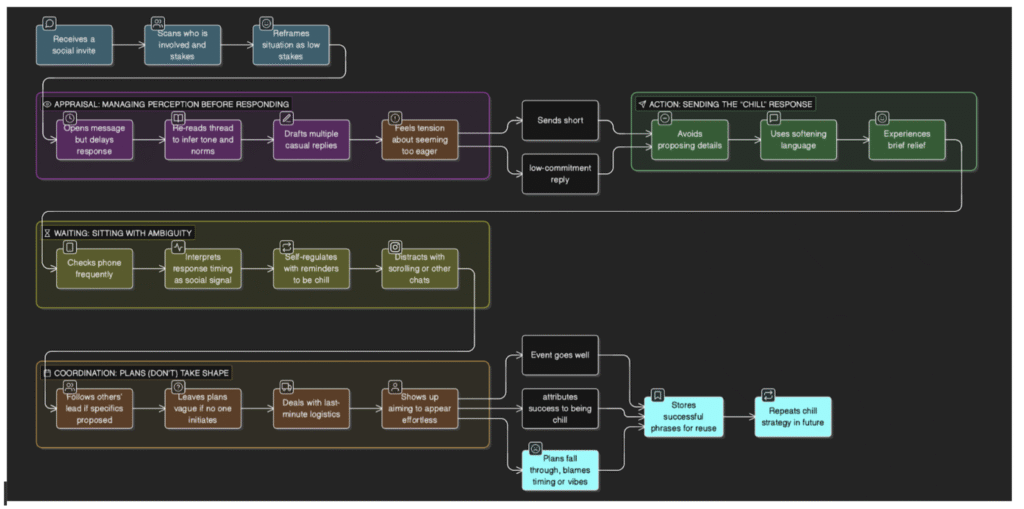
| Goal | To appear nonchalant, relaxed, and confident in social situations (especially around peers) without seeming desperate, insecure, or overly invested. | |
| Motivation | Wants to be perceived as someone who is:
Underlying this is a desire for social belonging without social risk. I want to come across as chill because being visibly invested or anxious feels socially risky and might push people away. |
|
| Conflict | Feels a tension between:
This creates a paradox: The more he tries to be chill, the less chill he can feel internally. |
|
| Attempts to Solve |
Overall result: He succeeds socially, but often at the cost of authenticity or emotional clarity. |
|
| Setting/ Environment | Primarily social contexts, including:
These are environments where tone, timing, and “vibe” matter more than explicit communication. |
|
| Tools |
Notably, these tools amplify ambiguity rather than resolve it. |
|
| Skills |
However, he lacks tools for:
|
|
| More | He isn’t indifferent, he’s actively managing perception.
“Chill” is not a personality trait here; it’s a behavioral strategy. |
Journey Map
Physical Persona
I used AI as a writing and structuring aid to help organize and clearly articulate my own interview insights into a behavioral persona and journey map. All observations, interpretations, and design decisions are my own, and I reviewed and edited all content for accuracy.
3. The academic overcommitter
We created the “Academic Overcommitter” persona after observing a recurring pattern: participants consistently accepted social invitations with genuine intent to attend, yet cancelled last-minute when academic demands intensified (e.g. office hour, midterm, etc.). Interviewees described feeling torn between maintaining friendships and pursuing academic excellence, often overestimating their capacity to balance both. They reported saying yes to social plans during calmer periods, only to cancel when assignments, exams, or research deadlines suddenly felt urgent—even when these deadlines were known in advance. We synthesized these behaviors into the “Academic Overcommitter” persona, which represents users whose commitment-making and flaking patterns stem from fluctuating academic anxiety and a persistent underestimation of their workload.
Behavioral Persona
Name: Marcus “The Academic Overcommitter”
Activated Role: Student (academically driven)
Goal: To achieve academic excellence and secure future opportunities (internships, grad school, career prospects) while maintaining some semblance of social connection.
Motivation: Preserve academic standing, meet personal achievement standards, and avoid falling behind peers.
Conflict: Marcus optimistically commits to social plans during low-stress periods, but cancels when academic pressure mounts—even when he technically has time—because he cannot mentally justify “fun” when work remains incomplete.
Attempts to Solve: Accepts social invitations → Feels optimistic about balancing everything → Academic deadline approaches or anxiety spikes → Reassesses priorities → Convinces himself the social event is “not essential” → Cancels last-minute → Feels guilty but relieved → Rationalizes decision as “responsible”
Setting/Environment:
- Academic spaces (library, lab, study rooms, office hours)
- Dorm/apartment (where studying happens)
- Coffee shops (dual study/social space)
- Text/digital communication (where most cancellations occur)
- Lecture halls and collaborative workspaces
Tools:
- Calendar apps (Google Calendar, Outlook, Apple Calendar)
- Academic management tools (Canvas, Blackboard, Notion, Todoist)
- Messages (iMessage, GroupMe, Discord)
- Productivity apps (Forest, Pomodoro timers)
- Note-taking apps (Notion, OneNote, GoodNotes)
Skills:
- Time estimation (poor—consistently underestimates workload)
- Academic planning and organization
- Rationalizing decisions
- Crafting apologetic but academically-justified cancellation messages
- Finding productive study environments
Routines:
- Checks academic deadlines multiple times daily
- Accepts social invitations when feeling on top of work
- Re-evaluates commitments as events approach
- Studies late into the night before cancelling morning/afternoon plans
Habits:
- Says “yes” to social plans when workload feels manageable (Monday–Wednesday)
- Cancels plans that fall near deadlines, even self-imposed ones
- Uses academics as a socially acceptable excuse, even when it’s partially anxiety-driven
- Feels phantom guilt about “wasting time” during social activities
- Overestimates future free time (“I’ll have more time next week”)
Journey Map:
https://drive.google.com/file/d/1O9zFcm5PwQBI61rPpQ7QhJdkEfMjpab0/view?usp=sharing



