
Baseline Study
Study Overview
The purpose of our baseline study was to improve poor posture and hunching. Poor posture can have detrimental effects on someone’s spine, overall health, and how they feel moving in their body, while research shows good posture can even boost your mood. For this reason, we were hoping to determine what causes poor posture practices and why, as well as understanding how this behavior affects a person’s mood and well-being.
Participant Recruitment
We targeted our study towards people who struggle with maintaining healthy posture or sitting for long periods of time, specifically focusing on people who often sit at a table or desk to do work, which includes students and people who work a desk job.
Key Research Questions
We were hoping to find answers to the following research questions:
-
How is a person affected by poor posture? What pains or other issues does it cause?
-
Are people aware of their own posture?
-
Are there any emotional triggers to poor posture? Does poor posture affect someone’s mood?
-
How does the environment affect someone’s posture? Do certain desk set-ups help? Is there a social factor involved?
-
Which types of tasks cause posture to be worse or better?
-
What methods do people already use to attempt to fix their posture and what are their pros and cons?
Study Methodology
To help us answer these questions, we first screened possible participants to find people who worked at desks, struggled with poor posture, and had the desire to improve their posture. We then interviewed each participant about their posture habits and set them up for a five day diary study where they would complete two entries per day. These entries asked them to list any periods of the day where they sat for more than 30 minutes and collected the following data about each session: time of day, sitting duration, activity, posture, body feeling, and emotional state. The mix of the qualitative and quantitative data collected, along with a post-interview to gain more insights from participants, helped us to really understand the causes and effects of poor posture. We have outlined our insights and findings below.
Raw Data
Affinity Map

Frequency Map
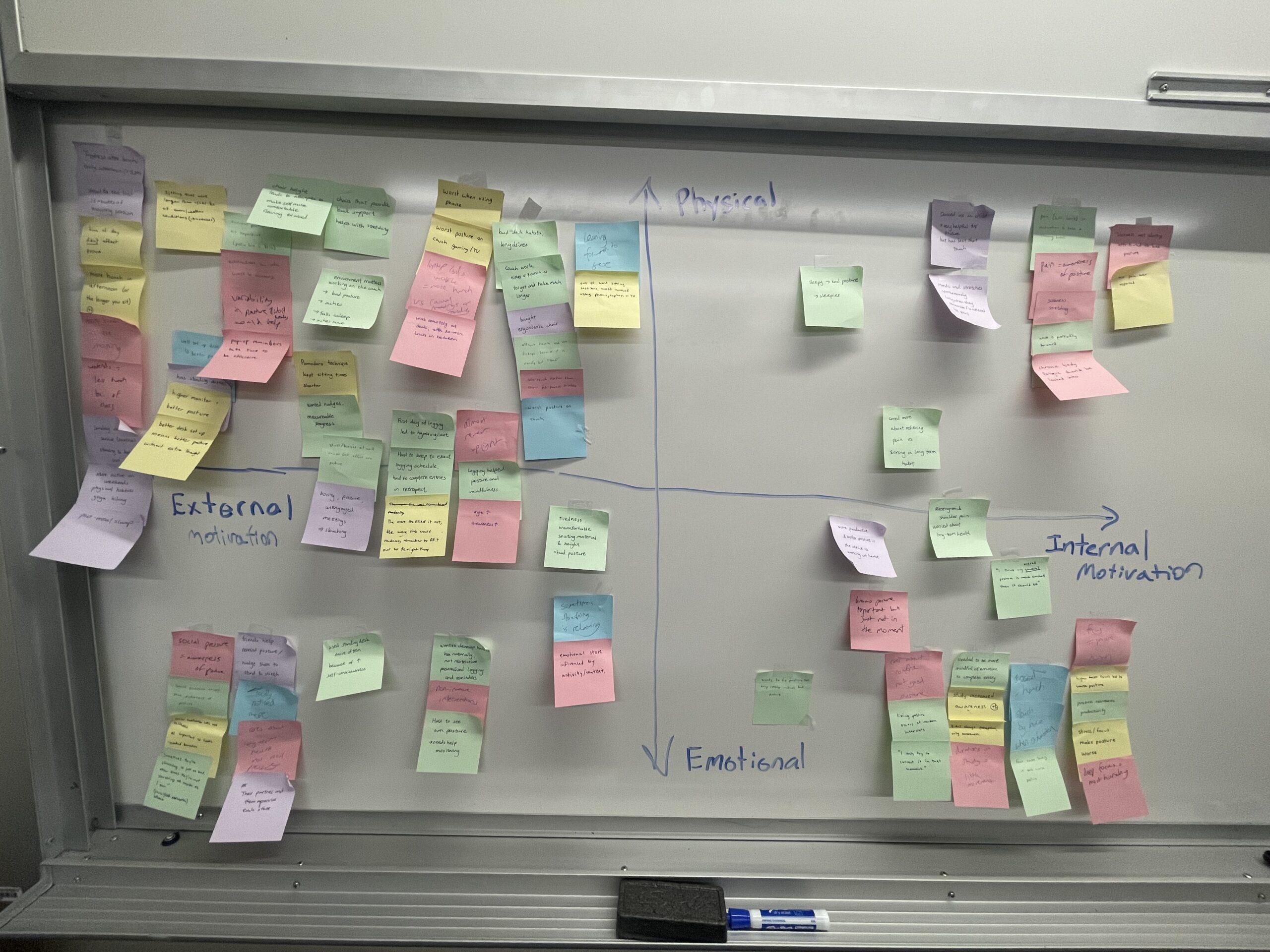
Timeline

Based on our mappings, we developed the following 4 grounded theories:
Grounded Theory #1: Posture tends to be worse at the extremes of the attention spectrum.
Subtheory 1: Posture breaks down because people hunch forward to focus intently on a task.
- Lucy recalls that when stressed in trying to meet a deadline, she hunches over and gets really close to her screen
- Avery noticed that when she is deeply focused, she leans forward without realizing it
- Sisely also noted that she leans forward when focused
Questions:
- Are specific tasks more likely to trigger forward hunching than other tasks?
- Does moving closer towards the computer screen actually effectively help focus or is it just a natural tendency?
- How could screen size, font size, or other visual aspects of a task affect how much a person hunches forward?
- Does posture deteriorate gradually as the user focuses or is it a rapid shift once a person reaches a certain level of focus
Subtheory 2: Posture can become poor because slouching often occurs when someone is completely relaxed.
- Sisely noted that she is either very calm or very focused when she is slouching
- Sarthak found himself slouching more and more as he grew tired and more relaxed after work
- Rachel said that if she is tired, she tends to just slouch
Questions:
- Does slouching result in the same pains that hunching does?
- Does slouching happen during relaxation because people don’t notice or because it is simply more comfortable?
- Can you prevent slouching in a way that does not disrupt the relaxation that often occurs alongside it?
Grounded Theory #2: Social pressure causes more internal awareness of posture
Subtheory 1: Social mirroring overrides a person’s own intention regarding their posture
Questions:
- What kind of internal conflict, if any, does a person feel between comfort/belonging and their posture goals?
- Does the closeness of the social relationship (close friend vs. acquaintance) affect mirroring?
- Does mirroring require group consensus or an “average” of the setting?
Subtheory 2: The difference in public and private self leads to inconsistencies in postural appearance
Questions:
- At what point do participants become aware they’ve shifted from public to private self? In this case, would making private spaces feel more “public” change postural behavior, even if it is done artificially (e.g. via cameras, assigned partner accountability, tracking made social)?
Grounded Theory #3: People value good posture, but it rarely registers as an immediate or urgent problem, often because it’s cognitively deprioritized or simply forgotten in the moment.
Subtheory 1: Participants are generally aware of what “good posture” is and value it, but maintaining it requires active attention that competes with other tasks.
- Sisely notes that when she begins working, she often sits upright initially, but once she becomes focused on the task, she stops paying attention to her body altogether. She only notices her posture after feeling discomfort or stiffness.
- Avery describes becoming so absorbed in work that she forgets to check in with her posture. She explains that posture “falls out of awareness” when she is concentrating, even though she knows it matters.
- Rachel mentions that she does not consciously choose to slouch, but rather “ends up there” after long periods of uninterrupted focus.
Questions:
- At what point during an activity do participants first realize their posture has changed?
- What sensations (pain, stiffness, fatigue) tend to bring posture back into awareness?
- Does correcting posture feel disruptive to focus or workflow?
Subtheory 2: Because poor posture does not cause immediate or obvious negative consequences, participants normalize it until discomfort becomes unavoidable.
- Avery explains that mild discomfort feels “normal” during long work sessions, and she usually pushes through it rather than adjusting how she is sitting.
- Sisely recalls noticing back or neck pain only after standing up from a long session, at which point the opportunity to correct posture has already passed.
- Binu describes posture correction as reactive rather than proactive, she adjusts only once pain becomes distracting enough to demand attention.
Questions:
- How much discomfort do participants tolerate before changing their posture?
- Do participants interpret early discomfort as a posture issue or as general tiredness?
- Would earlier or subtler cues encourage posture adjustment before pain sets in?
Grounded Theory #4: Physical setups and environmental cues play an important role in subconsciously subverting or enhancing a person’s posture
Subtheory 1: Suitable desk height, seat padding, and lumbar support makes it easier for participants to retain good posture.
- Rachel recalls an instance when she was playing board games with friends on a low desk. As a result, she had to hunch forward to engage with the pieces, which led to back pain.
- Rachel recalls her experience sitting on different chairs. Those that are too hard or angular compels her to twist and fidget in her seat attempting to find a comfortable position.
- Binu recalls working on a soft couch and sinking into the material. She finds herself relying entirely on the cushions for support, the comfort making it difficult to find the incentive to adjust her posture.
Questions:
- Are there office chairs whose ergonomic designs have been medically or clinically validated?
- Are there lightweight, portable ergonomic accessories that allow you to customize your seating or desk arrangement outside your regular workstation?
Subtheory 2: In-person meetings or video conferences keep participants in a higher state of alertness and engagement, naturally leading to better posture.
- Both Rachel and Binu find that their posture worsens during long, tedious meetings where they are not engaged.
- The camera on aspect can also be interpreted as a form of surveillance that changes how they choose to present themselves
Questions:
- Are there microtasks participants can engage in while attending long meetings to keep themselves focused (i.e. doodling, taking notes)?
- Can we incorporate software that lets users see their own reflection on their monitor even when their camera is turned off during meetings?
Subtheory 3: Working in different environments (cafe, workstation, home) and settings (standing desk, couch, bed) influences attentiveness and productivity, potentially causing posture-related issues to arise
- Binu mentions an instance where she accidentally fell asleep while trying to work on the couch at home. The low-stakes and flexible home environment caused her to accidentally fall asleep in a very problematic position and she recalled intense soreness and aches after waking up.
- Binu also mentioned working on her laptop in bed, which causes her to hunch over the keyboard while propped up in pillows
- Rachel reflects that her productivity and posture is better when she is at her workstation or standing desk.
Questions:
- Are there ways to increase the friction of moving to leisure spaces for work, such as keeping devices attached to the work desk or monitoring screen tilt to ensure the monitor stays at the required peripheral?
- Are there external tools that can help with focus in noisy environments, such as headphones that play ambient sounds?
System Models
Connection Circle
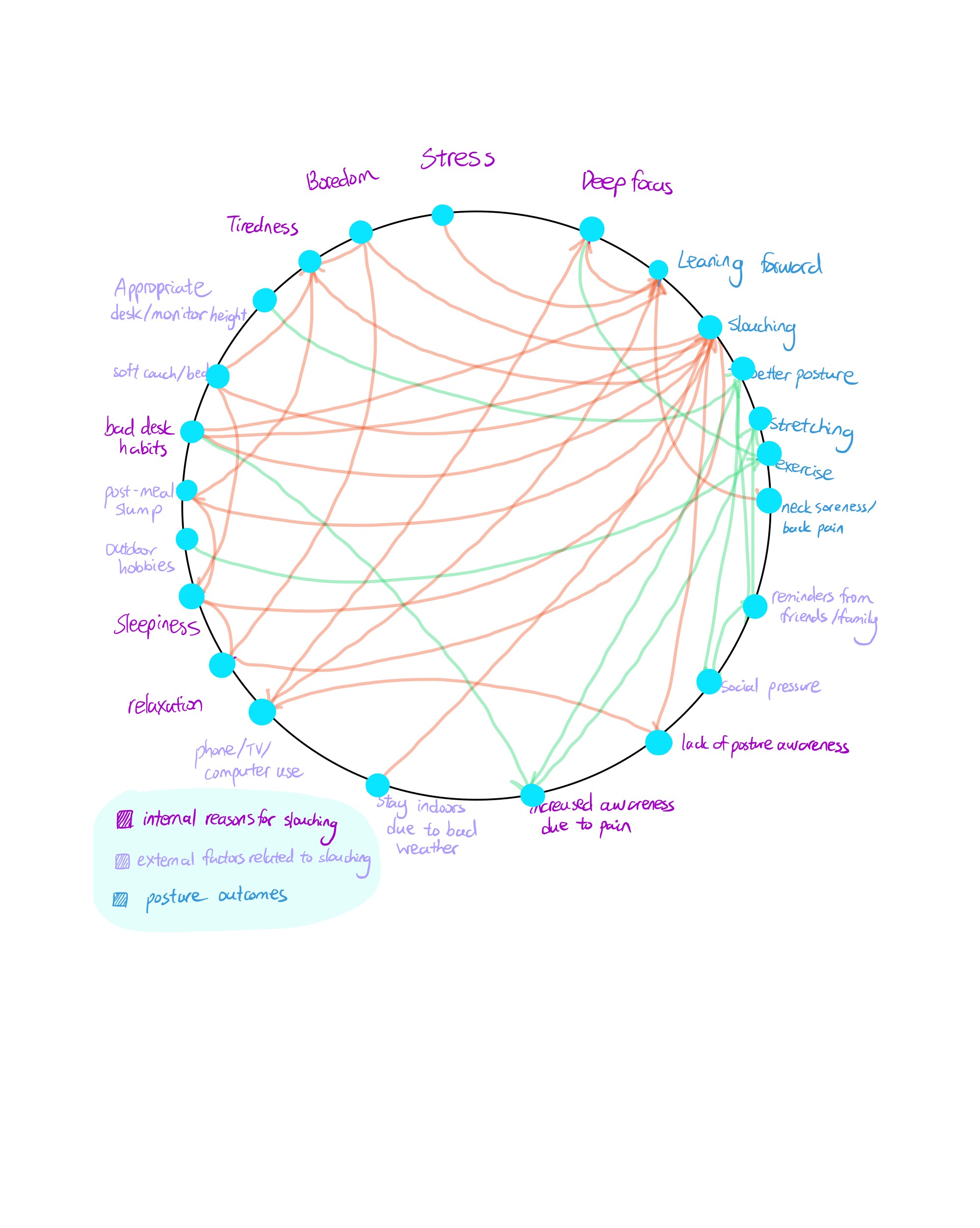
From the connection circle, we can identify three primary positive feedback loops. First, long-term bad desk habits can lead to higher pain-related posture awareness and increased motivation to change. Second, while deep focus on a task when seated could lead to worse hunching, focus on physical activity and exercise can help revert some of the negative consequences of bad posture. Finally, social nudges serve as effective reminders for breaks, stretches, and better posture.
Most negative feedback loops originate from emotion and physical setup. Participants who are sleepy or tired often seek softer seating options like a couch or bed, forgoing their posture in the process. At the same time, ill-suited desk or chair heights can make it more taxing and difficult for participants to retain good posture.
Fishbone Diagram
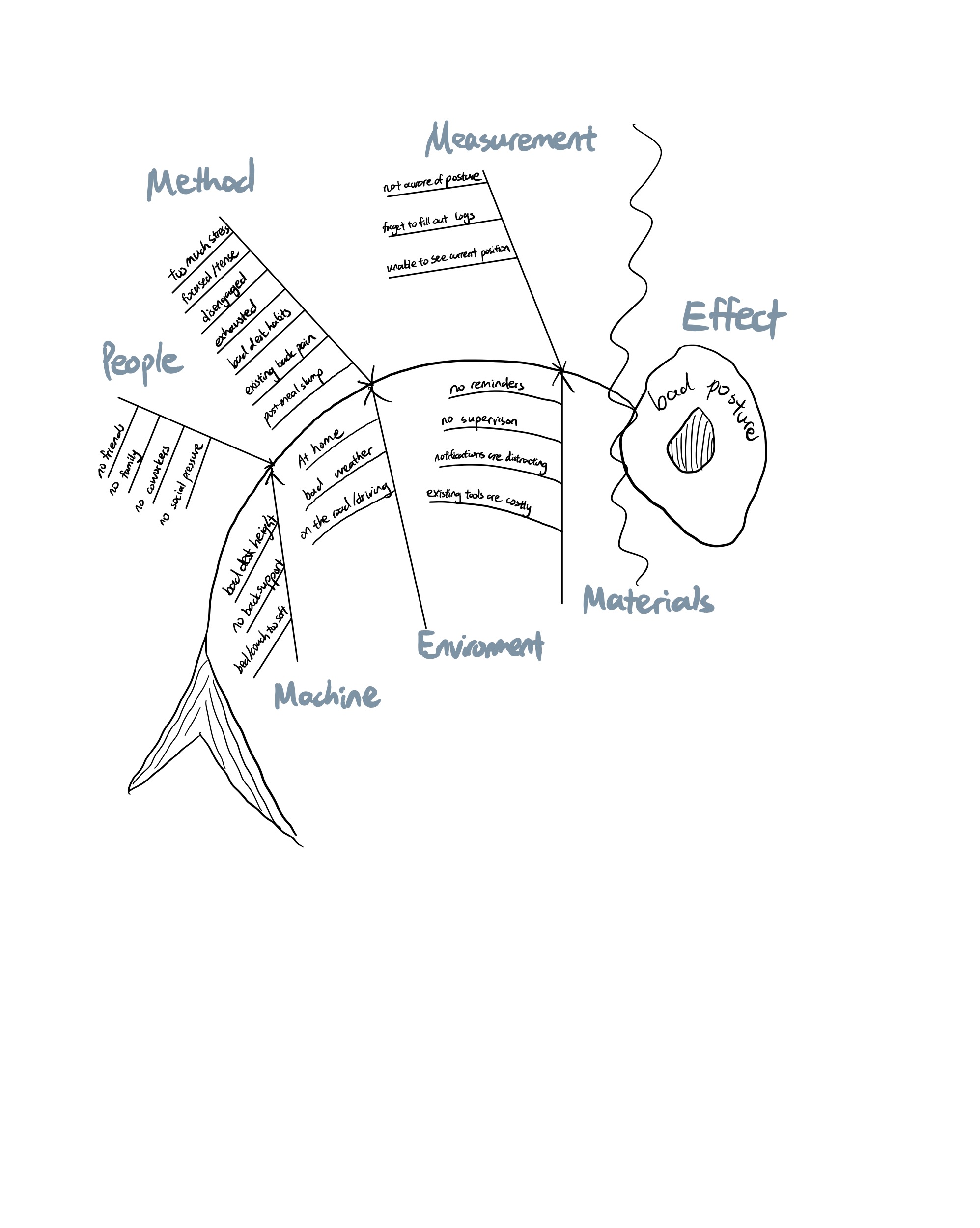
From the fishbone diagram, we can see that bad posture is difficult to measure as the behavior is autonomous and subtle. The participant usually does not notice they are slouching until they feel pain or soreness as a result of doing so. Most of the methodology originate from emotional or physical cues such as stress, focus, or fatigue. This suggests that other situations could spill over into bad posture. Therefore, it is important to incorporate context into our interventions (eg. Whether the participant was bored at meetings or stressed due to work). Machine also offers possible explanations for these cues, such as poor desk or monitor setup or a lack of ergonomic seating options.
Secondary Research
Literature Review
As a team, we identified research papers that walked us through the span of posture, starting from defining good and bad posture (both on a conceptual level as well as physiologically) to reviewing controlled interventions completed via experiments. A central finding regarding posture is that knowledge is not enough when it comes to avoiding poor posture (Quka et al., 2023), implying that posture as a habit dominates. In today’s context, there is an increasing number of cases where a person simply doesn’t practice good posture (Fiebert et al., 2021), and our review found one consistent reason for this across several articles: interfering with a habit was hypothesized to potentially reduce productivity. This concern was slightly surprising yet made sense, since the majority of the research articles’ settings were either at school or workplaces and reported productivity levels in their results.
While this did not shape the type of interventions we researched, it did lead us to some key findings regarding posture interventions:
- Breaks proved highly effective in alleviating posture-related pain, discomfort and were associated with improved cardiovascular health, and are not associated with a decrease in productivity (Davis et al., 2014; Penning et al., 2017; Shakerkavar et al., 2025). Breaks in our review included standing up, brief walking or pacing, and mild exercise (e.g. stretching, yoga, brief workouts) breaks.
- External feedback, such as software notifications via screen pop-ups or sound, can be effective at reminding a person to fix their posture, but they are also shown to be distracting. The worse one’s posture is, the higher likelihood such feedback increases cognitive load and thus takes the person out of their natural focus (Baer, 2022). However, when done consistently, external reminders alone can help keep such posture in check (Davis et al., 2014).
- Ergonomic interventions, including desk and chair equipment, are a key part in creating an environment that facilitates better posture, as they ease the effort and accessibility needed for good posture by building it into the ergonomic product (O’Sullivan et al., 2012; Davis et al., 2014).
Comparative Research
To better understand how some of these interventions have played out in the real world, we took a look at products that currently exist. These products ranged from software applications to physical devices and add-ons. Full product descriptions can be seen in our comparative research slides, though the majority of these products target sitting posture (some also target other positions, such as standing, walking, and overall posture). Trends we found were:
- Most solutions take an approach of “force-fixing until correct” whether that is by immediate feedback (Upright, Posture Pal app, SitApp, Hyud) or periodic feedback (Posture Monitor with MediaPipe).
- The Posture Pal plush, Forme bra, and Posture Reminder take an opposite approach by serving as static, passive reminders of the user’s posture.
- There is a large window for personalization throughout products, catering to users on many levels, including but not limited to interface/appearance, posture calibration and tracking, and usage and reminding frequency.
- Webcam-based products (Posture Monitor with MediaPipe, Hyud, SitApp) shared common concerns of feeling invasive due to continuous monitoring over periods of time, whether that is 100% continuous or selectively so.
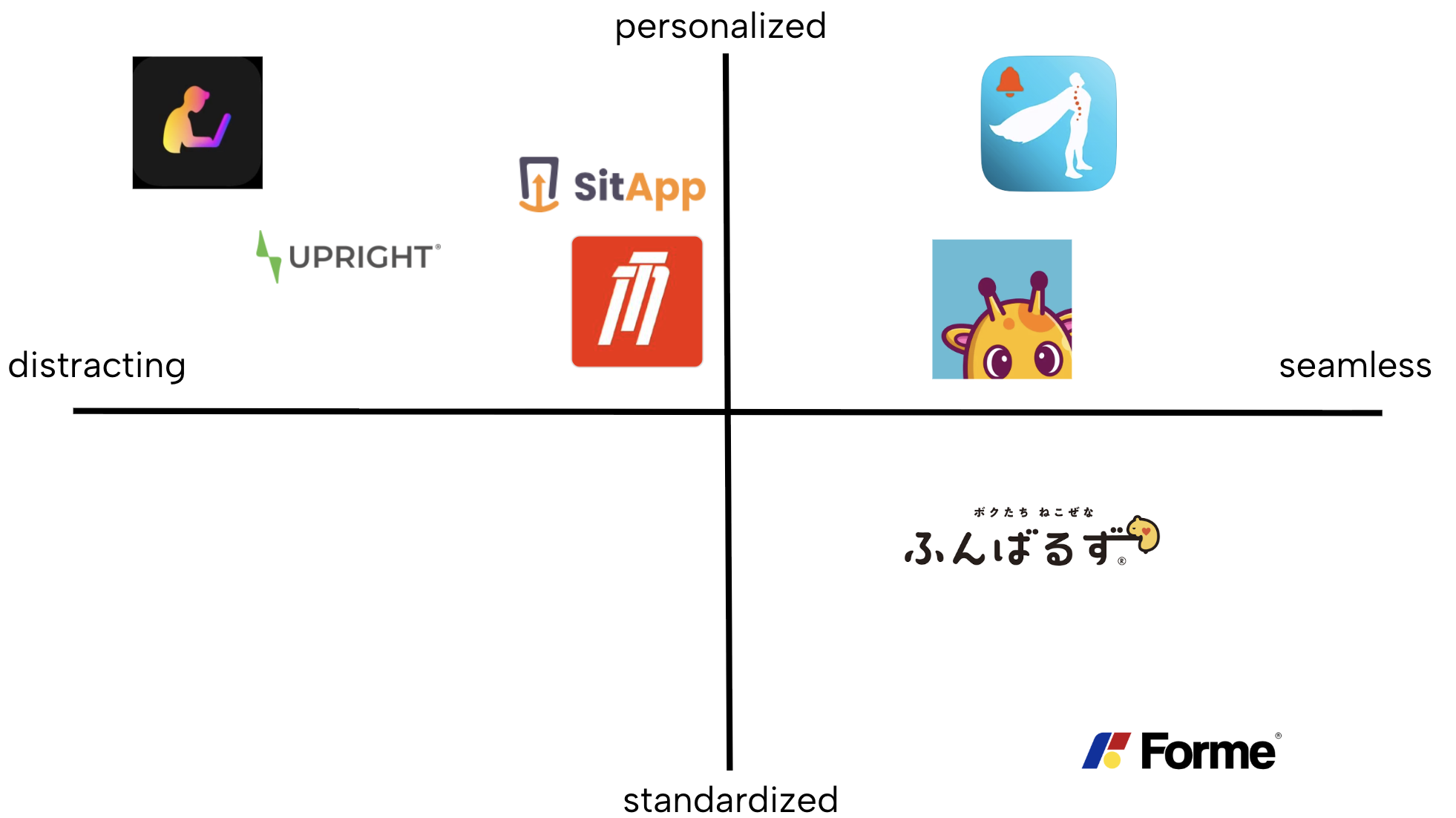
Another critical takeaway regards the difficulty of balancing personalization with seamlessness. Current products excel at one dimension but sacrifice the other, minus two that we evaluated as achieving both—the Posture Pal app and Posture Reminder.
Most importantly, none of these products were guaranteed to work over time, once the user stops using the product; that is, it’s not proven that any of these products create a new habit of maintaining good posture, rather these mainly seek to mitigate poor posture at the moment. Attempts to encourage habitually good posture aren’t typically central to these products’ designs, and though they may partly be considered, it could be presumed that some products bank on creating user dependency.
2×2 Map
Our synthesized points 1 and 3 converge under the category of evaluating a product’s invasiveness and ease of incorporation, and point 2 was about personalization and catering to the user’s specific posture situation. Because of this, we decided on the following axes:
- Personalized–Standardized: a majority of competitors focused on narrowing and personalizing the user experience to the user themselves, with many utilizing AI or calibration methods to measure goals and progress.
- Distracting–Seamless: we brought up privacy concerns when discussing competitors, and noted that intrusiveness comes in two ways (data privacy and distraction from user experience), so we decided that the seamlessness and hassle of using the product is more relevant to habit and behavior change.
Proto-personas and Journey Maps
Persona 1
| Drawing | Name | B.D. |
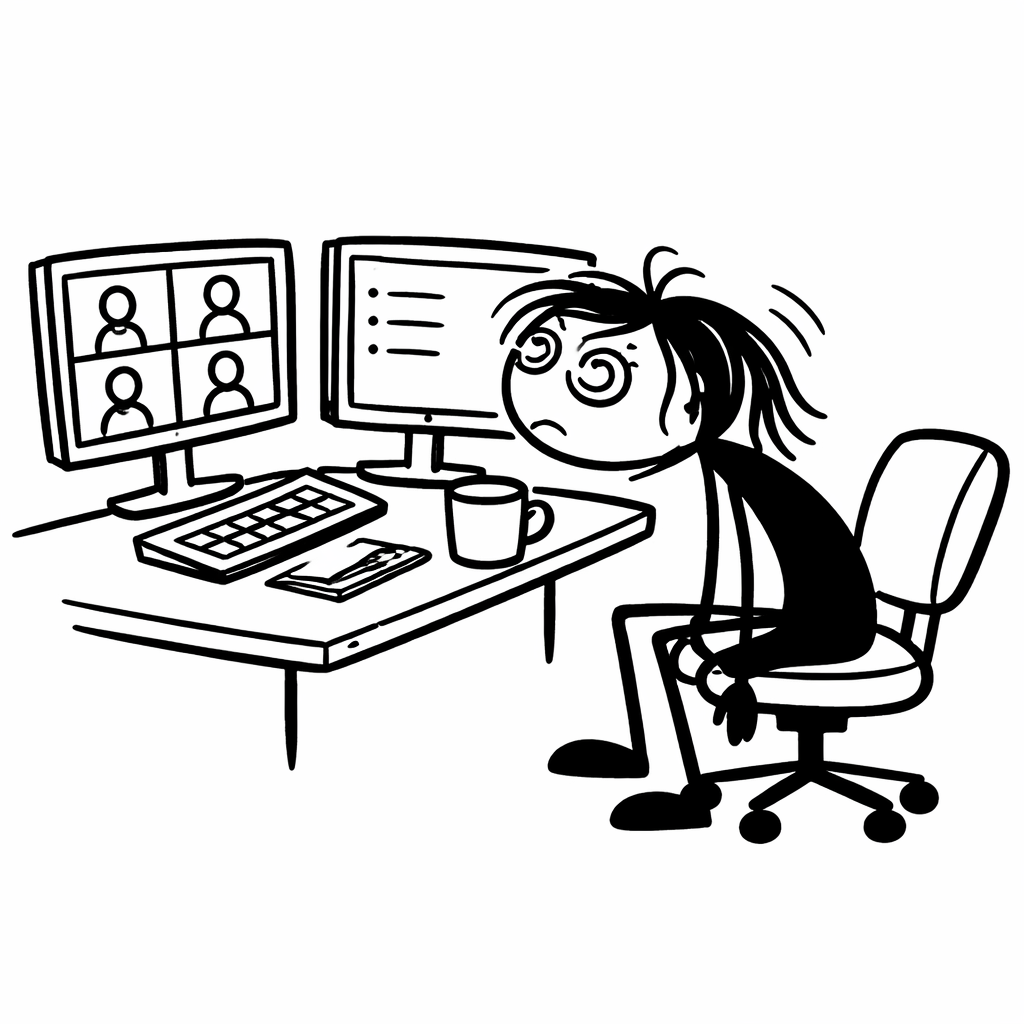 |
Activated Role | Proposal Administrator (part-time remote) |
| Goal | I want good posture to become a habit of mine, even without external tools or support devices. | |
| Motivation |
|
|
| Conflict |
|
|
| Attempts to Solve |
|
|
| Setting/ Environment | Mostly home, occasionally at workplace | |
| Tools |
|
|
| Skills |
|
|
| More |
|
Journey Map 1
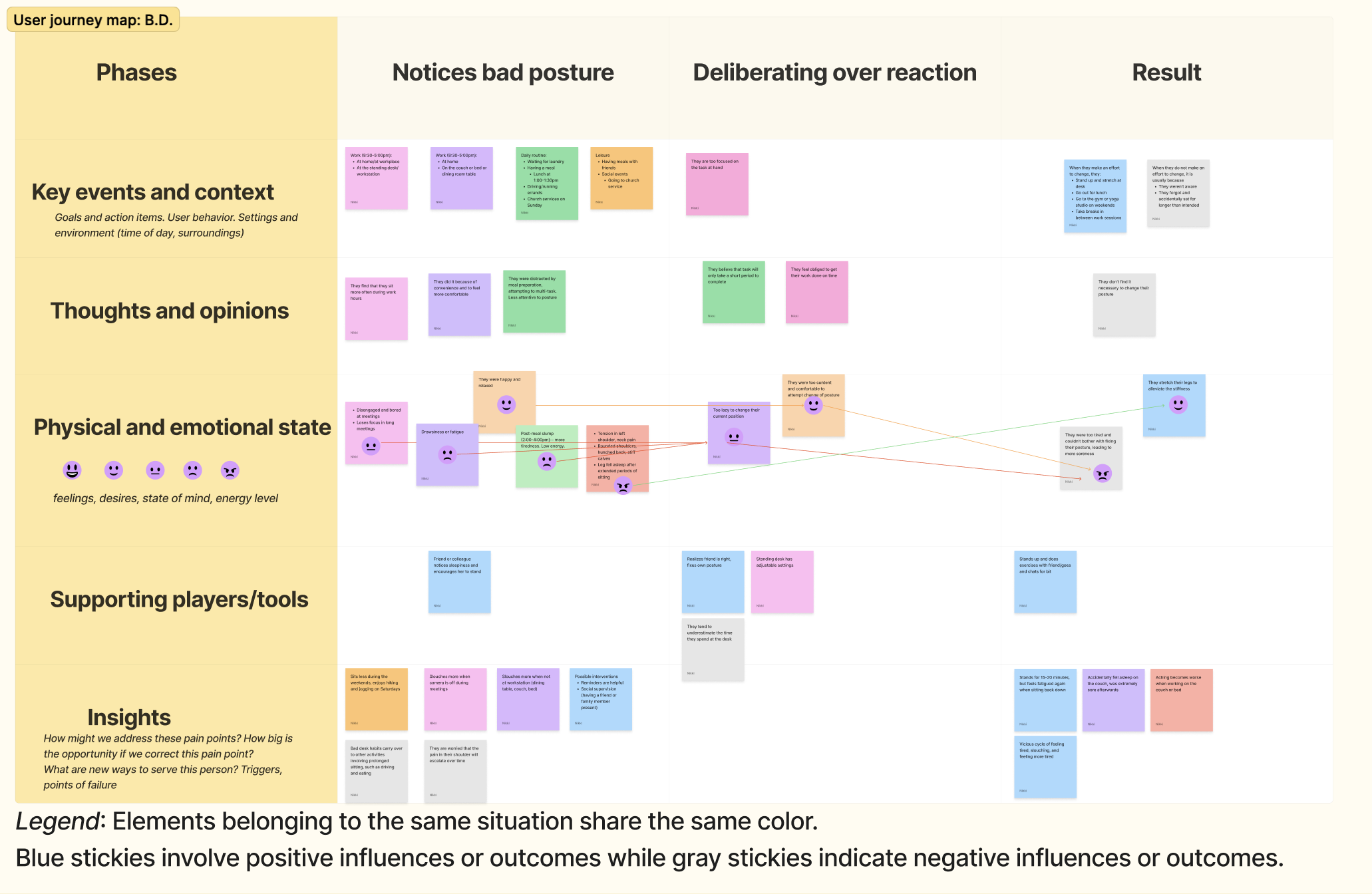
B.D. represents the semi-remote office worker who is intent on building a habit for good posture but has not yet found a systematic way to do so. From their persona profile, we can see that they are already experiencing the consequences of long-term hunching due to work settings. By working from home, they have more flexibility and privacy to allow for in-the-moment or workout-related interventions such as wearing a posture-correction band or doing yoga exercises on the floor. Their hobbies can also be transformed into micro habits for improving posture. However, because they live alone, they are cut off from the social supervision. As shown in their journey maps, the presence and monitoring of friends and colleagues can bring posture-related issues to their attention and prompt adjustments. In addition, the convenient working-from-home settings may link other bad habits to bad posture. For example, B.D. mentioned working on the couch or bed when they are tired or distracted, which both leads to less productivity and worse posture.
Persona 2
| Drawing | Name | R.B |
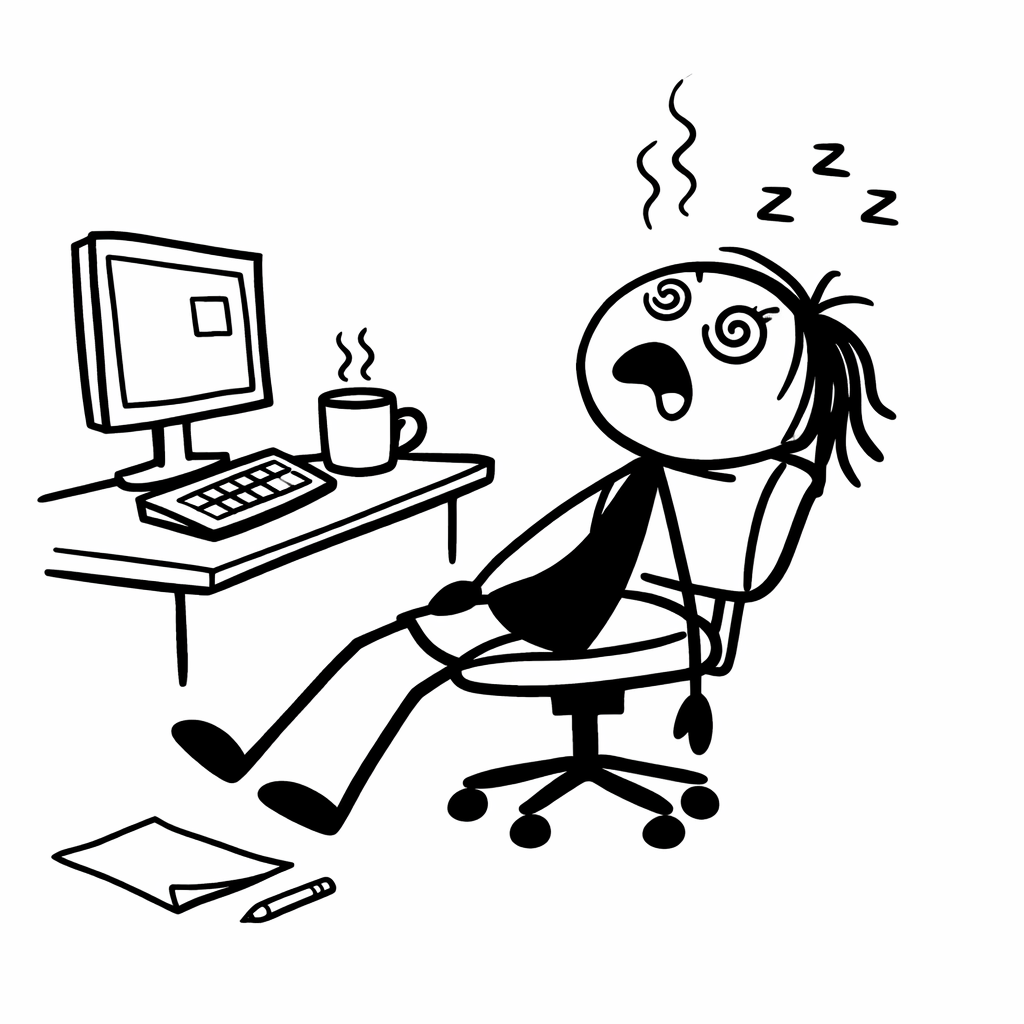 |
Activated Role | Product Designer (remote) |
| Goal |
|
|
| Motivation | I want good posture because I am mostly worried about the pain and health complications that result from bad posture. When it comes to posture, I value comfort more than how I look. | |
| Conflict |
|
|
| Attempts to Solve |
|
|
| Setting/ Environment | Home, occasionally at church building | |
| Tools |
|
|
| Skills |
|
|
| More |
|
Journey Map 2
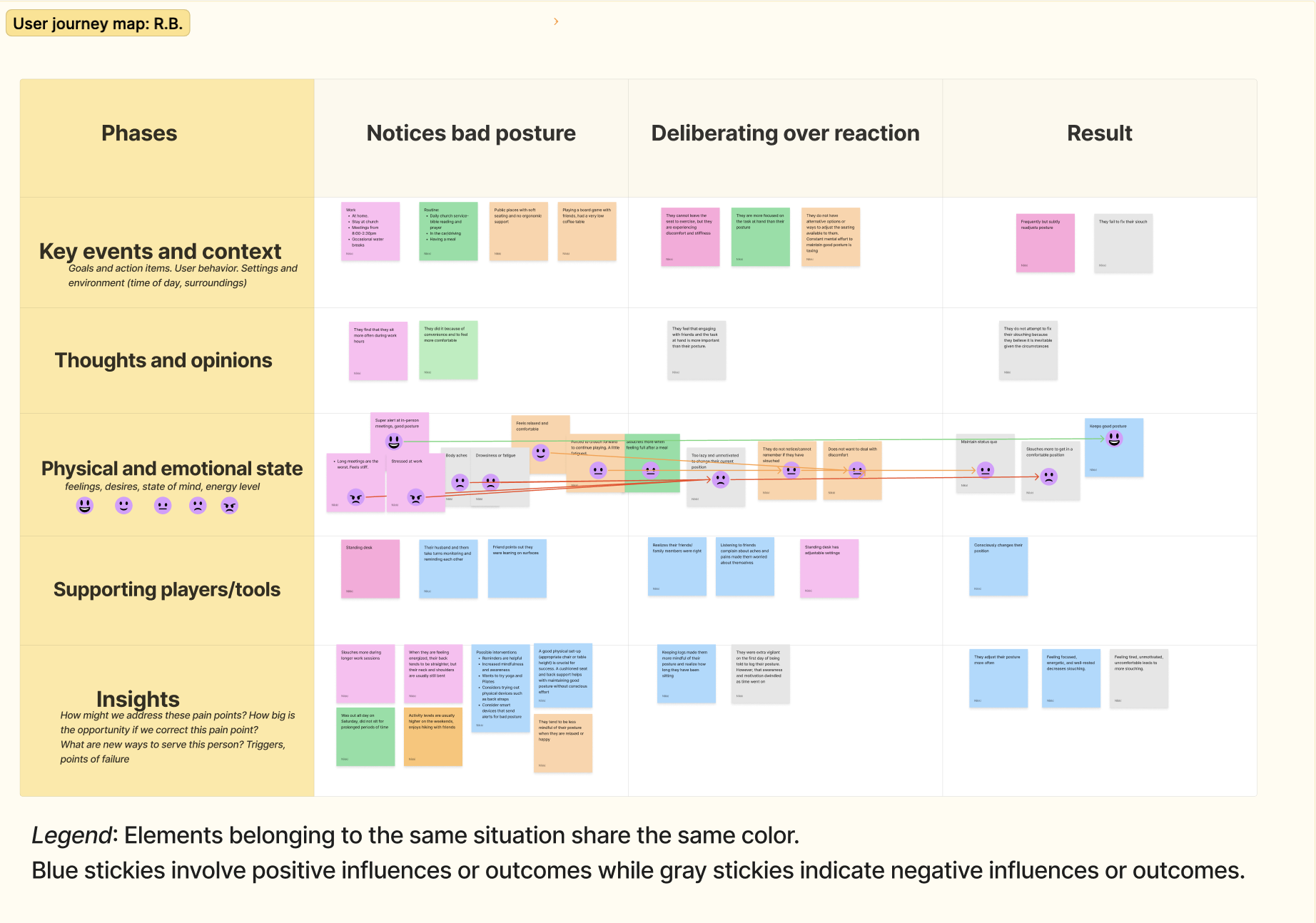
R.B represents the remote worker who lives with a partner. They are not experiencing any posture-related pain and prefers a prevention rather to intervention approach. They are only willing to put effort to fixing their posture so long it does not inconvenience their established routine in any way. From their persona profile, they prefer to rely on the use of external tools (ergonomic settings, cushion support, correction bands) to negate the health consequences of bad posture rather than building intrinsic motivation or putting in conscious effort. From their journey map, we can see that they have an inclination to lean on surfaces for support, whether it is in standing or sitting positions. A way to decrease this tendency is to help them build stronger core muscles. In addition, their posture is more affected by their physical state (energy level) than the specific task at hand. Therefore, for these types of personas, it may be more helpful to focus on adding seamless and indirect nudges to their existing schedule rather than forcing them to use strict or inhibitive surveillance software. Better environmental cues could also be helpful, such as finding the optimal chair and table height and lighting conditions.



